THE SHORT ANSWER
Five campaigns are filed against this model year: occupant sensor wiring, a passenger inflator, the ignition switch, front belt anchors and police-only control arms. One names just 79 cars and one excludes civilian models, so only the VIN settles it. A Chevrolet dealer repairs an open campaign at no charge, subject to a federal 15-year cutoff.
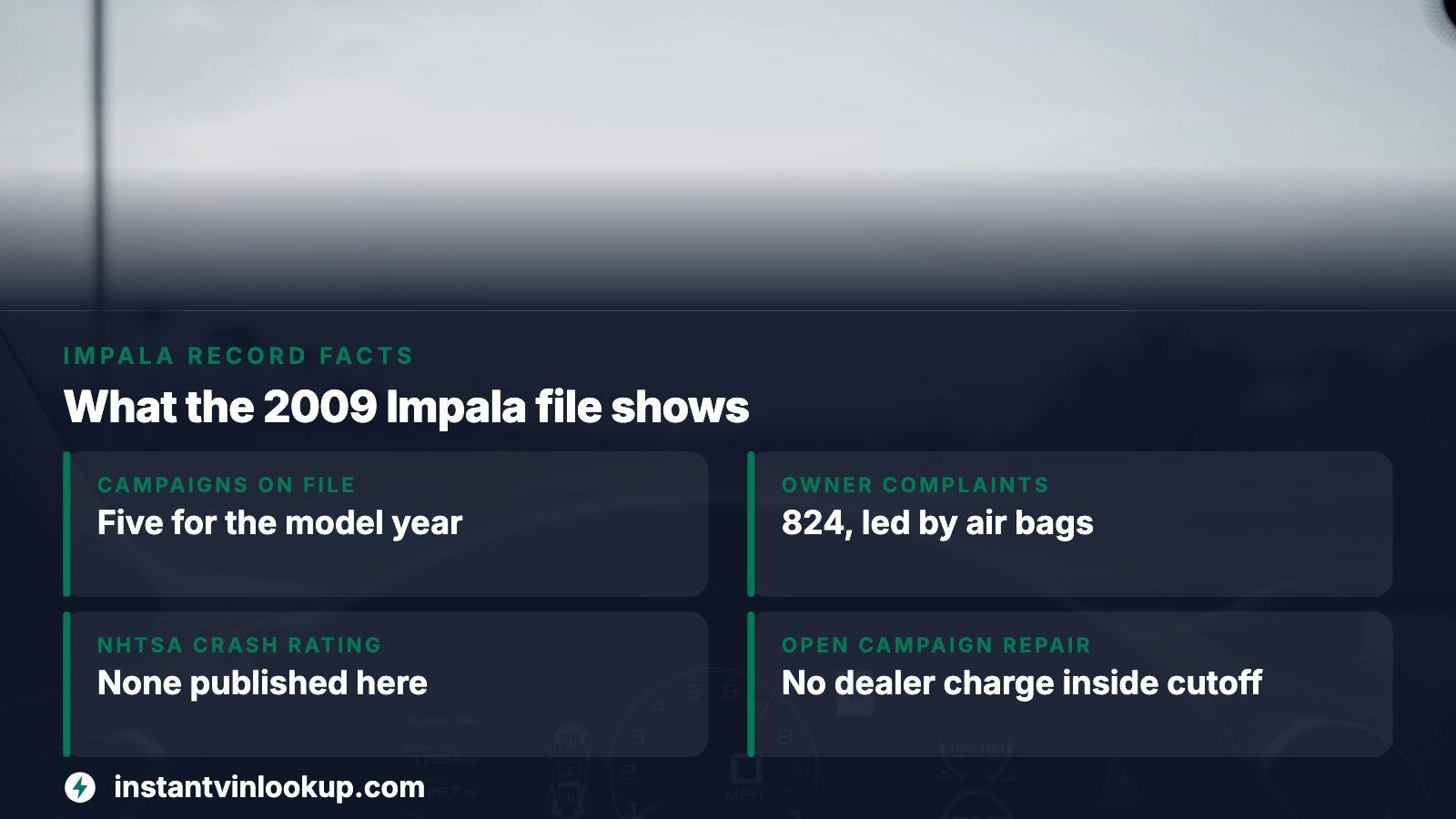
- Campaigns on file
- 5 for the 2009 model year
- Owner complaints
- 824, led by air bags at 28%
- NHTSA crash rating
- None published for this configuration
- Open campaign repair
- Dealer cost is zero while the 15-year cutoff holds
What an instant lookup does with a 2009 Impala
A VIN belongs to one car, so it is the only input that can shrink five model-year campaigns into an answer for the sedan you are considering. Enter all 17 characters and the no-cost preview comes back within seconds, listing the record types held for that Impala.
Buying the full Impala report is a one-time charge for that VIN. Beyond open recalls it lists any title brand, accident entries and the mileage history. At this age the pairing matters: a recall shows what the maker conceded, and the rest shows what happened to this Impala after delivery.
Finding and typing the VIN, step by step
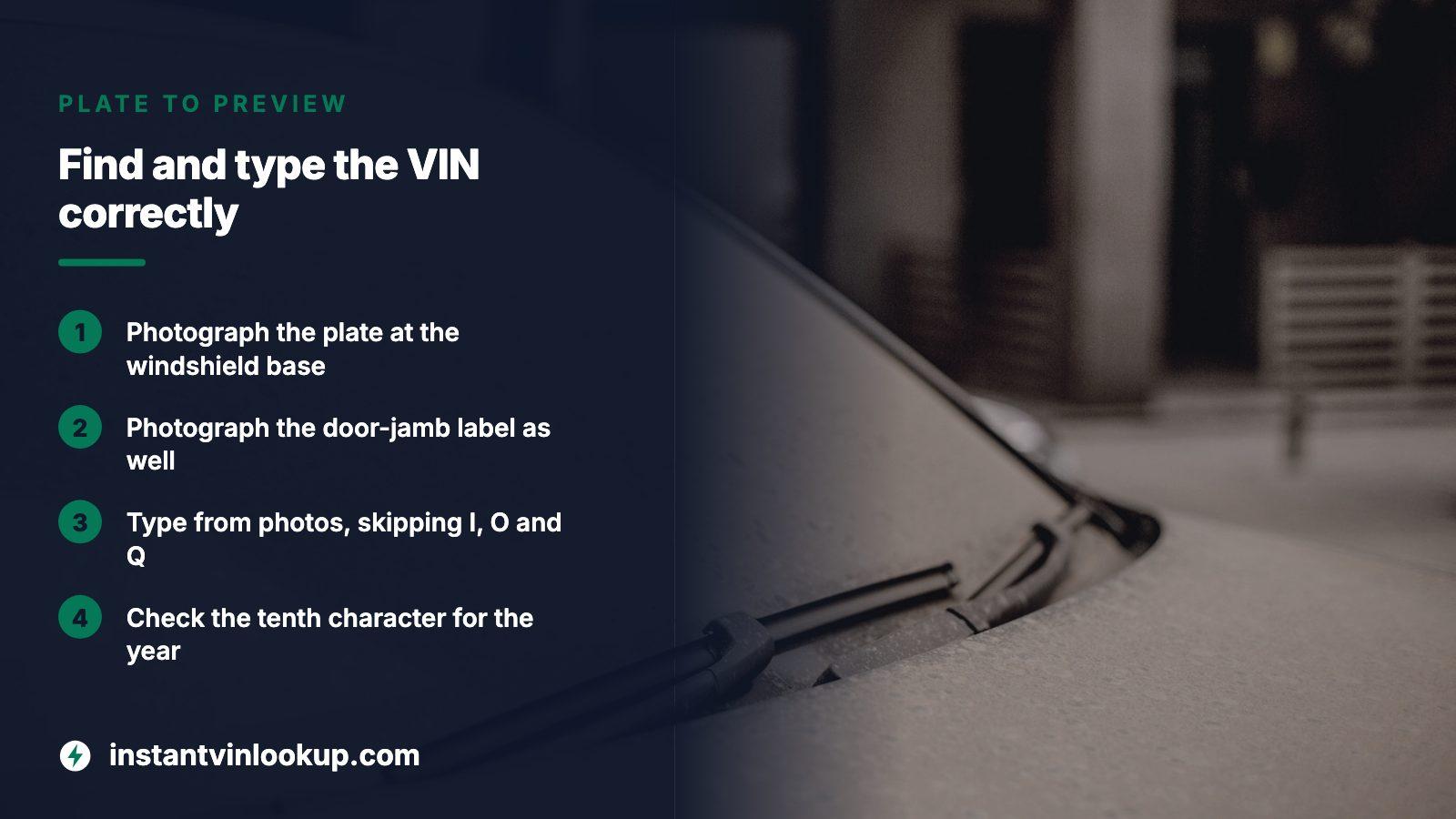
- Crouch outside the driver's side of the windshield base, read the plate through the glass, and photograph it.
- Open the driver's door and photograph the label on the jamb. Both photos should show the same 17 characters.
- Type from the photos. Those letters never appear in a VIN, so an I, O or Q you think you see is a 1 or a 0.
- Check the tenth character: a 2009 model carries a 9 and a 2010 an A, which matters because two of the five campaigns span both years.
- Run the lookup and read the preview before deciding on the report.
The five campaigns and who each one is aimed at
NHTSA files these under the 2009 Impala. The right-hand column decides whether one applies to a car, and each number works in NHTSA's recall search.
| Campaign | Part | Who it reaches |
|---|---|---|
| 08V517000 | Passenger front air bag inflator | 79 model year 2009 Impalas, started October 10, 2008 |
| 10V480000 | Front seat belt anchors | Model years 2009 and 2010, started November 5, 2010 |
| 12V377000 | Front lower control arms | Police Impalas only, model years 2008 to 2012 |
| 14V355000 | Ignition switch | Impalas of model years 2006 to 2014, started September 23, 2014 |
| 16V507000 | Passenger presence sensor wiring | Model years 2009 and 2010 built April 25, 2008 through February 16, 2010 |
What goes wrong, and what the dealer does
- Sensor wiring (16V507000): the passenger seat frame can chafe the sensor module's wires, which may disable that air bag or blow a fuse that takes out every air bag and belt tensioner. Dealers tape the wires and swap damaged ones.
- Ignition (14V355000): a loaded key ring and a bump can knock the switch out of Run, killing the engine and possibly the air bags' ability to deploy. The fix is two new rings plus an insert or head cover.
- Passenger inflator (08V517000): the inflator tube could fracture when it fires. Dealers replace the passenger bag.
- Belt anchors (10V480000): webbing at the door-side lap anchor may be fastened wrongly. Dealers inspect both front belts and refit anchors.
From an NHTSA owner complaint
Filing in November 2014, an owner described getting the ignition recall letter, then a second saying parts had arrived. Expecting a repaired or replaced switch, the owner found only smaller key-ring holes on the keys, and asked whether that counted as a fix.
That matches the notice, which changes the keys rather than the switch. Ask what the work order lists before assuming a new switch went in.
Why one Impala can differ from the one beside it
Consider the inflator notice, which names 79 vehicles. A 2009 Impala outside that group is not covered, and an ad never reveals which side a car is on. The sensor-wiring notice is far wider, spanning builds from April 25, 2008 through February 16, 2010, so it reaches 2010 cars too.
The control arm notice excludes every Impala that is not a police vehicle, so a retired patrol car and a civilian sedan of the same year part company. The report's ownership and use type entry is where a police or fleet past would appear, when recorded.
From an NHTSA owner complaint
Filing in June 2021, an owner reported a "service air bag" message that stayed on after a restart, at 121,000 miles. The maker said the VIN was outside campaign 16V507000, yet the owner said the car showed the failure that recall describes.
The build window is a hard line: the same year and symptom do not put a car inside a campaign, so trust the VIN result over the listing.
Reading the result: open, closed or not named
- Open: the campaign reaches this VIN and no completed repair is on record. A Chevrolet dealer does the work at no cost to the owner.
- Closed: a repair is recorded. Ask for the work order and match the part replaced to the campaign.
- Not named: the VIN falls outside the build window or vehicle class, a good outcome for that campaign.
Red flags are an open air bag or sensor campaign on a car with a damage record, and a seller who calls a recall handled but has no paperwork. A mailed notice is not a repair.
From an NHTSA owner complaint
Filing in May 2019, an owner reported air bag trouble since 2016. After the recall notice, a dealer rewrapped the wires under the passenger seat and the system behaved for about six months. Then the same warning returned, but only when someone sat in that seat.
A closed record proves a work order, not a lasting cure. Ask if the warning has returned, and test-drive with a passenger up front.
824 owner complaints and what they add
Recalls are defects the maker has acknowledged; complaints are unverified owner reports no agency has ruled on. This model year is the second heaviest of 13 Impala years on record, at 2.76 times the median, and filings peaked in 2014.
| System | Complaints | Share | Typical age at failure |
|---|---|---|---|
| Air bags | 232 | 28% | 6.7 years |
| Electrical system | 224 | 27% | 5.8 years |
| Engine | 179 | 22% | 5.5 years |
| Vehicle speed control | 130 | 16% | 5.4 years |
| Service brakes | 75 | 9% | 3.7 years |
Shares overlap because one report can name several systems. Owners described a crash in 43 filings, a blaze in 9 and an injury in 43, all accounts rather than findings.
Where the free repair ends
The manufacturer pays for a recall remedy, with a carve-out in 49 U.S.C. §30120(g): no free fix is owed when the first purchaser took delivery over 15 calendar years before the announcement.
The five campaigns here began between 2008 and 2016, inside the window for a 2009 car. A notice issued from now on could fall outside the free-repair rule altogether, though dealers often honor it anyway. Settle that with a service desk, using the VIN, before any money changes hands.
What the federal file leaves out
NHTSA's crash-test program has no score on file for this setup: overall, frontal, side and rollover are all blank, and the car offered neither forward collision nor lane departure alerts. A blank is no failing grade, but it leaves recalls and the car's own history to carry the decision.
- Ask a mechanic to start with air bags, the electrical system and the engine.
- Check the wiring under the hood for scorch marks and home-made splices, since owners reported fires on this year.
Cost, and what to do with the answer
The preview is free and always comes first. Each VIN is billed once for the report, and multi-report packs of 3, 5 or 10 suit anyone comparing sedans. No renewals follow; costs are on the pricing page.
- Open campaign: book the repair at a Chevrolet dealer, or make completion a condition of sale.
- Seller says it was done: ask for the work order.
- Title or damage entry: price it in or walk away.
- Clean result: still have a mechanic look it over.
Where this information comes from
- NHTSA: Recalls — The federal search where each campaign number above can be matched to a VIN.
- U.S. Code: 49 U.S.C. 30120, remedies for defects — The statute that puts repair costs on the manufacturer and sets the 15-year cutoff.
- NHTSA: New Car Assessment Program ratings — The crash-test program, and the place to confirm which configurations carry a rating.
- NMVTIS: National Motor Vehicle Title Information System — The national title record, which covers brands that the safety file does not.
- NHTSA owner complaint 11420450 — owner experience, paraphrased
- NHTSA owner complaint 11210081 — owner experience, paraphrased
- NHTSA owner complaint 10661301 — owner experience, paraphrased
Sources and photos: Facts checked against the sources above in November 2026. Photos by Iain, JavyGo and Dennis Eusebio on Unsplash; diagrams by InstantVINLookup.
Keep reading
- VIN Lookup: Check a VIN Number on a Car Before You BuyHow the lookup and its free preview work for any vehicle, not only this sedan.
- Where Is the VIN Number? Find It in a Minute, Then Verify ItOther places a VIN is stamped if the dash plate is hidden or scuffed.
- Airbag Deployed Check: Spot a Hidden Deployment From the VINTwo of these campaigns involve air bags, so this car's deployment history is worth a look.
- 2009 Volkswagen Jetta Recalls: Which of the 7 Reach Your VINA sedan from the same model year, for shoppers weighing the two.
Frequently asked questions
How many recall campaigns cover the 2009 Impala?
Five are filed: air bags, the ignition switch, belt anchors and a police-only control arm. Each names a build window or vehicle class, so a given Impala may fall under only some.
Is the ignition switch recall on a 2009 Impala serious?
The notice describes the switch slipping out of Run under a heavy key ring and a jolt, which kills the engine and can stop the air bags firing. Until repaired, GM advised carrying only the key.
Can I check an Impala's recalls before going to see it?
Yes, and it is the better order. Photos of the dash plate and door label are enough: confirm the tenth character is a 9, run the number and read the preview.
Will a dealer charge to fix an open Impala recall?
Not for an open campaign inside the federal 15-year limit. Give the service desk the VIN and the campaign number, such as 16V507000, whose GM number is 36110. Ask them to confirm the repair is still free before booking.
Did NHTSA give the 2009 Impala a crash-test rating?
No rating is published for this configuration: overall, frontal, side and rollover are all unrated. That leaves the recall list and this car's own damage history as the best evidence you can gather.
Now check the car itself
The guide explains what to look for. The report shows what this VIN has on record.