THE SHORT ANSWER
For a car, SUV or light truck, stand outside at the driver's side and look through the windshield at the dash corner: federal rules put a VIN plate there, legible in daylight. Then check the certification label on the driver's door pillar area. Trailers, motorcycles and motorhomes use other spots, and some cars carry hidden copies. Make every copy match the title before trusting the car, then put the VIN through the free preview.
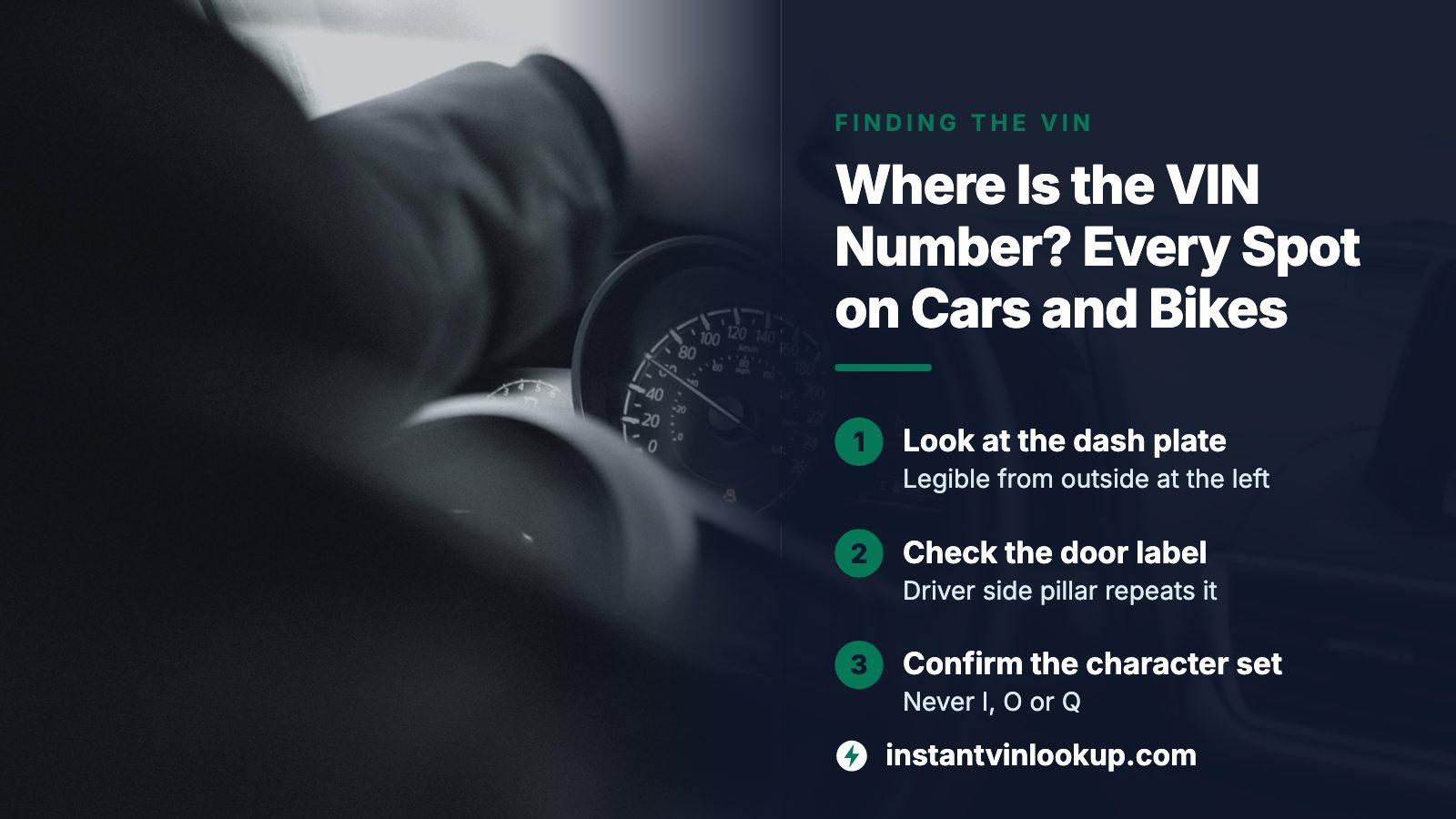
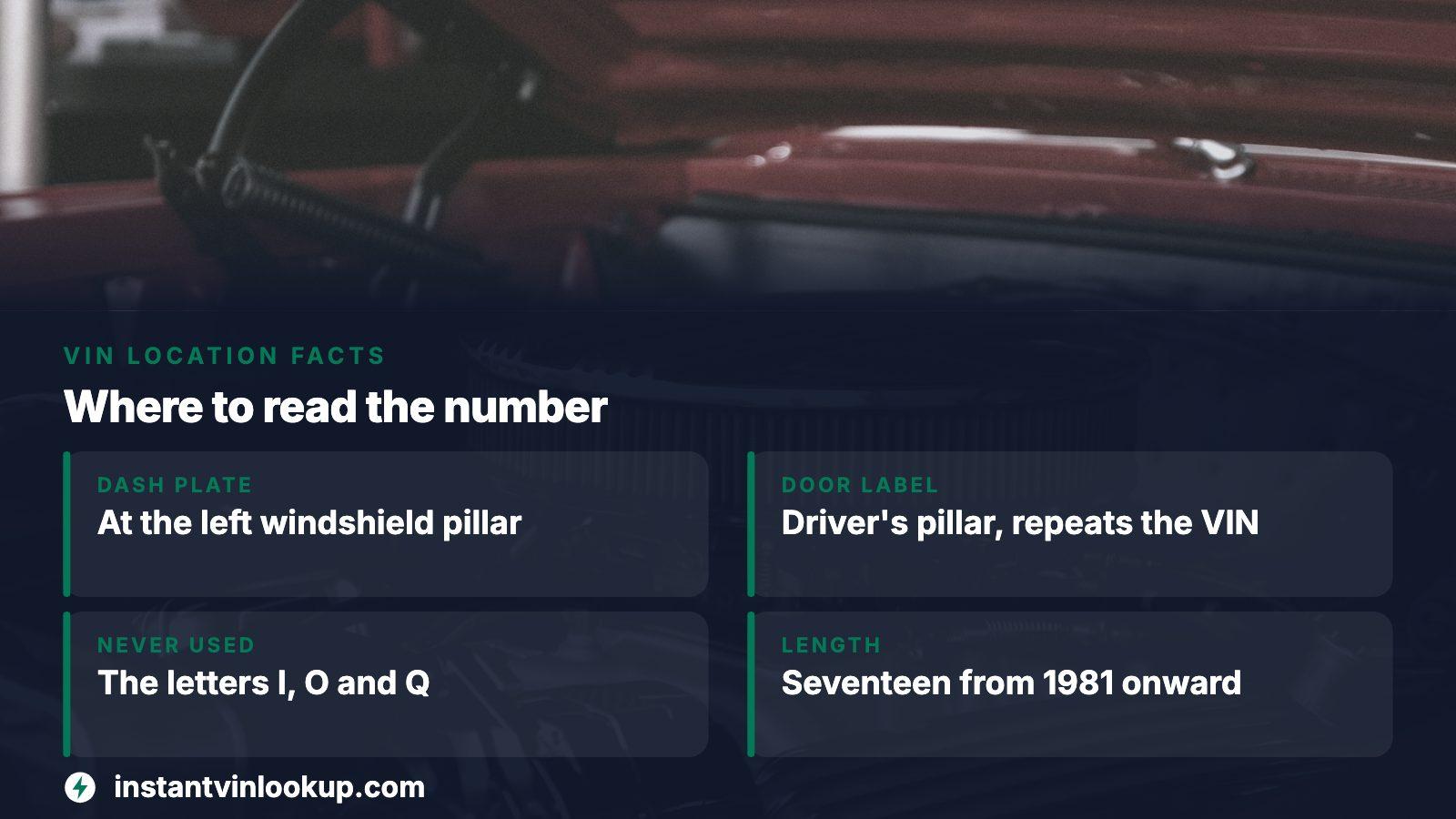
- Dash plate
- Legible from outside, at the left windshield pillar
- Door label
- Driver's side pillar area, repeats the VIN
- Never used
- The letters I, O and Q
- Length
- 17 characters from the 1981 model year on
The dash corner you read through the glass
The federal VIN rule explains the plate you can see through the glass. For cars, SUVs and light trucks the number must be inside the cabin and legible in daylight to a person standing outside at the left windshield pillar, with no part moved. Characters are at least 4 mm tall.
To check it, stand beside the driver's door and peer into the corner of the dash. Parking permits and sun shades hide it more often than a plate is truly missing. New glass can also dislodge a plate. If it is loose or crooked, read every other copy before drawing a conclusion.
The certification label at the driver's door
The second copy is on the maker's certification label. Swing the door open and scan the hinge side, the latch side and the door's own edge. Where none of those suited a model, the standard allows the far left end of the dashboard, or else the inner door panel.
- Build month and year, which may not match the model year in the ad
- Gross vehicle and axle weight ratings, handy before towing
- A conformity statement tied to the build date
- The maker's name, to check against the badge
Rivets or adhesive hold the label so firmly that it tears if removed. Lifted corners, fresh rivets or a mismatched finish deserve a closer look.
Trailers, motorcycles and motorhomes put it elsewhere
| Vehicle | Where to look first |
|---|---|
| Trailer | Certification label, forward half of the left side |
| Motorcycle | The label closest to the join of steering post and handlebars |
| Motorhome or van camper | Chassis maker's number, often in the engine bay or under the driver's seat |
A motorhome carries its chassis maker's number, so a decode naming the truck brand instead of the camper brand is expected.
Cars imported through a registered importer can carry an added plate reading substitute for U.S. VIN, with the original maker's number filled in, positioned so it never covers the original.
Paperwork that carries the number
Without the car in front of you, the title, registration and insurance card print the number, and so does the front of a dealer's Buyers Guide. But paper only shows what someone typed. A state verifier handbook has inspectors read the vehicle first, compare second, and refer the car for inspection if the two disagree. Buyers can copy that order. Ask a private seller for a photo of the title and a photo of the plate in the same message, so you can compare the two strings before you drive across town.
Copy the number without a typo
- Photograph the plate and label close up, then zoom in to read.
- Count 17 characters. Before the 1981 model year, makers used shorter formats.
- Spot any I, O or Q. None is allowed, so a lookalike O is a zero.
- Test position 9, a check digit computed from the other characters to expose copying slips.
- Read position 10 against the advertised year: L means 2020, M means 2021, R means 2024.
A number that passes is well formed, which is not the same as belonging to this car.

Why one matching copy is not proof
A clone is a stolen vehicle wearing another car's identity. In Operation Roadrunner, a multistate case, officers recovered roughly 250 of them. The thieves lifted VINs from look-alike cars, same make, model and year, so buyers, titling offices and police saw genuine numbers on forged paperwork. Checking the car against the paper, at several points, is what makes that trick hard.
From an NHTSA owner complaint
A 2018 Toyota Camry owner told NHTSA in April 2026 that, after buying from a dealer, an inspection found the engine's number differing from the chassis VIN. The owner took that to mean an engine swap of unknown origin and mileage, and says the dealer and Toyota were notified but the car stayed on the road.
That is the owner's reading, not a ruling by the agency. The lesson for a buyer is to ask whether any major component was replaced and to let a mechanic read the numbers first.
When the dash plate is missing or the number will not read
Work outward from the dash.
- Door label first, then the hidden stampings.
- On your own car, the title, registration or insurance policy confirms the number.
- If nothing can be read on your own car, ask your state motor vehicle agency about an inspection. California, for one, has DMV staff find another accessible number if the federal label is absent or cannot be read; other states differ.
- On a car you are buying, stop until the seller explains.
From an NHTSA owner complaint
A dealer-sale buyer of a 2020 Chevrolet Silverado told NHTSA the VIN plate was missing from its original location. The buyer located a small plate inside the door, and a later report on the truck listed 137,164 miles where the odometer had said 88,000 at purchase. The buyer phoned the Texas DMV.
The record does not show the outcome. It does show why a missing plate sends you to the other copies and the mileage record before money moves.
Number verified? Run the lookup
When the copies agree, type the VIN into the lookup box on this site. The free preview shows whether anything is on file for that exact vehicle. If it looks worth reading, the report is a single purchase, with the available choices listed on the pricing page.
Read the title brands, odometer entries and theft records first; they bear most on the mileage and cloning cases above. Two official lookups take the same number at no charge: NHTSA for open recalls, NICB for theft, flood and salvage declarations. The FTC adds that no history report replaces a mechanic's inspection.
Where this information comes from
- eCFR: 49 CFR Part 565, VIN requirements — The rule behind the dash plate, the allowed characters and what each position means.
- eCFR: 49 CFR 567.4, certification label — Where the label goes on cars, trailers and motorcycles, and what it must list.
- California DMV: Vehicle Verifier License Handbook — How one state's verifiers record and compare a VIN, backup locations and the motorhome chassis rule.
- NMVTIS: Information for consumers — The cloning case and what the federal title record shows.
- FTC: Used Cars — The Buyers Guide, the recall and salvage lookups, and the advice to get an inspection.
- NHTSA owner complaint 11732365 — owner experience, paraphrased
- NHTSA owner complaint 11735782 — owner experience, paraphrased
Sources and photos: Facts checked against the sources above in November 2026. Photos by Miles Loewen, Jakub Żerdzicki and Victor Hughes on Unsplash; diagrams by InstantVINLookup.
Keep reading
- Vehicle Identification Number: What an Instant Lookup Reads From ItWhat each of the 17 characters means once you have found them.
- VIN Lookup: Check a VIN Number on a Car Before You BuyHow to run the lookup and read the preview after the copies agree.
- Imported Car VIN Check: What an Instant Lookup Shows and MissesWhat to check on a car that came from abroad and may carry a second plate.
- NICB VIN Check: What the Instant Theft and Salvage Lookup ShowsThe theft and total-loss screen to run on a number you have verified.
Frequently asked questions
Where is the VIN number on a car?
Read the plate seen through the windshield at the driver's side dash corner, then the label on the driver's door pillar or latch post. Both show the same 17 characters. If either is gone, try the hidden stampings, then the title.
Can I find the VIN without going to the car?
Yes: the title, registration, insurance card, a dealer's Buyers Guide and many repair invoices print it. Ask the seller for close photos of the plate and door label too, and treat paper as a claim until it matches the metal.
Is a VIN just another name for the plate number?
No. Your state issues the plate number, and it can change at re-registration. The maker assigns the VIN, and it stays with the vehicle for life. Lookups run on the VIN, so the tag cannot substitute for it.
Why does the number I found have fewer than 17 characters?
Vehicles from before the 1981 model year used shorter, maker-specific formats. On a newer one, a short string is probably a stray stamping, an engine serial or a replacement plate. Find another copy before typing anything into a lookup.
What if the VIN is missing from my own vehicle?
Try the door label and hidden stampings, then confirm against the title, registration and insurance policy. If nothing can be read, your state motor vehicle agency can say whether an inspection is needed. California requires one when the number on the certificates differs from the number on record; states vary.
Now check the car itself
The guide explains what to look for. The report shows what this VIN has on record.