
THE SHORT ANSWER
The 2013 Honda Accord has 6 campaigns on NHTSA's model-year list, and only some reach any one car. One covers a narrow build window, the driveshaft pair covers 4-cylinder CVT cars with a road-salt registration history, and the battery sensor notice runs through 2016 models. Type the VIN to see which are open on that Accord. Honda's duty to pay for repairs ends for notices announced more than 15 years after first retail sale.
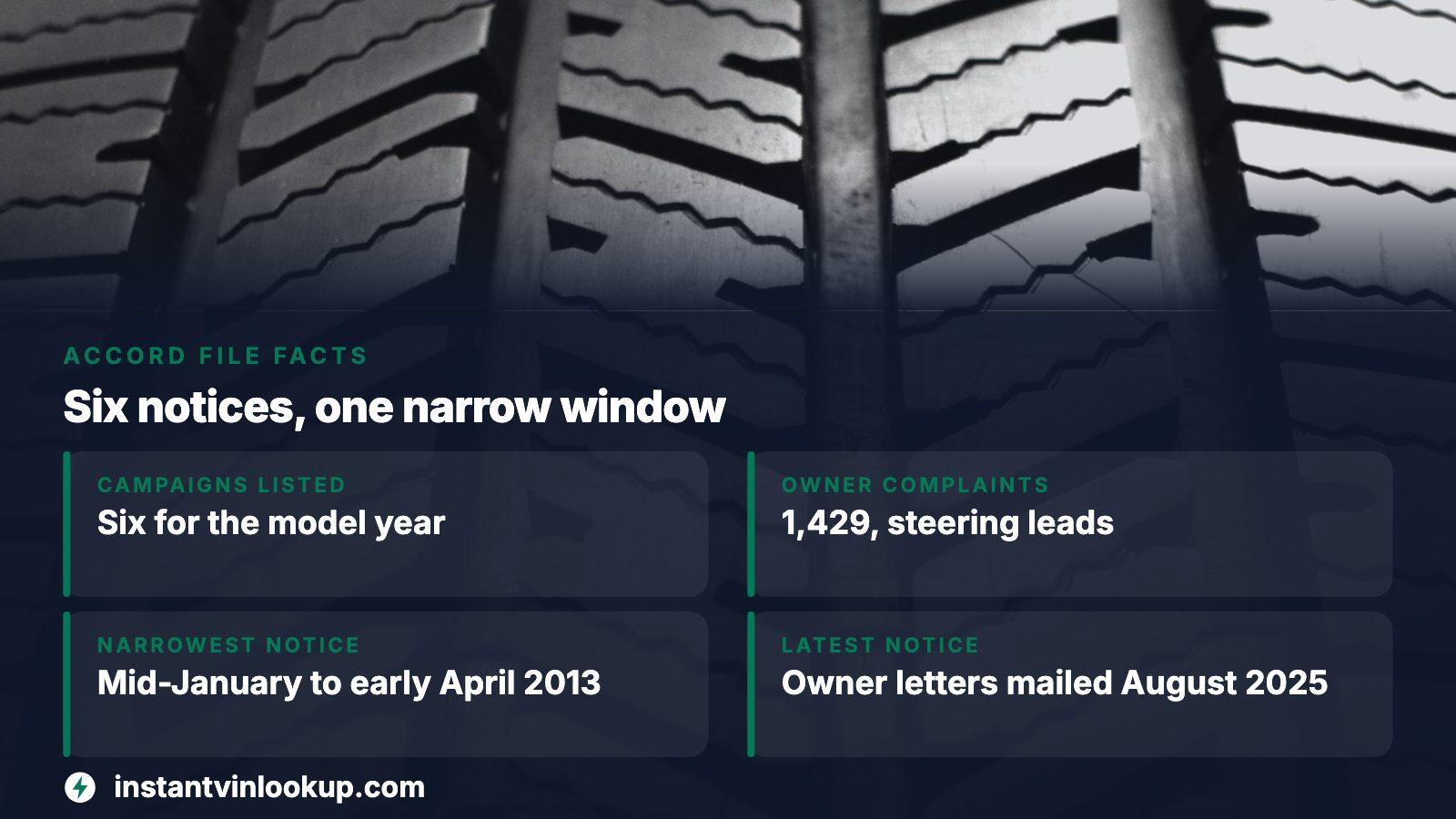
- Campaigns listed
- 6 for the 2013 model year
- Owner complaints
- 1,429, with steering the largest group at 35%
- Narrowest notice
- 13V297000, a build window from mid-January to early April 2013
- Latest notice
- 25V422000, owner letters mailed August 2025
Why the lookup runs on the VIN and not the model year
A listing that says 2013 Accord leaves out nearly everything Honda used to draw the lines around each campaign. The fuel tank notice stops at a build date in April 2013. The driveshaft notices want a 4-cylinder engine, a CVT and a registration history. The battery sensor notice runs from 2013 through 2016. Two sedans from one lot can return different answers.
An instant lookup settles it. Type the 17 characters into InstantVINLookup and the answer returns in seconds, matched to that one car. A free preview comes first, listing the kinds of records the VIN holds. Open recalls sit in the report beside title, damage and odometer entries, so one VIN answers the recall question and its neighbors.
The six campaigns and what each asks of a VIN
Paste any number below into NHTSA's recall search to read the full notice. The last column is what a VIN has to satisfy.
| Campaign | Fault | What the VIN has to match |
|---|---|---|
| 13V297000 | Fuel tank neck out of spec, pump may not seal, fire risk | LEV II rated, built between January 15 and April 5, 2013 |
| 17V418000 | Battery sensor case lets water in, short circuit, fire risk | Accords from 2013 through 2016 |
| 20V769000 | Driveshaft coating degrades, salt corrodes it, shaft can break | 2013 to 2015, 4-cylinder, CVT, sold or registered in listed states |
| 25V422000 | Same corrosion fault, expands 20V769000 | 2013, 4-cylinder, CVT, same registration condition |
| 23V858000 | In-tank fuel pump may fail, engine can stall | Certain cars, in a notice spanning many Honda and Acura models |
| 18V042000 | Passenger airbag inflator can rupture after years of humid heat | Zone by registration state; worded around 2010 to 2012 Accords |
The last row is the odd one. NHTSA's model-year list has carried it, yet the wording names earlier Accords and the Crosstour, not the 2013 sedan. Whether it touches a given car is a VIN question, and a Honda dealer can confirm.
Getting the 17 characters right before you run it
The plate and the ad can disagree, so the plate wins.
- Crouch beside the driver's door and read the metal plate on top of the dash through the windshield. Photograph it, since one misread character returns a different car or none.
- Compare it with the label inside the door jamb and the title the seller holds. All three should match.
- Check the tenth character. A D there marks a 2013 model, a quick test of whether the ad's year is honest.
- Type from the photo, run the lookup, and read the preview before choosing the report.

Open, repaired or not listed: reading the answer
- Open: a campaign reaches this VIN and no repair is on record. Phone a Honda dealer with the VIN and ask for a date, since parts and appointments vary.
- Repaired: ask for the work order. On the battery sensor, an interim adhesive seal can precede the sensor swap, so learn which step was done.
- Not listed: the VIN sits outside the build dates, engine or transmission, so that campaign is closed for this car. The part itself can still fail.
- Expanded: 25V422000 widens the earlier driveshaft notice, so an old driveshaft entry deserves a second look.
From an NHTSA owner complaint
An owner filing in September 2025 received an email alert for driveshaft campaign 25V422000 and booked the dealer. The dealer decided the shaft needed no replacement, though the owner had photos of visible corrosion, and the complaint lists 53,456 miles. After more than two hours of waiting, nothing was done. Honda opened a case, and its staff, after consulting a regional technician, sided with the dealer.
An open entry earns a car an inspection, which can end with no parts changed. Photograph the underside before and after.
Why to look it up before the letter arrives
Honda's battery sensor notice began in November 2017. Water can reach the sensor case and cause an electrical short, which raises fire risk. Letters follow the maker's schedule, and one can land with a previous owner, so the VIN is the faster route.
From an NHTSA owner complaint
Writing in September 2017, an owner described smoke at a stoplight in the left turn lane. The owner got out, and within minutes flames showed under the hood. The fire company put it out, and the owner judged the Accord a total loss. Notice 17V418 had only just arrived, and the car had not yet reached a dealer.
NHTSA's file for the model year holds 9 owner reports that mention a fire. Those are owners' descriptions, not findings, but they explain why an open battery sensor entry gets booked at once. A buyer can ask the seller to repair it before paying, or price in the wait.
Repairs paid for before a notice covered the car
Campaigns grow after the first mailing. The second driveshaft notice, 25V422000, expands the first.
From an NHTSA owner complaint
In May 2022 the driveshaft failed on one owner's Accord. The dealer mentioned a recall that did not include the VIN, and the owner paid for the repair after Honda gave a discount. Later the notice for 25V422000 arrived. A reimbursement request was refused, and the owner was asked for bank records showing the cash withdrawal behind the bill.
Keep the invoice and proof of payment for any driveshaft work. If a seller says the shafts were replaced, ask when, by whom and who paid, then look up the VIN to see whether a notice still shows open.
Time limits apply as well. Federal law stops requiring Honda to pay once 15 calendar years separate the first retail sale from a notice's announcement. All six campaigns fall inside that span, but a 2013 car is nearing the edge. Some dealers do the work anyway, so ask first.
What a recall list will not show about this Accord
NHTSA holds 1,429 owner complaints for the 2013 model year. The largest group, 504 or 35%, concerns steering, followed by 416 on the electrical system and 179 on the engine. None of the six campaigns is about steering, so a clean lookup is silent on that front. Nobody has verified these reports, so use them as a reason to test the car, not a verdict.
- Ask whether the steering has ever been repaired or replaced.
- Ask for service records and dealer paperwork on any campaign marked done.
- Ask if it was ever wrecked and whether an insurer paid for the repair.
What the lookup costs, and what to do with the answer
Entering a VIN and viewing the preview carry no charge. A full report is bought once per VIN, with nothing recurring. Packs of three, five or ten reports serve a multi-car shortlist. Amounts sit on the pricing page.
- List each campaign marked open, with its number.
- Call a Honda service desk with the VIN and ask whether parts are in stock before booking.
- Request repair orders for anything marked done, driveshaft first.
- Read the report's title, damage and odometer entries, which a recall file leaves out.
- Pay a mechanic to inspect the steering, the electrical system and the underside, where salt corrosion shows, before agreeing a price.
Where this information comes from
- NHTSA: Recalls — The federal search where each campaign number above can be matched to a VIN.
- U.S. Code: 49 U.S.C. 30120, remedies for defects — The statute that puts the repair cost on the maker and sets the 15-year cutoff.
- NMVTIS: National Motor Vehicle Title Information System — The national title record, which holds brands the recall file does not.
- NHTSA owner complaint 11025021 — owner experience, paraphrased
- NHTSA owner complaint 11686380 — owner experience, paraphrased
- NHTSA owner complaint 11682838 — owner experience, paraphrased
Sources and photos: Facts checked against the sources above in November 2026. Photos by Johnathan Kaufman, JavyGo and fr0ggy5 on Unsplash; diagrams by InstantVINLookup.
Keep reading
- VIN Lookup: Check a VIN Number on a Car Before You BuyHow the lookup and its preview work for any vehicle, not only this sedan.
- Airbag Deployed Check: Spot a Hidden Deployment From the VINThe airbag campaign names replacement inflators fitted after a crash, so a past deployment is worth knowing about.
- NHTSA Investigation Check: Look Up a Model, Then Run the VINNHTSA also logs investigations that touch this model year, and this explains how to read one.
- 2013 Hyundai Elantra Recalls: Type the VIN, See Which ApplyA common rival at a similar age and price, with its own campaign list to compare.
Frequently asked questions
How many recalls apply to a 2013 Honda Accord?
NHTSA's model-year list shows 6 campaigns, covering the battery sensor, fuel tank, fuel pump, driveshafts and an airbag inflator. Few Accords fall under all of them, because build dates, engine, transmission and registration history split the population. The VIN says which apply.
Can I look up Accord recalls without the VIN?
Year, make and model return the full list of six, and most searches stop there. That cannot say which notices reach one car, because each has its own range and conditions. NHTSA offers its own VIN search, and an instant lookup here adds title and damage entries.
Does the driveshaft recall cover every 2013 Accord?
No. It reaches only 4-cylinder Accords with a CVT that were first sold in, or registered at any point in, road-salt states running from New England and the Mid-Atlantic to the Great Lakes, Iowa and Missouri. A V6 car or a manual gearbox falls outside that wording.
Is a 2013 Accord recall repair still paid by Honda?
Mostly yes. The federal repair duty under Section 30120 lapses once 15 calendar years have passed since a car's first sale to a retail buyer. A 2013 car reaches that mark within a few years, and some dealers still do the work, so ask before you buy.
What do I see before paying for the full report?
The free preview lists the kinds of records held for the VIN, enough to judge whether a report earns its price. The report itself is one payment for that VIN with nothing to renew. Look to the pricing page for amounts.
Now check the car itself
The guide explains what to look for. The report shows what this VIN has on record.