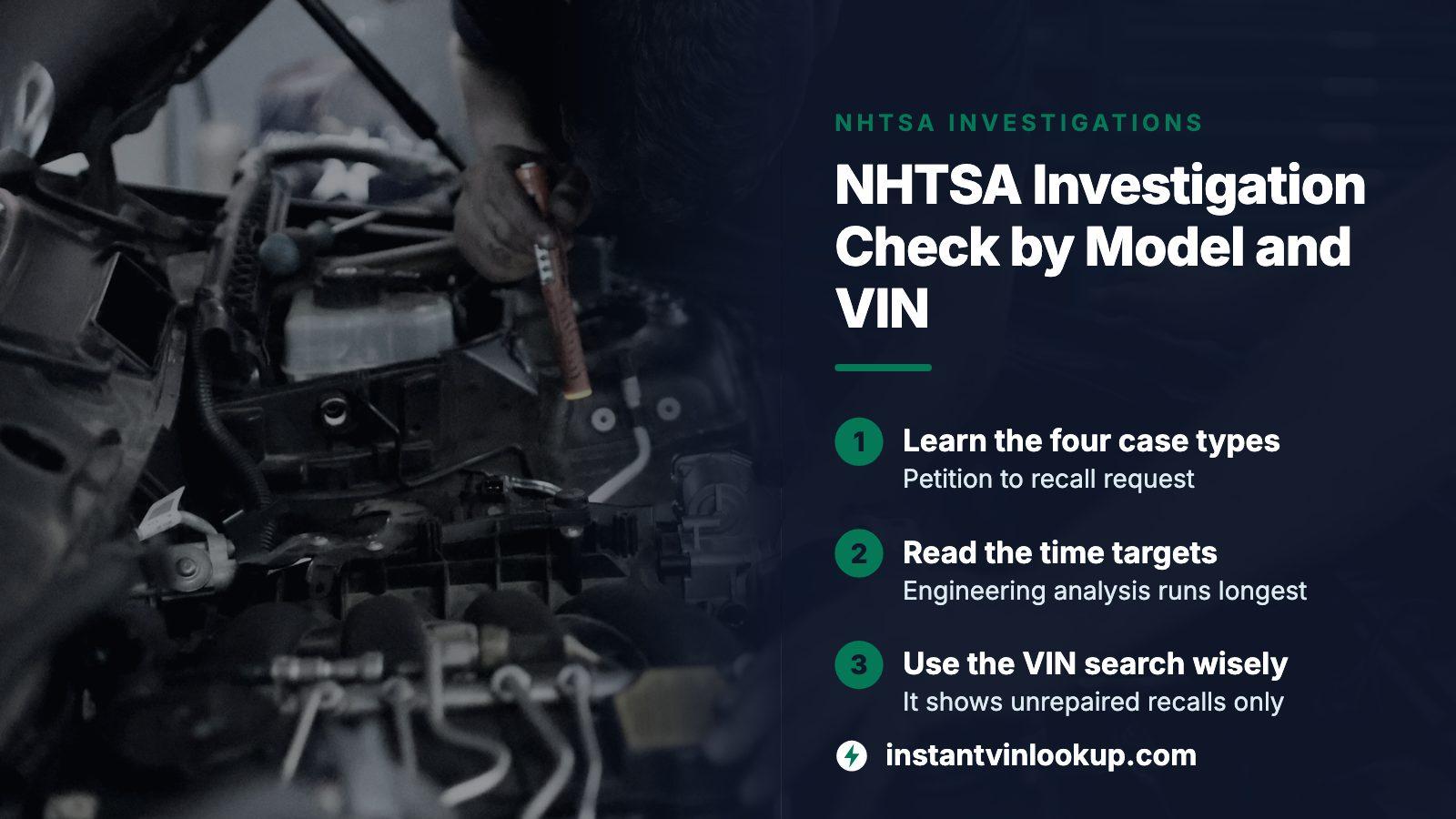
THE SHORT ANSWER
NHTSA lists investigations by year, make and model, so search those three fields on its recall page and read what each case examines. A VIN search on the same site returns unrepaired recalls for one car and nothing more. Because the two answer different questions, a VIN lookup comes next, for open recalls plus the title, collision and mileage record of that one car. NHTSA's tools cost nothing, and so does the preview here.
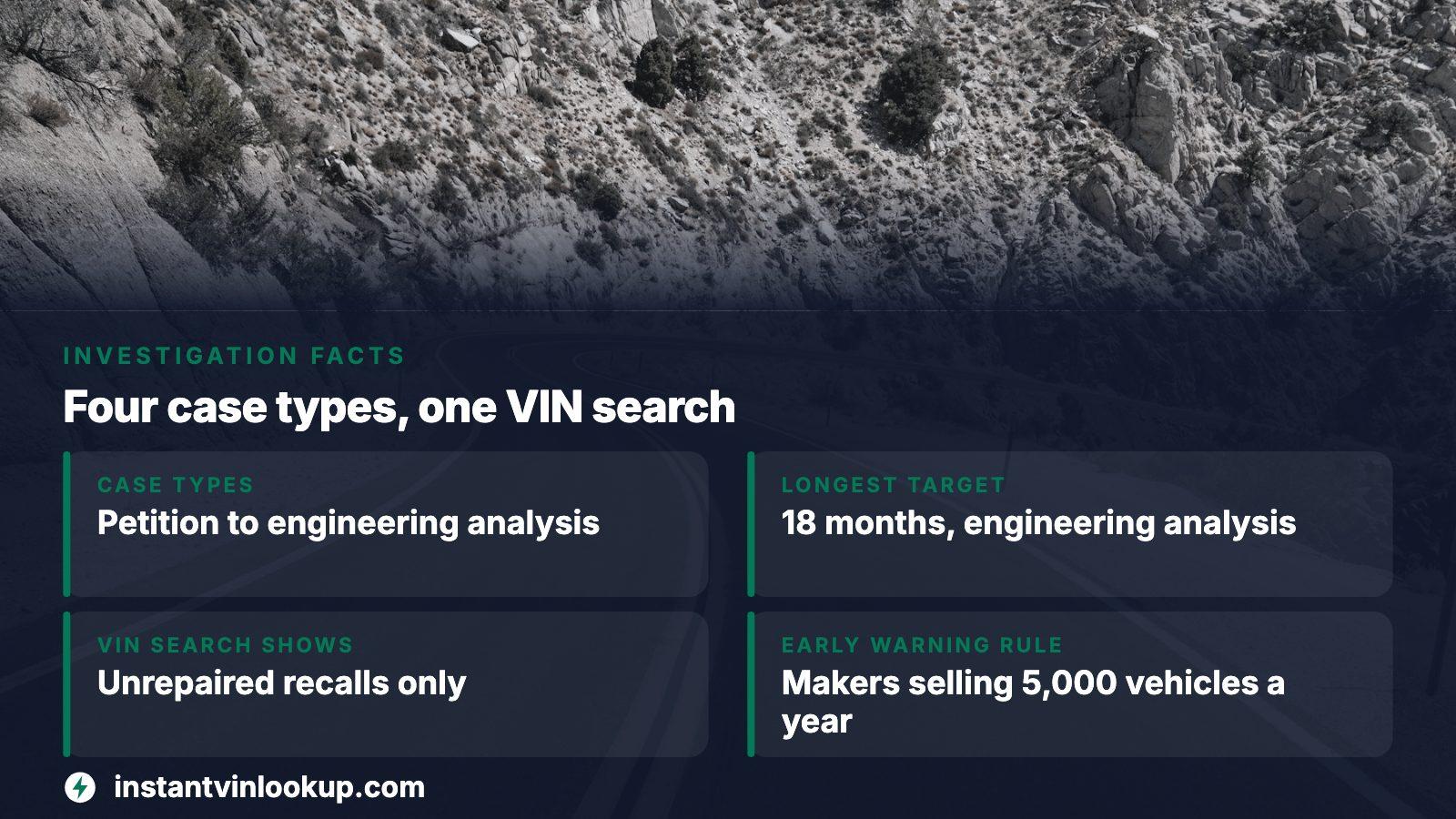
- Four case types
- Defect petition, preliminary evaluation, recall query, engineering analysis
- Longest target
- 18 months for an engineering analysis
- NHTSA VIN search
- Shows unrepaired recalls only
- Early warning threshold
- Makers selling at least 5,000 light vehicles in a year
Two lookups, because cases and VINs sit at different levels
NHTSA files an investigation against a vehicle model, never against one serial number. A model search shows what the agency is looking into. A VIN search shows whether a single car still carries an unfixed recall. Neither says how the car was treated before you met it.
| Question | Where to ask | What comes back |
|---|---|---|
| Is anything being investigated on this model? | NHTSA recall page, searched by year, make and model | Recalls, investigations, complaints and manufacturer communications for that model |
| Does this exact car have an unrepaired recall? | NHTSA recall page, searched by VIN | Unrepaired recalls only, or a message that none are tied to the number |
| What has happened to this car? | The VIN lookup on this site | Title, damage, odometer and recall records matched to one VIN |
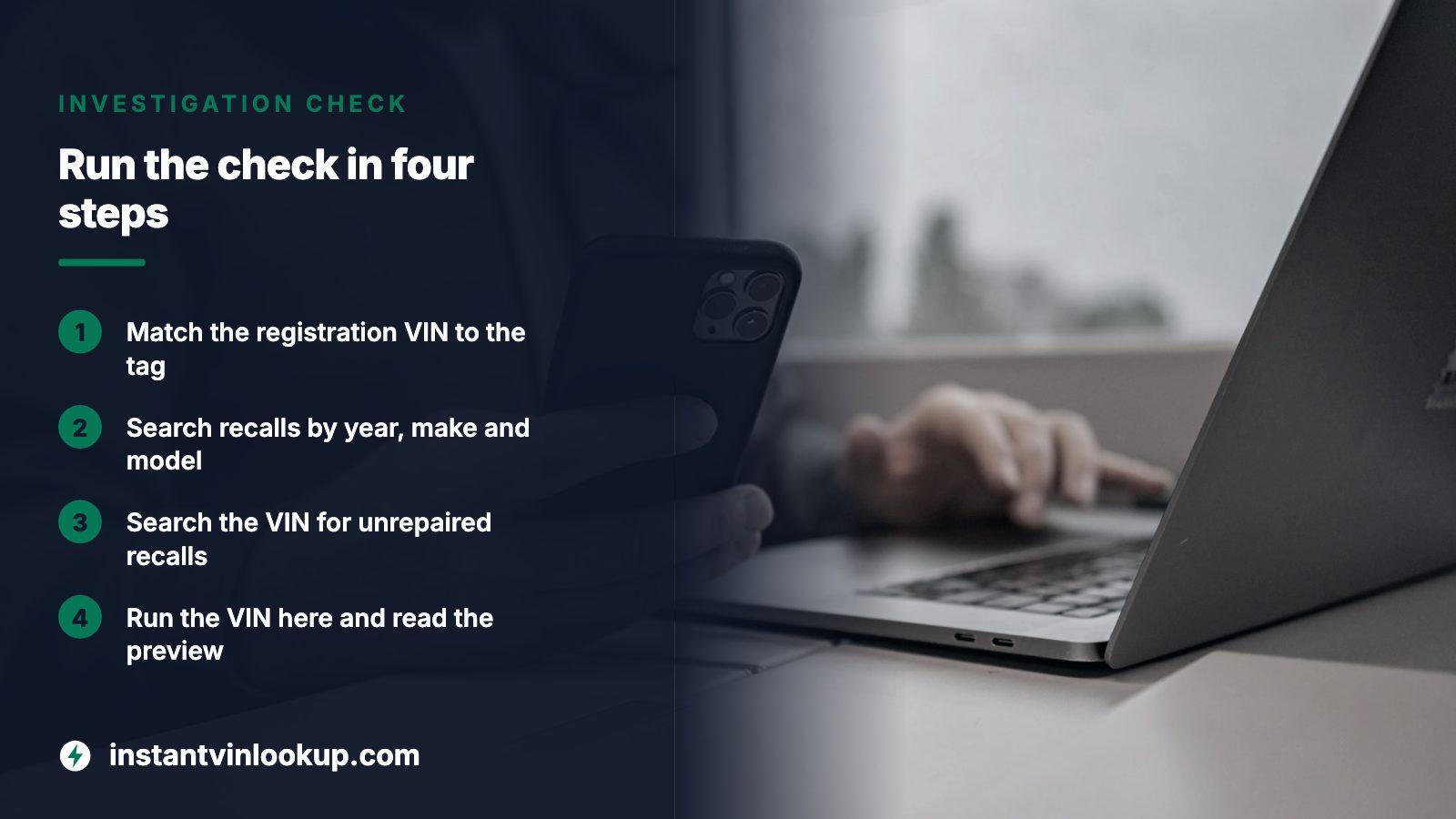
Run the check in four steps
- Take the VIN from the registration and match it with the tag in the dash corner, visible through the driver-side glass. Seventeen characters are easy to mistype, so type from a photo.
- Open NHTSA's recall page and enter the year, make and model. Read the investigation entries before the recalls, since a case that is still open has not turned into a campaign yet.
- Search the VIN on the same page for unrepaired recalls. NHTSA accepts up to 100 VINs per search, handy on a lot with several candidates.
- Put the VIN in the lookup box on this site. The free preview reports whether any records exist, so you learn before paying whether there is anything to read.
NHTSA also lets you find a case directly by its NHTSA ID or by the date it opened or closed, which helps when a seller or a news story hands you a case number.
Where an investigation sits between a complaint and a recall
NHTSA describes a path with stages. Owner complaints enter a public database once personal details are stripped out. Staff screen them, and similar reports about the same product can justify opening a case. The agency weighs any petitions, runs the investigation, then monitors the recall that may follow.
| Investigation type | NHTSA's target to finish |
|---|---|
| Defect petition | Four months |
| Preliminary evaluation | Eight months |
| Recall query | Eight months |
| Engineering analysis | 18 months |
Those are targets, not deadlines. A case ends one of two ways: NHTSA sends the manufacturer a recall recommendation, or it finds no safety-related defect. On a closed entry, read which ending applies.
What manufacturers must send NHTSA while a question is still open
A recall is rarely the first paper trail. The rules in 49 CFR Part 579 oblige manufacturers to keep information flowing to the agency long before anyone decides a defect exists.
| Duty | What the rule covers | Section |
|---|---|---|
| Early warning reports | Quarterly filings from any maker whose light-vehicle output reaches 5,000 annually: production figures, death and injury incidents tied to a claimed defect, and tallies of warranty claims, field reports, complaints and property damage claims, split by component | 579.21 |
| Bulletins and notices | Copies of messages sent to several dealers or owners about any defect, safety-related or not, including warranty extension letters and product improvement bulletins | 579.5 |
| Foreign campaigns | A report within five working days of deciding on a recall abroad, or of a foreign government's written notice, for a model the same as or close to one sold here | 579.11 |
The early warning window reaches back further than most buyers expect. Each filing covers the model years in the period plus the nine before them, discontinued models included, so a car up to ten model years old is still inside it.
Reading an open case without overreacting
An investigation is a question the agency is asking about a model, and the answer can be no. Use it to decide what to inspect, not whether to walk away.
- Read what is being examined: the component, the symptom and the model years named.
- Note the type and the dates, and compare the entry's age with the target time for that type.
- On a closed entry, find out whether it ended in a recall or in no finding.
- Ask the seller whether the symptom ever appeared on this car, and whether any repair, bulletin or warranty extension applied.
- Treat a search with no entries as an absence of cases, not a certificate that the car is sound.
From an NHTSA owner complaint
In January 2018 the owner of a 2013 Ford Explorer told NHTSA about an odd smell in the cabin on the driver's side, noticed at assorted speeds with no warning light on. The car had not been to a shop. A Ford dealer and the maker, both phoned by the owner, said an investigation was ongoing and pointed to NHTSA. Mileage was listed near 25,000.
The owner heard about the case in a phone call, with no case number attached. When a seller mentions an investigation, ask which one, then find it on NHTSA's own pages.
When the recall is finished and the symptom is not
A completed recall repairs only what the recall describes. Whether your symptom is gone from a particular car is settled by the test drive and the mechanic.
From an NHTSA owner complaint
Writing to NHTSA in March 2019, another 2013 Explorer owner cited an investigation by its number, EA 17-002, which the owner said opened in July 2017. The same on-and-off exhaust smell was reaching the cabin. By the owner's account, every relevant recall had been performed and the smell remained.
That is one owner's account, and it says nothing about how the case ended. For a buyer the lesson is narrower: a clean recall result does not replace a drive aimed at the symptom the investigation names.
What a clean NHTSA VIN result still leaves out
A result reading zero unrepaired recalls is good news with limits. According to NHTSA, the VIN search does not display:
- Recalls whose repair has been done
- Brand-new recalls whose VIN lists are still being filled in
- Anything older than 15 years, apart from makers who extend their own coverage
- Campaigns by small manufacturers, including some specialty and ultra-luxury brands
- Manufacturer service campaigns unrelated to safety, and recalls on international vehicles
Search again later if a recall was announced recently, since NHTSA adds VINs continuously. A history lookup covers what the federal search never touches: title brands, collision entries and mileage readings.
What the lookup here adds, and what it does not
Once the VIN is in, the preview tallies how many records exist for that car. The report itself puts open recalls next to title brands, accident and damage entries and odometer readings. NHTSA investigations are not part of it: they live on the agency's site and are searched by model.
NHTSA's searches cost nothing, and the preview is free. Beyond that, one report is a single purchase, and anyone weighing a whole shortlist can buy three, five or ten at once. Nothing renews, and the pricing page shows every amount. Spend only on cars that survive the NHTSA searches, then book an independent inspection for the winner.
Where this information comes from
- NHTSA: Check for Recalls — How the model and VIN searches differ, what the VIN search omits, and NHTSA's complaint-to-recall stages.
- NHTSA: Resources related to investigations and recalls — The four investigation types, their target times and the ways to search them.
- NHTSA: Datasets and APIs — What the agency asks makers for after a first review, and the public investigation and bulletin data.
- eCFR: 49 CFR Part 579 — The reporting duties for early warning data, bulletins and foreign campaigns.
- NHTSA owner complaint 11065627 — owner experience, paraphrased
- NHTSA owner complaint 11190306 — owner experience, paraphrased
Sources and photos: Facts checked against the sources above in November 2026. Photos by Mustafa Sheikhmouss, Anastasiia Nelen and Will Truettner on Unsplash; diagrams by InstantVINLookup.
Keep reading
- VIN Lookup: Check a VIN Number on a Car Before You BuyThe full walk-through of a VIN lookup, from reading the number to the preview.
- Where Is the VIN Number? Find It in a Minute, Then Verify ItEvery place the number is stamped, for when the dash tag is unreadable.
- NICB VIN Check: What the Instant Theft and Salvage Lookup ShowsThe theft and total-loss screen to run alongside the NHTSA searches.
- Sample reportSee a finished report before you buy one.
Frequently asked questions
How do I check whether a car model is under NHTSA investigation?
Search the year, make and model on NHTSA's recall page. Investigations appear next to recalls, complaints and manufacturer communications. A case can also be pulled up by its NHTSA ID, by the date it opened or closed, or on the agency's dashboard.
Can I check an NHTSA investigation by VIN?
Not directly. NHTSA's VIN search returns unrepaired recalls for one car, while investigations are tied to models. Search the model for cases, use the VIN for recalls, then run a history preview here to learn what happened to that particular car.
Does an open NHTSA investigation mean I should skip the car?
No. A case can end in a recall recommendation or with no safety-related defect found, and NHTSA weighs how often and how seriously a problem shows up. Use the case to choose what to inspect: the named component, any related repair, and any bulletin or warranty extension.
How long does an NHTSA investigation take?
NHTSA sets targets by type: four months for a defect petition, eight for a preliminary evaluation, eight for a recall query and 18 for an engineering analysis. Treat them as targets rather than deadlines.
Is the VIN preview on this site free?
Yes. The free preview reports whether records exist for the VIN, and nothing is charged until you open the report. The report is a one-off payment and never renews. It covers open recalls and vehicle history, and does not list NHTSA investigations.
Now check the car itself
The guide explains what to look for. The report shows what this VIN has on record.