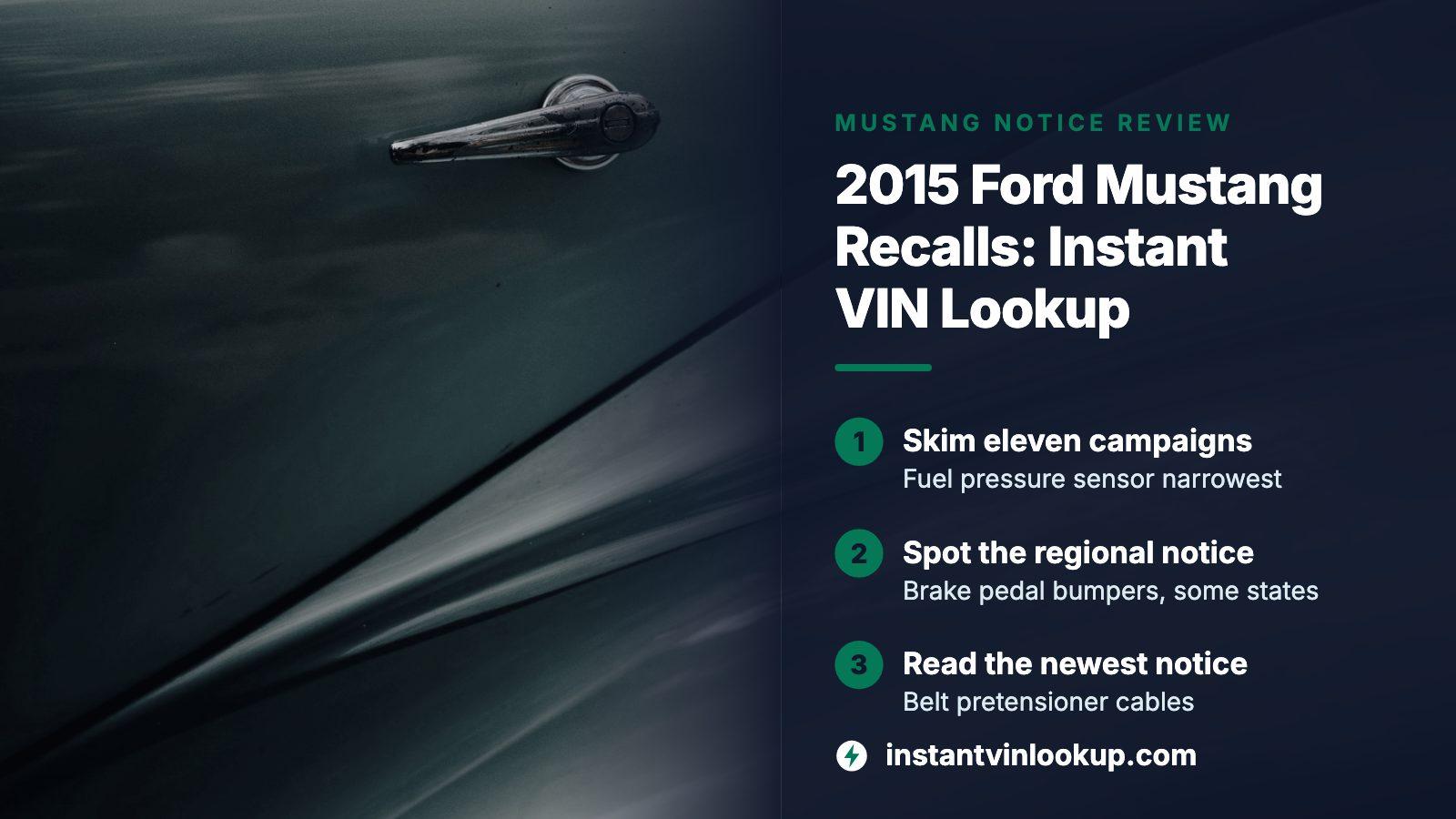
THE SHORT ANSWER
The 2015 Mustang has 11 campaigns. Several apply only to a short production window, one is limited to ten states, and the two newest are still being phased in. Enter the VIN and the instant lookup shows which of the 11 are open on that car, so you know what to ask the seller or dealer.
- Campaigns on file
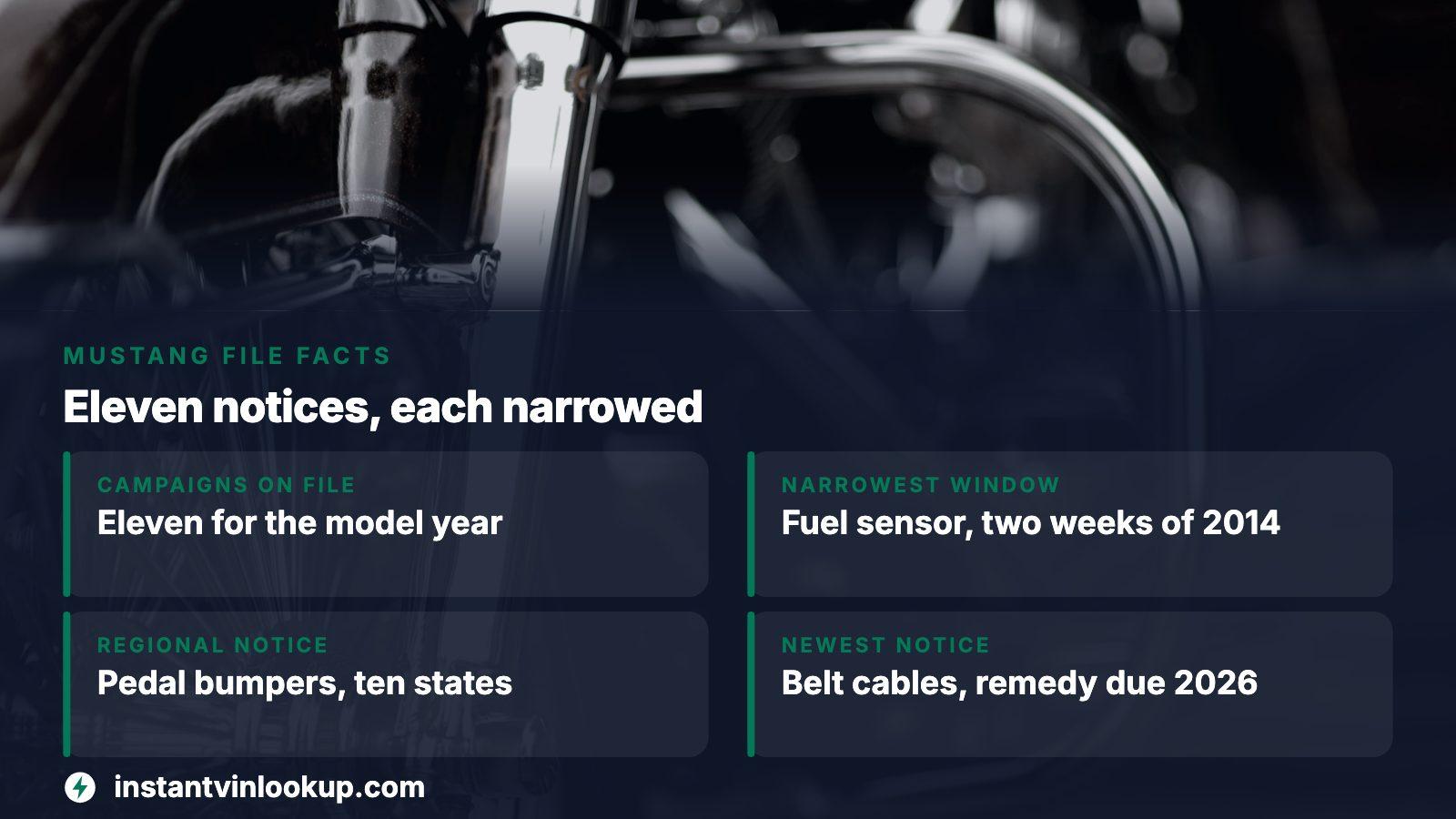
- 11 for the 2015 model year
- Narrowest window
- 14V774000, fuel pressure sensor, cars built over about two weeks in fall 2014
- Regional notice
- 22V011000, brake pedal bumpers, ten listed states
- Newest notice
- 25V614000, belt pretensioner cables, final remedy expected December 2026
The eleven notices and what narrows each one
Every campaign here is on NHTSA's list for this model year. The last column shows what decides whether one coupe is inside it.
| Campaign | Part | What narrows it |
|---|---|---|
| 14V649000 | Passenger belt tension sensor | Built Aug 18 to Oct 2, 2014 |
| 14V774000 | Fuel pressure sensor | Built Sep 25 to Oct 9, 2014 |
| 15V339000 | Fuel tank and vapor lines | 2.3L engines built Feb 14, 2014 to Feb 10, 2015 |
| 15V832000 | Rear caliper guide pin | Roush Stage 3 GT built Apr 1 to Oct 31, 2015 |
| 16V643000 | Door latch | Shared with other Ford models |
| 16V779000 | Oil cooler hose | Built Feb 24, 2015 to Aug 30, 2016 |
| 20V331000 | Door latch, second round | Cars repaired under an earlier latch notice |
| 22V011000 | Brake pedal bumper | Sold or registered in ten listed states |
| 22V082000 | Rear camera wiring | 2015 to 2017 Mustangs |
| 25V572000 | Rear camera image | 2015 to 2019, widens an earlier notice |
| 25V614000 | Front belt pretensioner cables | 2015 to 2017, remedy due December 2026 |
When the build date settles it
Three notices were written around the 2014 build year. The fuel pressure sensor notice spans about two weeks of production. The belt notice spans about six weeks and concerns a passenger tension sensor that can mistake a child for an adult, or the reverse, which changes how the passenger air bag fires. The fuel tank notice runs from February 2014 to February 2015 but touches only 2.3L engines, where underbody heat can degrade the tank, its vapor lines and the seals on the parking brake cable.
The oil cooler notice crosses model years: 2015 through 2017 Mustangs built from February 24, 2015 to August 30, 2016, with a hose that can slip off the cooler tube. Lost oil can end an engine. A coupe built in March 2015 is inside that window; one built in fall 2014 is not.
Running the lookup on the car in front of you
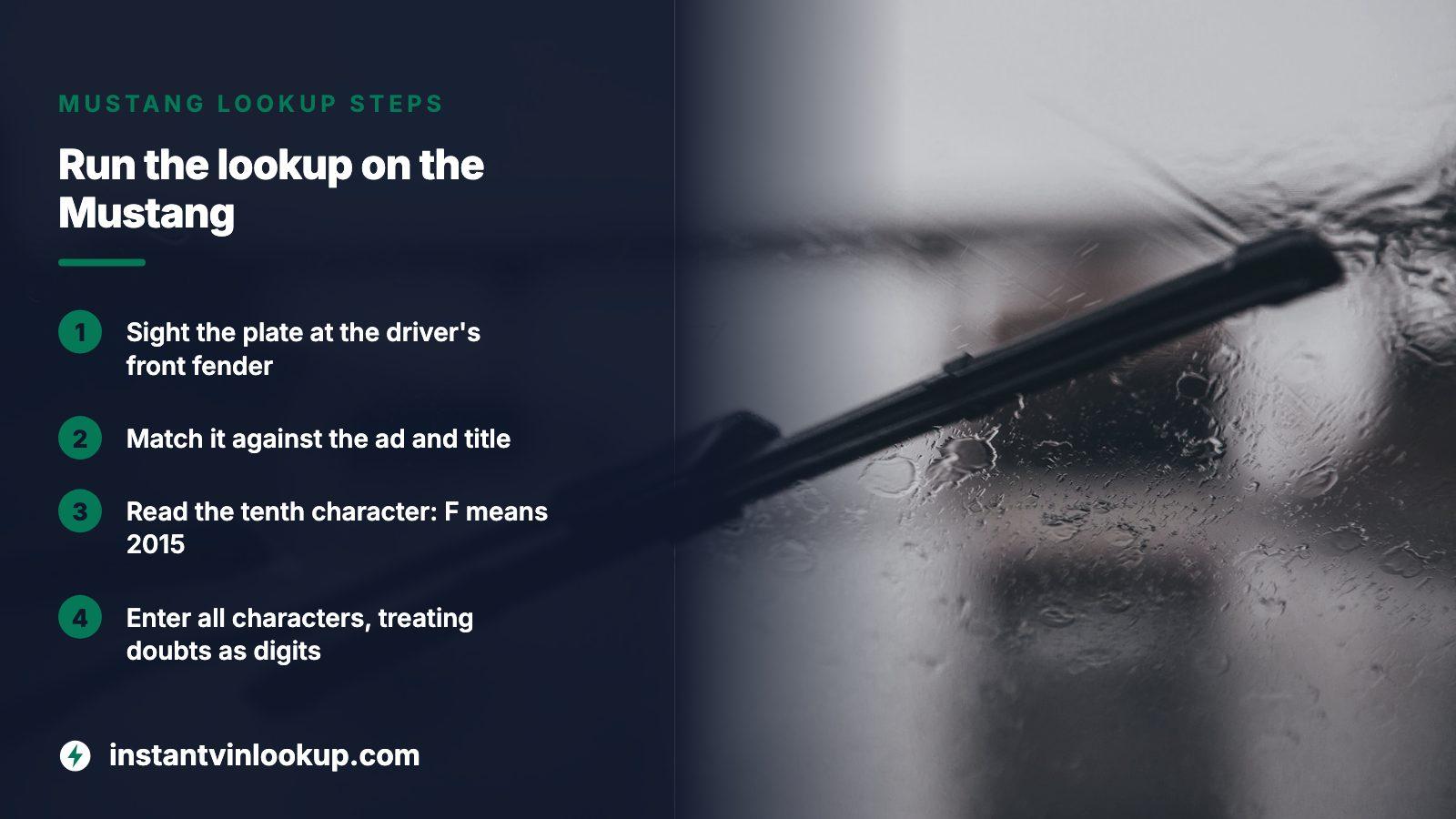
- Bend down at the driver's front fender and sight through the windshield to the plate riveted to the dash. The door-jamb label repeats it, so photograph that one.
- Match it against the ad and the title; a difference deserves a question to the seller first.
- Read the tenth character. F stands for 2015, so any other letter means the ad has the wrong year.
- Enter all 17 characters. Treat a doubtful character as a digit, because the alphabet used in VINs has no I, O or Q.
The lookup reads that exact VIN against each of the eleven notices and answers in seconds.
Where the car has lived: the ten-state brake pedal notice
Campaign 22V011000 reaches 2015 Mustangs sold or registered in Florida, Georgia, Alabama, Mississippi, Louisiana, Texas, Virginia, North Carolina, South Carolina or Hawaii. The bumper behind the brake pedal can corrode and separate in heat, humidity and salt air. Brake lights may then stay on, and on an automatic the shifter could move out of Park with no foot on the pedal. Dealers fit new brake and clutch pedal bumpers at no charge.
From an NHTSA owner complaint
One owner was driving home at about 55 mph when the engine bogged down and an orange wrench light came on. The coupe managed only 10 to 15 mph, and the brake lights stayed lit after shutdown. Broken yellowish plastic lay on the floorboard, and no shop had inspected the car yet. The owner tied it to the pedal bumper recall but said it covers listed regions, not theirs.
A region list means a clean result says little about the part. Ask where the coupe spent its years, and have the pedal area checked on any car from a humid or salted climate.
Open, done or half done: reading the result
- Open: the notice reaches this VIN and no repair is on record. Give a Ford dealer the VIN and ask for a booking.
- Done: ask for the work order and learn which campaign it belongs to. The second-round latch notice exists because earlier repairs under three older notices may have been done wrong.
- Not listed: the VIN falls outside that window or region. The part can still fail.
- Open, no part yet: the notice applies but the remedy has not shipped.
From an NHTSA owner complaint
An owner who had just bought a Mustang found its VIN inside the second-round latch notice. The dealer would not read the latch date codes, saying the earlier work looked begun but unfinished and so could not be closed out. Ford pointed the owner back to the dealer, which replied that its software did not permit the inspection.
Treat done as a claim to verify. If one dealer will not look, try another Ford dealer before the sale closes.
The two newest notices, and repair parts that lag
Campaign 25V572000 covers 2015 through 2019 Mustangs whose rear camera may show a blank, distorted or inverted picture in reverse. Campaign 25V614000 covers 2015 to 2017 cars with front belt pretensioner cables that water and road salt can eat away. If one snaps, the belt may fail to hold an occupant.
From an NHTSA owner complaint
One owner's camera went black in reverse during June 2024. A dealer ordered parts, then said after several calls that none were available, and nobody diagnosed or repaired the car. A notice for 25V572000 arrived later, and Ford then said parts could be had.
Open can mean waiting. Ask whether the part has shipped for your VIN, and weigh the asking price against a repair you cannot schedule.
What owner complaints add to the eleven
Recalls are defects the maker has admitted. Complaints are owner reports nobody has verified: 436 for this model year in the pull behind this page. Electrical leads the named systems at 66, with engine and service brakes at 51 each and back over prevention, the rear camera, at 41.
- Within those, 26 reports mention crashes, 7 mention fires and 19 mention injuries, all in the owners' own words.
- NHTSA also lists 3 investigations touching the model year, an early signal that can end with no recall.
How long Ford has to pay for the repair
49 U.S.C. 30120 puts the repair bill on the maker, with a cutoff measured between two dates: the first retail sale and the maker's notice to owners. The limit is 15 calendar years, and a resale never restarts the count. All 11 Mustang notices fit well inside it, but a car first sold in 2014 or 2015 will cross the line in a few years, and a later announcement brings no right to a free fix. Some makers repair older cars anyway, so ask.
What the lookup costs and what to do with the answer
You pay nothing to see the preview. One purchase buys the full report on one VIN, and packs of three, five or ten cover a longer shortlist. No subscription sits behind it, and the pricing page holds the amounts. In the report, open recalls sit beside title brands, damage and odometer readings, where a wrecked or rolled-back Mustang shows itself.
- Write down each campaign marked open, with its number.
- Ask a Ford dealer whether the part has shipped for that VIN.
- Request the work order for each one marked done, and read the latch and camera ones twice.
- Read the title, damage and odometer entries a recall list cannot show.
- Have a mechanic inspect the pedal area, oil cooler hose, fuel lines and camera wiring, then settle the price.
Where this information comes from
- NHTSA: Recalls — The federal search where each campaign number can be matched to a VIN.
- U.S. Code: 49 U.S.C. 30120, remedies for defects — The statute that puts repair costs on the maker and sets the 15-year cutoff.
- NMVTIS: National Motor Vehicle Title Information System — The national title record, which holds brands that a recall list leaves out.
- NHTSA owner complaint 11619019 — owner experience, paraphrased
- NHTSA owner complaint 11692059 — owner experience, paraphrased
- NHTSA owner complaint 11742144 — owner experience, paraphrased
Sources and photos: Facts checked against the sources above in November 2026. Photos by Anshul Gurjar, Thibault Valjevac and Steve Smith on Unsplash; diagrams by InstantVINLookup.
Keep reading
- VIN Lookup: Check a VIN Number on a Car Before You BuyHow the lookup and its preview work for any vehicle, not only this coupe.
- Sample reportA finished report to read before you decide whether to buy one.
- NHTSA Investigation Check: Look Up a Model, Then Run the VINThree investigations touch this model year, and this shows how to read one.
- 2016 Dodge Charger Recalls: Instant VIN Lookup by CampaignAnother American performance car, with its own campaign list to compare.
Frequently asked questions
How many safety recalls apply to a 2015 Mustang?
The federal file holds 11 campaigns for the 2015 model year, numbered from 14V649000 to 25V614000. Most are tied to a build window, a state list or an engine option, so one Mustang sits under some and not others. Only its VIN settles which.
Can I check Mustang recalls without the VIN?
Year, make and model return all 11 and nothing more, since that list cannot say which notices reach one coupe. NHTSA runs its own VIN search, and an instant lookup here adds title, damage and odometer records after the free preview.
Does the brake pedal bumper recall cover every 2015 Mustang?
No. Campaign 22V011000 reaches 2015 Mustangs sold or registered in ten listed states. Owners elsewhere have filed complaints about the same part failing, so a car outside the list may still need it.
What if a dealer will not finish a Mustang recall repair?
Several owners reported dealers refusing the work or saying the part was not in. Call a second Ford dealer with the VIN, and try Ford's customer line, 1-866-436-7332. If a remedy is missing or fails, a complaint to NHTSA puts it on record.
What do I see before paying for the full report?
The free preview lists the kinds of records held for the VIN, enough to judge whether a report is worth buying. The report is paid once, nothing renews, and the pricing page lists the amounts.
Now check the car itself
The guide explains what to look for. The report shows what this VIN has on record.