THE SHORT ANSWER
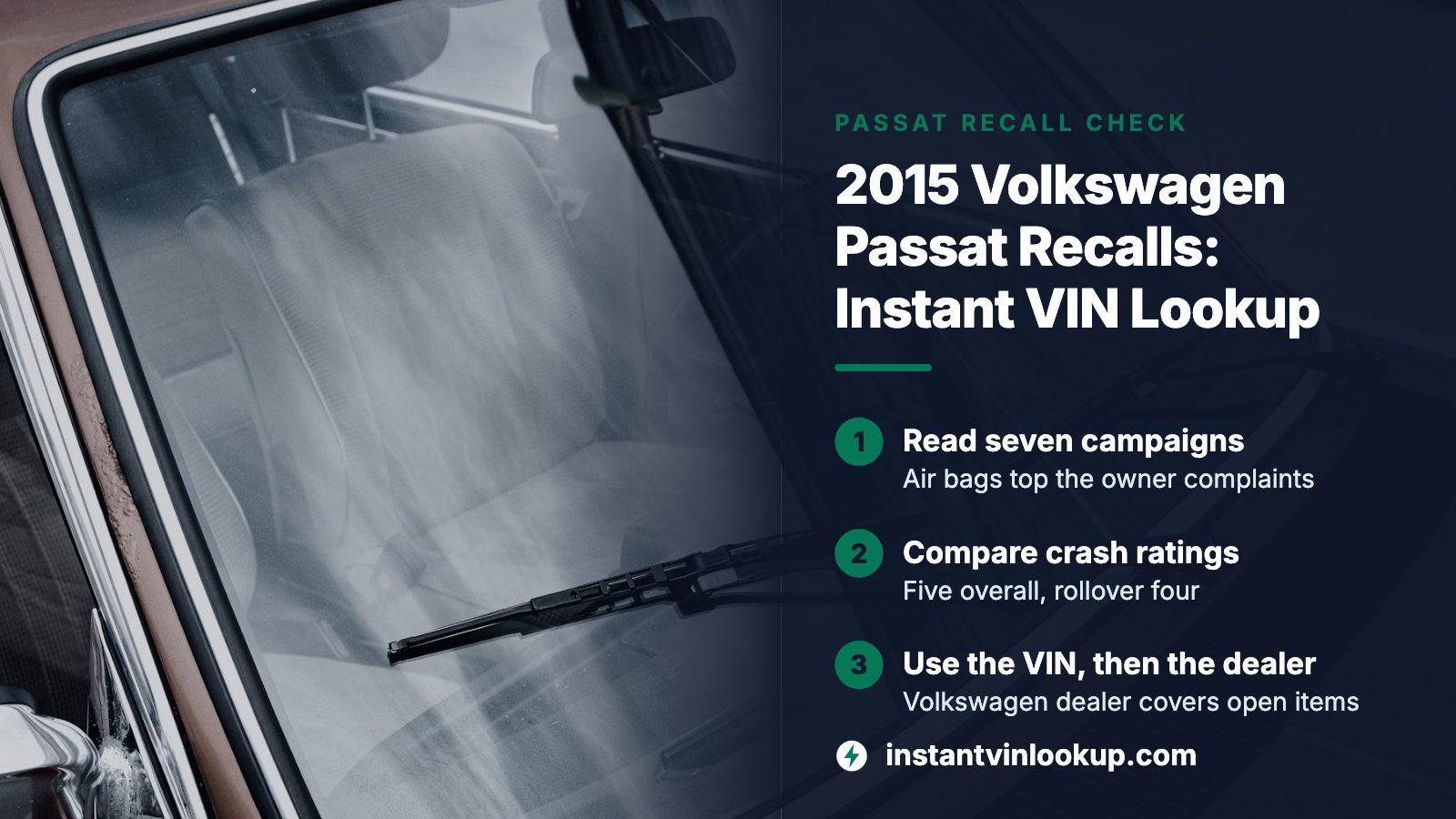
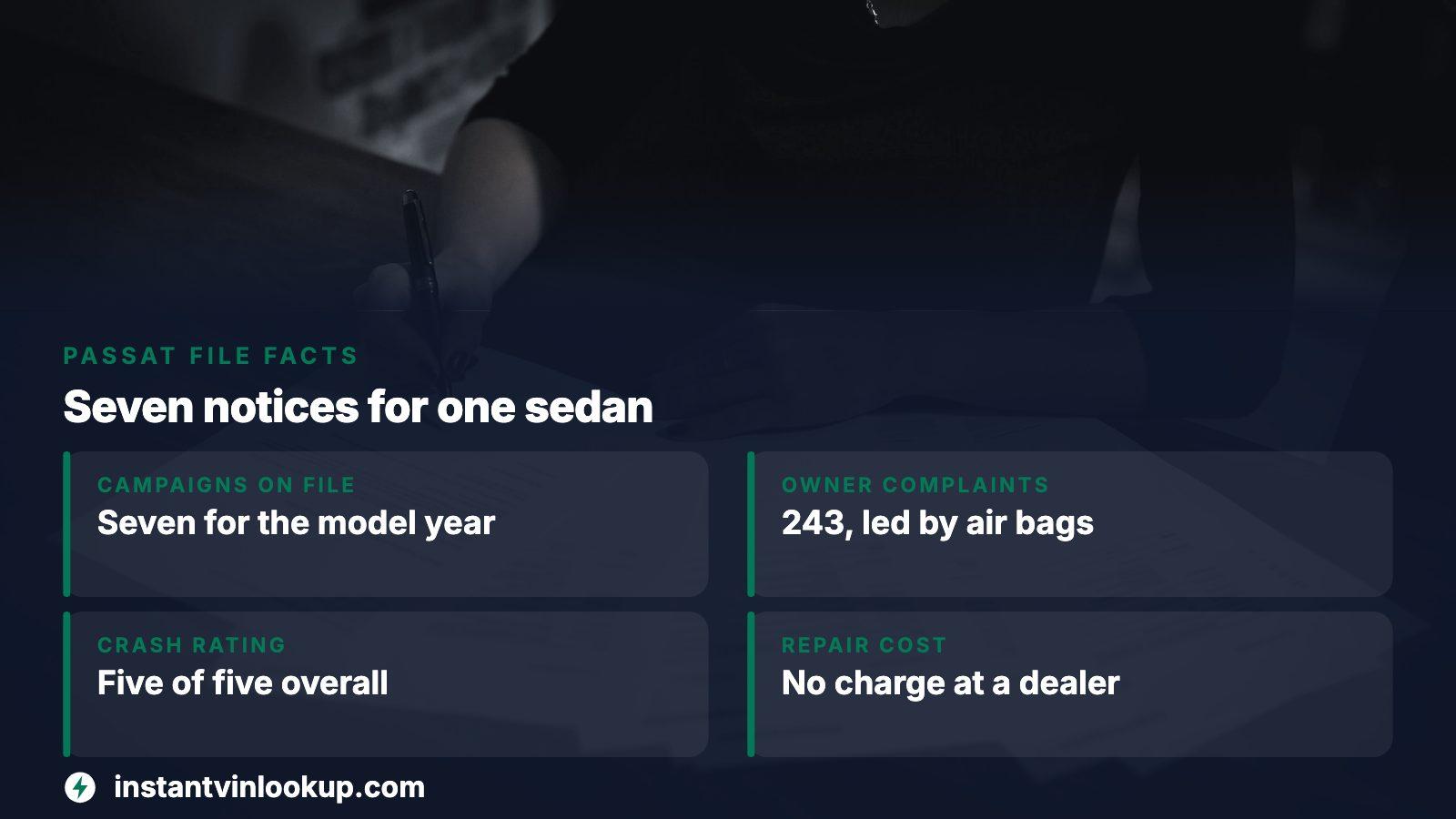
The 2015 Volkswagen Passat carries 7 NHTSA recall campaigns: two on the driver's air bag inflator and one each on the brake vacuum pump camshaft, headlight aim, front seatback recliner, a rear brake line and the fuel rail. Each has its own build window, so the VIN decides which reach a given car. A Volkswagen dealer does any open repair at no charge.
- Campaigns on file
- 7 for the 2015 model year
- Owner complaints
- 243, led by air bags at 36%
- NHTSA crash rating
- 5 of 5 overall, 4 of 5 for rollover
- Repair cost
- No charge at a Volkswagen dealer
What the lookup returns for one 2015 Passat
Start with the 17-character VIN of the car you are considering. The preview counts the records held against it, section by section, before any money changes hands. The report is a single payment for that VIN, and no subscription sits behind it.
On a 2015 Passat, three parts of the report earn the closest read. The open recall list comes first, because seven campaigns exist and only some reach any one car. Accident and damage records come next, since the driver's air bag inflator has been recalled twice and a repaired front end can hide behind a fresh inflator. Odometer readings come third, to test the dash mileage against dated entries.
The seven campaigns at a glance
NHTSA files these under the 2015 Passat. Several also name other models, such as the Jetta, Golf or an Audi.
| Campaign | Subject | What the notice says |
|---|---|---|
| 19V014000 | Driver air bag inflator | Excess pressure on deployment could make the inflator explode. Dealers fit a different inflator. Began March 4, 2019. |
| 19V862000 | Driver air bag inflator, again | Reaches cars thought to be repaired under an earlier Takata campaign. Dealers replace the inflator once more. Began December 20, 2019. |
| 15V705000 | Brake vacuum pump camshaft | The lobe driving the pump may shear and cost brake assist. Dealers update the engine software. Began March 2016. |
| 19V389000 | Headlight aim | A cap that locks the horizontal aim may be missing. Dealers inspect and block the adjustment. Began July 16, 2019. |
| 14V670000 | Seatback recliner | Manual front recliners on cars built September 23 to October 9, 2014 may let the seatback shift unexpectedly. |
| 15V373000 | Rear brake line | A left rear line may be under-tightened on cars built May 18 to 21, 2015. Dealers tighten the fitting. |
| 15V028000 | Fuel rail | A sealing cap may fail and leak fuel into the engine bay. Dealers fit new rails. Began February 6, 2015. |
Two inflator notices, one part
Settle the driver's air bag inflator first. Campaign 19V014000 warns that the inflator could burst on deployment and throw metal at the occupants. The later 19V862000 reaches 2012 to 2015 Passats thought to have been fixed under an earlier Takata campaign, and has dealers replace the inflator a second time. So a note saying the air bag was already repaired can still leave one campaign open.
From an NHTSA owner complaint
An owner who filed in March 2019 had received the 19V014000 notice and phoned a dealer, only to hear that the replacement part was out of stock. Volkswagen could not give a date. The car had not failed, and a VIN lookup tool agreed the part was unavailable.
That was 2019, so ask a dealer today whether the part is on hand for the VIN, and have the seller book the work first.
Brake assist, a camshaft and a loose fitting
Two notices touch braking. Campaign 15V705000 says the camshaft lobe that drives the vacuum pump may shear off, leaving less brake assist, and the dealer's fix is a software update. Campaign 15V373000 is narrower: Passats built over four days in May 2015 may have a loose line at the left rear wheel, which can leak fluid.
From an NHTSA owner complaint
In November 2020 a Passat buyer filed a complaint about a car with about 49,000 miles and a pedal that was soft on some days and sank on hot ones. Mechanics blamed the master cylinder, and the owner had paid over $1,500 for new pads, new rotors and a flush of the brake fluid. The filing lists the camshaft campaign number at the top, yet nobody had tied the two together.
Whatever the cause, a soft pedal calls for a hard test drive and a shop visit. A clean recall record does not clear it, and an open one does not explain it.
Why one Passat is named and its twin is not
Campaigns are cut by production dates, and some cuts are tight. The fuel rail notice names Passats built April 7 to November 18, 2014, the recliner notice runs September 23 to October 9, 2014, and the rear brake line notice covers four days. The headlight notice is the wide one, naming Passats from 2012 through 2020.
From an NHTSA owner complaint
A filing from February 2026 describes a Passat that sputtered, then lost power at about 35 mph. The dealer traced it to a fuel leak under the hood. Afterward the owner found the fuel rail campaign, 15V028000, and Volkswagen confirmed the car's VIN was not in it.
Same symptom, same model year, still outside the list. A VIN match puts a campaign on a car; a leak can happen without one.
Running the lookup in about a minute
- Read the plate through the glass at the windshield's driver-side base, then check the maker's label on the driver's door frame. Photograph both.
- Compare the two readings character by character. A single wrong letter sends the lookup to another car or to nothing.
- Check the tenth character. A 2015 model year shows F there, and a listing sold as a 2015 over any other letter needs an explanation.
- Paste the VIN into the lookup box, read the preview, then decide on the full report.
Seller photos of those two spots are enough to run the number before you drive out.

Reading the result, and what owners add
- Open: the campaign reaches this VIN and no completed repair is on record. A Volkswagen dealer does the work at no charge.
- Repaired: ask for the work order and match the campaign number, not only the part name.
- Not listed: the VIN sits outside every window. That does not rule out the same symptom.
Owner complaints and crash tests sit in a separate file. NHTSA holds 243 complaints on this model year, and 88 of them, about 36%, name air bags. Engine follows with 53 and the electrical system with 48. Owners flagged 11 crashes and 2 fires. Several air bag filings describe a warning light with a dead horn and dead steering wheel buttons, a clock spring failure that owners said no recall matched. Treat all of it as unverified. NHTSA's crash tests gave the Passat 5 of 5 stars overall, but only 4 for rollover.
Paying for the report, and acting on the answer
The preview is free and always comes first. The report is one payment for one VIN. If you are weighing several Passats, bundles of 3, 5 or 10 reports cover them in a single purchase, and nothing renews afterward. The amounts are on the pricing page.
- Open inflator campaign: have the seller schedule the dealer repair before you pay, and ask the dealer about the part.
- Open brake line or fuel rail campaign: the same dealer visit, at no charge, before the sale closes.
- Damage entry near the front: ask for the repair invoice and have a shop inspect the front end and the air bag system.
- Clean result: still arrange an independent inspection before agreeing on a price.
Where this information comes from
- NHTSA: Recalls — The federal search where each campaign number above can be matched against a VIN.
- NHTSA: New Car Assessment Program ratings — The crash-test program behind the star results for this model year.
- U.S. Code: 49 U.S.C. 30120, remedies for defects — The statute that puts the repair cost on the manufacturer and sets the 15-year cutoff.
- NHTSA owner complaint 11186366 — owner experience, paraphrased
- NHTSA owner complaint 11374849 — owner experience, paraphrased
- NHTSA owner complaint 11715795 — owner experience, paraphrased
Sources and photos: Facts checked against the sources above in November 2026. Photos by Max Tokarev, Michal Biernat and Dimitri Karastelev on Unsplash; diagrams by InstantVINLookup.
Keep reading
- VIN Lookup: Check a VIN Number on a Car Before You BuyA fuller walk through the lookup, from typing the VIN to reading the preview.
- Where Is the VIN Number? Find It in a Minute, Then Verify ItMore places to read the number when the windshield plate is dirty or the door label is worn.
- Airbag Deployed Check: Spot a Hidden Deployment From the VINTwo of this car's campaigns concern the driver's inflator, so its crash history matters.
- 2015 Nissan Altima Recalls: Instant VIN Lookup for Each CampaignA same-year sedan often cross-shopped with the Passat, with a longer campaign list to compare.
Frequently asked questions
What is the recall count on a 2015 Volkswagen Passat?
NHTSA lists 7 campaigns. That figure counts every notice naming the model year, including some issued for the Jetta, Golf, Eos, CC and Audi models too. A given Passat does not need to fall inside all seven, since each notice carries its own build range. Run the VIN to see which ones apply.
Are recall repairs on a 2015 Passat free?
Yes. Federal law makes the manufacturer cover the cost of a recall repair, and the statute carries a 15-year cutoff. Take the VIN to a Volkswagen dealer and ask for any open campaign. If a part is back-ordered, ask for a call when it arrives.
Does a repaired driver air bag mean the Passat is clear?
Not necessarily. Campaign 19V862000 exists for cars thought to have been repaired under an earlier Takata campaign, and it has dealers replace the inflator again. Ask for the work order, note which campaign it closed, and run the VIN to see whether another one remains open.
Can I check a Passat's recalls before I see the car?
Yes. Ask the seller for photos of the two VIN locations and compare them before you type anything. The preview takes seconds and tells you whether the car deserves a drive. A seller who stalls over the number has told you something about the listing.
Does a clean recall result make a 2015 Passat a good buy?
No. A recall result covers only campaigns that reach that VIN. Owner filings describe trouble no campaign covers, such as clock spring failures behind an air bag warning light, or a fuel leak on a car outside the fuel rail notice. Pair the result with title, damage and odometer entries, then add a mechanic's inspection.
Now check the car itself
The guide explains what to look for. The report shows what this VIN has on record.