THE SHORT ANSWER
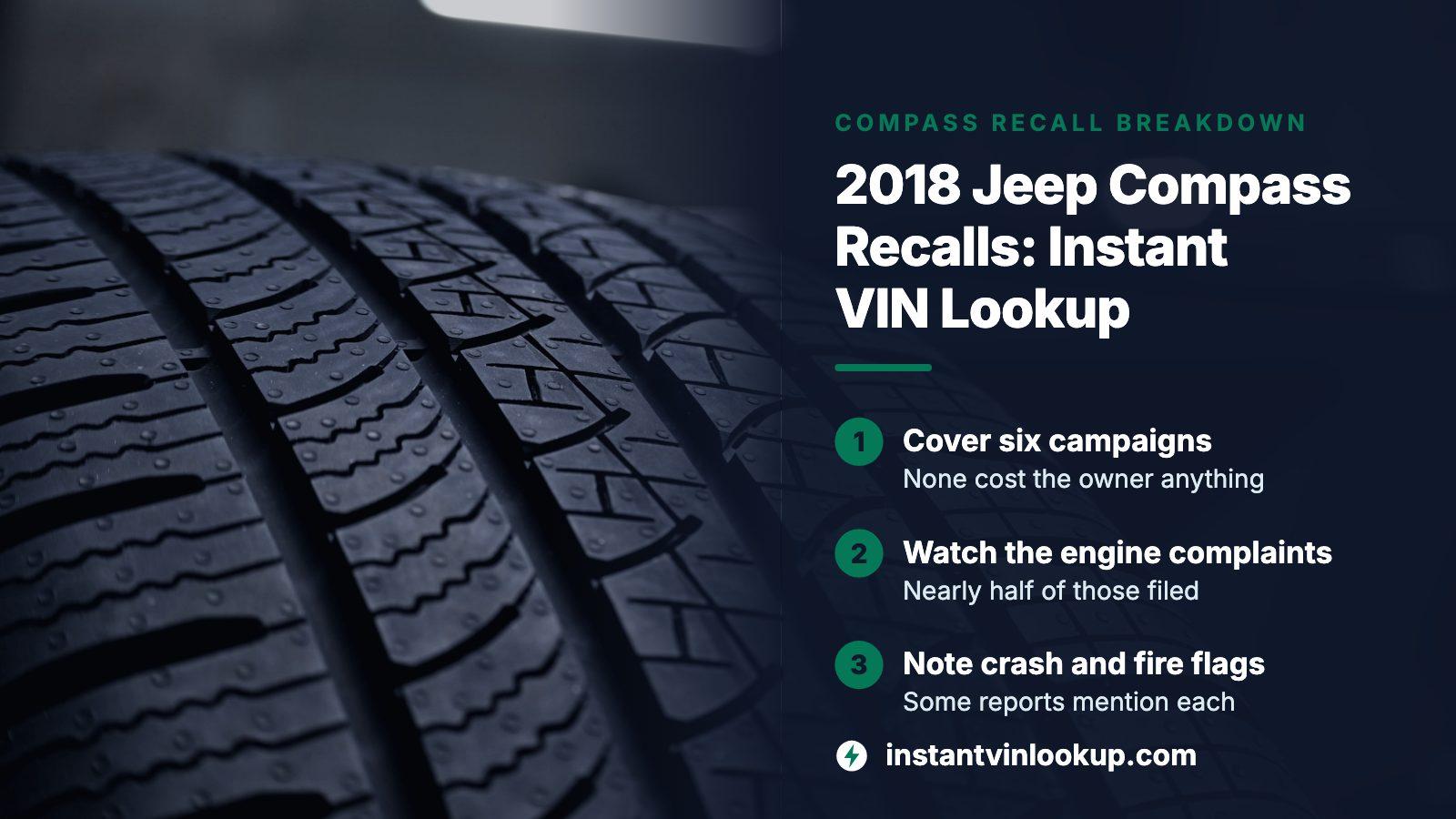
Six campaigns cover the 2018 Compass: 18V279000 (front lower control arm), 17V740000 (gauge cluster dimming), 18V524000 (powertrain control module, stalls), 18V523000 (rear brake calipers), 17V670000 (oil pump housing on 2.4L engines) and 17V732000 (passenger air bag module). Dealers repair each at no cost to the owner. Build range decides which apply, and the lookup compares the VIN with all six.
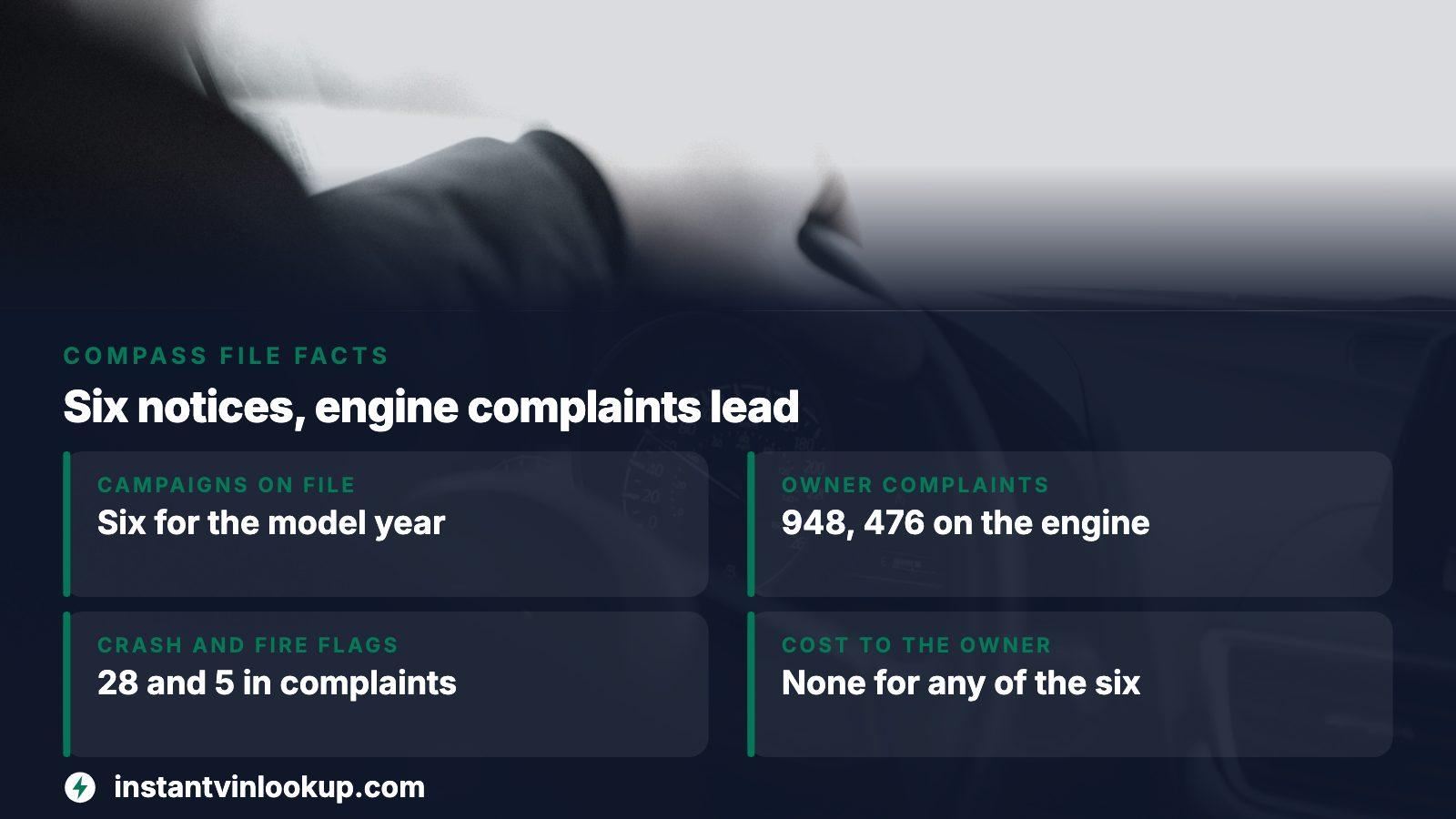
- Campaigns on file
- 6 for the 2018 model year
- Owner complaints
- 948 filed, 476 naming the engine
- Crash and fire flags
- 28 and 5 among those complaints
- Repair cost to the owner
- none for any of the six
What an instant lookup returns for a 2018 Compass
Enter the 17 characters and the preview comes back in seconds, showing which kinds of records exist for that VIN. The report behind it is one payment, and it lists open recalls beside things a recall file never carries: odometer readings, damage records and title brands. A search for 2018 Jeep Compass recalls hands everyone the same list of six. It cannot say whether the SUV in the driveway sits inside any of them, and the VIN does that sorting.
The six campaigns and what each one fixes
Each number below works in NHTSA's recall search. The bracketed code is Chrysler's own reference for the same action.
| Campaign | The defect | The repair |
|---|---|---|
| 18V279000 (U42) | Front lower control arms welded badly, so one could separate and the driver lose control | Dealer inspects, swaps arms if needed |
| 17V740000 (T70) | Gauge cluster backlight stays too bright at night and has no dimming | Software update |
| 18V524000 (U87) | A regulator chip on the control module's circuit board can quit, and the engine stalls or refuses to start | New module |
| 18V523000 (U86) | Rear caliper pistons coated too thinly, gas pockets form, rear braking weakens | Brake system bleed |
| 17V670000 (T65) | 2.4L engines only: the oil pump housing may crack and the pump give out | Pump inspection, replacement as needed |
| 17V732000 (T73) | Loose mounting nuts inside the passenger air bag assembly could become projectiles | New passenger air bag module |
Three of the six name other models beside the Compass, and 17V740000 reaches back to 2017 builds.
The stall campaign that spans the Chrysler lineup
Campaign 18V524000 casts the widest net. Its text lists Renegade, Cherokee and Grand Cherokee beside the Compass, plus Ram, Fiat, Dodge and Chrysler vehicles, because the same module went into all of them. A Compass that loses power in traffic matches the picture NHTSA draws.
From an NHTSA owner complaint
One owner, filing in December 2025, wrote about repeated stalls with no restart, some on a busy highway. The Jeep dealer billed over $700, pointed at wiring and then a circuit fault, and held the car about two weeks. The owner read campaign 18V524000 as a match for every symptom yet says the car was left out of it. No repair outcome appears in the filing.
A campaign number tests a VIN, not a symptom. A stalling Compass outside the range is still a stalling Compass, and the bill then lands on the owner, so find out which side of the line the car sits on before buying it.
Production ranges: one VIN covered, its neighbor not
NHTSA's records say "certain" vehicles for a reason. Chrysler draws each campaign around build dates, equipment or both, so two Compass SUVs on one lot can fall on opposite sides of a cutoff. The oil pump campaign adds an engine condition, since only 2.4L cars are named.
From an NHTSA owner complaint
Someone who filed in November 2024 heard at a dealer that a noisy front lower control arm needed work, and that labor alone would pass $700. The control arm campaign turned up in an online search, but the VIN was not on its list, so the dealer declined to cover the job. The filing asks for the VIN to be added, and it does not claim that the welding defect caused the noise.
A recall page shows what exists, and the VIN shows who gets the repair without a bill. Noise, pulling or shuddering up front deserves a mechanic even when the lookup comes back empty.
Engine complaints outnumber everything else in the file
NHTSA's complaint file for this model year holds 948 entries. The engine is named in 476 and the electrical system in 380, and 175 name both, which suits stalls that touch each system. Crash is flagged on 28 filings, fire on 5, and 18 injuries are reported. Owners typed those flags while filing; no investigator confirmed them, and a single event can yield several entries.
None of that proves a defect in one car. It does hand a buyer questions: was the oil pump campaign done on a 2.4L car, was the control module replaced, and can the seller show paperwork? The lookup answers the first two for a VIN, and the paperwork answers the last.
A closed campaign and a fixed car are different claims
A dealer marks a campaign complete when the specified work is done. That records a swapped part or a loaded update, not the end of the symptom.
From an NHTSA owner complaint
A September 2023 filing describes three stalls in traffic, one at highway speed and one in an intersection, each with a young child aboard. The dealer had worked on the Jeep twice and called the recall fulfilled because a part had been replaced, yet the stalling carried on. The filing never names the campaign.
Ask for the work order, read what was replaced, and drive the Compass long enough to include some stop-and-go traffic.
Running the lookup from the listing or the lot
- Compare the number on the dash plate, seen through the glass on the driver's side, with the sticker on the door post. They must agree.
- Check the tenth character. A 2018 Compass carries a J there, and any other letter contradicts the ad.
- Enter the VIN in the lookup and read the preview, which arrives in seconds.
- If the Compass is still a candidate, buy the report and read its open recalls first, then the damage and odometer entries.

Reading the answer: open, done or not listed
- Open: the VIN sits inside a campaign and no repair is recorded. Call a Jeep dealer with the campaign number and ask about parts and a date before agreeing on a price.
- Done: a repair is on record. Ask for the work order, since a record and a repaired car are separate claims.
- Not listed: the VIN falls outside the range. That settles the paperwork, not the symptoms.
- Not listed but symptomatic: stalling, a no-start, a soft rear brake pedal or front-end noise earns a mechanic's visit before any deposit.
What the lookup costs and the step after it
Reading the preview costs nothing. The report is paid once per VIN, and shoppers weighing several Compass SUVs can take 3, 5 or 10 reports in a bundle. No renewal follows, and the pricing page lists the amounts. NHTSA's own recall search is free and settles the open-recall question alone; the report earns its place when you also want damage, odometer and title entries before settling on a price. All six campaigns reached NHTSA in 2017 and 2018, far inside the federal 15-year limit on no-charge repairs. If one is open, a Jeep dealer can book it, and a mechanic's look at the engine bay and front suspension is the sensible step after that.
Where this information comes from
- NHTSA: Recalls — The federal search where each campaign number above can be matched to a VIN.
- NHTSA: 2018 Jeep Compass recalls and complaints — The six campaign records and the owner complaint counts quoted on this page.
- U.S. Code: 49 U.S.C. 30120, remedies for defects — The statute that puts the repair cost on the maker and sets the 15-year cutoff.
- NHTSA owner complaint 11702263 — owner experience, paraphrased
- NHTSA owner complaint 11624377 — owner experience, paraphrased
- NHTSA owner complaint 11545558 — owner experience, paraphrased
Sources and photos: Facts checked against the sources above in November 2026. Photos by Pablo Alvarez, Carrie Allen www.carrieallen.com and Miles Loewen on Unsplash; diagrams by InstantVINLookup.
Keep reading
- VIN Lookup: Check a VIN Number on a Car Before You BuyHow the lookup and its preview work for any vehicle, not only this Jeep.
- NHTSA Investigation Check: Look Up a Model, Then Run the VINWhat to do when many owners report one symptom that no campaign covers yet.
- 2016 Jeep Wrangler Recalls: Instant VIN Lookup for All 5 CampaignsAnother Jeep model year with several campaigns that split by build range.
- Sample reportSee where open recalls sit among the title, damage and odometer entries.
Frequently asked questions
Which recalls apply to a 2018 Jeep Compass?
NHTSA has six campaigns on file for the model year: control arm, gauge cluster, powertrain control module, rear brake calipers, oil pump housing and passenger air bag module. Each covers certain vehicles by production range, so a given Compass may fall in all of them, some or none. Only a lookup by VIN sorts them.
Does the 2018 Compass have an engine stall recall?
Two campaigns involve stalling. 18V524000 covers a failing chip in the powertrain control module, and 17V670000 covers a cracked oil pump housing on 2.4L engines. Neither reaches every car. A Compass that stalls and is not listed still belongs with a mechanic, because losing power in traffic is a safety fault either way.
Can I check 2018 Compass recalls without the VIN?
Year, make and model return the list of six, but not which ones reach one car. NHTSA's search accepts a VIN and costs nothing. The lookup here takes the VIN too, and its report adds entries that a recall search lacks: odometer readings, damage records and title brands. Without the VIN you only know what might apply.
Will a Jeep dealer repair these at no charge?
Federal law makes the manufacturer bear the repair cost, with one exception for cars first sold well over a decade and a half before the announcement. All six campaigns date from 2017 and 2018, nowhere near that line. Dealers can still bill for diagnosis unrelated to a campaign, so get any extra charge in writing first.
What do I see before paying for the full report?
The preview shows which kinds of records exist for the VIN, so you can judge whether the report is worth buying. You pay once per report, each report covers a single VIN, and bundles of three, five or ten exist for people comparing cars. Nothing renews and there is no subscription.
Now check the car itself
The guide explains what to look for. The report shows what this VIN has on record.