THE SHORT ANSWER
No VIN lookup returns a battery size directly, since the federal build record has no parts fields. The VIN's job is to identify the exact engine and trim, which a parts counter turns into a group size. Then check the type: a car with start-stop is built around AGM or EFB, and most of them also need the new battery registered with the charging system after the swap.
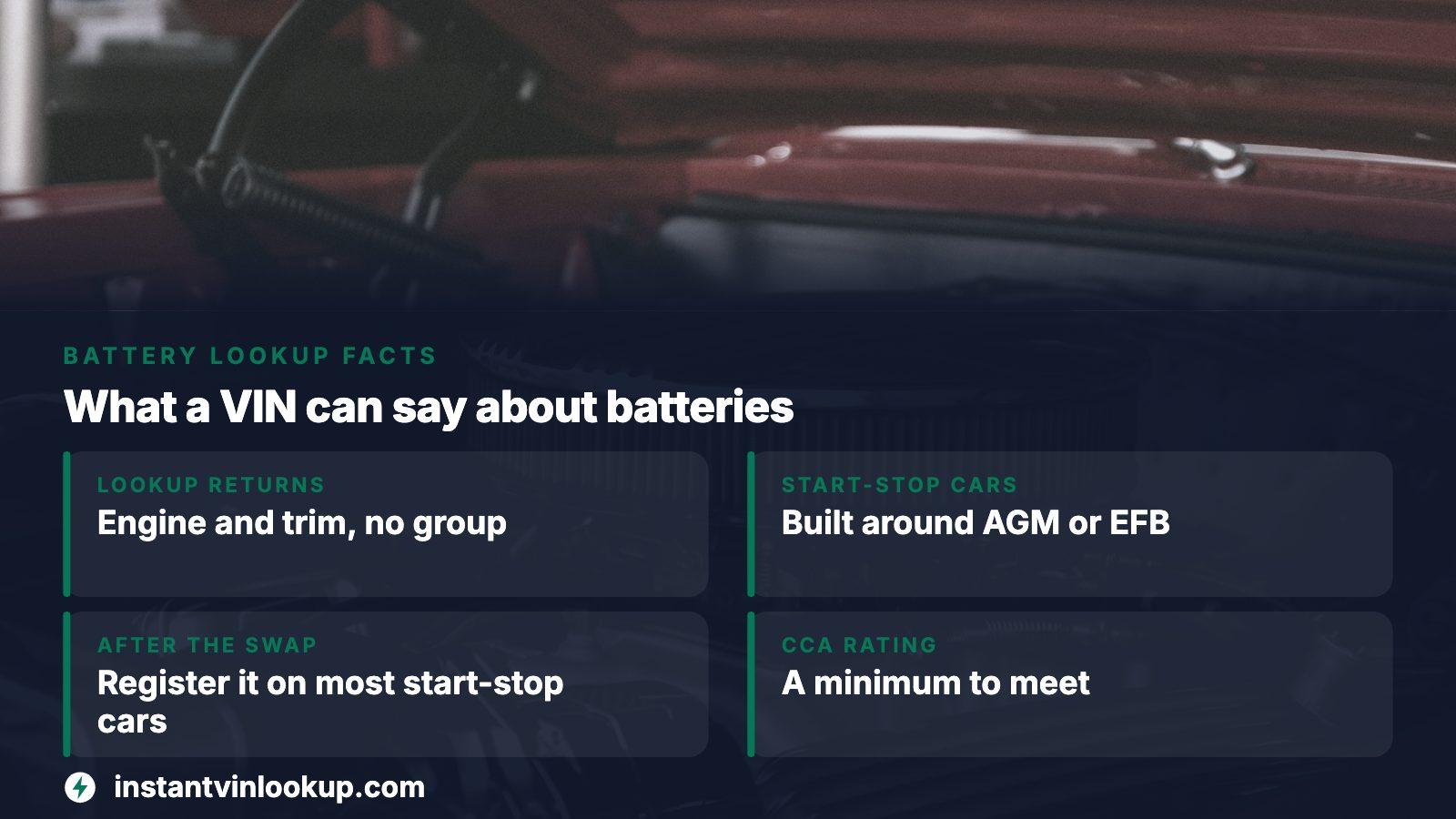
- Lookup returns
- Engine and trim, not a group number
- Start-stop cars
- Built around AGM or EFB, not flooded
- After the swap
- Registration on most start-stop cars
- CCA rating
- A minimum to meet, not a score to beat
What the instant lookup returns, and what it leaves open
Type in the 17 characters and the build record comes back: what the car is, how it is bodied, how big its engine is and what fuel it burns. That is the factory's description of the vehicle, not a parts catalog, and it has no battery field. So the VIN gets you to the battery by a side road: it names the engine and trim that every battery lookup starts from.
| Open question | Who settles it | What the VIN adds |
|---|---|---|
| Group size for the tray | Parts counter | The engine and trim they ask for |
| AGM, EFB or conventional | Owner's manual | The right manual entry to read |
| Registration after the swap | Manual or the maker | Confirmation of the exact trim |
| Is the fitted battery correct | Label checked against the manual | Nothing; read it by eye |
From VIN to battery in five moves
- Copy all 17 characters from the paperwork and match them to the car.
- Run the lookup and note the engine and trim.
- Find that engine's battery entry in the owner's manual and read the construction it names.
- Hand the VIN to the parts counter and ask outright whether AGM or EFB is required.
- Choose construction first, group second, and a CCA that meets the minimum.
The preview here is free and shows how many records exist for the car before you pay for anything. If you also want the title, accident and odometer entries, the report is bought once and nothing renews afterward. NHTSA's recall search costs nothing and takes the same 17 characters,

Group number: the shape of the box
A group number is a physical description. It explains why a battery drops into the tray and why the cables reach, and it explains nothing about the contents. It pins down:
- Length, width and height, so nothing touches the hood liner or a brace
- The side the positive post is on, which decides whether the cables reach
- Post style, whether top, side or threaded stud. Adapters exist but are second best
- How the clamp holds it down, because a loose battery vibrates and vibration shortens its life
Two batteries can share a group number and still be built quite differently, so matching the group settles fit and leaves construction open.
Three constructions, and which swaps run backward
A conventional flooded battery holds liquid electrolyte and belongs in a car without start-stop or heavy electrical cycling. An EFB, the enhanced flooded type, is reinforced for more cycling and sits behind many entry-level start-stop setups. An AGM keeps its electrolyte in a glass mat, takes deep and frequent cycling best, and anchors the more demanding cars. The manufacturers' guidance on swaps runs one way:
- AGM for AGM, in the same housing and a comparable class
- EFB for EFB, and occasionally AGM in its place
- Going down a grade, from AGM to EFB or flooded, is the move to skip
- A car with no start-stop gains nothing it needs from AGM, so paying for one is optional
This is industry guidance, not a regulation. The manufacturer's own word overrides it, and that word varies by make.
Why start-stop duty is hard on a battery
An ordinary car starts the engine once per trip, and after that the alternator does the work. A start-stop car shuts down at each light and restarts, and while it idles off the battery alone powers the fans, lights and screens. That is deep cycling, all day. Industry guidance says a standard flooded battery in this role fails early, sometimes within months, though it fits the tray without complaint.
From an NHTSA owner complaint
A 2018 Chevrolet Equinox owner filed in December 2022 after the battery failed at 67,900 miles, the fifth in the car's life. According to the owner, four earlier batteries went in over four years, and the dealer said the climate, the roads and the stop/start system were killing a cell about every 16,975 miles. The owner called it a "stop/start system design defect" and said the manufacturer extended the warranty once, then declined to pay for the next battery.
The owner never says which type was fitted, so this is no wrong-battery story. It shows how hard the duty is on any battery, and why a seller should be asked how often it has been replaced.
Registration: the step after the swap
Most start-stop cars run a battery management system that logs the battery's age and condition and tunes the charging to match. Install a fresh battery without telling the system and it carries on using the old unit's record, so the new one is charged as if it were tired. The remedy is called registration, battery adaptation or a BMS reset. It takes a scan tool and a few minutes, and a hurried job leaves it out.
Ask before the work, not after
Does this car need the new battery registered, and who is doing it? A shop set up for newer cars answers at once. In a driveway the same question applies, which is why a do-it-yourself swap is harder than it used to be.
CCA: meet the minimum, skip the arms race
CCA states how much current a battery can supply when cold, for a short burst, and so how well it turns over a chilled engine. The manufacturer picks a minimum to suit the engine and the weather the car was built for. Meeting it is sensible, and a modest margin helps in a cold region. Chasing the biggest figure does not. A higher rating cannot rescue the wrong construction, and it will not help a battery survive duty it was never designed for.
Reading the battery on a used car
Before you talk price, read the label on the battery under the hood. A conventional flooded unit in a start-stop car is a finding: it is close to failing or already failing, and it suggests the upkeep was done to a budget instead of a specification. A date code, where present, gives a rough age. No single clue settles a purchase, but a start-stop system that quits working, a new battery struggling within a year, or charging-system warnings after a change each point at a mismatch.
From an NHTSA owner complaint
Another 2018 Equinox owner wrote in March 2022 that brake, steering and stability warnings filled the dash after the auto stop-start engaged. The dealer traced it to low battery voltage and fitted a new battery at 55,436 miles, the third in four years, after earlier swaps at 18,500 and 32,562 miles. The warranty was due to end at 58,300 miles.
Ask for the battery's service history, and treat a quick run of replacements as a reason to look harder. Then run the VIN: the preview is free and counts the records on file. The report adds title brands, accident entries and odometer readings, which you can set beside the date code and the seller's story.
Where this information comes from
- VARTA: EFB and AGM differences — Manufacturer guidance on which constructions may replace which, and why housing and performance class should match.
- Banner: registering start-stop batteries — Why a replacement battery has to be registered with the vehicle's management system, and what the procedure does.
- Midtronics: battery issues in auto start-stop vehicles — How start-stop duty strains a battery and why a conventional one wears out in that service.
- NHTSA: Recalls — The government search for open safety recalls by VIN, worth running while the number is in hand.
- NHTSA owner complaint 11497355 — owner experience, paraphrased
- NHTSA owner complaint 11458742 — owner experience, paraphrased
Sources and photos: Facts checked against the sources above in November 2026. Photos by Towfiqu barbhuiya, Scott Graham and Victor Hughes on Unsplash; diagrams by InstantVINLookup.
Keep reading
- Parts by VIN: Run the Instant Lookup Before You OrderThe wider question of what a VIN can and cannot tell you about parts.
- Oil Type by VIN: What an Instant Lookup Returns, and What It Can'tAnother spec where the VIN names the car and the manual makes the call.
- VIN Lookup: Check a VIN Number on a Car Before You BuyRun the lookup itself and see what the preview shows before you pay.
- Sample reportSee a finished report before deciding whether to open one for your car.
Frequently asked questions
Can a VIN tell me what battery my car takes?
Only indirectly. The factory record has no parts fields, so no group number is printed. The VIN identifies the exact engine and trim, and a parts counter converts those into a group size. Ask which construction the car requires too, because fit seldom goes wrong and type often does.
How do I know whether my car needs AGM or EFB?
Check the owner's manual, which outranks the battery's label if they disagree. Start-stop cars are the ones built around those two types, and trim or engine can change whether a car has the feature, even within one model year. Use the VIN to confirm your exact trim before you read.
What goes wrong if I fit a standard battery in a start-stop car?
Day one looks normal: it fits, the car starts, the lights work. Months later it stops holding a charge, and by then nobody links the problem to the choice at the counter. Start-stop that quietly stops working is often the first warning.
Does a replacement battery have to be registered?
On most start-stop cars, yes. The management system keeps the old battery's age and condition on file and charges the new one accordingly until told otherwise. A scan tool resets it in minutes. Check the manual or the manufacturer's guidance, because the rule differs by make.
Does this site show my battery group size?
No. The preview is free and shows how many records exist for the VIN. The paid report lists factory specifications, including the engine, the detail to take to a parts counter. Group size is not in the factory record, so the counter or the manual supplies it.
Now check the car itself
The guide explains what to look for. The report shows what this VIN has on record.