THE SHORT ANSWER
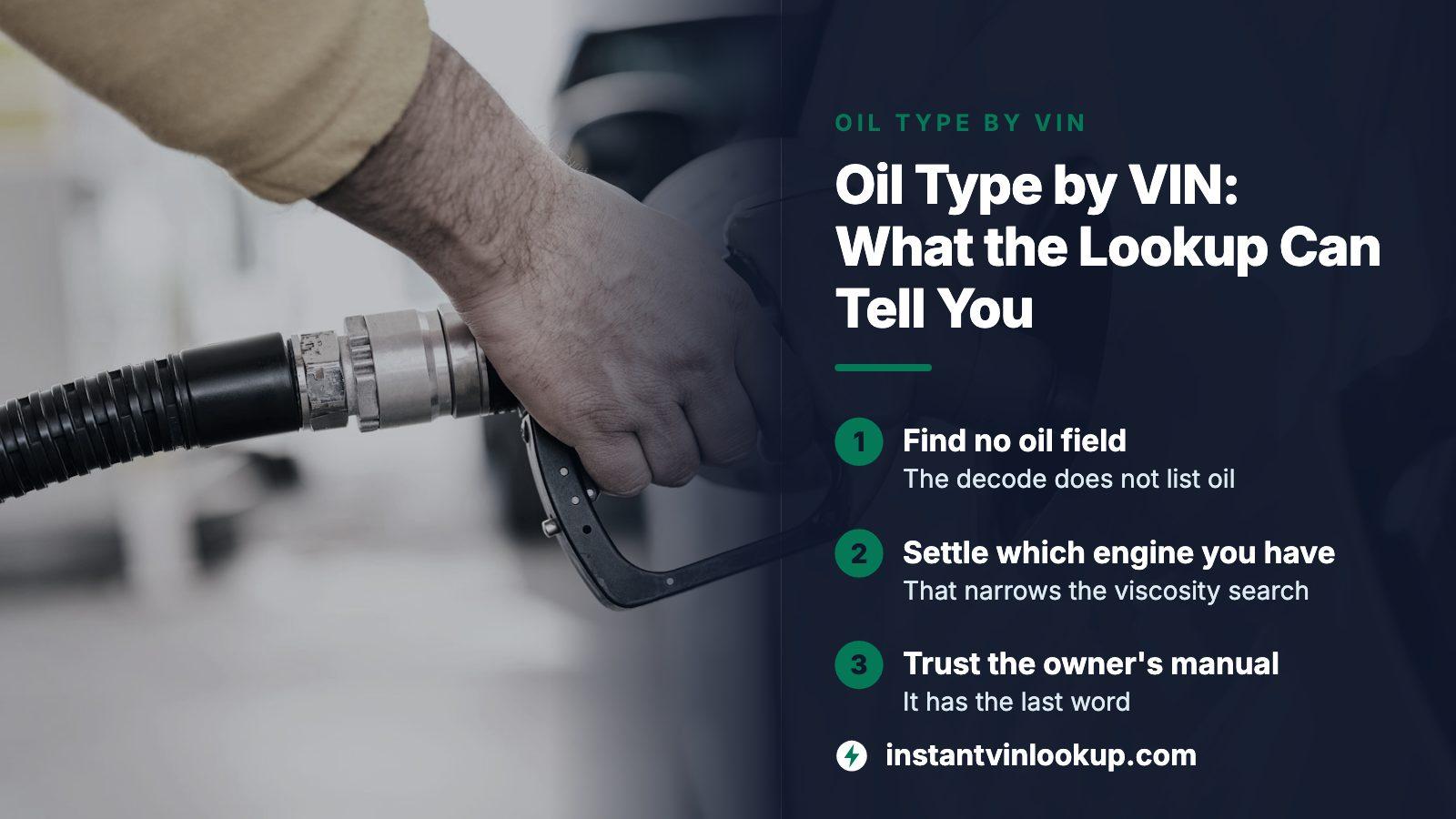
No lookup can read an oil type straight off a VIN, because the federal decode lists build facts and none of them is oil. What a lookup does give you is the exact engine: size, cylinders, fuel and, where the maker reported them, the turbo and injection fields. Carry those to the manual or a dealership parts department, then buy a bottle whose back label shows the grade, the API category and any approval the maker names.
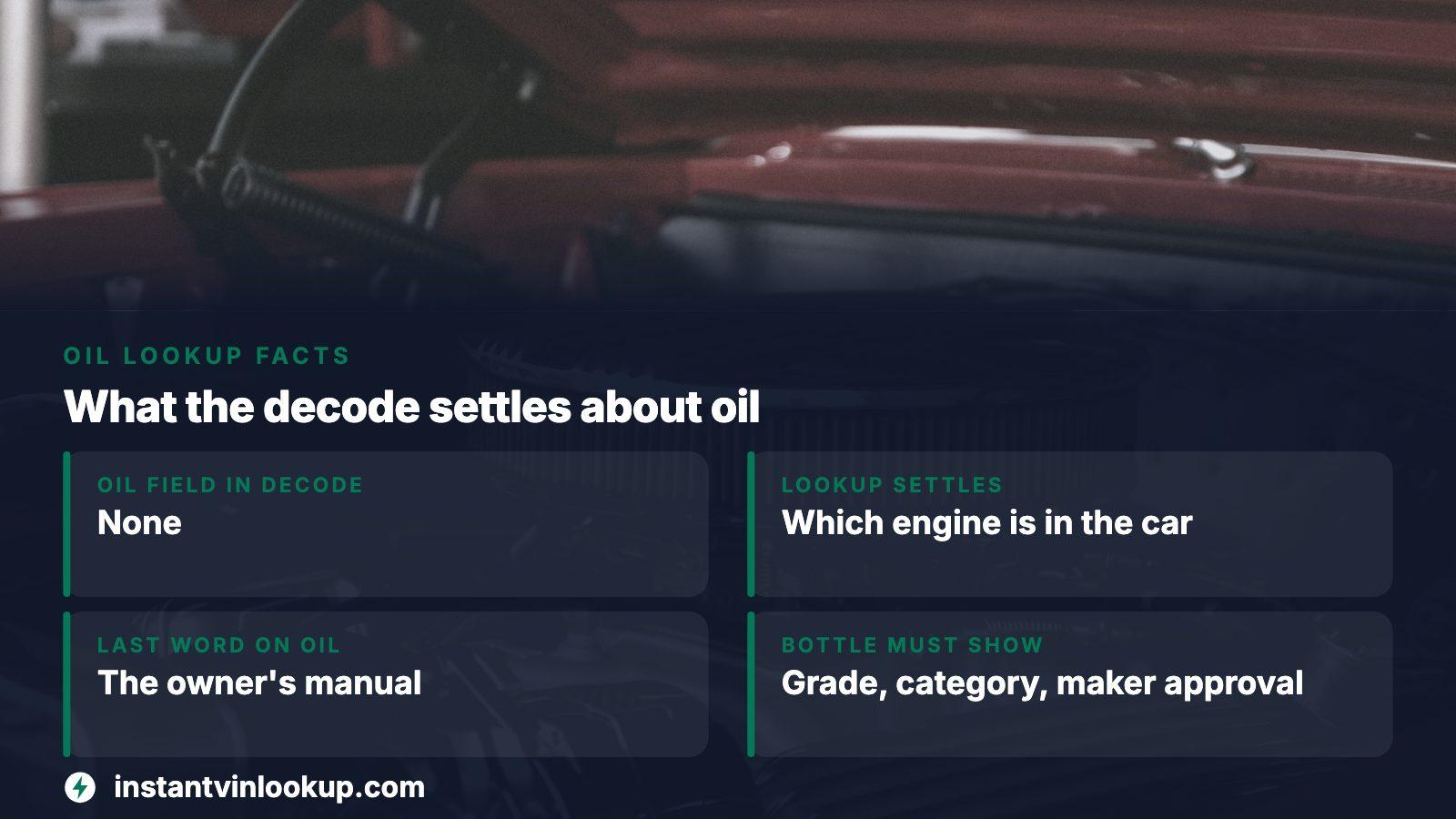
- Oil field in the decode
- None
- What the lookup settles
- Which engine is in the car
- Last word on oil
- The owner's manual
What a VIN decode fills in for the oil question
A decode returns the maker's own build record for the car. The engine block of that record is where an oil search should start, because each field narrows the question even though none of them states an oil.
| Field in the decode | What it tells you | How it helps with oil |
|---|---|---|
| Displacement and cylinders | Which of the model's engines is under the hood | Picks the right engine entry in the manual |
| Fuel type | Gasoline, diesel or another fuel | Shows whether the gasoline categories apply at all |
| Turbo | A yes, or an empty field | Flags an engine where the API category deserves attention |
| Fuel injection type | How fuel reaches the cylinders | Direct injection plus a turbo is the pairing to watch |
| Engine model | The name of the engine family | The phrase to quote at a dealer parts counter |
Why no lookup can print a grade for you
NHTSA's decoder dataset runs to 145 variables. Cylinders, displacement, fuel, turbo and engine model are on the list, and not one entry mentions oil, viscosity or lubricant. The decoder page also says its data is reported by the manufacturer. That fits: a build filing describes hardware, while the oil requirement sits in the maker's service documents, where it can be revised during a model's run.
A site that prints a grade beside your VIN is matching your engine to a catalog entry or a retailer's parts-fit table. The match may be right, or it may reflect what a shop stocks. Treat it as a pointer, not the final word.
Four steps from the VIN to the right bottle
- The VIN is stamped on a small plate at the driver's end of the dash, readable from outside the car, and printed again on the door-pillar label. Your registration or insurance card should carry the same string.
- Run the lookup and note the model year, engine size, cylinder count, fuel, and the turbo and injection fields. Compare the make, model and year it reports with the car in front of you.
- Open the manual to the entry for that engine. With no manual, call a dealership's parts department and give them the VIN.
- Buy a bottle whose back label shows the same viscosity grade and category, plus the maker approval by name if the manual lists one.
The lookup takes seconds. Skip the manual or the phone call and the guess usually falls back on the model name on the trunk lid.

The three requirements a bottle has to meet
- Viscosity grade, such as 0W-20 or 5W-30. It describes how the oil flows when cold and at working temperature.
- API service category, shown as letters in the top half of the round donut symbol. For current gasoline engines the newest is SP, which API began licensing in May 2020.
- Maker approval, a named specification that some manufacturers publish and test products against. Where the manual names one, treat it as a requirement and not a suggestion.
Grade gets checked because it is printed large. API's own advice is to start with the owner's manual. It adds that the newest category carries the properties of earlier ones, so a manual that calls for SN is fully served by an SP oil. Going the other way is where trouble starts: its chart labels older categories for older engines, with SN listed for engines from 2020 and earlier.
Where the category matters most: turbo plus direct injection
Some gasoline engines suffer low-speed pre-ignition, a combustion event that fires ahead of the spark and shows up at low rpm under load. API lists protection against it among the jobs SP was built for, next to timing chain wear and deposits on pistons and turbochargers.
This is where the turbo and injection fields earn their place. A yes in the turbo field, or a direct-injection entry, puts the engine in the group where matching the category is not optional.
A blank field is not a no
Those fields depend on what the maker reported, and some decodes leave them empty. If the car is turbocharged but the field is blank, rely on the engine model name and the manual, not on the empty box.
What the wrong grade costs at the pump
FuelEconomy.gov puts a number on it. Running the grade the maker recommends is worth about 1% to 2% of gas mileage. Fill a 5W-30 engine with 10W-30 and you give up that much; fill a 5W-20 engine with 5W-30 and the loss runs from 1% to 1.5%. The same page suggests looking for the words Energy Conserving on the API symbol.
A percent or two is small on one tank but repeats on every tank, and it is the mildest reason to use the grade written in the manual.
Red flags when the result and the car disagree
- The make, model or year is not your car. A mistyped character can decode a different vehicle, NHTSA's tool accepts partial VINs, and a year typed into its form overrides the year in the VIN.
- The engine size differs from what the manual lists. A decode shows what left the factory, so a replacement engine would not appear in it.
- The turbo and injection fields are empty on a car you know is boosted. Go by the engine model name instead.
- Two sites name two different oils. Usually one matched the wrong engine of the same model year, or quoted an older recommendation.
If any of these shows up, settle which engine you have before buying a single bottle.
Buying used with no oil-change records
No VIN lookup can say which oil went into a used car or how often it was changed, and a history report will not list oil changes either. It can still sharpen your questions: odometer readings show how far the car drove between entries, and a front-end collision is a reason to ask what was replaced afterward.
With no paperwork, change the oil and filter soon after purchase, using the grade and category in the manual. You then know what is in the pan, and every interval after that starts from a known point.
What the preview shows and what the report costs
Preview first: no payment is asked for at that stage, and you learn whether the VIN has anything on file. The report itself is paid once per vehicle, with a three, five or ten pack for anyone shopping around, and it never turns into a recurring bill. Current figures are listed on the pricing page.
Engine details sit in the factory-spec part of the report, beside the history records. Enter the VIN, confirm the engine, and only then go looking for the specification.
Where this information comes from
- NHTSA: VIN decoder (vPIC) — Shows that decoder data is reported by the manufacturer, that partial VINs are accepted and that a typed year overrides the VIN's year.
- NHTSA: vPIC API — The variable list behind the decode, including the engine, turbo and injection fields and no oil field.
- API: Oil categories — What SP is designed to protect against, which categories fit older engines, and API's advice to start with the manual.
- API: Latest oil categories — Start of SP licensing and where the category and Resource Conserving wording sit on the donut.
- FuelEconomy.gov: Keeping your car in shape — The mileage effect of using the wrong grade, with the two worked examples.
Sources and photos: Facts checked against the sources above in November 2026. Photos by engin akyurt, Dylan Michaud and Victor Hughes on Unsplash; diagrams by InstantVINLookup.
Keep reading
- VIN Lookup: Check a VIN Number on a Car Before You BuyHow to run the lookup and what the free preview shows.
- Where Is the VIN Number? Find It in a Minute, Then Verify ItLocate the 17 characters on the car before you type them in.
- Coolant Type by VIN: What an Instant Lookup Does and Does Not Tell YouThe same engine-first route for the other fluid a decode cannot name.
- Transmission Fluid by VIN: What an Instant Lookup Shows and Leaves OutGearbox fluid follows the same path from engine ID to manual.
Frequently asked questions
Can I find my oil type with just the VIN?
Not directly. The decode lists build facts such as engine size, cylinders and fuel, and has no oil entry. It does confirm which engine you have, and the oil requirement is tied to that engine. Take the result to the owner's manual or a dealership parts department for the actual specification.
Is 5W-30 or 0W-20 right for my car?
Whichever grade the manual lists for your engine. FuelEconomy.gov notes that using a different grade can cost a percent or two in mileage, and the category and any maker approval on the label matter as much as the grade.
What does API SP on a bottle mean?
SP is an API service category for gasoline engines, licensed since May 2020. API says the category was built to guard against low-speed pre-ignition, timing chain wear and piston and turbocharger deposits, and that an SP oil fully serves a manual calling for the older SN category.
Does a VIN lookup show whether my engine is turbocharged?
A decode has a turbo field and a fuel injection field, but both depend on what the maker reported, and some decodes leave them blank. A yes is useful. An empty box proves nothing, so check the engine model name or the manual before assuming the engine is a plain one.
Will a vehicle history report show when the oil was last changed?
No. A report is built from reported events, and routine oil changes are not among them. It can still show odometer readings and damage records that guide your questions. Start with the preview, which is free; the pricing page shows what a full report costs.
Now check the car itself
The guide explains what to look for. The report shows what this VIN has on record.