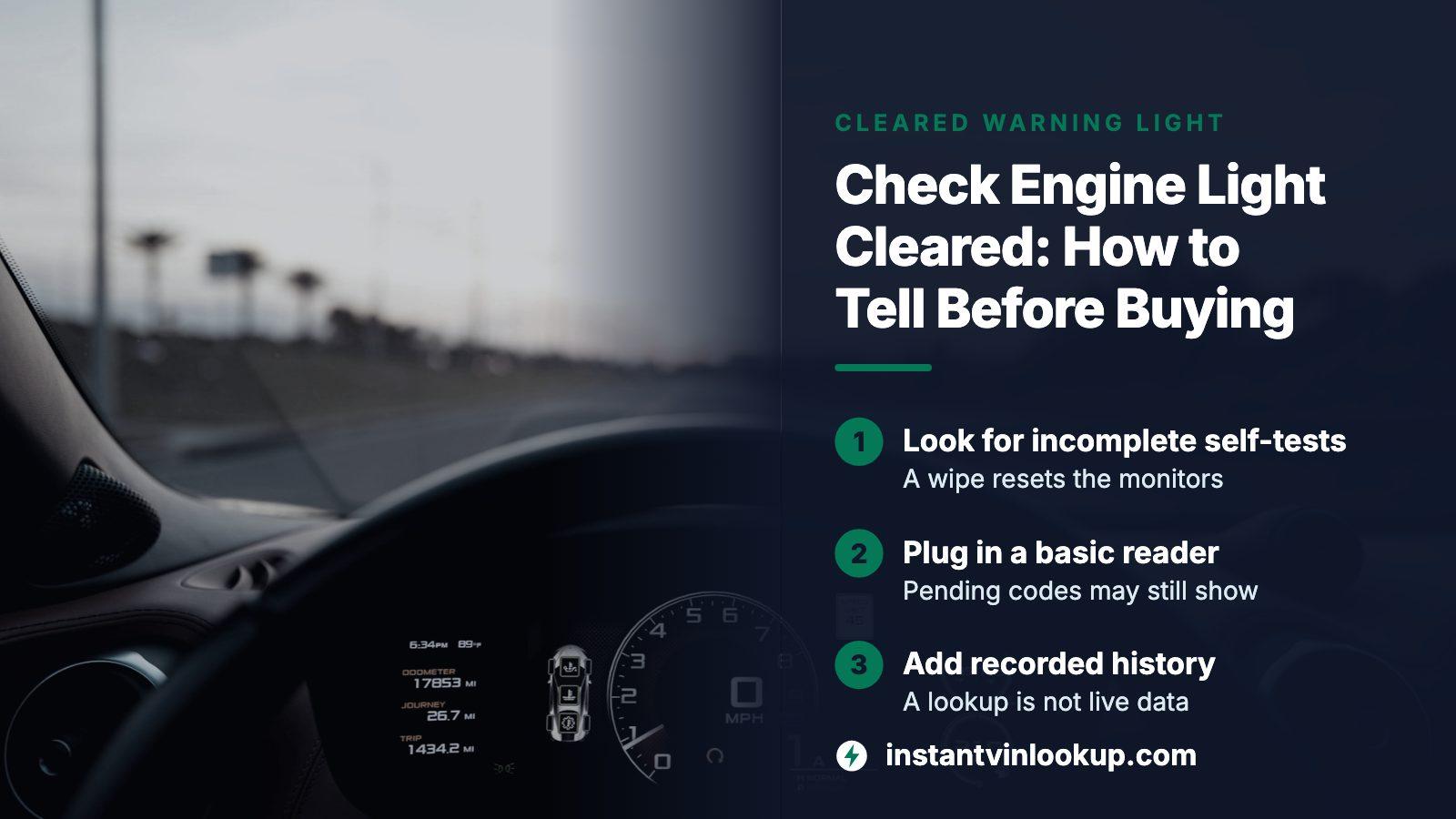
THE SHORT ANSWER
Usually yes, a cleared light leaves a trace. Erasing the codes, by scan tool or by disconnecting the battery, resets the emissions self-tests to incomplete until the car has been driven enough to rerun them. A reader on the diagnostic connector lists which tests are unfinished. That shows the memory was wiped recently, not why. A VIN lookup adds reported crashes, mileage readings, title brands and recalls, which no reset touches.
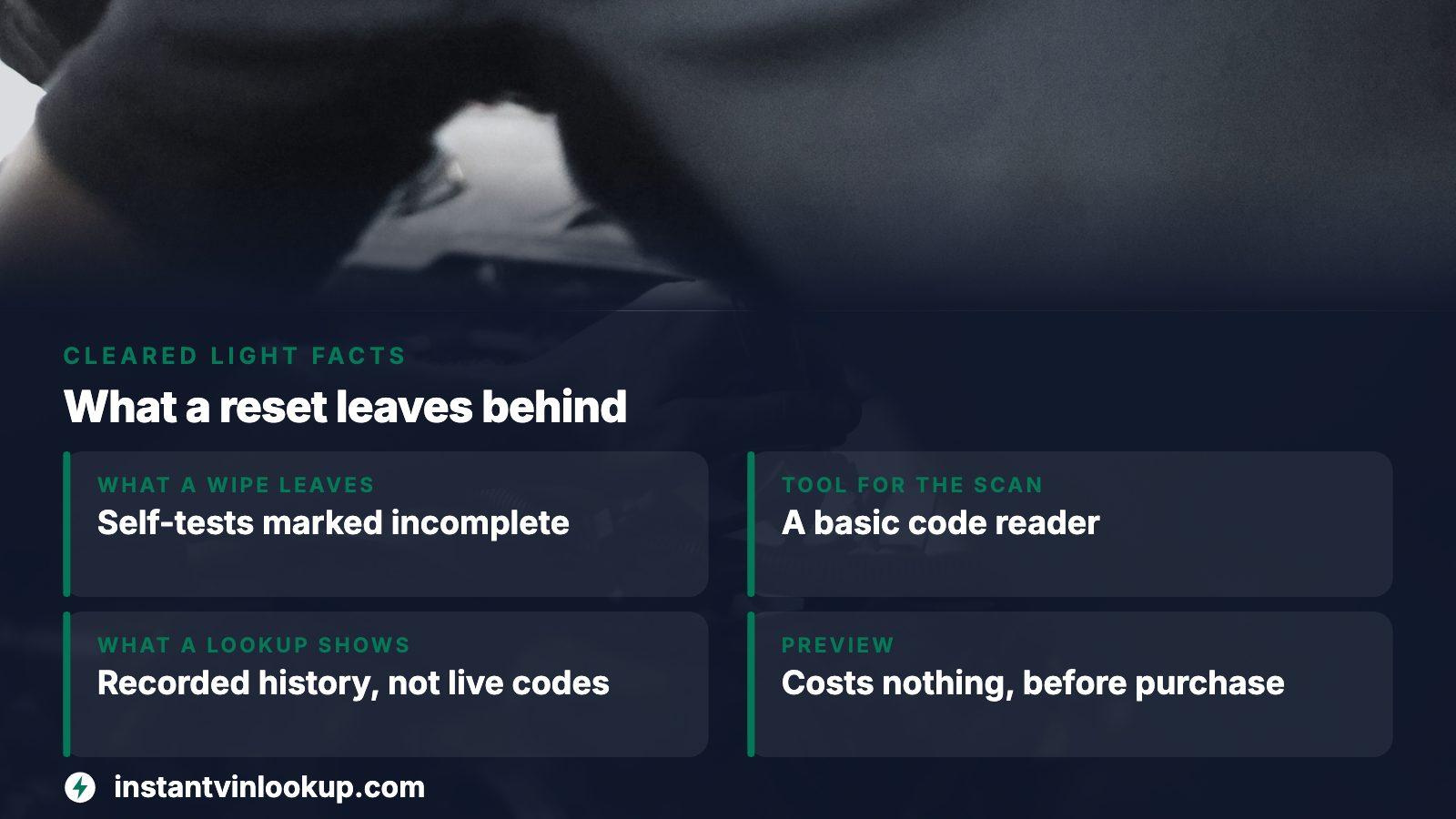
- What a wipe leaves
- Self-tests marked incomplete
- Tool for the scan
- A basic code reader
- What a lookup shows
- Recorded history, not live codes
- Preview
- Costs nothing, before any purchase
What a reset changes inside the car
A fault code lives in the engine computer's memory. Erase it, with a scan tool or by pulling a battery cable, and the lamp goes dark at once. The same wipe sends the computer's emissions self-tests back to incomplete. Those tests only run while the car is driven under particular conditions, so a second wipe does nothing to help: the unfinished status has to be driven off.
That is the trace. A dark dashboard together with a list of unfinished tests is not how a car in ordinary use looks. California's Bureau of Automotive Repair tells owners who disconnected or replaced a battery to drive a week or two before a Smog Check so the monitors can reset, which gives a rough idea of how long a fresh wipe stays readable.
Reading the monitors in a few minutes
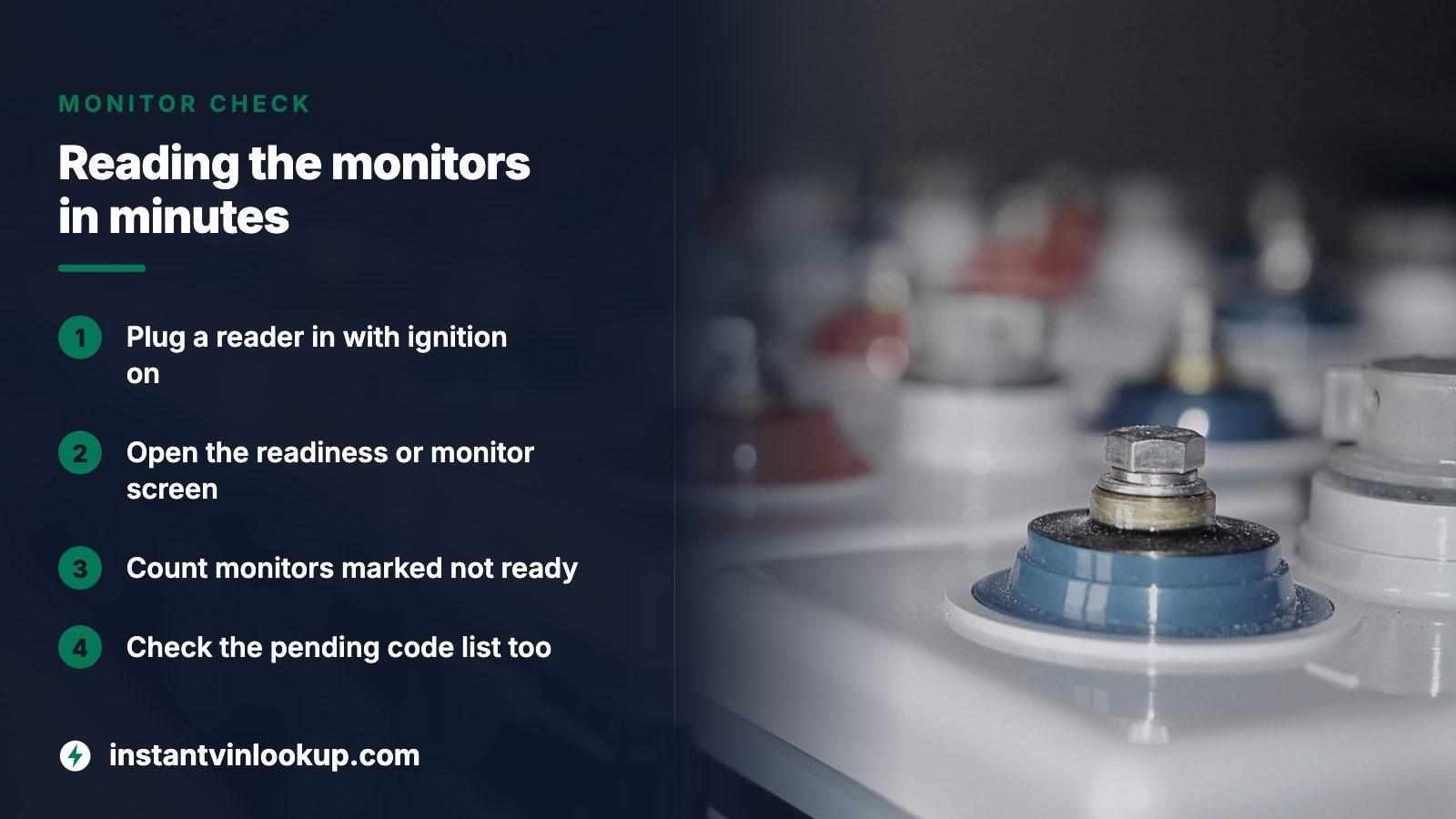
No shop is needed. A handheld reader, or a small adapter that pairs with a phone, shows monitor status. Work through it in this order at the car:
- Turn the ignition on and plug the reader into the connector under the dashboard on the driver's side.
- Open the screen named readiness, monitor status or I/M status.
- Count the monitors marked incomplete or not ready, and write the number down.
- Open the pending list as well. A code that has come back since the wipe says the fault is still there.
- If the reader offers distance or ignition cycles since the codes were cleared, note that too. A figure beats a hunch when you talk price.
From an NHTSA owner complaint
A 2018 Ford Fusion buyer, a self-described retired dealership mechanic, plugged in a scanner when the lamp lit two days after delivery. Besides a stored code, it reported codes cleared 298 miles before the sale. He says the lamp came back later with low coolant, and that the dealer and Ford declined his request for warranty help with the engine.
That mileage figure is what step five is for: a number on a screen instead of a feeling.
How many unfinished tests an inspector tolerates
Federal inspection rules give you a yardstick, even if your state runs no test. They set lines by model year, so a seller who claims the car would pass anywhere is claiming something specific.
| Model year | Turned away under the federal default | Turned away where a state uses the option |
|---|---|---|
| 1996 to 2000 | Any one incomplete test | Three or more incomplete |
| 2001 and newer | Any one incomplete test | Two or more incomplete |
| 1995 and older | Usually no OBD-II readiness data to read | Not applicable |
Under the procedure in 40 CFR 85.2222, a car with unfinished tests is sent off to drive and return, and it fails if the second check still shows them. A fresh wipe tends to leave most monitors incomplete rather than one or two, so it clears every line in the table.
Innocent reasons for the same reading
Hold the number as a question rather than a verdict. A new battery, a repair that ended with a code wipe and a car that barely moves all put the same screen in front of you.
| What you see | A fair reading | What settles it |
|---|---|---|
| Unfinished tests, battery just replaced | A battery change erases the same data | The receipt, or the date on the battery |
| Unfinished tests, recent repair | Many repairs end with the codes erased | An invoice with a date and a description |
| Unfinished tests, car sat for weeks | Little driving gave the tests no chance to rerun | Odometer readings in the history |
| Unfinished tests, no explanation | The one worth pressing on | A second reading after several days of driving |
| All monitors complete, lamp dark | The ordinary result for a car in regular use | Still read the records |
The blunter trick: a lamp that never lights
Some sellers skip the wipe and disable the lamp. Turn the key to on without cranking, and the instrument cluster should light the engine symbol briefly as a bulb test, then drop it once the engine runs.
The federal inspection procedure fails a car whose lamp stays dark in that key position, even when no codes are stored. If the symbol never appears, ask why before you ask anything else. A cluster that stays blank at that moment is not showing a healthy car, only a lamp that cannot report anything.
What a VIN lookup shows that a reset cannot touch
A scan reads the computer's memory, and anyone can wipe that. A lookup reads records that other parties filed about the car, which the seller has no way to reach. Enter the 17-character number here and the free preview counts the records on file before you pay anything.
- Odometer readings by date, to see whether mileage climbs steadily or stalls and drops.
- Crash and damage entries, with auction or salvage photos where they exist. A wiped lamp beside a reported crash raises an obvious question.
- Title brands such as salvage, flood or rebuilt, which move the price whatever the dashboard shows.
- Open recalls, which can explain a symptom no stored code ever mentions.
Neither check replaces the other. A reader never shows history, and a record search never shows live codes.
Reading the scan and the records together
| Scan result | Record result | How to read it |
|---|---|---|
| Monitors unfinished | Crash or damage entry on file | The wipe may follow a repair. Ask for the shop invoice before the price talk. |
| Monitors unfinished | Nothing on file, odometer steady | Often a battery job or a small repair. Ask for the date, then drive the car a few days. |
| Monitors complete | Salvage or flood brand | The tests finished, but the history is the problem. Price the brand, not the lamp. |
| Monitors complete, no codes | Clean history | The best case you can document. Book an independent inspection anyway. |
What to do before you pay
- Put two questions to the seller: when the battery last lost power, and which repairs the car has had recently. Expect dates and paper, not reassurance.
- Offer to return after several days of normal driving. The car sorts out the answer for you.
- Write an independent mechanic's inspection into the deal, and mention to that shop that the monitors read unfinished.
- Run the preview on the VIN while you wait, and the NHTSA recall search as well.
From an NHTSA owner complaint
The owner of a 2012 Chevrolet Equinox told NHTSA the timing chain broke at about 68,000 miles and wrecked the engine. Only afterward, the family says, did they learn the codes had been cleared and the lamp reset shortly before they bought it, although one of their own mechanics had looked the car over and found nothing wrong.
A look-over and a test drive do not reveal a wipe. The monitor screen does, in minutes.
Where registration needs an emissions inspection, a car with unfinished tests cannot complete one yet, and 40 CFR 51.357 treats a late return after rejection as non-compliance. Price that wait in. Opening the full report is one payment, never a subscription; the pricing page lists single reports and packs.
Where this information comes from
- eCFR: 40 CFR 85.2222 — The readiness check, the return-and-retest step, the tolerance for a few unset monitors and the key-on lamp test.
- GovInfo: 40 CFR 51.357 — The federal rejection rule for unset readiness codes, the state option by model year and the duty to return.
- California Bureau of Automotive Repair: Smog Check — Advice to drive a week or two after a battery change so the monitors can reset.
- NHTSA owner complaint 11479868 — owner experience, paraphrased
- NHTSA owner complaint 11349872 — owner experience, paraphrased
Sources and photos: Facts checked against the sources above in November 2026. Photos by Dennis Eusebio, Vanya Smythe and Mustafa Sheikhmouss on Unsplash; diagrams by InstantVINLookup.
Keep reading
- OBD2 Codes Explained, and What an Instant VIN Lookup AddsWhat a stored code records, how to read one and why the lamp matters more than the number.
- VIN Lookup: Check a VIN Number on a Car Before You BuyThe lookup itself: enter the number and see what is on file.
- Airbag Deployed Check: Spot a Hidden Deployment From the VINAnother warning lamp that can be cleared while the records still show the crash.
- PricingSingle reports and packs, with the preview first and no subscription.
Frequently asked questions
How can I tell whether the check engine light was cleared recently?
Usually, yes. A reader on the diagnostic connector shows the monitor list, and a recent wipe leaves several tests marked incomplete until the car has been driven enough to rerun them. The reading shows that the memory was erased, not who did it or why, so use it to put a direct question to the seller.
Will a VIN check show that the light was cleared?
No. A VIN lookup reads records that third parties filed, such as crashes, mileage readings, title brands and recalls. It does not read the car's computer. Use a reader for the codes and monitors, and the lookup for the history behind them.
How long until the monitors read ready again?
It depends on the car and the driving. California's Bureau of Automotive Repair advises a week or two of driving after a battery change. Short trips and older cars can take longer, and a reading still unfinished after that wait deserves a technician's attention.
Does disconnecting the battery cause the same result?
Yes. Cutting power erases the same stored data, so a new battery or a repair that involved disconnecting it can leave the identical unfinished list. That is why the reading is a question for the seller and not proof of fraud.
Can a car with cleared codes pass an emissions test?
Not straight away where inspections check readiness. Under the federal procedure a car with unfinished tests is told to drive and return, and it fails if the second check still shows them. Where a state takes the lenient option, a few unset monitors are tolerated by model year, as the table above shows.
Now check the car itself
The guide explains what to look for. The report shows what this VIN has on record.