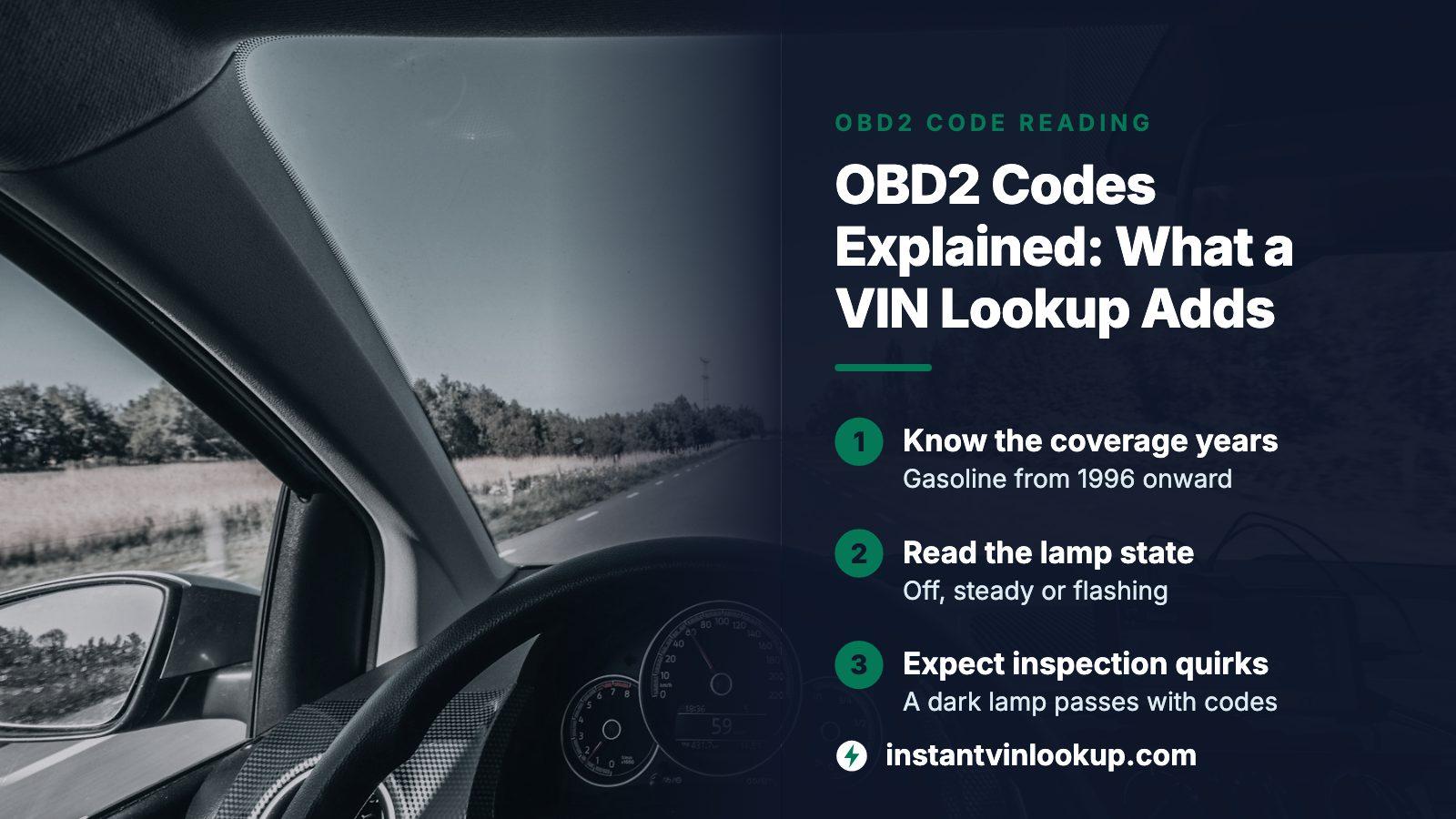
THE SHORT ANSWER
OBD2 codes are fault records stored by the engine computer in gasoline cars from model year 1996 and diesel cars from 1997. Read a code from the left: letter, standard or maker-defined, subsystem, then the exact fault. Urgency sits in the dash lamp rather than the code number. A steady lamp marks a confirmed fault; a flashing one marks a misfire in progress. A VIN lookup cannot read codes, but it shows the recorded history behind them.
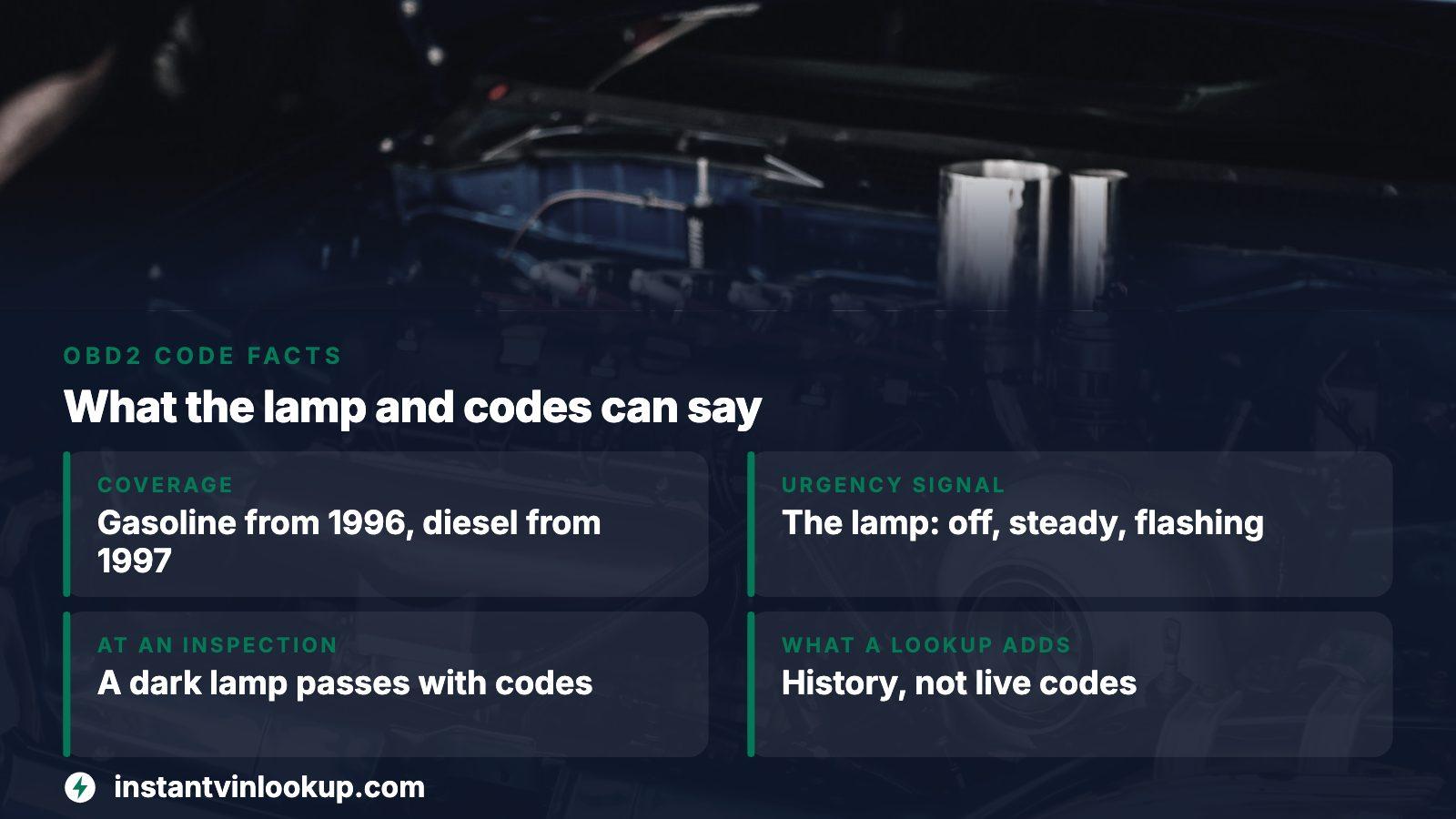
- Coverage
- Gasoline from model year 1996, diesel from 1997
- Urgency signal
- The lamp: off, steady or flashing
- At an inspection
- A dark lamp passes, even with codes stored
- What a lookup adds
- Recorded history, not live codes
What an OBD2 code records, and what it leaves out
Inside the engine computer, monitoring routines run while you drive, each comparing a measurement against a limit. When a reading lands outside its limit, the computer stores a diagnostic trouble code. That is the whole event: a test was failed. The code does not say which component caused the failure.
Take P0420, the catalyst efficiency code. It comes from comparing an oxygen sensor ahead of the converter with one behind it. A worn converter gives that result, but so do a tired sensor, an exhaust leak and a long-running misfire. The computer is reading voltages, not inspecting the converter.
From an NHTSA owner complaint
A 2012 Ford Focus owner told NHTSA in April 2018 that a dealer read P0420, ran a back-pressure test and declared the catalytic converter plugged, a repair the owner puts above $1,700. The owner declined, sought another opinion, and says the real culprit was an evaporative purge valve stuck open. The owner describes the first visit as "incorrectly diagnosed".
One owner's account does not prove a cause, but the habit it argues for is sound: treat the code as the test that failed, and ask what evidence supports any part a shop wants to replace.
Reading a code from left to right
Every code is a letter followed by four digits, and each position narrows the question. The first two characters decide whether an inexpensive reader can tell you anything useful.
| Position | What it tells you |
|---|---|
| Letter | The system family. P means powertrain, the only family an emissions inspector looks at. B, C and U are used for other systems on the car. |
| Second character | Who defined the code. A 0 or a 2 means the industry standard fixes its meaning on every make. A 1 means the manufacturer defined it. |
| Third character | The subsystem inside that family, such as fuel metering or ignition. |
| Last two characters | The specific fault, such as one cylinder misfiring rather than another. |
A popular shortcut says only P0 codes are generic. California's OBD II rule, which federal law adopts, names both P0xxx and P2xxx as standardized and allows P1xxx only as a manufacturer-defined range, with approval. The digit-by-digit tables live in SAE J2012, a paid standard, so check any chart against your car's service information.
The lamp carries the urgency, not the code
No regulation ranks codes from minor to severe. The malfunction lamp carries that signal instead, in three states.
| Lamp | What it means | What to do |
|---|---|---|
| Off | Nothing confirmed is holding the lamp on, though stored or pending codes may exist. | Read the memory anyway if you are buying. |
| Steady | A fault was confirmed and the lamp was commanded on. The rule attaches no deadline to it. | Book a diagnosis. Nothing in the rule marks it an emergency. |
| Flashing once per second | Misfire is occurring right now, at a level the rule links to converter damage. | Ease off the throttle and have the car checked promptly. |
The flash requirement comes from California's regulation. It ties the flash to a misfire in progress, and when the misfire stops the lamp stays lit rather than going dark, since the fault is on record. Cars that cut fuel to protect the converter are exempt from flashing. The rule never tells a driver to stop; easing off is judgment, not law.
A stored code does not fail the smog test by itself
Many owners assume a stored code fails an emissions inspection. It does not. Paragraph (d)(2) of 40 CFR 85.2222 lets a car through the onboard-diagnostic check whenever the lamp is dark, stored codes or not. The inspection asks the computer one question about the lamp; it does not read out the whole memory.
The same rules are strict about the connector: under 40 CFR 85.2207(a), a 1996 or newer vehicle fails if its diagnostic connector is missing. So when a seller says the car passed emissions, hear what that proves. The lamp was dark on test day. It says nothing about stored codes, pending ones or what the memory held last month.
Which cars have OBD2, and how a lookup settles it
Gasoline passenger cars and trucks need the system from model year 1996, and diesel ones from 1997. Nearly every used car clears that bar, but an older truck or project car is worth confirming before you bring a reader to the seller's driveway.
A VIN lookup ties the number to the factory specifications for that exact vehicle, model year and engine among them. That tells you whether the 1996 and 1997 rules apply, and which engine the codes you are about to read describe. A code only makes sense against the right engine.
Reading codes on a car before it is yours
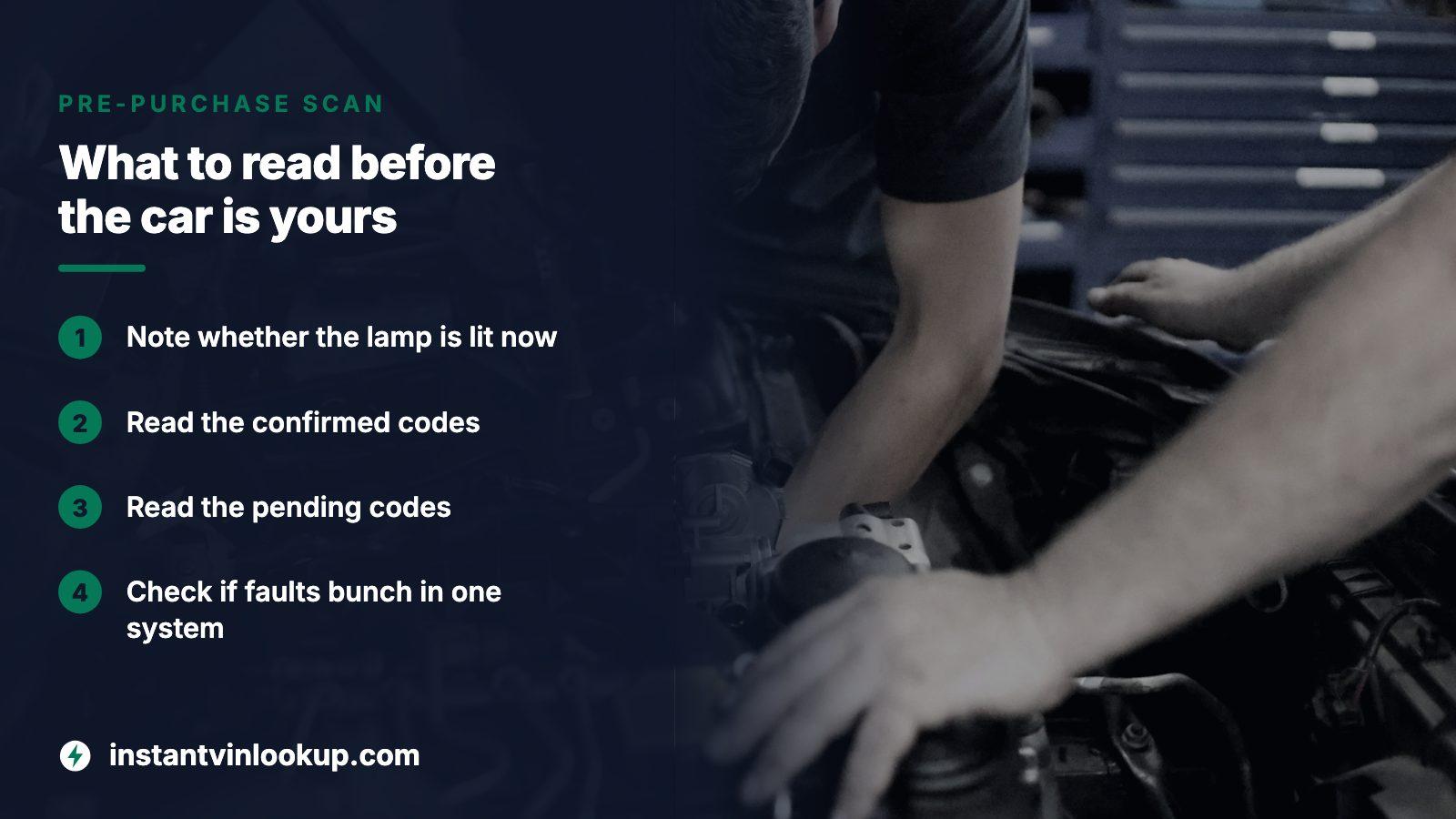
A reader plugged in on a test drive lets a used car report on itself, which is rare. Ask it for four things.
- Whether the lamp is lit right now, the one thing an inspection tests.
- Confirmed codes: faults that failed a monitor more than once.
- Pending codes: faults that failed once and await a second strike. They preview the next lamp.
- Whether the faults bunch up in one subsystem. That pattern tends to mean one underlying problem.
From an NHTSA owner complaint
A 2013 Honda Accord owner reported to NHTSA that the car slowed and stopped at roughly 15 mph pulling away from a stop sign, then shut off. Several warning lamps, check engine among them, stayed lit after a restart. The dealership found no codes tied to those symptoms, but it did find a throttle actuator code, P2176, "stored in history".
The lesson for a buyer: a memory can hold history that neither the lamp nor the active list shows, so ask for stored and pending codes too. A blank memory on a worn older car is odd as well, because a battery disconnect or a deliberate wipe empties it. The page on a cleared check engine light explains what a reset leaves behind.
What the lookup shows that a scan tool never will
A code describes the computer's present state, and a reset can change it. A history record describes events that third parties logged, and a reset cannot touch those. The preview costs nothing and comes first. Opening the full report is one payment, never a subscription; the pricing page covers single reports and packs.
- Odometer readings over time. A mileage that jumps or falls explains codes that do not fit the seller's story.
- Accident, damage and salvage entries, with auction photos where they exist. A crash on file beside a nearly empty code memory raises the question of what was cleared.
- Title brands. A brand plus an unexplained lamp history is a reason to walk away or renegotiate.
- Open recalls. A recall can explain a symptom that a code only hints at.
NHTSA's own recall search by VIN costs nothing and is worth running either way. No report shows live codes, and no scan shows history.
Where this information comes from
- eCFR: 40 CFR 85.2222 — The inspection rule behind the point that a dark lamp passes even with codes stored, paragraph (d)(2).
- eCFR: 40 CFR 85.2207 — The test standard that fails a 1996 or newer vehicle with a missing diagnostic connector.
- California Air Resources Board: Title 13 CCR 1968.2 — California's OBD II regulation: the once-per-second misfire flash, the fuel-shutoff exemption and the standardized versus manufacturer-defined code ranges.
- NHTSA: Recalls — Where a VIN is checked for unrepaired recalls.
- NHTSA owner complaint 11089863 — owner experience, paraphrased
- NHTSA owner complaint 10504876 — owner experience, paraphrased
Sources and photos: Facts checked against the sources above in November 2026. Photos by Sander Jeurissen, Mustafa Sheikhmouss and Willian Cittadin on Unsplash; diagrams by InstantVINLookup.
Keep reading
- Check Engine Light Cleared: How to Tell, and What a VIN Lookup AddsWhat a reset leaves behind, and why an empty code memory deserves a second look.
- VIN Lookup: Check a VIN Number on a Car Before You BuyThe lookup itself: enter the number and see what is on file.
- Sample reportSee a finished report before you decide whether to open one.
- PricingOne report or a pack, with the preview first and no subscription.
Frequently asked questions
Can a VIN check show OBD2 codes?
No. A VIN lookup returns records tied to the number: title, damage, odometer, recall and factory data. Trouble codes live in the car's own computer, and only a reader plugged into the diagnostic port can display them. Use the lookup for the past and the reader for the present.
Can I drive on with the check engine lamp lit?
A steady lamp means a confirmed fault that needs diagnosis, with no emergency written into the rule. A flashing lamp means misfire is happening, and California's Air Resources Board says continued driving could damage other components. Ease off and get it looked at promptly.
Do I need a dealer tool to read OBD2 codes?
Not for standardized codes. Anything beginning P0 or P2 has an industry-defined meaning, so an inexpensive reader can interpret it on any make. A P1 code is manufacturer-defined, and an independent shop may need factory-level information to decode it. Whichever reader you buy, ask it for pending codes as well as active ones.
Can a seller clear the codes before I arrive?
Yes, and a battery disconnect does it by accident. A reset leaves no entry in any history record, so a VIN lookup cannot reveal it. The car itself may give it away: a blank memory on a worn older car, and self-tests that have not finished since. Drive it a while, then read it again.
Does a service reminder mean the same as the check engine lamp?
No. The check engine lamp is an emissions-system warning that regulation defines, and it goes with stored codes. A maintenance light is driven by a distance or time counter set by the maker, has no legal definition and stores nothing.
Now check the car itself
The guide explains what to look for. The report shows what this VIN has on record.