THE SHORT ANSWER
Type in the VIN and the lookup reads whatever factory data NHTSA publishes for that pattern. When a curb weight is on file it appears as a whole number of pounds. When it is not, the field is simply empty. Treat any figure as a model-family reference, then check it against the maker's spec sheet or a scale if the weight matters to your purchase.
- Reported as
- Whole pounds, when on file
- Often missing
- Many sedans return a blank field
- Same truck, same figure
- One number per model-year family
- Not on the door plate
- The plate shows GVWR, not curb weight
What a lookup actually gives you for curb weight
Type the VIN into the search box and the decoder first names the vehicle: year, make, model, body style, engine. Weight sits further down in that same factory record, in the dimension group, as a single integer. A 2023 Toyota Highlander pattern I decoded returned 4515, and a 2022 Ford Escape pattern returned 3884. Those are what the federal database holds, nothing more.
The word curb matters. It means the vehicle as it rolls off the line with standard equipment, a full tank, and every operating fluid topped up, but with no driver, passengers or luggage. NHTSA's own variable description lists oil, transmission fluid, coolant, air conditioning refrigerant and fuel.
Curb weight versus the numbers beside it
Curb weight is what the vehicle weighs empty. The weight rating is the ceiling the maker sets for the vehicle fully loaded. The gap between them is roughly what you can load.
Sample results from real decodes
To see how the field behaves, I ran a set of partial VIN patterns through NHTSA's decoder. Some returned a weight, some did not. The spread below shows why you should read the result as a reference, not a certificate.
| Pattern decoded | Curb weight returned |
|---|---|
| 2022 Ford F-150 crew cab | 6893 lb |
| 2022 Ram 1500 | 6396 lb |
| 2022 Chevrolet Silverado LTD | 5090 lb |
| 2022 GMC Sierra HD | 8353 lb |
| 2022 Ford Transit cargo van | 5533 lb |
| 2022 Jeep Wrangler | 5100 lb |
| 2019 Tesla Model 3 | 4100 lb |
| 2022 Tesla Model Y | 4416 lb |
| 2023 Honda Civic sedan | Blank |
| 2016 Toyota Camry | Blank |
Two of the ten came back empty. That is normal. The decoder's own notice says a missing value means NHTSA has no data for the variable, not that the vehicle lacks the property.
Why two different trucks can show the same weight
Here is the catch that surprises people. I decoded five separate 2022 F-150 crew cab patterns: a 5.0 liter four-wheel-drive, a 3.5 liter four-wheel-drive, and a 2.7 liter two-wheel-drive among them. Every one returned 6893. Engines and drivelines differ in weight, so those trucks cannot all weigh the same on a scale.
What you are seeing is a representative figure attached to the model year, not a measurement of the individual vehicle. For a quick sanity check on a listing, that is useful: a seller claiming a mid-size crossover weighs far more than the decoder says deserves a second look. For anything that needs precision, a trailer hitch rating or a ferry fare charged by weight, it is a starting estimate only.
When the weight field comes back blank
A blank does not mean the VIN is wrong. The decoder can still identify the year, make and engine while having no stored weight. Older cars and some high-volume sedans are the usual gaps. A 2018 F-150 with the 2.7 liter V6 was blank too, even though a 2022 truck of the same name was not.
- Check that all 17 characters were typed correctly, since one wrong character changes the decoded pattern.
- Look at the model year the lookup assumed. The decoder sometimes warns that the year may be off, and the wrong year means the wrong record.
- Try the maker's published specification for that exact trim, which usually lists a weight even when the federal record does not.
- For a hard number, weigh it at a public scale with a full tank and an empty cabin.
How to run the lookup and read the VIN correctly
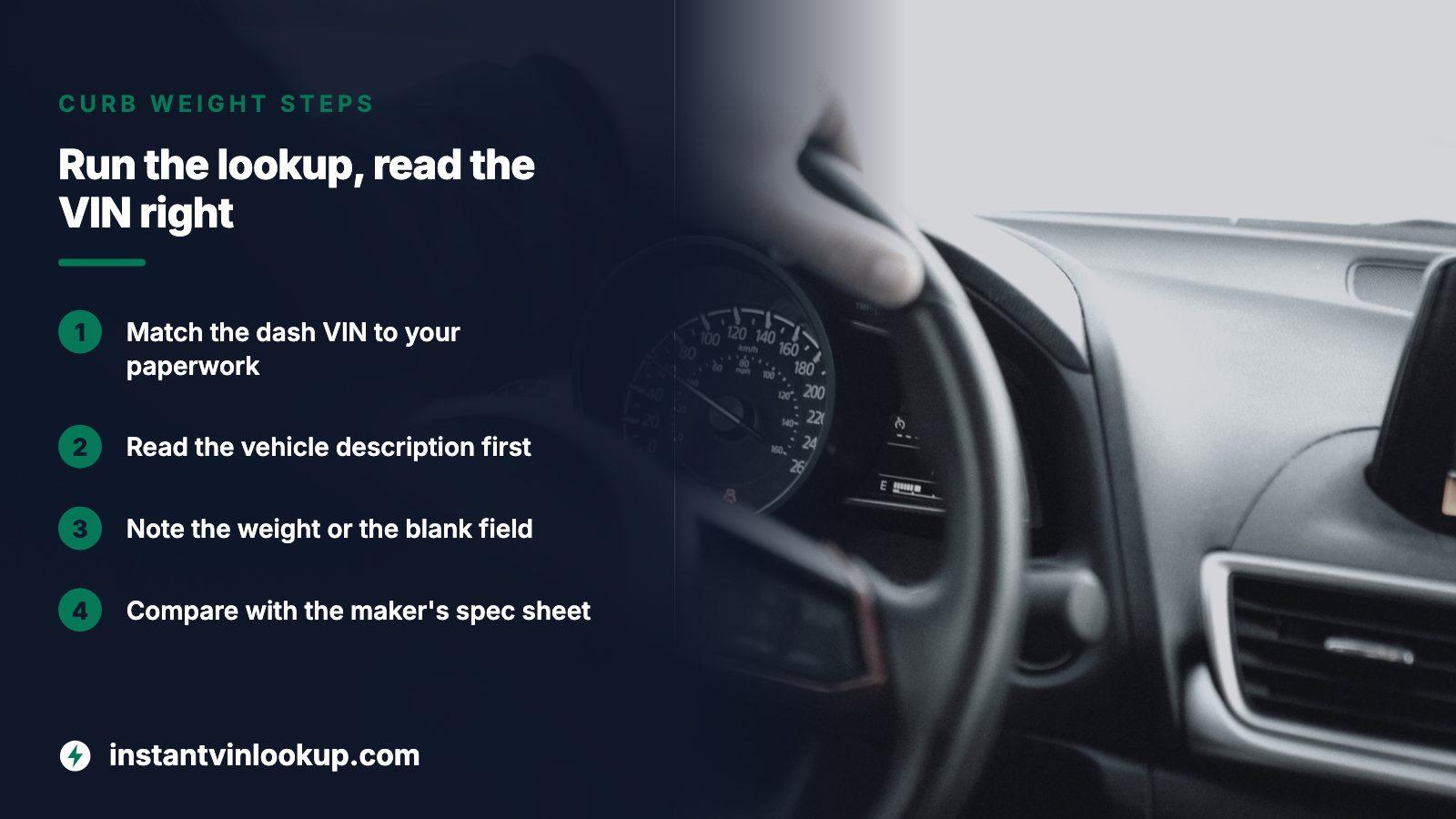
Look through the glass at the lower corner of the dash on the driver's side for the stamped number; the same 17 characters appear on the title, registration and insurance card. Photograph it and read from the photo, because the letters I and O are never used, so a character that looks like one is a 1 or a 0.
- Read the number off the dash and off your paperwork, and make sure the two agree.
- Enter it in the lookup and read the vehicle description first. If the year or engine is wrong, stop and recheck the VIN.
- Note the weight if one is shown, and write down whether the field was blank.
- Compare the figure with the maker's spec sheet for the same trim.
- Run the same VIN through the preview to see what else the record holds.
The door plate will not give you curb weight
Buyers often assume the sticker in the driver's doorway lists the empty weight. It does not. Federal rules make the maker print the weight rating on that label, plus a rating for each axle and the build month and year. The rating is set so that it cannot fall below the vehicle's unloaded weight, the rated cargo, and 150 pounds for every designated seat.
Subtract a believable curb weight from the rating on the plate and the remainder is the load the maker allows. It also exposes a mismatch: if the lookup shows a weight above the rating on the plate, one of the two readings belongs to a different vehicle.
Where a spec lookup stops and a history check starts
A weight figure says nothing about what has happened to the car. Two vehicles with identical specifications can differ by a salvage brand, a rolled odometer or an unrepaired collision. A spec lookup answers what the vehicle was built as. It cannot answer what has been done to it since.
That is where the report from this site earns its place for a careful buyer. Factory specs share the page with title brands, collision damage, mileage readings and open recalls, all keyed to one VIN. If a car was rebuilt after heavy damage, the structure and equipment may no longer match the original weight, and the history is how you would find out.
A practical rule
Use the weight as a consistency check on the listing, then use the history to learn whether the vehicle still matches the description on the day you sign.
When the number really matters
Buyers look up weight for a handful of reasons, each needing a different level of care.
- Towing: you need the maker's tow rating for the exact configuration, not a family figure.
- Garage lifts, trailers and car haulers: the lift or deck rating has to exceed the real weight with margin.
- Registration and fees: some jurisdictions price registration by weight, so ask the motor vehicle agency which weight it uses.
- Electric vehicles: battery packs make them heavy, so a bridge, ramp or parking structure limit deserves a look.
- Shipping: carriers bill by weight, and a scale ticket settles disputes.
Cost and what to do next
The lookup and the history preview cost nothing. Going on to the full report is one payment, with bundles if you are weighing several cars and no recurring charge. Rates live on the pricing page.
If the weight matches the listing and nothing looks odd, open the preview and see what it says about the title and mileage before deciding on the full report. If the weight was blank, do not guess: pull the maker's sheet for the trim, and keep the VIN handy for the history check.
Where this information comes from
- NHTSA vPIC API — The federal decoder behind the sample results, and its definition of the curb weight field.
- 49 CFR 571.3: definitions — Federal wording for curb weight, unloaded vehicle weight and weight rating.
- 49 CFR 567.4: certification label — Where the door plate sits, what it states and the minimum behind the rating.
Sources and photos: Facts checked against the sources above in November 2026. Photos by Zoshua Colah, Miles Loewen and Ilia on Unsplash; diagrams by InstantVINLookup.
Keep reading
- GVWR by VIN: Get the Weight Rating Fast, Then Confirm It on the DoorThe door plate rating that pairs with curb weight, and how a lookup reports it.
- Wheelbase by VIN: Instant Lookup for Any Car or TruckAnother dimension you can pull from the same factory record.
- Drivetrain by VIN: What an Instant Lookup Shows and When It Is BlankFour-wheel drive adds weight, so see what the VIN says about yours.
- VIN Lookup: Check a VIN Number on a Car Before You BuyThe full walkthrough of what a VIN lookup returns.
Frequently asked questions
Can you find the curb weight of a car from the VIN?
Sometimes. The VIN is decoded against NHTSA's database, which stores curb weight in pounds for some vehicles and nothing for others. When a number appears it is a model-family figure. When the field is empty, use the maker's specification for your trim or weigh the vehicle at a public scale.
Why did my VIN lookup return no weight?
The decoder has no stored value for that pattern, which is common for older cars and some sedans. It does not mean the VIN is invalid. Recheck every character, confirm the model year the lookup assumed, then look at the maker's spec sheet for the exact trim you are considering.
Is curb weight on the driver's door sticker?
No. That certification label carries the weight rating, a rating per axle, the build date and the VIN. Curb weight is the empty vehicle. The rating is the loaded maximum. Subtracting the first from the second approximates how much cargo and passengers the maker allows.
Does curb weight include passengers and fuel?
It includes a full tank of fuel and every operating fluid, standard equipment and air conditioning where fitted. It excludes the driver, passengers and cargo. That makes it the lightest realistic weight the vehicle will have on the road, so loaded weight is always higher.
Will a VIN history report show curb weight?
The report lists factory specs for the vehicle, and weight may be among them when the data exists. Its real value is the record behind the specs: title brands, damage, odometer readings and recalls. Run the free preview first to see what it holds for your VIN.
Now check the car itself
The guide explains what to look for. The report shows what this VIN has on record.