THE SHORT ANSWER
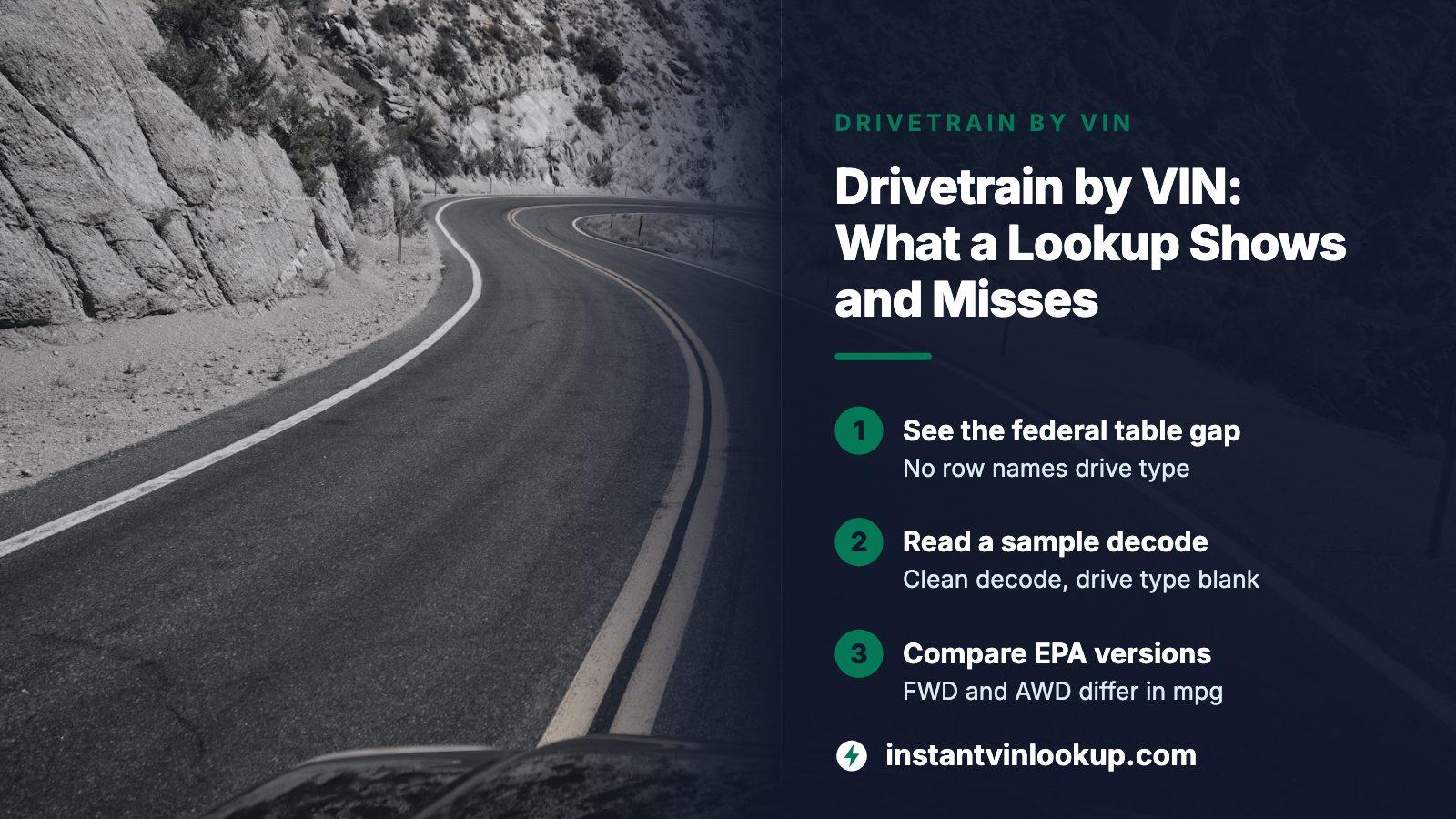
Yes, sometimes. Federal rules list what a VIN must let you work out about a vehicle, and drive type is not on that list. Makers add it voluntarily, so a decode names front-, rear-, all- or four-wheel drive on many cars and returns nothing on others. This site's own sample car, a 2012 BMW 535i, decodes cleanly in NHTSA's tool with an empty drive type. Use the result to shortlist, then check the hardware.
- Federal VIN table
- No row names drive type
- NHTSA decoder, sample car
- Clean decode, drive type empty
- 2019 RAV4, EPA combined
- FWD 30 mpg, AWD 28 (no stop-start)
Why the drive type line is optional by design
A lookup decodes the factory build first: year, make, model, engine and body for nearly every modern vehicle, and the driven wheels for many. That last item is the odd one out, and federal law explains why.
The VIN content rule, 49 CFR 565.15, assigns each class of vehicle a set of attributes that must be recoverable from characters four through eight. For a passenger car the table asks for the model line, the series, the body style, the engine and the restraint devices. No row names drive type for any class. Beyond the required items, the maker picks the characters and their positions, so whatever else gets encoded is voluntary.
Running the check, from the car to the result
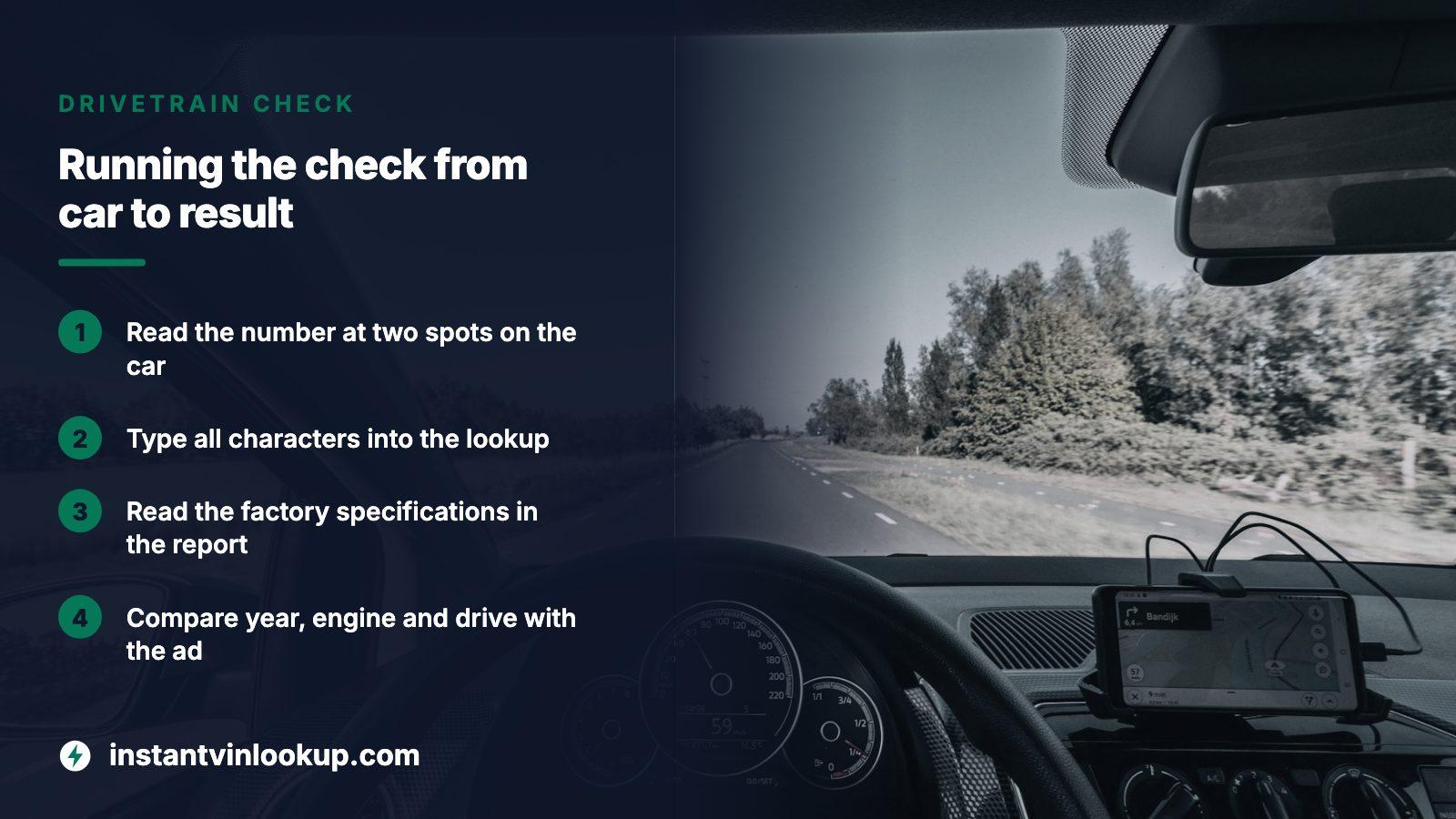
- Read the number off the car in two spots, the dash plate and the door-frame label, and photograph both. They must match character for character.
- Type all 17 characters into the lookup box. The preview costs nothing and tells you how many records exist for that vehicle.
- In the report, read the factory specifications. A drive type shows there when the maker encoded one; copy the wording as printed.
- Hold year, engine, body and drive type up against the ad. A mismatch is a finding. A blank is only a gap.
- Search NHTSA's recalls with the same 17 characters, since drive type can decide whether a campaign applies.
Four results you may see, and what each one means
| What the line says | What it usually means | Your next move |
|---|---|---|
| A drive type matching the ad | The maker encoded it and the seller read it correctly | Glance underneath anyway; it takes a minute |
| Nothing at all | The maker left drive type out of its VIN pattern | Read it off the hardware and the manual; a blank is no warning |
| Different words from the ad | Two tools with two vocabularies, such as 4x2 and front-wheel drive | Compare the cars, not the labels |
| A drive type that contradicts the car | One pattern may cover several builds, or the ad is wrong, or the car was altered | Believe the hardware, then ask the seller to explain in writing |
Only the last row needs action before money changes hands.
Why NHTSA's decoder returns a blank on an ordinary car
NHTSA's vPIC page says the catalog rests on VIN patterns that manufacturers file with the agency and covers model years from 1981 on, for the U.S. market. Its drive type field accepts FWD, RWD, AWD, 4WD/4x4, bare axle codes such as 4x2 and 6x4, a 2WD/4WD value and Other.
A slot is not a guarantee. This site's sample vehicle, a 2012 BMW 535i six-cylinder sedan, decodes cleanly on the federal tool, check digit included, yet the drive type comes back empty. The car is fine and so is the tool. That field simply has nothing in it for this VIN.
Four-wheel, all-wheel and the labels between them
NHTSA lists AWD and 4WD/4x4 as separate choices. EPA's vehicle data splits them further: part-time four-wheel drive, a combined four-wheel-or-all-wheel value and all-wheel drive each get an entry, and a footnote admits that EPA did not distinguish all-wheel from four-wheel drive before model year 2010.
Mechanically, all-wheel drive generally stays engaged without any input. The older four-wheel-drive layout waits for the driver to engage it, with a transfer case that often adds a low range. Makers blur the terms, so judge the hardware, not the badge on the tailgate.
Confirming the drivetrain with your own eyes
- Behind the rear bumper, a housing at the middle of the axle fed by a shaft from the gearbox means the rear wheels receive power. A plain beam or trailing arms means they do not.
- Behind the gearbox, a second casing with an output toward the front axle is a transfer case. A 4H and 4L selector in the cabin points the same way.
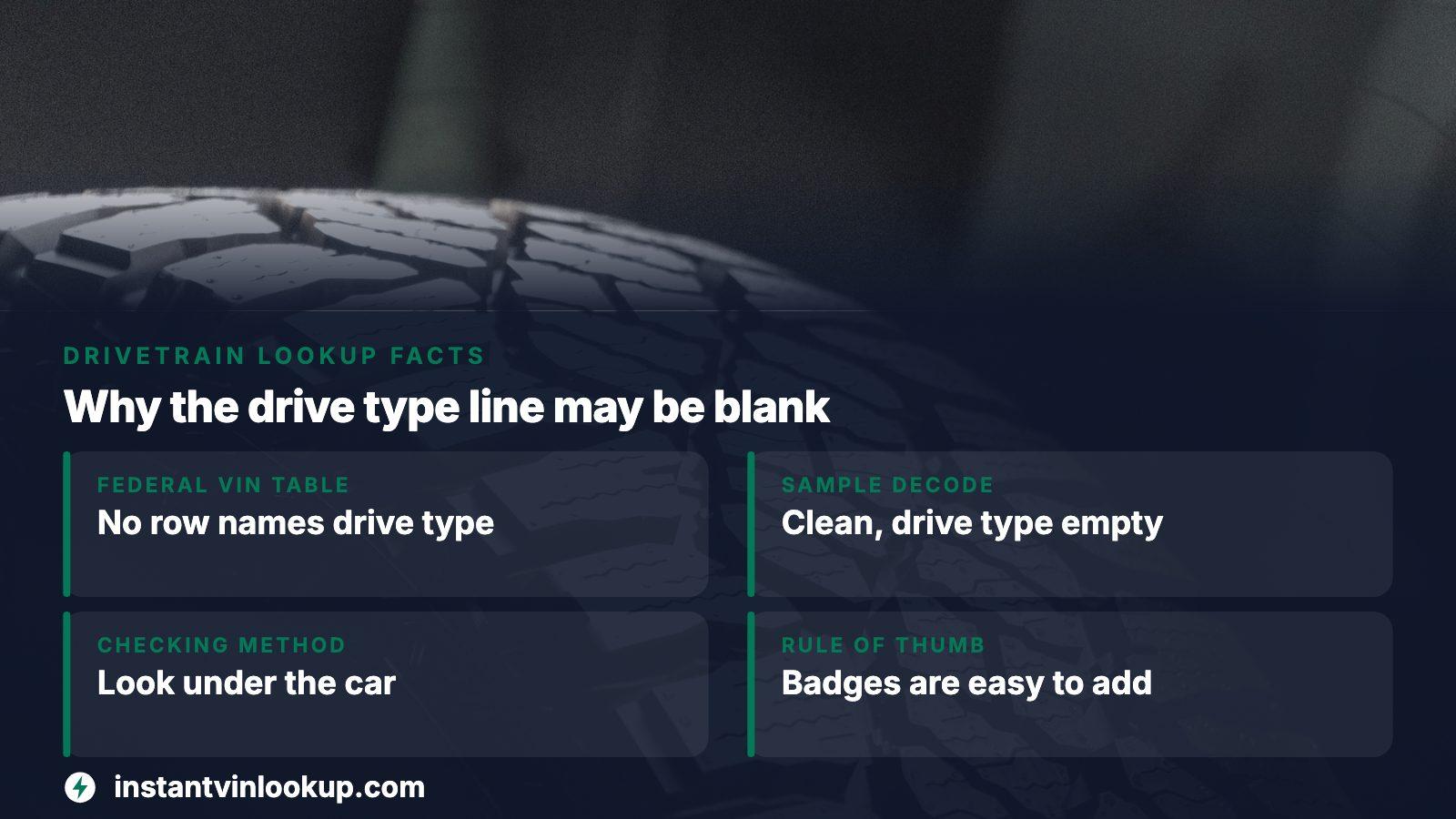
- Trim badges are easy to add or peel off, so when badge and hardware disagree, the hardware wins.
- The owner's manual tire pages often say to keep all four tires matched, a hint that the car drives all four wheels.
When the decode and the car disagree, trust the car. A decode describes a pattern, and one pattern can span several builds.
What the drive type does to running costs
Drive type is a spec with a price. In EPA's records for the 2019 Toyota RAV4, the front-wheel-drive version and the all-wheel-drive version share a 2.5 liter engine and an eight-speed automatic, yet the first is rated at 30 mpg combined and the second, without stop-start, at 28. Other costs follow the hardware:
- Tires: many all-wheel-drive systems want four tires worn evenly, so one ruined tire can mean buying a set.
- Fluids: transfer cases and extra differentials hold oil that a two-wheel-drive car never needs changed.
- Towing behind a motorhome: whether a car can roll on all four wheels depends on its drivetrain.
From an NHTSA owner complaint
The owner of an all-wheel-drive 2014 Jeep Grand Cherokee reported that the transfer case broke while driving. A representative of the maker blamed tires whose tread depths differed by more than 3/32 of an inch, and the company paid part of the repair. The owner still called it a safety issue.
The takeaway: on an all-wheel-drive car, ask for the tire receipts and measure the tread on all four before you buy.
When the drivetrain decides a recall or a breakdown
A recall can hinge on drive type. NHTSA's list for the 2016 Dodge Charger holds two driveshaft campaigns. Number 17V097000 covers certain 2014 to 2017 Chargers and Chrysler 300s with all-wheel drive, where front driveshaft bolts can work loose. Number 18V281000 covers certain 2015 to 2018 pursuit Chargers with all-wheel drive and a V8, where a joint may seize or crack. Both require all-wheel drive, so a rear-wheel-drive Charger sits outside the two.
From an NHTSA owner complaint
A 2013 Ford Explorer owner described the SUV lurching on the road, then leaking oil. The shop reported that a driveline unit needed repair and that the transfer case was full of metal shards, and a mechanic judged the SUV unsafe to drive.
The takeaway: lurching plus an oil leak near the middle of the drivetrain calls for a tow truck, not a test drive. Ask for driveline service records before buying one.
What the lookup costs and what the report adds
The preview is free, and the report is a single payment with no renewal, whether you take one or a larger pack. Amounts are on the pricing page. NHTSA's decoder and recall search cost nothing, so use them first.
A drivetrain line says nothing about history. A car sold as all-wheel drive can still carry a salvage brand, an odd odometer record or damage on file, which the report's title, damage and mileage entries exist to show. It holds only what someone reported, so a mechanic's inspection still comes first.
Where this information comes from
- 49 CFR 565.15: VIN content requirements — the table of attributes a VIN must make decipherable, with no row for drive type
- NHTSA vPIC: VIN decoder — describes the decoder's manufacturer-reported data and its model year and market limits
- NHTSA vPIC API: Drive Type values — the entries the federal drive type field can hold, from FWD and AWD to bare axle notation
- EPA fueleconomy.gov: web services data fields — defines the drive field and carries the footnote on all-wheel versus four-wheel drive before 2010; its vehicle records hold the RAV4 ratings
- NHTSA recalls data: 2016 Dodge Charger — the two driveshaft campaigns that name all-wheel drive
- NHTSA owner complaint 11063352 — owner experience, paraphrased
- NHTSA owner complaint 11291237 — owner experience, paraphrased
Sources and photos: Facts checked against the sources above in November 2026. Photos by Will Truettner, Sander Jeurissen and Rob Wingate on Unsplash; diagrams by InstantVINLookup.
Keep reading
- VIN Lookup: Check a VIN Number on a Car Before You BuyHow the lookup works and how to read a full result.
- Transmission by VIN: What an Instant Lookup Shows for Your CarThe neighboring spec: what a decode says about the gearbox.
- Where Is the VIN Number? Find It in a Minute, Then Verify ItFind the number on the car before you decode it.
- 2016 Dodge Charger Recalls: Instant VIN Lookup by CampaignA worked example of drivetrain deciding which recalls apply.
Frequently asked questions
Can I tell if a car is AWD or 4WD from the VIN?
Often, though never by requirement. A decoder names the drive type only if the maker built it into the number, so you may see AWD, 4WD, front-wheel drive or nothing. Treat the lookup as the claim, then confirm it under the car and in the owner's manual.
Why is drive type blank in the NHTSA decoder?
The federal table of VIN attributes omits it, and the tool reports only what the maker's pattern provides. The sample car on this site returns an empty field on an otherwise clean decode. A blank is a coverage gap, not a sign of damage or a mistyped VIN.
What does 4x2 mean in a VIN decode?
It is older axle notation: four wheel positions, two of them driven. It does not say which pair, so it can describe a front-wheel-drive car or a rear-wheel-drive pickup. NHTSA's list carries 4x2 beside FWD and RWD, which is why two tools can word one vehicle differently.
Does 4x4 mean the same thing as all-wheel drive?
Not always. NHTSA keeps AWD and 4WD/4x4 as separate entries, and EPA separates part-time four-wheel drive from all-wheel drive. Look for a transfer case and a 4H and 4L selector, since a label alone cannot tell you which system sits underneath.
Do I need a history report just to check the drivetrain?
No. The decode, the owner's manual and a look underneath settle drive type. A history report answers another question: whether the car has a salvage brand, damage records or odd odometer readings. See the preview first, which is free, then buy the full report for a car that has passed your first screening.
Now check the car itself
The guide explains what to look for. The report shows what this VIN has on record.