THE SHORT ANSWER
You cannot get a key code by VIN from any public lookup, this one included. The VIN sits where anyone can read it through the glass, so a code that followed from it would work as a key to every parked car. Dealers and registered locksmiths obtain codes through manufacturer channels once ownership and identity check out. A lookup gives you the decoded build, open recalls and a preview of the car's records.
- Key code from a lookup
- Not available to the public
- Who releases it
- A dealer or a registered locksmith
- Jobs behind one new key
- Cut, chip, immobilizer
- Preview
- Shown first, before any purchase
What an instant lookup returns, and the one thing it leaves out
Enter a VIN and the first thing back is the car itself: year, make, model, engine and other factory details decoded from the 17 characters. The same number can be run against open recall records and, in a history report, against what agencies and insurers have filed on the vehicle. A key code is not on that list.
| What you want | From a VIN lookup? | Where it comes from |
|---|---|---|
| Year, make, model, engine | Yes | Decoded from the number |
| Open safety recalls | Yes | Federal recall records |
| Theft, title brand, odometer, insurance entries | Yes, in the report | Agency and insurer filings matched to the VIN |
| The key code | No | The manufacturer, via a dealer or registered locksmith |
Why the number on the dash cannot double as a key code
Under the federal VIN standard, the number has to be visible through the glass, from a spot outside the car beside the driver's side pillar, with nothing opened or moved. Every parked car shows its number to anyone walking past.
Now picture a code that could be worked out from that number. The digits the law makes public would double as the credential for making a key, and a lookup that handed it over would be cutting keys for strangers' cars. The restriction is the design, not red tape.
Cut, chip, immobilizer: what a new key really involves
People say a new key as if it were one purchase. On many recent cars it is three jobs, and a quote only makes sense once you know which ones you need.
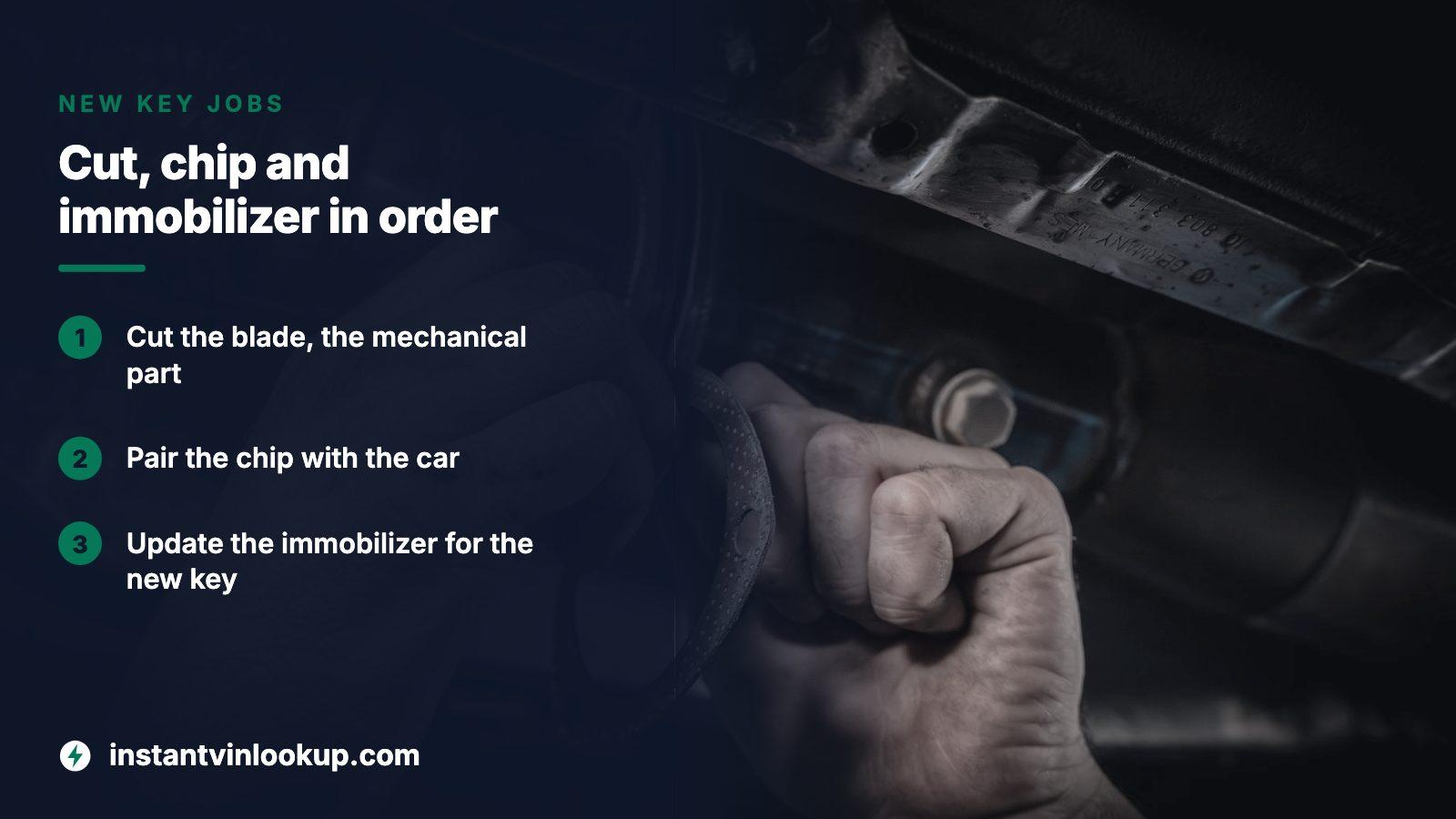
- Cutting the blade. The mechanical part, copied from an old key or, when none exists, made from the code. The code serves this step and no other.
- Pairing the chip. The transponder inside the key must be registered with the car, which takes diagnostic equipment and sometimes manufacturer security access.
- Updating the immobilizer. Adding a key is one operation and wiping the keys that should stop working is another. The second matters if a key was lost rather than broken.
A spare copied from a key you hold usually needs the first two jobs. Losing every key needs all three, with the code behind the first.
Who can release the code, and how to check them first
Two doors lead to a code. One is a dealer franchised for the make. The other is an independent locksmith holding a vehicle security credential, who draws on the manufacturer's own channels. Both verify you before releasing anything.
NASTF, the industry task force for automotive service, keeps the registry behind the second door, and anyone can search it by business name or registry ID. Do that before you hand over a VIN, a title and an address. A professional who does this work has the ID ready.
From an NHTSA owner complaint
In a 2022 filing, the owner of a 2010 Chevrolet Malibu bought in December 2018 described two early lockouts by the anti-theft system and, by about 77,000 miles, more than ten activations in three months. The step taken was a Chevrolet dealership, which "recut keys from the vin number". The complaint does not say what paperwork the dealer asked for, or whether the lockouts stopped.
The takeaway: a key recut from a VIN is real, but the door to it is the dealer's counter, not a web form.
What to bring so the request is not turned down
Both routes want proof of two facts, ownership and identity, in documents rather than explanations.
- The title in your name, or a current registration
- Photo ID matching the name on that document
- The car itself, or its verified location, since the work is normally done at the vehicle
- Written authorization plus the owner's papers, if the titled owner is not the one at the car
A recent purchase with the title still in the mail is a common snag. Mention it on the first call, so the technician arrives knowing.
Reading a key quote line by line
Quotes vary because they bundle different work. Ask for the figure split into parts, so a second shop can be compared.
- The key itself, which costs less as a plain blade, more with a chip and more again as a proximity fob
- Originating the cuts from the code, charged when there is no original to copy
- Programming labor and the equipment behind it
- Travel to the car, or a tow if it will not move
- Immobilizer work beyond adding one key, including removing the old ones
From an NHTSA owner complaint
A 2023 complaint about a 2010 Nissan Altima says the car starts only with its fob and the trunk opens only with it too. The owner reports the manufacturer was unhelpful about a backup fob and named a price of over $300 for a replacement, and calls that a safety problem for anyone stranded without one.
Ask what a spare costs before you buy a car that depends on one fob.
Signs a website selling codes by VIN is not what it claims
Some pages promise a code for a VIN and a payment. The genuine process asks more of you, not less, so the warning signs are about someone asking too little.
- A code offered from the VIN alone, with no check that the car is yours
- A request to email a photo of your title and ID to an address you cannot verify
- An offer to skip the paperwork for an extra fee
- No business name, or a refusal to give a registry ID when asked
The ordinary pattern looks different: documents requested, the job declined if they do not establish ownership, and a listing in the registry under the name given.
Buying a used car with one key: run the lookup first
This is where an instant lookup earns its place. A seller with a single key has told you something about the car, so find out what before talking price. Enter the VIN for the free preview and read it against the seller's story. The decoded year, make and trim also let you describe the car accurately when a locksmith quotes a spare.
A missing key is a fair reason to check theft and total-loss records first, though not proof of anything. NICB's VINCheck screens for those at no charge. Then read the title brands, odometer readings and insurance records, since the car's record and the seller's account should agree. If the preview turns up records that matter, the full report is paid for once and does not renew.
At the car, ask how many keys it has ever accepted and who is holding them. Re-keying the immobilizer so that only keys in your hands still work is sensible on a car you intend to own for years. And if you already own a car with one working key, get a duplicate cut before it goes missing, while the job is a copy rather than an origination.
Where this information comes from
- eCFR: 49 CFR Part 565, Vehicle Identification Number requirements — The federal rule on where the VIN must sit so it can be read from outside the vehicle.
- NASTF: Vehicle Security Professional registry — The public registry of locksmiths and technicians authorized for vehicle security work.
- NHTSA: Recalls — Open safety recalls checked by VIN.
- NICB: VINCheck — A theft and total-loss screen built from participating insurers' records.
- NHTSA owner complaint 11466916 — owner experience, paraphrased
- NHTSA owner complaint 11524867 — owner experience, paraphrased
Sources and photos: Facts checked against the sources above in November 2026. Photos by Derek Nelson, Martin Fennema and Carrie Allen www.carrieallen.com on Unsplash; diagrams by InstantVINLookup.
Keep reading
- VIN Lookup: Check a VIN Number on a Car Before You BuyHow a VIN lookup runs from reading the plate to reading the result.
- Parts by VIN: Run the Instant Lookup Before You OrderAnother thing people expect a VIN to hand over, and where the number stops being enough.
- NICB VIN Check: What the Instant Theft and Salvage Lookup ShowsThe theft and total-loss screen to run before you talk price on a one-key car.
- PricingA single report or a pack, preview first, one payment and no subscription.
Frequently asked questions
Can I get my key code from my VIN?
Not from any public lookup. Only a dealer or a locksmith on the security registry can obtain it, and only after checking your title or registration and photo ID. A site selling the code from the VIN alone is a warning sign, not a shortcut.
Does a VIN lookup on this site show a key code?
No. The preview and the report cover the decoded vehicle and its records, such as theft, title, odometer and insurance entries. No consumer lookup returns a key code. The preview is free, so you see what a VIN does return before choosing a report.
How do I get a key made if I have lost every one?
Call a dealer for the make or a locksmith with the security credential, and be ready to prove ownership and identity. With nothing to copy, the blade is originated from the code and the chip then paired, so expect more than a spare costs. Ask for the old keys to be removed too.
How can I tell whether a locksmith is registered?
Look the business up in the public NASTF registry, using its name or registry ID, before sharing your VIN and documents. Professionals who do this work expect the question, and hesitation to give an ID is worth treating as an answer.
Does a key code program the key as well?
No. The code describes the cuts a blade needs, so it covers only the mechanical job. A chipped key must still be paired to the car, and the immobilizer may need to accept the new key and forget the old ones.
Now check the car itself
The guide explains what to look for. The report shows what this VIN has on record.