THE SHORT ANSWER
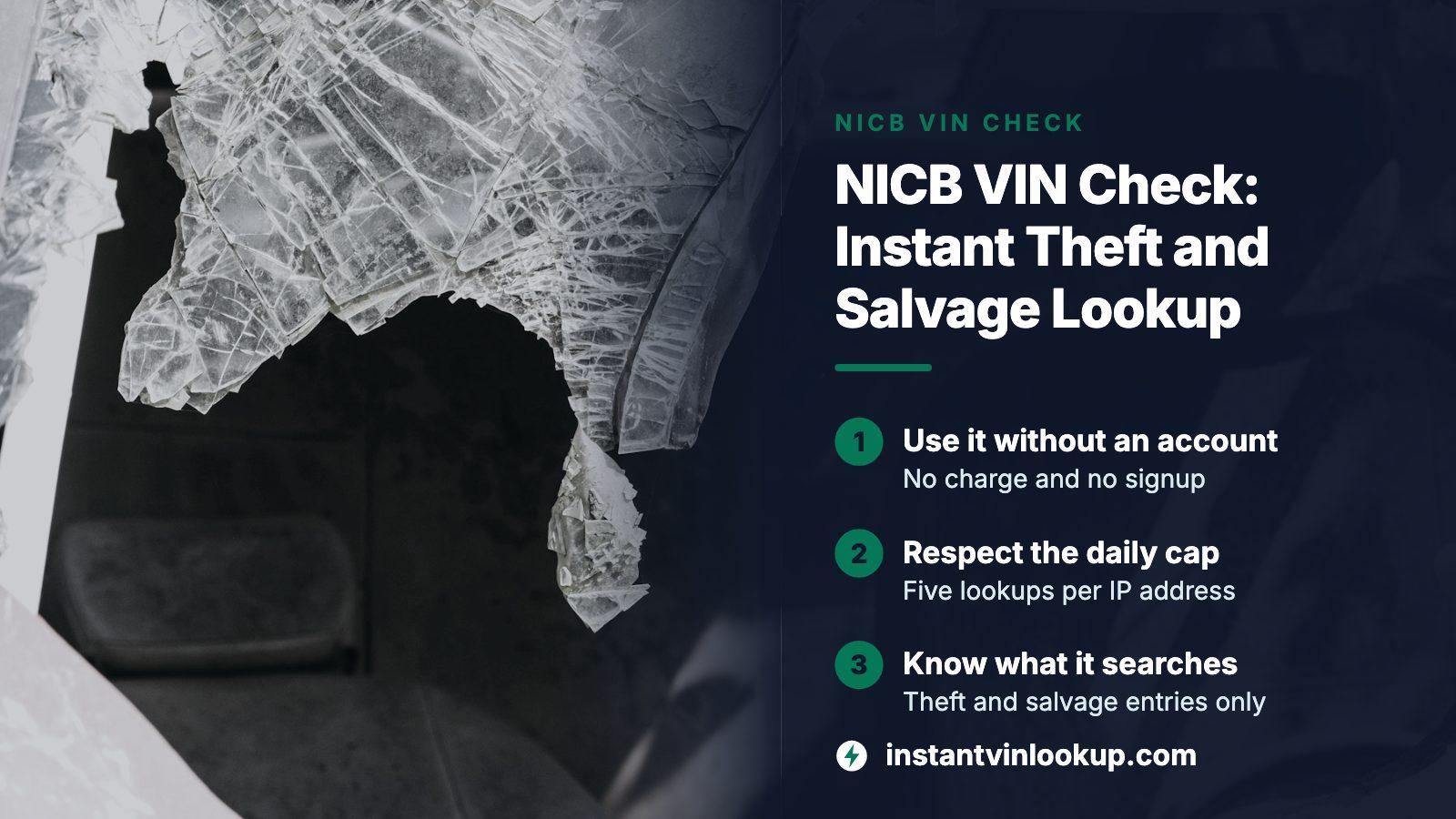
NICB VINCheck is a no-charge lookup from the National Insurance Crime Bureau. It tests a VIN against theft and salvage records that participating insurers submitted, and the answer appears right away. The tool caps each IP address at five lookups per day. It does not show title brands, mileage readings, liens, owner counts or accidents that fell short of a total loss, so follow it with a federal title record and a full report.
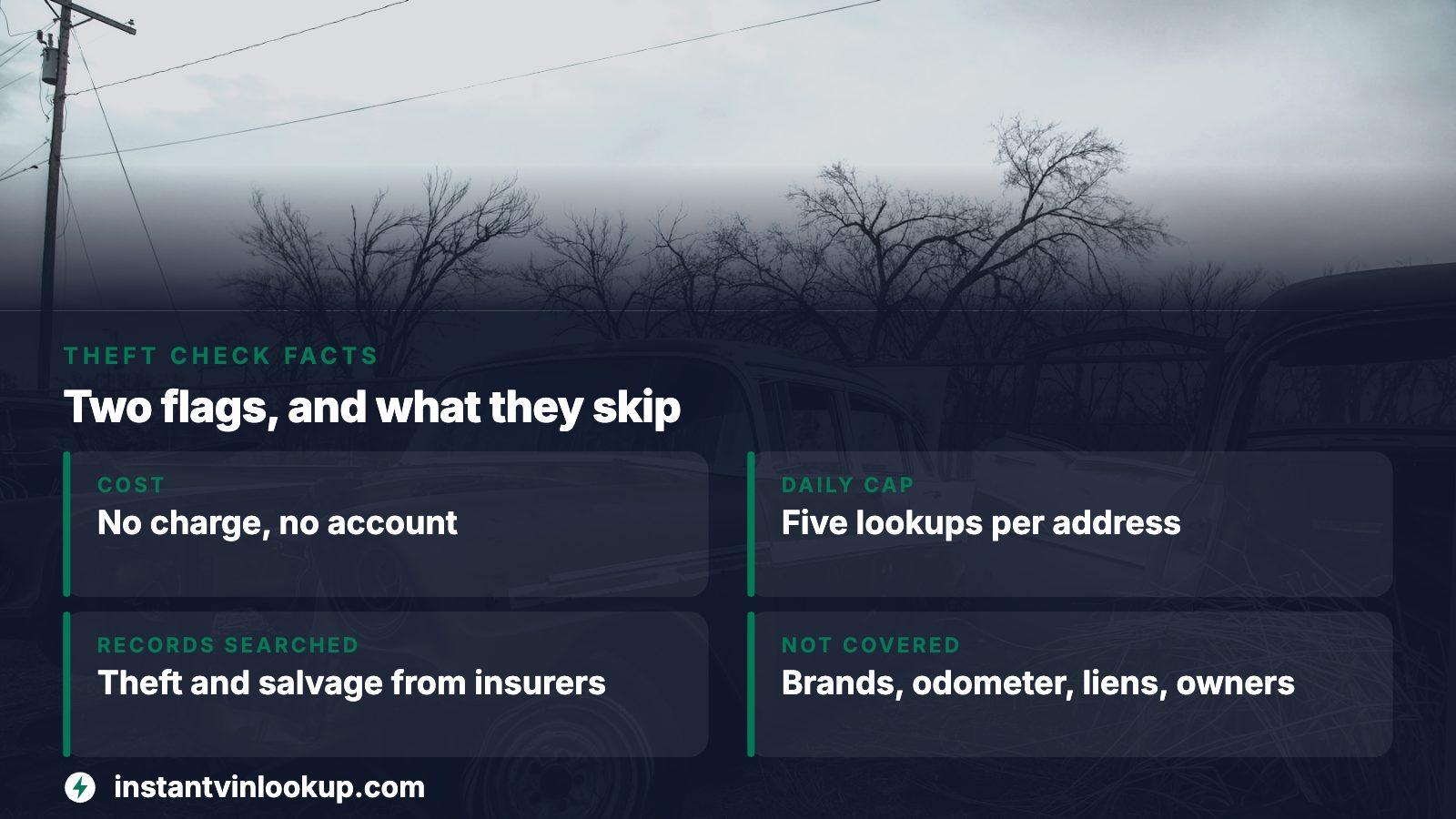
- Cost
- No charge, no account
- Daily cap
- Five lookups per IP address, per day
- Records searched
- Theft and salvage entries from participating insurers
- Not covered
- Title brands, odometer readings, liens, owners
Two flags, and only two: theft and salvage
The bureau behind VINCheck takes no profit. Property and casualty insurers fund it, and the tool is the public window onto the theft and salvage entries those members file. Type a VIN and the page either lists an entry or reports that none was found.
| Entry shown | What the insurer reported | What it means for you |
|---|---|---|
| Theft | The vehicle was stolen and has not been reported recovered | Treat it as stolen property until someone proves otherwise, and keep your money in your pocket |
| Salvage | The insurer classed the car as salvage, usually after a total-loss decision | Repair and a fresh title may have followed, so ask to see the paperwork |
Each entry is dated, and some salvage entries add the cause of loss if the insurer provided it. Neither flag tells you how severe the damage was, what was fixed afterward or who holds the title today.
Running the check from the driveway or the lot
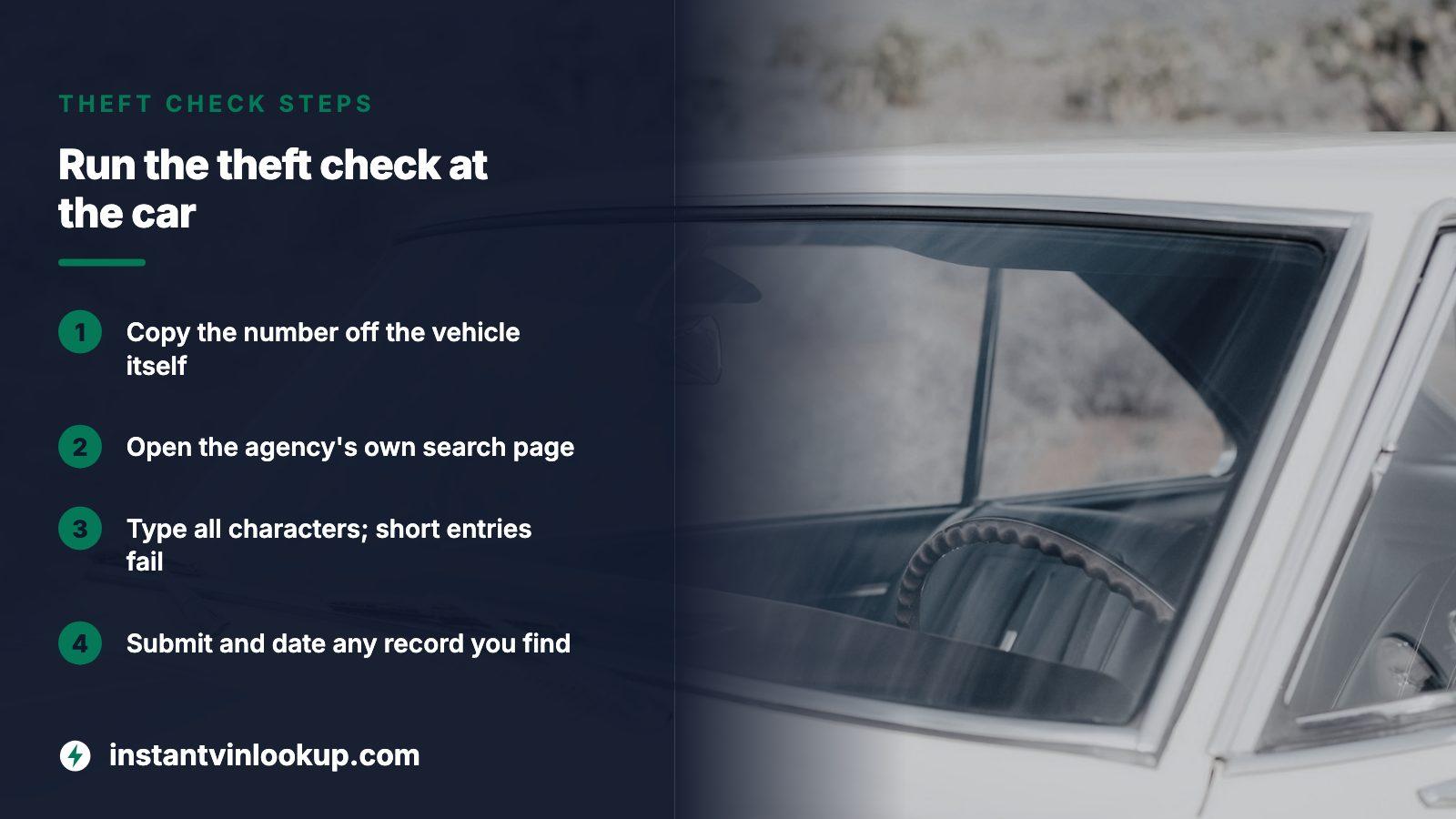
- Copy the number off the vehicle, not the listing. Two copies sit on the car, one at the dash corner behind the glass and one on the driver's door frame, and both must match the title.
- Open VINCheck on the NICB's own website. There is no app and no paid tier, so anyone billing you for an NICB search is reselling a public tool.
- Type all 17 characters, since a short entry is refused. The alphabet behind VINs leaves out I, O and Q, so a letter that looks like one of them is a misread digit.
- Agree to the terms, submit, and note the date beside any record that appears.
- Run it yourself even if the seller offers a screenshot, since a capture can belong to a different car.
The daily cap rarely troubles a single buyer, but a weekend of viewings can reach it. Shortlist first, decode each VIN to confirm it matches the advertisement, and spend your lookups on cars you would actually drive out to see. If the cap blocks you, wait a day.
When a record appears: what to do with it
A theft entry with no recovery means the insurer still treats the car as stolen. Walk away without paying or driving off, and say nothing about the record while you are still on the seller's property, because you cannot know who you are dealing with. A buyer of a stolen car usually ends up without good title, however convincing the paperwork looks. Give police the VIN, where the car sits and a copy of the advertisement.
A salvage entry calls for a different conversation. Read the date together with the cause of loss: a hail total loss and a structural front-end crash raise the same flag but are not the same car. Ask for the repair invoices, the shop's name and the inspection paperwork behind the rebuilt title, then price the car with that history in mind. Ask your insurer about cover first, since a rebuilt title often restricts it.
An old record raises a new question
A salvage entry dated years ago on a car being sold today means it was written off, repaired and retitled somewhere in between. That alone does not rule the car out. It moves the burden of proof to the seller.
Why a blank result is common and proves little
Most searches come back empty, and an empty page has three possible explanations the tool cannot separate: the car truly has no theft or salvage past, the insurer involved does not participate, or the loss never reached an insurer at all. The third happens more than buyers expect. An owner with no cover, a flood car sold for cash and a body-shop favor from a friend each leave a damaged car with a clean NICB result.
- Collisions that stopped short of a total loss
- Brands a state placed on the title, such as flood or lemon
- Mileage recorded at each title change
- How many owners the car has had
- Open safety recalls and lender liens
- Salvage auction listings
What silence actually says
Nothing was reported to that one database. That is a narrower statement than nothing was reported anywhere, and the gap between the two is where bad cars hide.
What the federal title record adds
NICB shows what member insurers chose to send. The national title system leans on legal duties instead, set out in Justice Department rules.
| Who reports | How often | Detail from the rule |
|---|---|---|
| Insurance carriers | Monthly | Cars they took as junk, salvage or total loss, limited to the newest model year and the four preceding it |
| Salvage yards, junk yards, recyclers | Monthly | Cars obtained in the prior month; a yard with fewer than five total-loss, salvage or junk cases annually is exempt |
| State titling agencies | Every 24 hours | Title data on all automobiles, every brand included, plus the odometer disclosure at title issue |
A federal title report is built around five indicators: the title state with its latest date, the brands states applied, the odometer figure, and any total loss or salvage on record. The department calls the report intentionally concise and says accident history is not among the indicators. A report with nothing flagged is no guarantee, it adds, and buyers should still get an independent inspection.
What to run after NICB, in order
- NHTSA's recall lookup by VIN, which shows open safety campaigns that a franchised dealer repairs at no charge to the owner.
- A title record pulled from an NMVTIS-approved provider, for brands and odometer readings.
- The VIN on this site, where the preview shows how many records exist for that exact vehicle.
- The full report, for cars still on your shortlist. It adds collision and damage records, salvage-auction pictures, liens, impounds, insurance entries and market value.
- A mechanic's inspection of the car you pick, because no database sees a bent frame rail.
What each step costs
NICB asks for no payment and no sign-up, and NHTSA's recall search is just as open. A VIN typed into this site returns a free preview before any money changes hands. After that, one payment buys one report, and bundles of 3, 5 or 10 exist for people comparing several cars. Nothing is billed on a schedule. The pricing page lists each amount.
Buy a report only for cars that survive the no-charge screens. If NICB flags a theft, stop there.
Confirm the VIN before you trust any answer
Every result belongs to the number you typed. Compare the dash tag, the door-frame label and the title document character by character, and photograph each so you can recheck at home. If the stamping on any copy looks off, with a different typeface or uneven depth, doubt the entire car. Swapping a VIN is how a stolen or written-off car passes as a clean one, and it fools every database. If a lookup was run on a number you later find you misread, run it again. If the paperwork will not match the metal, walk away.
Where this information comes from
- NICB: VINCheck — the free theft and salvage lookup and its daily search limit
- 28 CFR 25.55: Responsibilities of insurance carriers — monthly insurer reporting of salvage and total-loss cars, five model years
- 28 CFR 25.54: Responsibilities of states — state titling data sent every 24 hours, brands and odometer disclosure included
- 28 CFR 25.56: Responsibilities of junk and salvage yards — monthly yard reporting and the small-volume exemption
- U.S. Department of Justice: Understanding an NMVTIS report — the five indicators, the limits of a federal title report and the inspection advice
- NHTSA: Recalls — recall lookup by VIN for open safety campaigns
Sources and photos: Facts checked against the sources above in November 2026. Photos by Macro.jr, Wesley Tingey and Leo_Visions on Unsplash; diagrams by InstantVINLookup.
Keep reading
- VIN Lookup: Check a VIN Number on a Car Before You BuyThe wider lookup: test the number, read the preview and see what a report adds.
- Where Is the VIN Number? Find It in a Minute, Then Verify ItWhere the number sits on different vehicles, for a tag that is dirty or hard to read.
- Sample reportSee a finished report before you spend anything on one.
- PricingOne report or a bundle, with the preview first and no subscription.
Frequently asked questions
Is the NICB VIN check really free?
Yes. NICB gives the public VINCheck at no cost and asks for no account. The only restriction is the daily cap of five lookups per IP address. Any site billing you for an NICB lookup is reselling that public tool.
Does an NICB VIN check show accidents or mileage?
No. It reports theft and salvage entries from participating insurers and nothing else. Mileage comes from odometer readings recorded at title transfers, which sit in a federal title record. Collisions short of a total loss turn up, if at all, in insurance and auction entries inside a history report.
Why did the NICB check find nothing on a car that was wrecked?
The database holds only what member insurers submitted. A car written off by a non-member, repaired privately or never claimed on can return nothing and still have a damaged past. Check the title for brands, then inspect the paint, panel gaps and underbody yourself.
Does NICB VINCheck replace an NMVTIS report?
No, because the two answer different questions. NMVTIS is the title database that states, salvage yards and insurers must feed under federal rules, and approved providers sell consumer reports built on it. VINCheck is a narrower theft and salvage screen. Use both, then add an inspection.
Can a seller fake a clean NICB result?
A seller can show a capture of another vehicle's result, or of a number typed in by hand. Run the search yourself against the VIN on the car. If that number comes back stolen, end the purchase and give local police the VIN and the address where you saw the car.
Now check the car itself
The guide explains what to look for. The report shows what this VIN has on record.