THE SHORT ANSWER
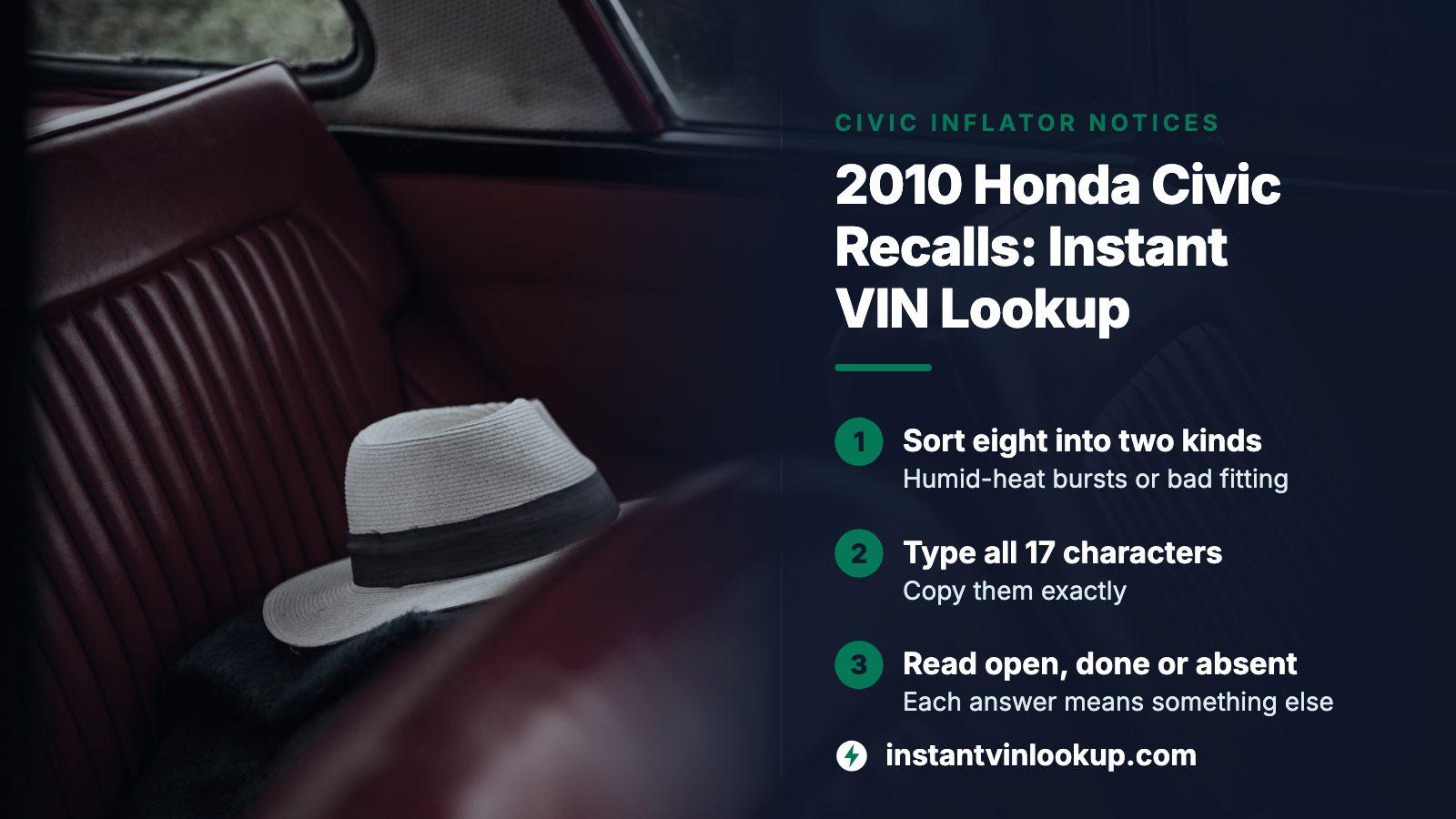
The 2010 Civic has 8 recall campaigns on NHTSA's model-year list, all about the passenger airbag inflator. Five cover inflators that can burst after years of humid heat. Three cover inflators fitted wrongly during a replacement. Registration state and repair history decide which apply, so run the VIN to learn what is still outstanding on the specific Civic in front of you, then arrange the work through a Honda dealer.
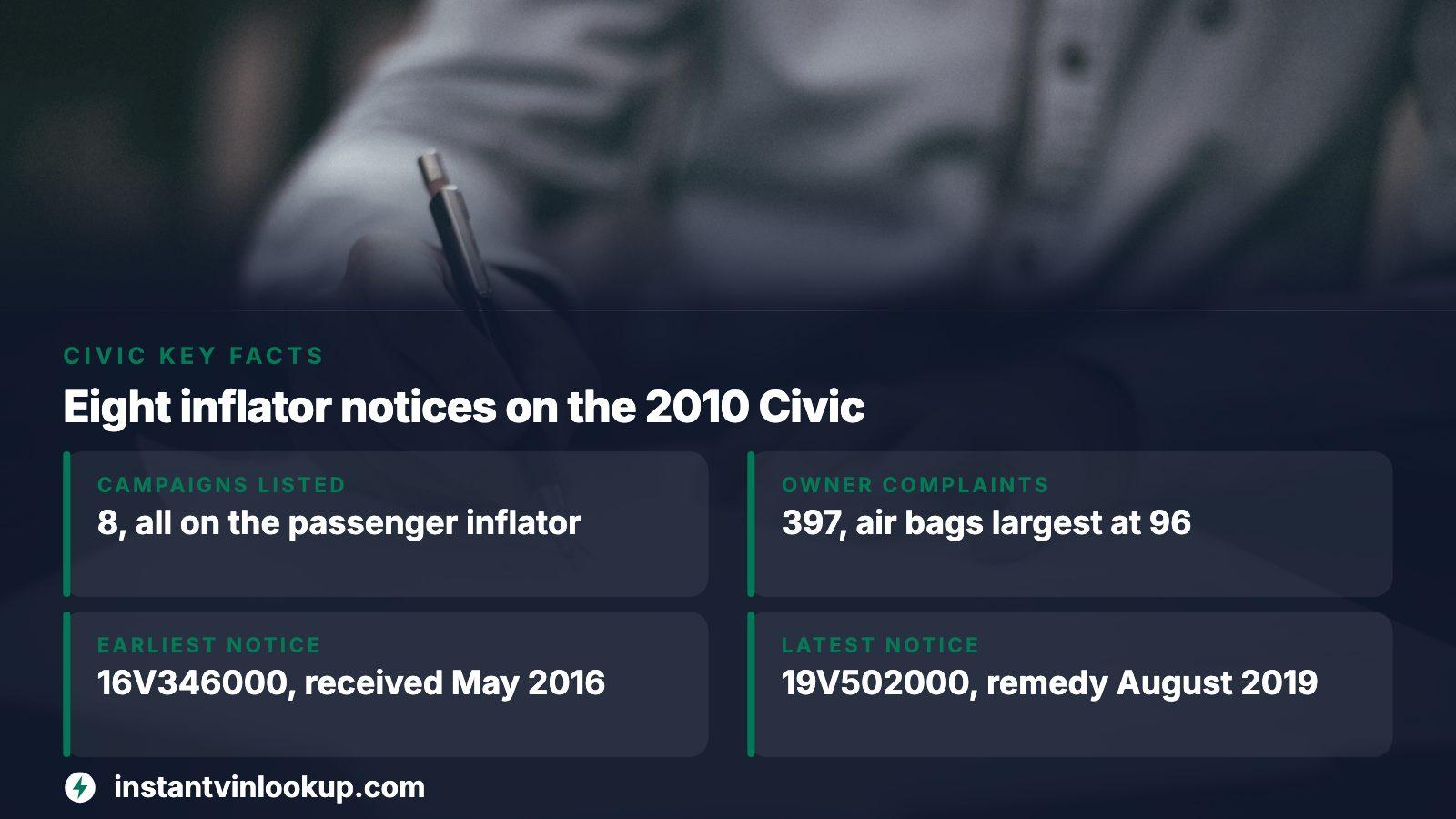
- Campaigns listed
- 8, all on the passenger airbag inflator
- Owner complaints
- 397, with air bags the largest group at 96
- Earliest notice
- 16V346000, received May 2016
- Latest notice
- 19V502000, remedy began August 2019
One part, eight notices: what the 2010 list contains
Most model years carry a scattering of unrelated faults. The 2010 Civic is different. When we pulled the year from NHTSA's recall data, all eight entries sat under the same component: the inflator inside the front passenger airbag. None is marked park-it or park-outside. The notices simply arrived in waves between 2016 and 2019 as Honda widened the net.
| Campaign | Received | What it says |
|---|---|---|
| 16V346000 | May 2016 | Inflator may rupture; Zone A registrations |
| 17V030000 | January 2017 | Rupture risk widened; interim letter, parts later |
| 17V545000 | August 2017 | Replacement inflators fitted incorrectly at one dealership |
| 18V042000 | January 2018 | May explode after humid heat; Zones A and B |
| 18V268000 | April 2018 | Passenger bag may be installed wrongly during replacement |
| 18V661000 | September 2018 | Same explosion risk, northern states added |
| 19V378000 | May 2019 | Installation fault on replacement inflators |
| 19V502000 | June 2019 | Replacement or service-part inflators may explode |
Sorting the eight into two kinds of problem
Counting through the notices, five describe an inflator whose propellant breaks down after long exposure to moisture and heat, a failure the notices say may throw shrapnel into the cabin. The other three are about workmanship: an inflator or module put in wrongly when someone replaced the original.
That second group matters to a buyer more than it first appears. A Civic that has already had an airbag replaced, perhaps after a crash, can fall under a campaign that a never-touched sibling does not. Ask the seller whether the passenger airbag was ever replaced, and by whom.
Why the VIN, not the year, answers the question
Honda grouped the humidity campaigns into zones. Zone A is the Gulf coast, California and Hawaii plus island territories. Zone B is a band of mid-Atlantic and central states. The 2018 expansion also names a set of northern states for 2010 and 2011 Civics. The wording covers cars originally sold or ever registered in the listed places, so moving away does not remove a car from a zone.
A listing that says 2010 Civic shows none of this. An instant lookup reads the 17 characters and matches them to that car, with its history, so the answer reflects the actual sedan rather than the average one. The preview is free and returns in seconds.
Finding the 17 characters and typing them correctly
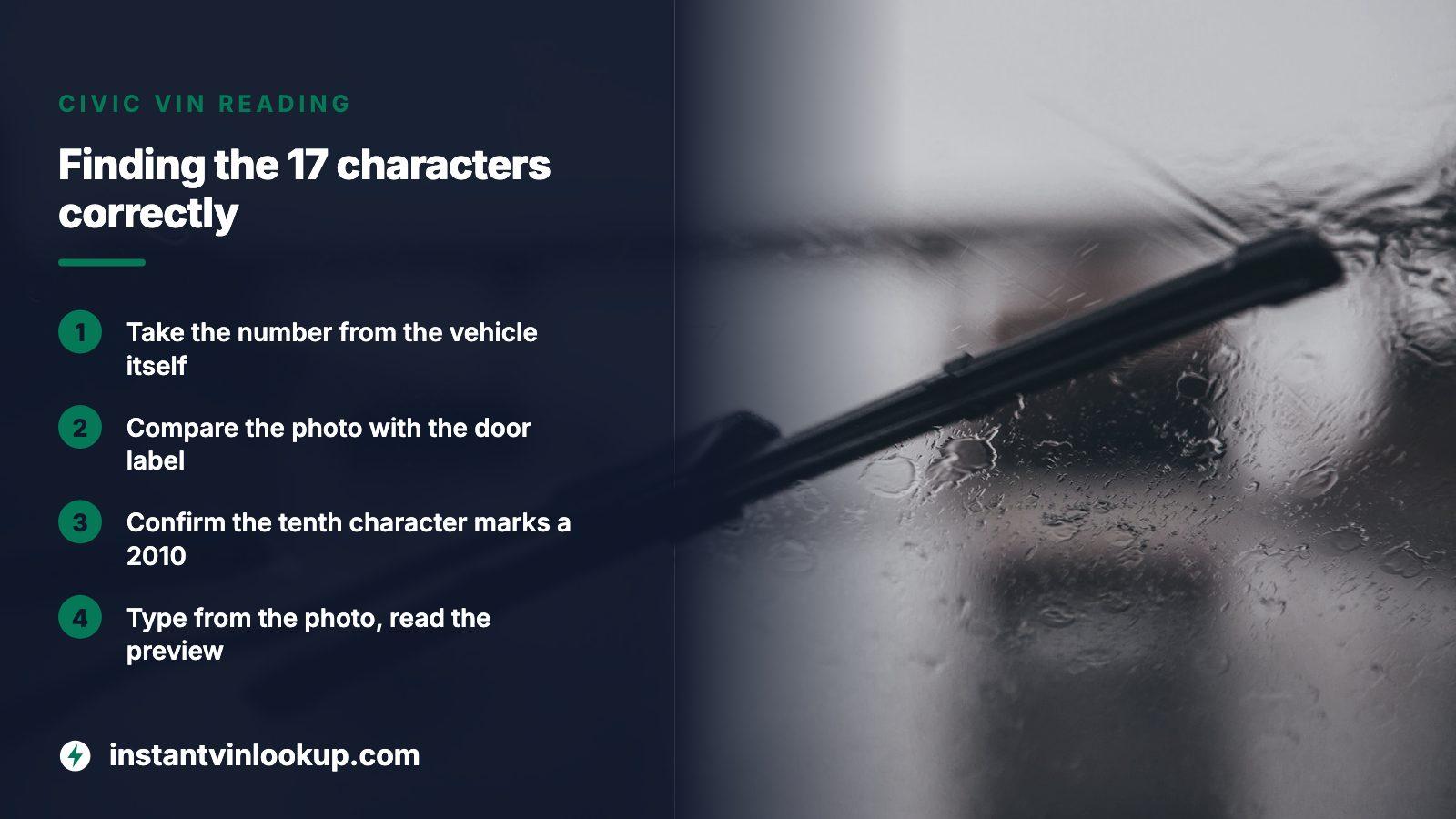
- Take the number from the vehicle itself, never the advert. It is stamped on a plate visible through the windshield on the driver's side, low in the corner. Photograph it.
- Compare the photo with the label in the driver's door frame and with the seller's title or registration.
- Confirm the tenth character is an A, which marks a 2010 model. Anything else means the advert has the year wrong.
- Type from the photo into the lookup box and read the preview before deciding on the full report.
A single mistyped character points to another vehicle or to no record, so have someone read your entry back to you.
Open, completed or absent: how to read what comes back
- Open means a notice covers the VIN and no completed repair is on record. Phone a Honda dealer with the VIN and ask when parts and a bay are free.
- Completed means the work was logged. Ask for the repair order, and check whether the part replaced was the original or a later replacement, since later notices target the latter.
- No match means none of the eight reached this VIN as recorded. It does not prove the airbag was never replaced, so ask about crash history too.
Honda's customer line printed in the notices is 1-888-234-2138, and NHTSA runs a Vehicle Safety Hotline at 1-888-327-4236. Both can confirm status from the VIN.
What owners say happens when they try to get it fixed
A recall listing says the repair is covered. It says less about how smoothly that goes.
From an NHTSA owner complaint
A person who bought a used 2010 Civic wrote in October 2022 that airbag recall letters began arriving the following year. The notice offered a loaner, so they asked, at least four times. Honda first seemed to agree, then declined because of the buyer's insurance, and the airbag stayed unrepaired.
The lesson for a buyer: if the lookup shows an open notice, make the seller get the repair done before you pay, so the scheduling battle is not yours.
From an NHTSA owner complaint
Another owner, filing in August 2022, said the airbag went off with no warning light beforehand while driving over a metal plate in a construction zone. The insurer judged the replacement cost too high and wrote the Civic off for salvage, though it was otherwise sound.
That owner's account is unverified, but it shows a second risk. An airbag event can end a cheap car's life as a salvage vehicle, and the brand then follows the VIN.
What the recall list leaves out about this Civic
NHTSA holds 397 owner complaints on the 2010 model year. Air bags lead with 96, followed by service brakes at 89, structure at 43, and wipers and visibility at 34. Of all of them, 31 mention a crash, 5 mention a fire and 32 injuries are reported. Brakes and wipers have no recall on this list, so a clear lookup says nothing about them.
Complaints are unverified owner statements, not findings. Treat them as test-drive prompts: press the brake pedal hard, run the wipers, and ask for service records.
What the lookup costs and the steps after it
The preview that follows a VIN entry is free. Buying the full report is one payment for that VIN, nothing recurring, and bundles suit shoppers comparing several cars; see the pricing page for amounts. Past the recall question, the paid report brings title brands, damage, odometer and salvage entries, which weigh heavily on a car this old.
- Run the VIN and write down every campaign number marked open.
- Ask the seller to have a Honda dealer complete them, or price the delay into your offer.
- Request repair orders for anything shown as completed.
- Read the report's title and damage entries for any past airbag event.
- Have a mechanic check the brakes and visibility parts before agreeing on a price.
Where this information comes from
- NHTSA recalls API: 2010 Honda Civic — The eight campaigns, their dates, scope and remedies as NHTSA publishes them.
- NHTSA complaints API: 2010 Honda Civic — Source of the complaint counts by component and the crash, fire and injury tallies.
- NHTSA owner complaint 11488784 — owner experience, paraphrased
- NHTSA owner complaint 11481606 — owner experience, paraphrased
- NMVTIS: National Motor Vehicle Title Information System — The federal title record, where salvage brands live that a recall file never shows.
Sources and photos: Facts checked against the sources above in November 2026. Photos by Nik, Thibault Valjevac and Scott Graham on Unsplash; diagrams by InstantVINLookup.
Keep reading
- VIN Lookup: Check a VIN Number on a Car Before You BuyHow the lookup and its preview work for any vehicle.
- Airbag Deployed Check: Spot a Hidden Deployment From the VINReplaced inflators feature in three of these notices, so a past deployment is worth knowing.
- 2020 Honda Civic Recalls: Run an Instant VIN Lookup on One CarThe same model ten years newer, with a very different recall list.
- Where Is the VIN Number? Find It in a Minute, Then Verify ItPhotos and places to find the VIN on the car itself.
Frequently asked questions
How many recalls does a 2010 Honda Civic have?
NHTSA's model-year list shows 8 campaigns, and all of them involve the front passenger airbag inflator. Not every Civic is under all eight, because registration state and past airbag repairs change which notices apply. A VIN lookup returns the open ones for that one car.
Is the 2010 Civic airbag recall safe to ignore?
No. The notices describe inflators that may explode and send metal fragments into the cabin, with serious injury or death as the stated outcome. Honda dealers replace the part at no charge to the owner. If a lookup shows it open, book it before driving passengers.
Does my state affect whether the recall applies?
For the humidity campaigns, yes. Honda defined zones by where the car was ever registered, not only where it is now. A Civic that once lived in Texas or Florida can still be covered after a move north, and the VIN lookup accounts for that.
What if the seller says the airbag was already replaced?
Ask for the repair order. Three of the eight campaigns exist because replacement inflators were fitted wrongly, and later notices cover replacement parts too. A replaced airbag is not automatically a fixed one, so check the paperwork and the VIN record together.
Do I have to pay for the recall repair?
The notices state that dealers perform the remedy free of charge. If someone quotes you a fee for work covered by an open campaign, call Honda customer service at the number in the notice and ask them to confirm the VIN is listed.
Now check the car itself
The guide explains what to look for. The report shows what this VIN has on record.