THE SHORT ANSWER
The 2020 Civic has 5 campaigns on NHTSA's list: 21V215000 and 23V858000 for the in-tank fuel pump, 23V458000 for the brake booster connection, and 24V064000 plus 26V332000 for the passenger seat weight sensor. Honda dealers do each repair at no charge. Which ones are open on a particular car depends on its VIN and on repairs already done, so look the VIN up before you buy or book a service visit.
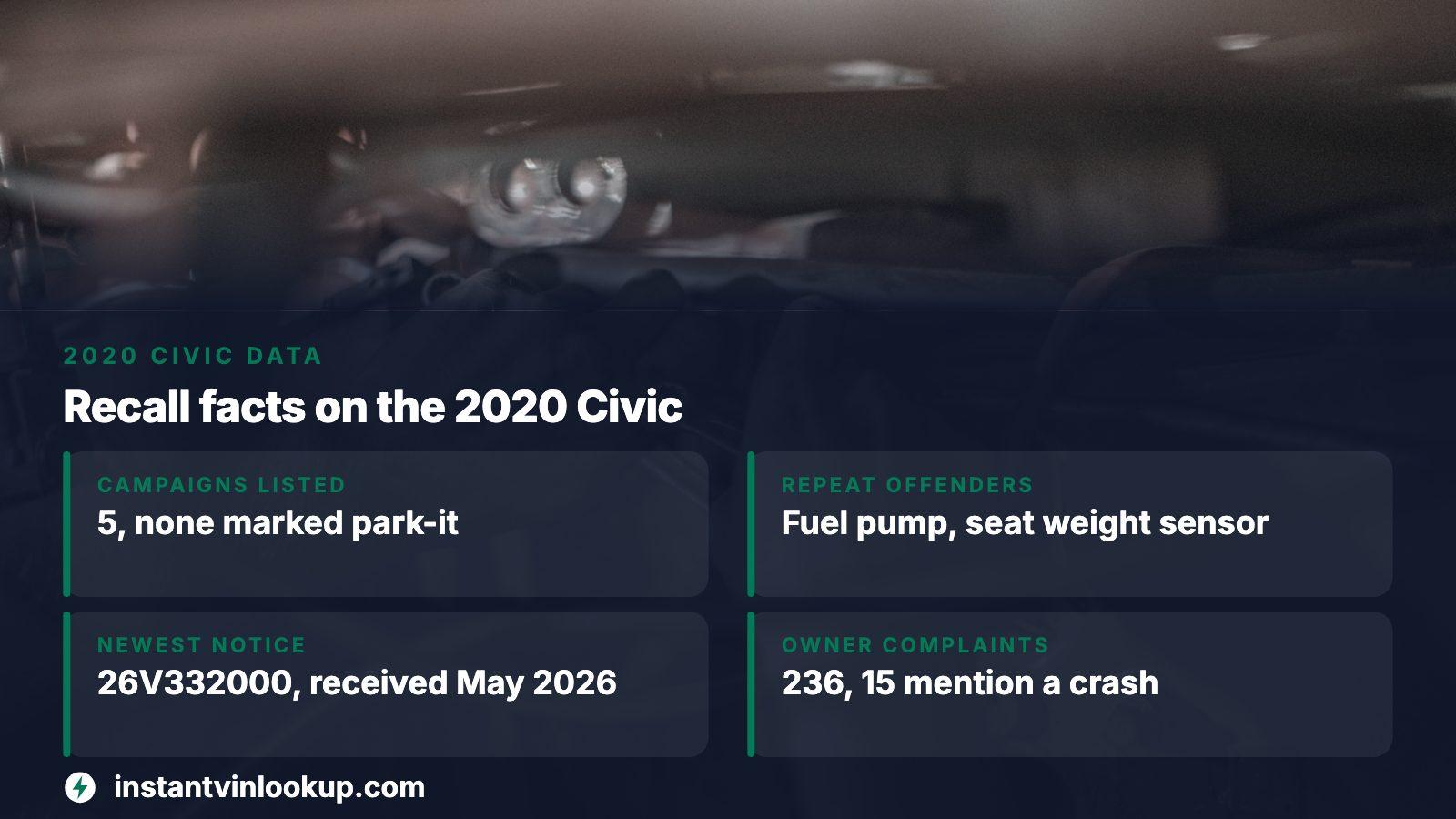
- Campaigns listed
- 5, none marked park-it
- Repeat offenders
- Fuel pump twice, seat weight sensor twice
- Newest notice
- 26V332000, received May 2026
- Owner complaints
- 236, with 15 mentioning a crash
The five notices NHTSA files under a 2020 Civic
We pulled the 2020 Civic from NHTSA's recall data and it returned five campaigns spread across five years. None carries a stop-driving instruction, and each names a free dealer remedy.
| Campaign | Received | Problem | Remedy |
|---|---|---|---|
| 21V215000 | March 2021 | Tank-mounted fuel pump can quit, killing the engine | New fuel pump assembly |
| 23V458000 | June 2023 | Brake master cylinder may separate from the booster | Inspect and repair the booster assembly |
| 23V858000 | December 2023 | Fuel pump again, now across more models | New fuel pump module |
| 24V064000 | February 2024 | Passenger seat sensor can crack and short out | New seat weight sensors |
| 26V332000 | May 2026 | Same sensor, can trigger unwanted air bag deployment | New seat weight sensors |
Why an instant lookup answers what the year cannot
Each campaign applies to some cars and not others. The brake notice, for instance, names only 2020 and 2021 Civics, while the fuel pump notices stretch across many Honda and Acura models. Body style matters too. When we queried NHTSA by body style, the hatchback came back with only the 2026 sensor notice and the Type R with only the later fuel pump notice.
That is the gap a VIN closes. The lookup reads the 17 characters, matches that car against the campaigns and returns what is open before you have left the listing page.
The fuel pump pair: a stall that can strike at speed
Two separate campaigns describe the same part, a low-pressure pump inside the tank. The first came in 2021, and the second in late 2023 described itself as an expansion of earlier notices, which means a car cleared under one may still turn up under the other. The stated risk is an engine that quits while moving, so a stall in traffic or on a ramp raises crash risk.
From an NHTSA owner complaint
One owner wrote in early 2026 that the car would shut down or refuse to restart for about an hour, then run normally. A dealer told them the VIN sat outside the recall and that pumps were being kept for recall cars only, so they went to Honda corporate. They counted at least 20 episodes since August 2025.
The lesson: a clean lookup does not clear a car that behaves like this. Ask the seller about stalling or hard restarts, and make your test drive long enough to include a hot restart.
The brake booster and the seat weight sensor
The June 2023 notice concerns a fastener holding the brake booster to the master cylinder. If it was assembled badly, the cylinder can separate and braking drops away. The dealer inspects the assembly and repairs it as needed.
The two sensor notices are about the seat weight sensor under the front passenger cushion. It can crack and short, which affects whether the passenger air bag stays suppressed as designed. The first notice called it a phased recall, with parts arriving in stages, and the 2026 notice names a much wider group of Civics.
From an NHTSA owner complaint
An owner reported in late 2025 that the sensor failed on a car with no crash history. A Honda dealer diagnosed an internal electrical fault, and the SRS warning light came on while driving and stayed lit.
An air bag warning light on a test drive is a reason to ask for the repair order.
Running the lookup: where the VIN is and what to copy
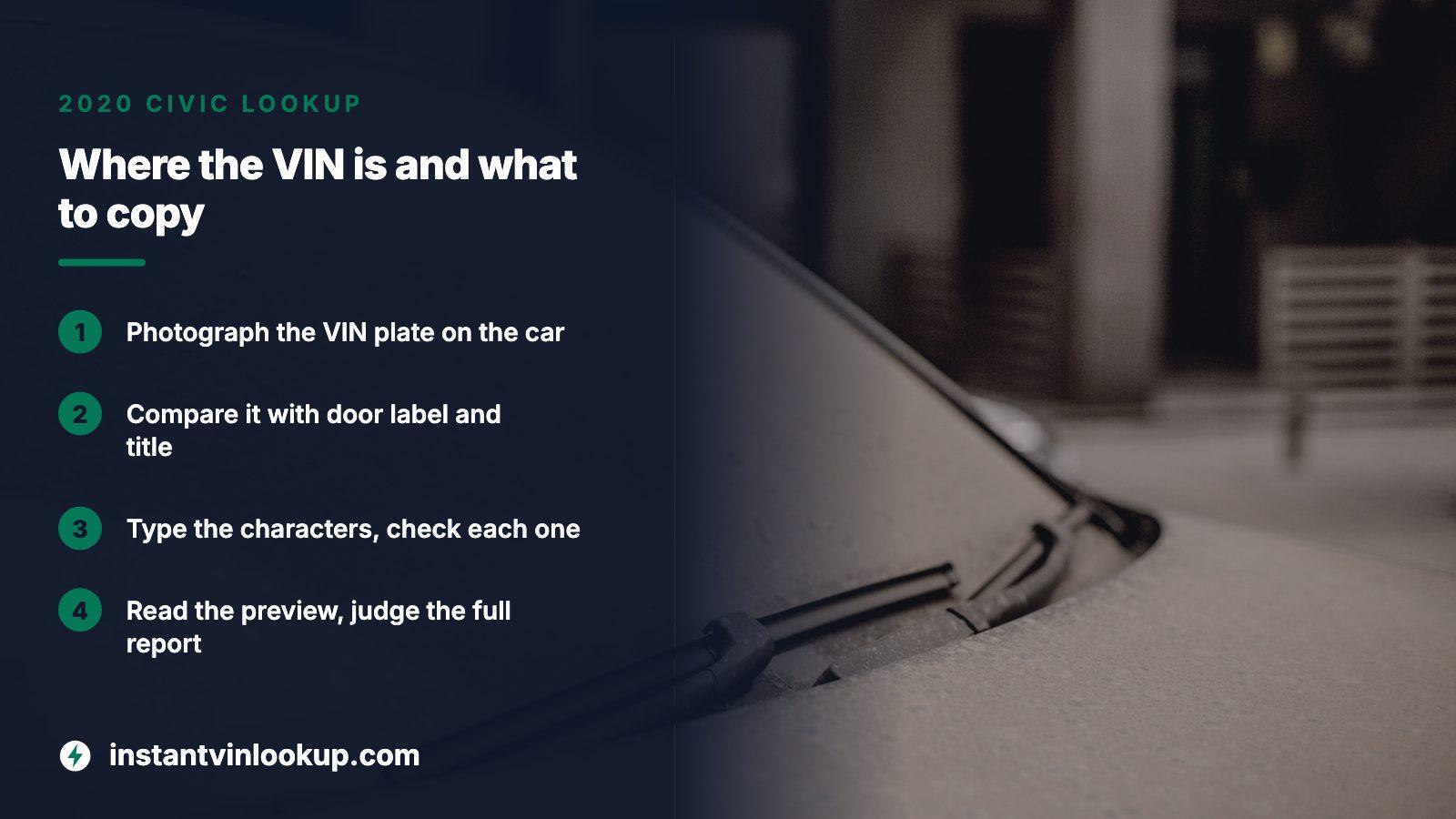
- Photograph the VIN plate on the car, found low in the windshield corner nearest the driver, instead of trusting the ad.
- Compare the photo with the door-jamb label and with the seller's title or registration. If the three disagree, stop and ask why.
- Type the characters into the lookup box, checking each one against your photo.
- Read the preview that comes back, then judge whether this particular Civic deserves the full report.
A single slipped character points the search at some other vehicle or at nothing, so ask a friend to read your entry aloud against the photo.
Open, done or missing: reading what comes back
- Open means a campaign covers the VIN with no completed repair on file. Phone a Honda dealer with the VIN and ask whether the part is on hand, since some owners report waiting months.
- Completed means a repair was logged. Ask for the repair order, and remember that two campaigns each cover the same part, so one completed notice does not settle the other.
- Nothing found means no campaign reached this VIN as recorded. It does not rule out a failing pump or sensor, which the owner complaints show can happen outside a campaign.
Honda's customer line in the notices is 1-888-234-2138, and NHTSA's Vehicle Safety Hotline is 1-888-327-4236. Either can confirm status from the VIN.
When the repair is free but the part is not there
A good share of the 2020 complaints are about parts, not defects. Owners with a notice in hand say dealers had nothing to install and could offer no date.
From an NHTSA owner complaint
An owner filing in March 2025 said they had tried for roughly six months to book a New Jersey dealer after getting the fuel pump notice. Each time the part was unavailable and they were told to wait for a callback. The car was also losing power.
If you are buying, an open notice is bargaining power. Ask the seller to finish the repair first, or reduce your offer for the time and risk you inherit.
What the recall file does not cover on this Civic
NHTSA holds 236 owner complaints on the 2020 model year. Electrical system and unknown or other lead with 38 each, then power train at 33, steering at 32 and air bags at 29. Within that total, 15 describe a crash, one describes a fire and the injury count is 14. These are unverified owner statements, but they show that many problems never become a campaign.
NHTSA's crash ratings are strong, with 5 stars overall on the 4-door and the 2-door, and its record shows no open investigation for this year. A recall lookup also says nothing about a salvage brand, which lives in title records.
What the lookup costs and what to do next
The preview that appears after you submit a VIN costs nothing. The full report is a single payment tied to that VIN, with no subscription behind it, and multi-report packs exist for people weighing several Civics. See the pricing page for the figures. On a 2020 Civic the paid report is where you would check for a title brand, damage history and the odometer trail, which no recall file contains.
- Note every campaign the lookup shows as open.
- Ask the seller to have a Honda dealer complete the work, or price the wait into your offer.
- Request repair orders for anything marked completed.
- Check the title and damage entries for a past air bag event.
- Take a long test drive with a hot restart and a firm brake stop.
Where this information comes from
- NHTSA recalls API: 2020 Honda Civic — The five campaigns with their dates, affected parts and remedies.
- NHTSA complaints API: 2020 Honda Civic — Complaint counts by component and the crash, fire and injury tallies.
- NHTSA safety ratings API: 2020 Honda Civic — Star ratings and the investigation count for the model year.
- NHTSA owner complaint 11716683 — owner experience, paraphrased
- NHTSA owner complaint 11697486 — owner experience, paraphrased
- NHTSA owner complaint 11648557 — owner experience, paraphrased
- NMVTIS: National Motor Vehicle Title Information System — The federal title record, where salvage brands live that a recall file never shows.
Sources and photos: Facts checked against the sources above in November 2026. Photos by Bence Balla-Schottner, JavyGo and Nina Mercado on Unsplash; diagrams by InstantVINLookup.
Keep reading
- VIN Lookup: Check a VIN Number on a Car Before You BuyHow the lookup and its free preview work for any vehicle.
- 2010 Honda Civic Recalls: Instant VIN Lookup for the Airbag NoticesThe same model ten years older, with a very different list.
- Airbag Deployed Check: Spot a Hidden Deployment From the VINUseful when a sensor or deployment story comes up in the sale.
- Where Is the VIN Number? Find It in a Minute, Then Verify ItPhotos and places to find the VIN on the car itself.
Frequently asked questions
How many recalls does a 2020 Honda Civic have?
NHTSA's list for the model year shows 5 campaigns. Two cover the fuel pump, one the brake booster connection and two the passenger seat weight sensor. No single car is necessarily under all five, so only a VIN lookup shows which remain open for the Civic you are weighing up.
Is the 2020 Civic fuel pump recall serious?
According to the notices, a pump that gives out can cut the engine mid-drive, which adds to crash risk. Dealers replace it at no charge. If a lookup shows the campaign open, book the repair before long highway trips, and ask the dealer whether the part is in stock.
Does a clear lookup mean the car has no fuel pump problem?
No. It means no campaign reached that VIN as recorded. Some owners in NHTSA's complaint file describe pump-like stalling on cars the dealer said were outside the recall. Treat stalling or hard restarts on a test drive as a reason to ask questions.
Do I pay for the recall repair?
The notices state that dealers do each remedy free of charge. If a shop quotes a fee for work under an open campaign, call Honda customer service at the number in the notice and ask them to confirm the VIN is listed.
What if the dealer says parts are not available?
Several owners report this. Ask for the date you were put on the list, keep the dealer's name, and call Honda customer service with your VIN. If you are buying the car, ask the seller to settle it first or lower the price.
Now check the car itself
The guide explains what to look for. The report shows what this VIN has on record.