THE SHORT ANSWER
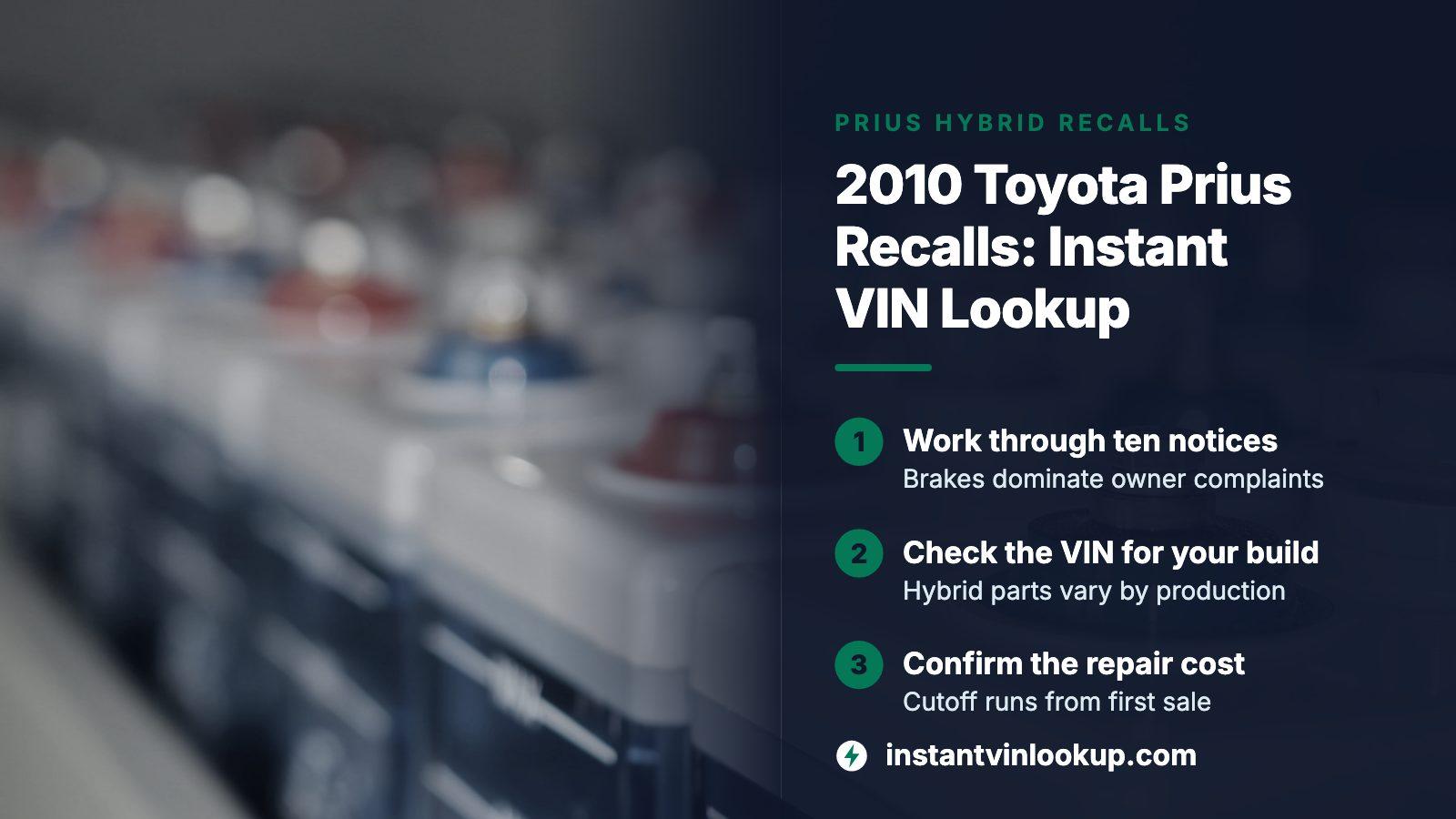
Ten campaigns are on file. Two cover an inverter problem that can leave the car short of power or stalled mid-drive, two cover brake behavior (an ABS reprogram and a brake booster pump), two involve air bags, two involve seat heater wiring and two are about missing load labels. Each depends on a build range or added equipment, so a VIN lookup separates covered cars from skipped ones and shows whether the repair was done.
- Campaigns on file
- 10 for the 2010 model year
- Owner complaints
- 2,823, about 70% naming the service brakes
- NHTSA crash rating
- None on file for the tested configuration
- Free-repair cutoff
- 15 years from first sale to announcement
What an instant lookup shows for a 2010 Prius
A classified ad gives you a model year. A VIN gives you one particular hatchback, and with ten campaigns on the books that gap matters. Type the 17 characters into the lookup box and the preview comes back in seconds, naming the kinds of records that exist for that car before any payment is asked for.
The full report puts open recall status beside mileage readings, damage entries, title brands and any auction or salvage photos. On a hybrid this old, the recall list is only one layer. It records what Toyota conceded, not how earlier owners treated the car.
Pulling the VIN off the car without typos
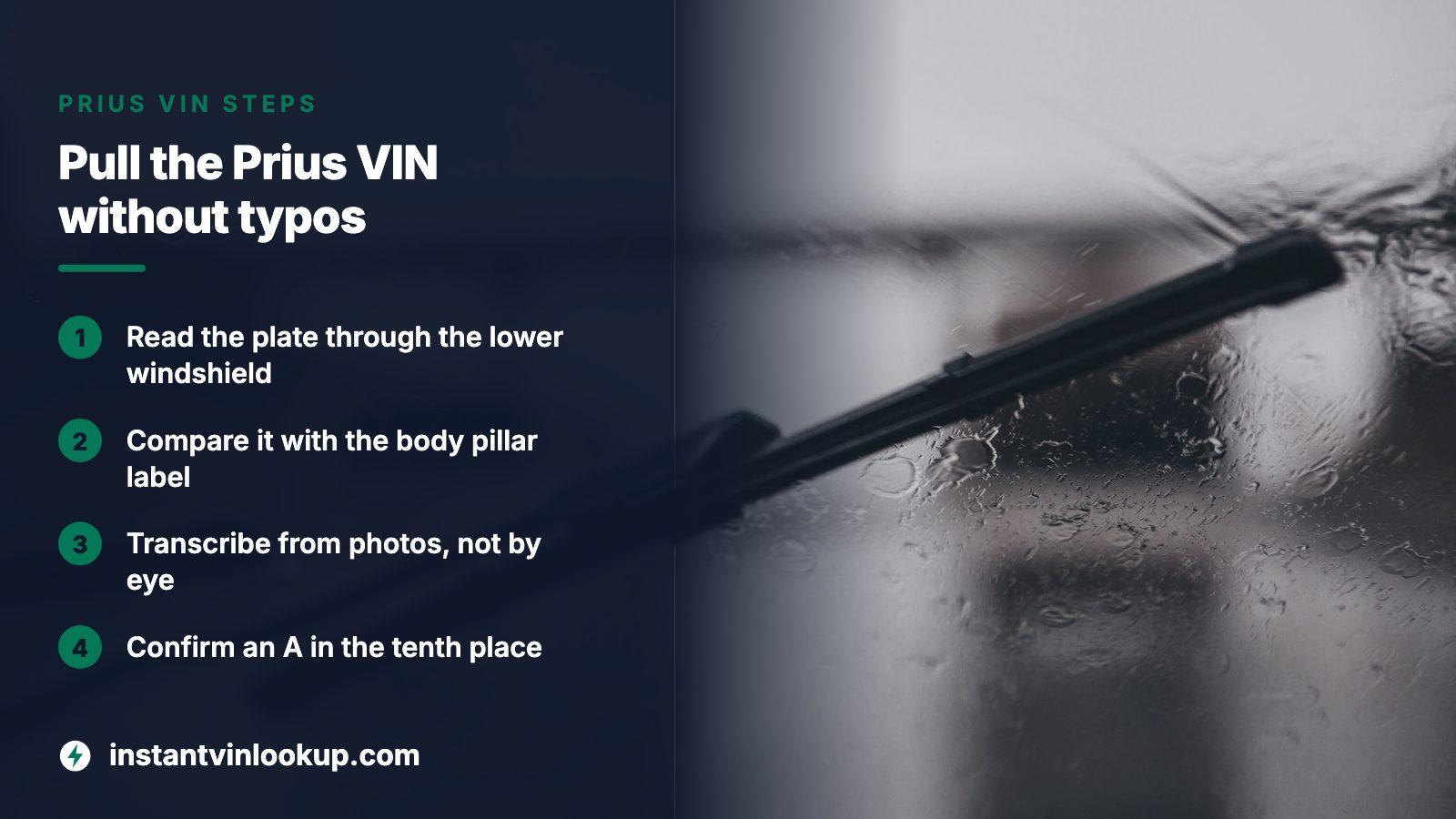
- Stand outside the driver's side and read the plate visible through the lower corner of the windshield. Photograph it instead of copying by eye.
- Swing the driver's door open and look at the label on the body pillar. The two strings must be identical, and the title should show the same one.
- Transcribe from the photos. No VIN contains I, O or Q, so a lookalike on the metal is really a 1 or a 0.
- Check the tenth character. A 2010 Prius should show an A there, and any other letter means the listing's year needs a second look.
The ten campaigns, grouped by what they touch
Each number can be pasted into NHTSA's recall search. They fall into five pairs, and the last column is what a dealer does without billing the owner.
| System | Campaigns | Fault in plain terms | Dealer fix |
|---|---|---|---|
| Hybrid inverter | 14V053000, 18V684000 | Heat or excess voltage can damage the power module, cut power or stall the car | Software update for two control units; the earlier notice also covers a failed inverter |
| Brakes | 10V039000, 13V235000 | Uneven pedal feel after ABS activity; nitrogen leaking into the fluid from the booster pump | ABS reprogramming; new pump assembly |
| Air bags | 13V014000, 16V487000 | Passenger sensor possibly not calibration-tested after accessories were fitted; weld in the curtain inflator can crack | Sensor test and recalibration; retention brackets |
| Seat heaters | 14V743000, 16V396000 | Accessory heaters with a copper strand element can short when the cushion is compressed | Heaters disconnected, purchase price refunded |
| Load labels | 10V035000, 10V036000 | Required load-capacity label missing | Corrected label mailed or installed |
The brake pump and inverter notices in practice
These four matter most on a hybrid. The inverter notices describe warning lamps, limp-home power and, in the worse case, a full shutdown while driving. The 2013 brake notice describes nitrogen gas entering the brake fluid, which can lower pedal pressure and lengthen stopping distance.
From an NHTSA owner complaint
An owner who filed in December 2025 lost brake assist at night during ordinary driving, with brake, ABS, stability and other warning lights coming on together. A Toyota dealer confirmed the booster pump had failed. The owner said that pump had already been replaced under a safety recall and gave out again after about 41,000 miles, and that the dealer declined to repair it, citing warranty limits.
A completed recall shows someone did the repair, not that it lasts. Ask the seller whether the pump was replaced, when and at what mileage, then have a mechanic road-test the brakes cold.
Why one 2010 Prius is covered and the next is not
The inverter notices name Priuses from 2010 through 2014. The curtain air bag notice names 2010 through 2012 cars plus the plug-in model. The seat heater notices concern accessory heaters, so a car without them has nothing to fix there. The model year gets you close, and the VIN settles it.
From an NHTSA owner complaint
An owner who filed in March 2026 said the check-engine light had pointed to a leaking fuel vapor canister for about 14 years. The owner had read about a large 2016 Prius recall for cracked canisters, but Toyota told them this car was not part of it.
News about the nameplate says nothing about one car. Read the result returned for the VIN itself.
A recall result and a repair program are different things
Brake trouble on these cars has produced a second kind of paperwork: manufacturer support programs, which run on their own terms and can lapse by date or mileage. The ten campaigns above are federal recall records. A program run without a recall filing may not appear among them.
From an NHTSA owner complaint
An owner who filed in April 2026 saw brake error codes at about 132,000 miles. The dealer quoted $3,938.89 for a booster assembly and master cylinder. The owner then found a customer support program from 2018 tied to the same codes, said it had run out, said no notice ever arrived, and asked Toyota to make it a formal recall.
Before buying, ask a Toyota dealer to check the VIN for any brake program as well as open recalls.
What the complaint file and crash ratings add
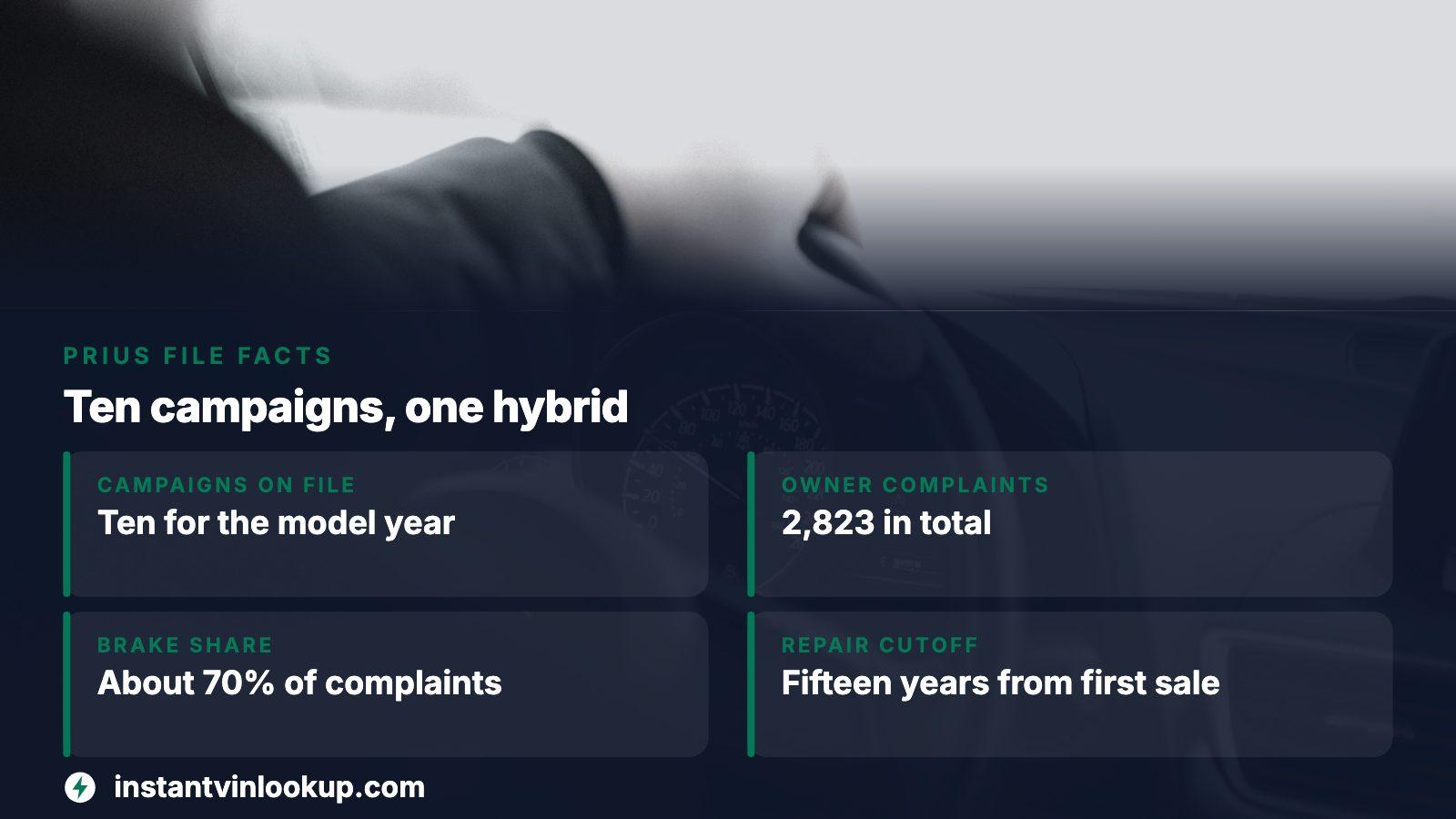
NHTSA holds 2,823 owner complaints on this model year, the heaviest of the 15 years the Prius has on record, at 13.65 times the median year.
| Area owners named | Share of complaints |
|---|---|
| Service brakes | 70% |
| Hydraulic | 30% |
| Electric | 18% |
| Vehicle speed control | 10% |
Owners can tick more than one area, so the shares add past 100%. These are unverified reports, but a pile this tight around the brakes explains why two campaigns sit there. NHTSA has no star rating on file for the tested configuration. Driver-assist gear differs between cars: a buyer could order forward collision warning that year, while lane departure warning was not available.
How long Toyota has to pay for a recall repair
By federal law, a recall repair is the manufacturer's expense, with a single exception. Under Section 30120 of Title 49, the obligation lapses once 15 calendar years separate the car's first retail sale from the announcement. All ten campaigns here were filed between 2010 and 2018, so each falls inside the window. A notice announced today is a different case, since a 2010 first sale is already past the mark, though some dealers will honor it regardless. Settle open items before you pay.
Cost, and what to do with the result
The preview costs nothing. The report itself is bought once for that VIN, packs suit shoppers weighing several cars, and there is no subscription. Check the pricing page for amounts.
- Run the VIN and write down every campaign marked open.
- Ring a Toyota service desk, give them the VIN along with the campaign number, and book the soonest opening.
- Ask the seller for work orders on anything marked closed, starting with the brake pump and inverter.
- Read the report's mileage, damage and title entries, which the recall list never covers.
- Have a mechanic test the brakes and scan for stored hybrid system codes before any haggling starts.
Where this information comes from
- NHTSA: Recalls — The federal search where each campaign number above can be matched to a VIN.
- U.S. Code: 49 U.S.C. 30120, remedies for defects — The statute that puts repair cost on the manufacturer and sets the 15-year cutoff.
- NHTSA: New Car Assessment Program ratings — The crash-test program, and where to confirm which configurations carry a rating.
- NMVTIS: National Motor Vehicle Title Information System — The national title record, which holds brands the safety file does not.
- NHTSA owner complaint 11707945 — owner experience, paraphrased
- NHTSA owner complaint 11722506 — owner experience, paraphrased
- NHTSA owner complaint 11732957 — owner experience, paraphrased
Sources and photos: Facts checked against the sources above in November 2026. Photos by Vanya Smythe, Thibault Valjevac and Miles Loewen on Unsplash; diagrams by InstantVINLookup.
Keep reading
- VIN Lookup: Check a VIN Number on a Car Before You BuyHow the lookup and its free preview work for any vehicle, not only this hatchback.
- Where Is the VIN Number? Find It in a Minute, Then Verify ItOther places a VIN is stamped if the windshield plate is hard to read.
- NHTSA Investigation Check: Look Up a Model, Then Run the VINFederal investigations touch this model year, and this explains how to read one.
- Airbag Deployed Check: Spot a Hidden Deployment From the VINTwo campaigns here involve air bags, so it helps to know whether a bag ever fired.
Frequently asked questions
How many recalls does a 2010 Toyota Prius have?
NHTSA lists 10 campaigns for this model year. That is a count for the year, not for one car. Each notice reaches a build range or a set of equipment, so one Prius may sit under several and another under none. A VIN lookup compares the exact car with every notice and shows whether a repair is open or complete.
Is a recall repair still free on a 2010 Prius?
For the ten campaigns on file, a Toyota dealer should do an open repair without charging you, since each was filed well inside the 15-year federal limit. A notice issued today may fall outside it, although dealers sometimes honor it anyway. Ask the service desk before you price the car.
Does a clean recall result mean the brakes and hybrid system are sound?
No. It means no open campaign for that VIN. Owners also describe failures after a recall repair, and brake programs that sit outside the recall file. Ask for service records, have a mechanic test the brakes and check for stored hybrid system codes.
Do the seat heater recalls apply to every 2010 Prius?
No. Both notices concern accessory heaters with a copper strand element, so a car that never had them has nothing to repair there. Ask the seller whether aftermarket heaters were fitted, and look under the seat covers for wiring that does not look factory.
What do I see before I pay for the full report?
The preview is free and shows which kinds of records exist for the VIN, so you can judge whether the report is worth buying. Paying is optional, and the report is a single payment rather than a subscription. Amounts are on the pricing page.
Now check the car itself
The guide explains what to look for. The report shows what this VIN has on record.