THE SHORT ANSWER
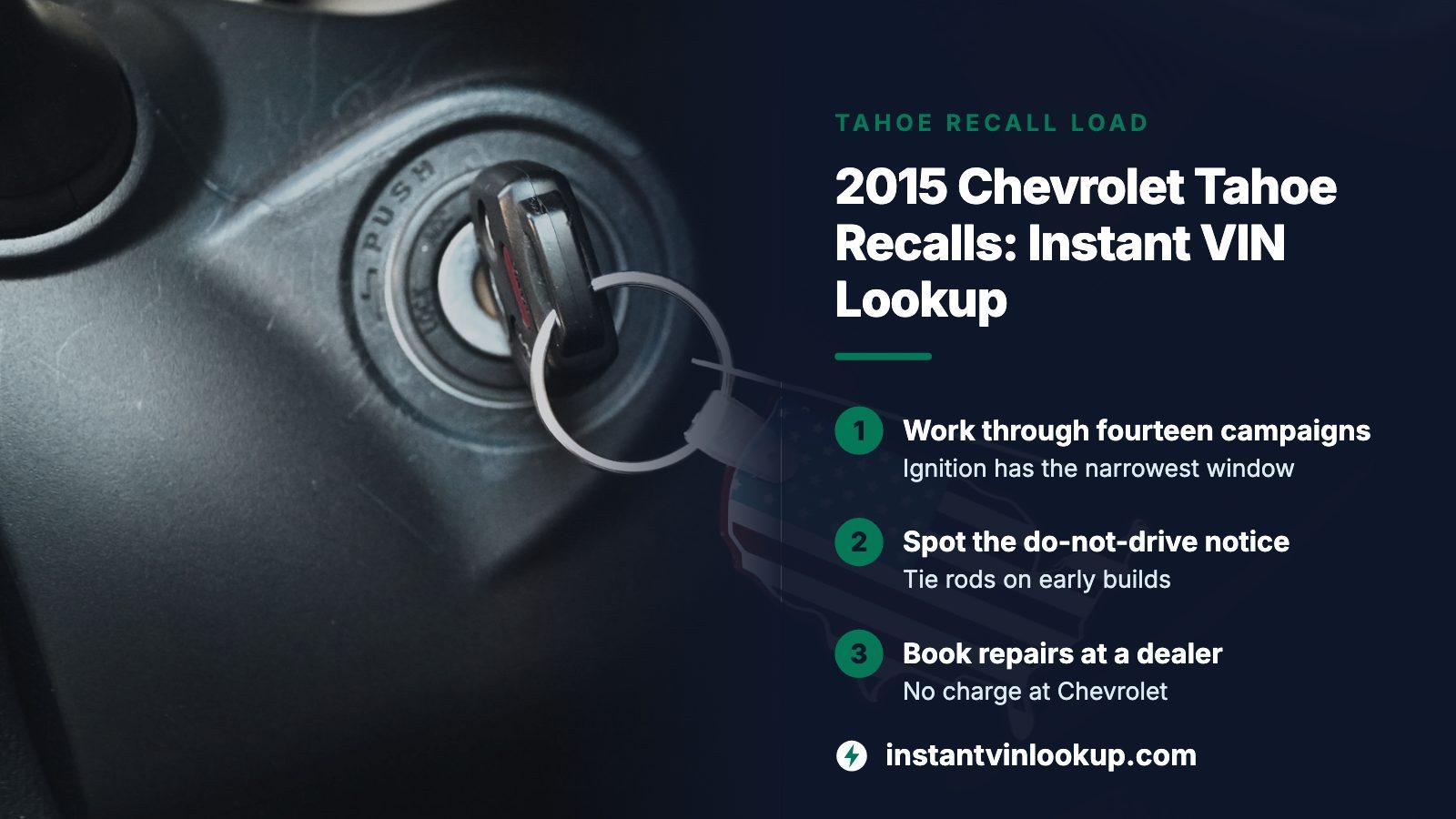
NHTSA lists 14 recall campaigns for the 2015 Chevrolet Tahoe, covering steering, brakes, air bags, seat belts, the ignition, the transfer case and a transmission cooler line. Build dates and equipment decide which reach one Tahoe, so the VIN settles it. A Chevrolet dealer does the repair at no charge. Run the VIN, read the preview, and get dealer paperwork for anything the seller calls done.
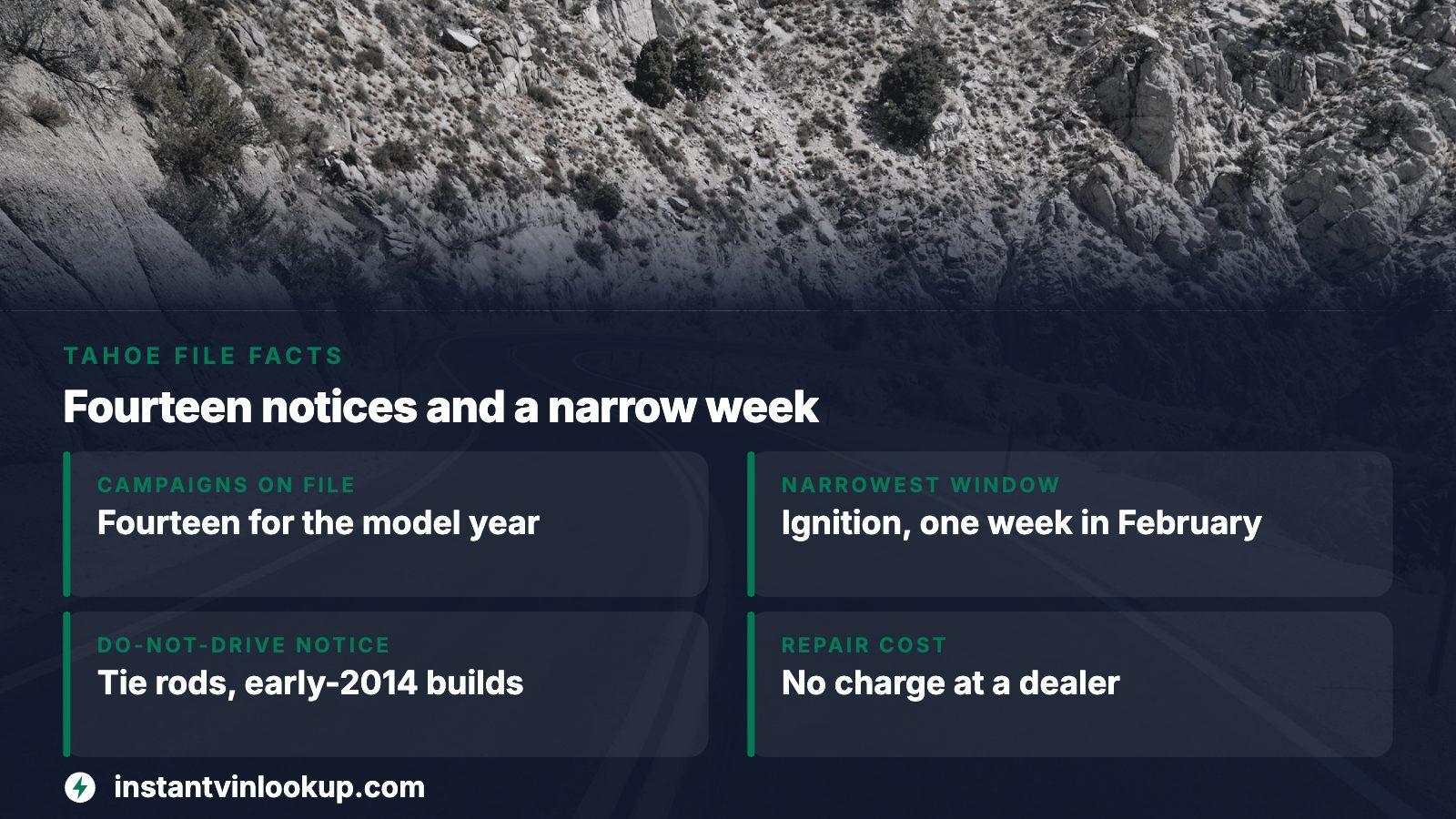
- Campaigns on file
- 14 for the 2015 model year
- Narrowest window
- 15V640000, ignition, Tahoes built February 6 to 13, 2014
- Do-not-drive notice
- 14V246000, tie rods, early-2014 builds
- Repair cost
- No charge at a Chevrolet dealer
What an instant lookup tells you about one 2015 Tahoe
An ad says 2015 Chevrolet Tahoe. The VIN says which Tahoe: when it was assembled, how it is equipped and what has been recorded against it. Those details decide which of the 14 campaigns were aimed at the vehicle, and the lookup matches them in seconds. Type the 17 characters and read the free preview before deciding on the report.
Open recalls come back quickest, but they are one slice. The paid report also covers title brands, crash and damage history, odometer readings and past owners, none of which a recall list holds. On a full-size SUV that may have towed, hauled a family or worked in a fleet, those can matter as much as any notice.
Getting the VIN right before you type it
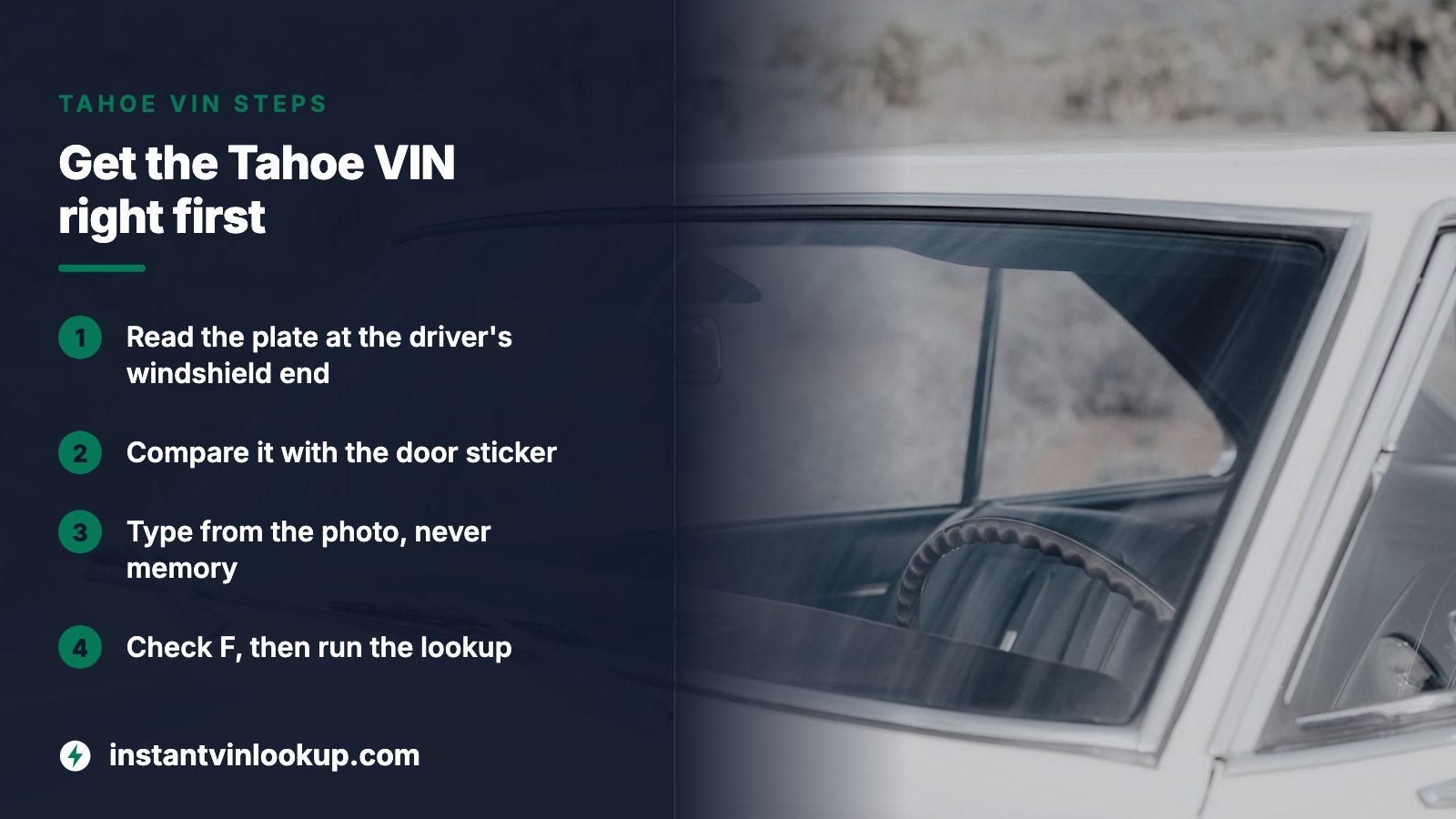
- Step to the driver's end of the windshield and peer through the glass at its lowest corner, where a small metal plate carries the number.
- Photograph it and compare it with the sticker in the driver's door opening and with the title. A mismatch deserves a direct question to the seller.
- Type from the photo, not memory. A character that looks like I, O or Q is a digit, because the format leaves those letters out.
- Check the tenth character. A 2015 model shows the letter F there, and anything else suggests the ad has the year wrong.
- Run the lookup and hold the decoded engine, drive and trim against the SUV. Several campaigns depend on equipment.
All 14 campaigns, grouped by the part involved
Condensed from NHTSA's notices. Any campaign number can be pasted into the federal recall search.
| Part | Campaigns | What the notice describes |
|---|---|---|
| Steering | 14V246000, 14V719000, 18V586000 | Tie rods possibly under-tightened on early-2014 builds; a module fault that can drop power assist suddenly; assist that cuts out briefly and returns with a jolt. |
| Brakes | 19V645000, 19V761000 | A vacuum pump that weakens and stiffens the pedal; a wheel-speed sensor fault that can brake one side, limited to 5.3 liter four-wheel drive builds with a 3.08 rear axle. |
| Front air bags | 16V651000, 17V437000 | Module software that can run a diagnostic during which bags and belt pretensioners would not fire. The later notice reaches cars whose first repair fell short. |
| Roof-rail air bags | 14V451000 | Tahoes built May 13, 2014; the bags may tear on roof carrier hardware. |
| Seat belts | 18V291000, 21V245000 | A driver pretensioner cable that can fatigue and separate. The first named police and special-service units; the second reaches cars given a wrong replacement cable. |
| Ignition | 15V640000 | A lock actuator that can bind or stick in start, for builds of February 6 to 13, 2014. |
| Transfer case | 14V374000 | A short that can shift a four-wheel drive case into neutral unprompted. |
| Transmission | 14V152000 | A six-speed automatic whose cooler line may be unseated, letting oil reach a hot surface. |
| Radio software | 14V301000 | A base radio with a built-in amplifier that can go silent, taking the door and belt chimes with it. |
Why a Tahoe's build week matters more than its model year
Some campaigns are tiny. Ignition notice 15V640000 names Tahoes assembled across about one week of February 2014. Tie rod notice 14V246000 runs from late January to late March 2014, and it told owners not to drive until a dealer had inspected the steering. A Tahoe built in summer sits outside both.
Wider campaigns still say certain vehicles. The brake vacuum notice names 2015 through 2018 Tahoes and their sister trucks, yet not every one qualifies.
From an NHTSA owner complaint
An owner who filed in December 2024 described a brake pedal that went hard at low speed and stops that took longer. They read about the vacuum pump recall, felt sure it matched, then typed the VIN into the recall site and was told the Tahoe was not included. A repair quote above $700 was waiting.
A matching symptom does not put a car inside a campaign. The VIN result is the answer that counts, and an uncovered fault is a cost to price into the offer.
When the first repair was not the last notice
Two pairs on the list show a pattern. Front air bag notice 16V651000 was followed by 17V437000 because some repaired cars lacked the full software update. Seat belt notice 18V291000 was followed by 21V245000 because some cars received the wrong replacement cable. A repaired status therefore needs a second look: ask which campaign was done and what was changed.
From an NHTSA owner complaint
A Tahoe owner who purchased the SUV used in 2021 filed in March 2026 about power steering trouble. Chevrolet told them its system showed a recall performed in 2019, before the purchase. The owner said they had no idea what work had been done on the SUV before it became theirs.
A seller's memory is not a record. The lookup shows repair status before the keys change hands.
Open, repaired or not aimed at this Tahoe
- Open: the campaign reaches this VIN and no repair is on record. Book it with a Chevrolet dealer at no cost, or make it a condition of the sale.
- Repaired: a dealer repair is recorded. Match the paperwork to the campaign and the part.
- Not aimed at this Tahoe: the VIN falls outside the build window or equipment limits. That closes the campaign, not the symptom.
Raise a direct question when you see a seller who says everything was done without dealer paperwork, a mailed notice treated as the repair, an open air bag campaign beside damage entries, or decoded specs that disagree with the SUV.
From an NHTSA owner complaint
An owner who filed in April 2026 saw a brake failure message at about 60 mph, and the Tahoe stopped by itself. The dealer diagnosed a failed brake control module that needed replacing, and the SUV was repaired. The owner linked the failure to campaign 19V761000, and the dealer said that recall repair was done in June 2020. The mileage was 134,916.
A completed campaign fixes the condition its notice describes, not the whole system. Brakes and steering on a Tahoe this age still deserve a mechanic's test drive.
What the 663 owner complaints add
The complaint file is separate: unverified owner reports, where one event can produce several. When this page was prepared NHTSA held 663 for the 2015 Tahoe, with service brakes the largest group at about 30%. The word recall, in some form, shows up in 145 of these reports, some from owners who found a campaign and some asking why none covers their fault. A campaign exists only where the maker has acknowledged a defect, so a repeated complaint with no notice still belongs on a mechanic's checklist.
Cost, then what to do with the result
The preview is free and always comes first. Past the preview you buy a report once, or a set of 3, 5 or 10 when several Tahoes are on your list. No subscription. Current prices live on the pricing page. The recall repair itself costs the owner nothing.
- Open campaign: book the dealer repair with the campaign number, or ask for the work as a condition of sale.
- Seller says it is done: ask for the work order and compare it with what the notice says was replaced or reprogrammed.
- Early-2014 build: confirm the steering and ignition campaigns by VIN before anything else.
- Clean result: still have a mechanic test the pedal and the power steering, and ask to see service records.
Where this information comes from
- NHTSA: Recalls — The federal recall search, where each campaign number above can be looked up by VIN.
- NHTSA owner complaint 11629323 — owner experience, paraphrased
- NHTSA owner complaint 11727015 — owner experience, paraphrased
- NHTSA owner complaint 11729416 — owner experience, paraphrased
- U.S. Code: 49 U.S.C. 30120, remedies for defects — The statute behind the no-charge repair, including the 15-year limit counted from first sale.
- Department of Justice: NMVTIS vehicle history — The national title record, which holds brands that a recall list never shows.
Sources and photos: Facts checked against the sources above in November 2026. Photos by Jake Kling, Wesley Tingey and Will Truettner on Unsplash; diagrams by InstantVINLookup.
Keep reading
- VIN Lookup: Check a VIN Number on a Car Before You BuyHow the lookup and its preview work for any vehicle, not just this Tahoe.
- Where Is the VIN Number? Find It in a Minute, Then Verify ItOther places a VIN is stamped when the windshield plate is hard to read.
- Airbag Deployed Check: Spot a Hidden Deployment From the VINTwo Tahoe campaigns concern air bag software, so deployment history is worth checking.
- 2015 GMC Sierra 1500 Recalls: Enter the VIN, See What AppliesThe same recall question for a related GM pickup, since several campaigns here also name it.
Frequently asked questions
How many recalls apply to a 2015 Chevrolet Tahoe?
NHTSA lists 14 campaigns for the model year, the oldest filed in March 2014 and the newest in April 2021. Many also cover other GM trucks and SUVs. The VIN shows which apply to one Tahoe.
Is there a recall for a hard brake pedal on a 2015 Tahoe?
Yes, 19V645000, for a vacuum pump that weakens over time, fixed by reprogramming the brake control module. It covers certain 2015 to 2018 Tahoes, so run the VIN. If the result says not included, a stiff pedal still needs a diagnosis.
Does Chevrolet charge to fix a recalled Tahoe?
No. The maker carries the cost, with a federal cutoff of 15 calendar years from first sale, and a 2015 Tahoe is still inside it. If a dealer refuses, ask for the reason in writing and report it to NHTSA.
Can I check a Tahoe's recalls before I go to see it?
Yes. Message the seller for the VIN or a sharp photo of the plate and run the lookup from home. The preview costs nothing, so you arrive knowing what to ask.
Did any 2015 Tahoe recall tell owners to stop driving?
One did: 14V246000, for Tahoes built late January to late March 2014, where a tie rod could separate from the steering rack. Owners were told not to drive until a dealer inspected.
Now check the car itself
The guide explains what to look for. The report shows what this VIN has on record.