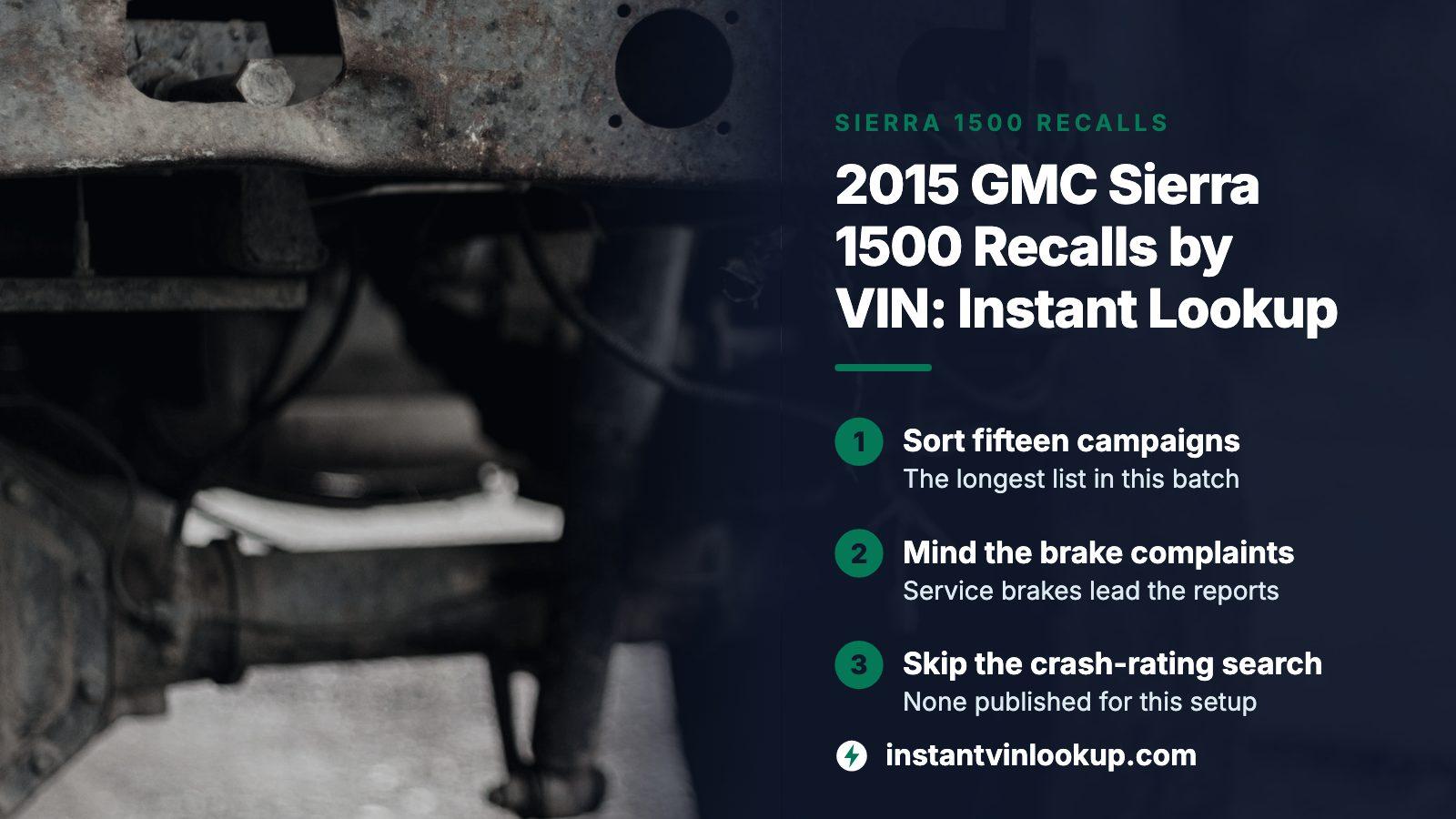
THE SHORT ANSWER
NHTSA lists 15 recall campaigns for the 2015 GMC Sierra 1500, from rear axle shafts and steering assist to air bag inflators and seat belts. The VIN decides which of them reach a specific truck, since each campaign names a production range. Dealers repair recalled trucks at no charge; run the VIN, then ask for dealer paperwork behind any campaign called done.
- Campaigns on file
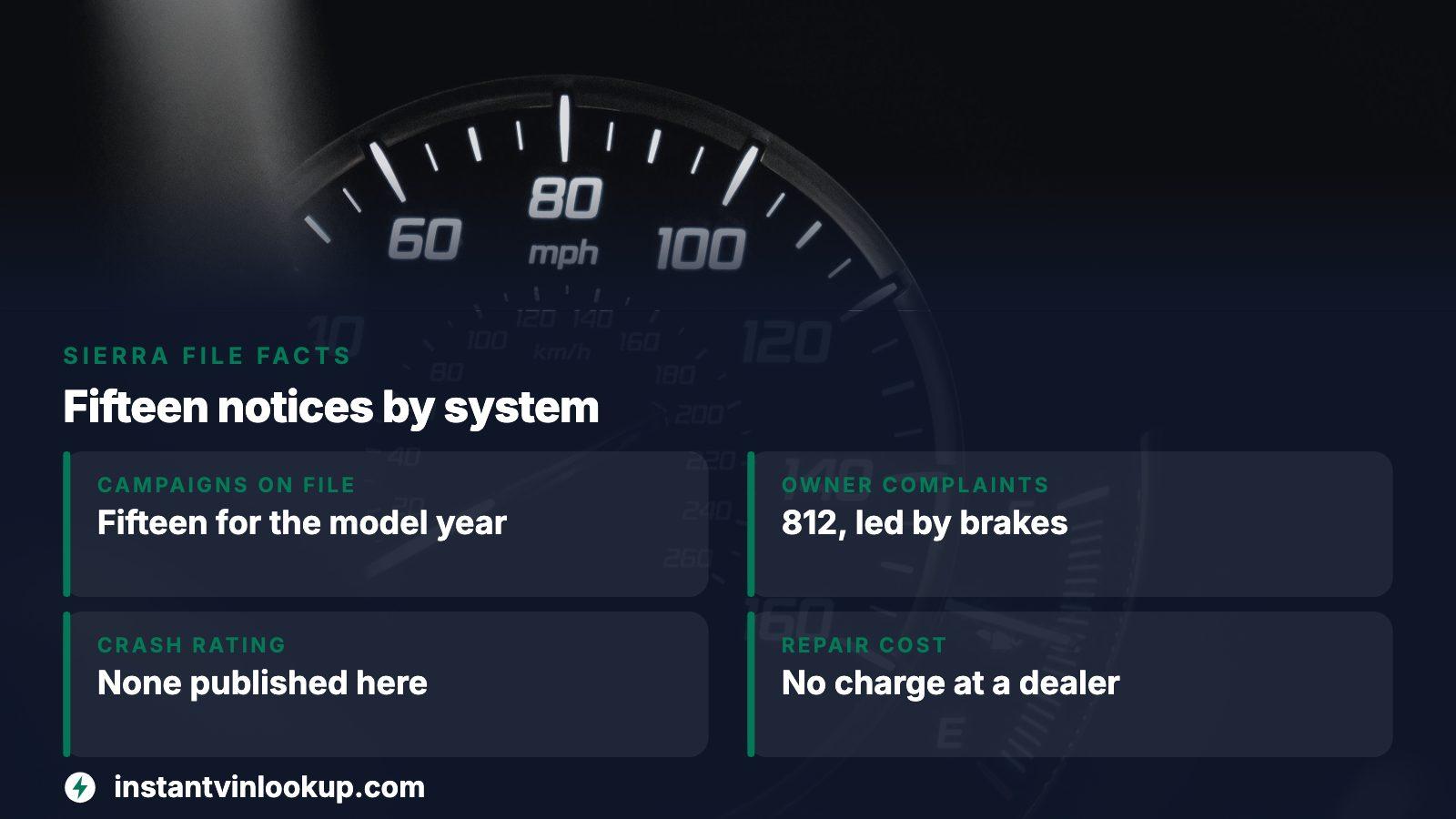
- 15 for the 2015 model year
- Owner complaints
- 812, led by service brakes at 30%
- Crash-test rating
- None published for this configuration
- Repair cost
- No charge at a franchise dealer
What an instant lookup shows for one 2015 Sierra 1500
The lookup works from the one identifier that belongs to a single truck: its VIN. Enter the 17 characters and the free preview comes back in moments, counting the records held for that Sierra before you pay anything. NHTSA files 15 campaigns under the model year, and the lookup shows which were aimed at the truck in front of you.
Open recalls are one slice of the full report, which also speaks to the title, past damage and mileage.
Five steps from the dash plate to a recall answer
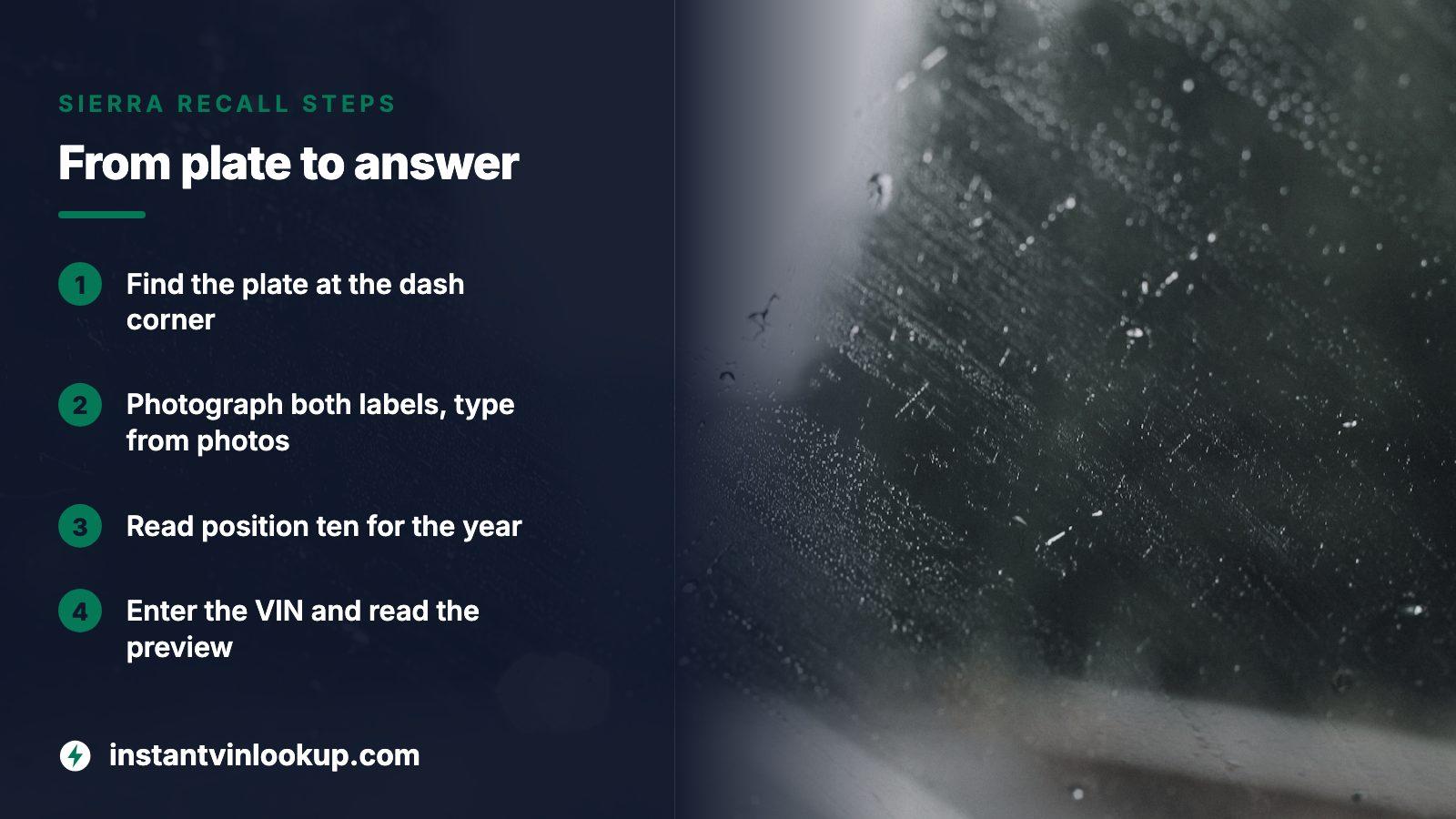
- Find the plate in the driver-side corner of the dash, readable from outside the glass; the door-jamb sticker repeats the number.
- Photograph both and type from the pictures. One wrong character sends the lookup to another truck or to nothing.
- Position ten of the VIN encodes the year of manufacture, so match it to the ad and raise any gap with the seller.
- Enter the VIN and read the preview, which costs nothing and shows what records exist before you decide on the report.
- Match the decoded cab, bed, engine and drive to the truck; some campaigns hinge on equipment such as four-wheel drive.
From an NHTSA owner complaint
A 2015 Sierra owner told NHTSA the truck had just been bought used from a dealer. In May 2025, pulling a small empty trailer into a fuel station, the brake pedal became impossible to press, and the truck barely missed the pumps before landing in a ditch. The dealer's service department found no fault, and the owner says no recall bulletin was mentioned.
A dealer saying the brakes are fine is not the same as the recall file showing nothing open for that VIN. Run it yourself before signing.
Why 15 campaigns does not mean 15 repairs owed
Take the rear axle campaign, 14V819000. GM limited it to Silverado and Sierra 1500 trucks assembled on just two days, November 24 and 25 of 2014. An improper heat-treatment left some rear axle shafts able to fracture under way, and a broken shaft can let the wheel separate. A Sierra built on any other date sits outside it.
Other campaigns reach wider spans or are shared with other GM trucks, but each notice names a range.
The filter and the thing filtered
A campaign number narrows a model year down. Only the VIN tells you whether this particular truck was narrowed in or out.
Fifteen campaigns grouped by the part involved
Descriptions follow NHTSA's notices, and a bare component name means the file gives no more.
| Part | Campaign numbers | What the file says |
|---|---|---|
| Rear axle | 14V819000 | Improper heat-treatment may fracture a rear axle shaft in motion. Two build days. |
| Roof-rail curtain air bags | 20V736000, 21V504000 | End cap may detach or inflator may rupture. The later campaign supersedes the earlier. |
| Frontal air bags | 16V651000, 17V437000 | Listed as frontal air bags, nothing more. |
| Seat belts | 16V209000, 21V245000 | The second is for the front belts. |
| Steering | 14V719000, 18V586000 | Both: electric power assist system. |
| Brakes | 19V645000, 19V761000 | Brake vacuum assist, and a speed sensor or tone ring used by antilock braking. |
| Seats, exhaust, ignition | 14V446000, 14V007000, 15V640000 | Seats; engine cooling and exhaust; ignition. |
| Transfer case | 14V374000 | Four-wheel drive trucks. |
The roof-rail air bag pair: which number is on the paperwork
Two of the 15 concern the same part. The first notice, 20V736000, warned that a roof-rail inflator could lose its end cap, and gas escaping at that moment can launch the cap into the passenger compartment. It listed Sierra and Silverado 1500 pickups from 2015 and 2016, plus heavier 2015 models.
Later GM replaced it with 21V504000, which also covers a split in the inflator wall, and trucks held under the first now go through the second. In both, the dealer swaps the left and right roof-rail modules and the owner pays nothing.
From an NHTSA owner complaint
In a complaint filed in December 2022, a 2015 Sierra owner said the notice for 21V504000 had arrived but the replacement part could not be had. The owner called the wait longer than reasonable. Nothing had failed on the truck yet.
So a letter received is not a repair done. Ask for the work order and look for roof-rail modules replaced, and if the dealer was still waiting on parts, treat that campaign as open.
Reading the result: open, repaired, or not aimed at this truck
A VIN result sorts each campaign into one of three states.
- Open: the campaign reaches this VIN and no repair is on record. Book it with a franchise dealer, where the work costs nothing.
- Repaired: the campaign applied and a dealer repair is recorded. Still match the paperwork to the part.
- Not aimed at this truck: the VIN sits outside the production range, as with the narrow axle campaign.
From an NHTSA owner complaint
An owner filing in April 2025 cited the brake vacuum campaign, 19V645000. The truck had been repaired under it on September 6, 2019, and the problem had come back. The owner asked NHTSA whether a second recall existed.
A recorded repair closes that campaign for the truck, not the part for good.
Signals that deserve a direct question:
- A seller who says every recall is done but has no dealer paperwork.
- An open air bag campaign on a truck that also shows damage records.
- A mailed notice treated as if it were the repair.
The 812 complaints are a separate file
Recalls are defects the manufacturer has acknowledged. Complaints are unverified owner reports, and one event can produce several. Of the 13 model years NHTSA holds for this truck (2009 to 2022), 2015 ranks second for complaint volume at 1.9 times the median year, and filings peaked in 2019.
Service brakes lead with 243 reports, about 30%, then exterior lighting at 130 and power train at 113. Brake reports typically arrive 4.3 years after the model year, with only 12% in the first three, so they land on later owners. Lighting skews early, 81% inside three years, so a tidy service history may already include that fix.
Across all 812, owners described 29 crashes, 10 fires and 14 injuries. Those are their words, not findings.
What a recall file cannot say about a used Sierra
No crash-test rating is on file at NHTSA for this configuration, which means untested, not poorly rated. Beyond that, the federal file describes the factory, not the life the truck has led: a pickup this age may have towed for a living or sat in a driveway. The full report adds:
- Crashes and damage on record, and any salvage or auction sale, with photos.
- Title brands, liens and impounds, which decide who may legally sell the truck.
- Odometer readings to compare with wear on the pedals and driver's seat.
- Owner history and use type, which separates a commuter from a work truck.
None of it replaces looking under the truck: frame rails and crossmembers for rust, hitch and trailer wiring for wear, rear springs and differential for sag or weeping.
Pricing, then your next move
The preview is free and always comes first. After it you pay once for a report, or buy a pack of 3, 5 or 10 if several trucks are on your list. Prices live on the pricing page.
- Open campaign: have a franchise dealer book the repair, or make it a condition of the sale.
- Seller says it is done: ask for the dealer work order and match campaign number to part.
- Clean result: still have a mechanic check the brakes, lighting and power train before you agree a price.
Where this information comes from
- NHTSA: Recalls — The federal recall search, where the campaign numbers above can be looked up by VIN.
- NHTSA owner complaint 11670475 — owner experience, paraphrased
- NHTSA owner complaint 11496321 — owner experience, paraphrased
- NHTSA owner complaint 11655854 — owner experience, paraphrased
- U.S. Code: 49 U.S.C. 30120, remedies for defects — The statute behind the no-charge repair, including the 15-year limit counted from first sale.
- NHTSA: New Car Assessment Program ratings — The crash-test program behind star ratings, and why some configurations carry none.
- Department of Justice: NMVTIS vehicle history — The national title record, which holds brands that a recall list never shows.
Sources and photos: Facts checked against the sources above in November 2026. Photos by Zoshua Colah, Cole Keister and NATHAN MULLET on Unsplash; diagrams by InstantVINLookup.
Keep reading
- VIN Lookup: Check a VIN Number on a Car Before You BuyHow the lookup and its preview work for any vehicle, not just this Sierra.
- Where Is the VIN Number? Find It in a Minute, Then Verify ItOther spots a VIN is stamped when the dash plate is scuffed or covered.
- Airbag Deployed Check: Spot a Hidden Deployment From the VINRoof-rail air bag notices make a truck's deployment history worth checking.
- 2017 Ford F-150 Recalls: Look Up Your Truck's VIN NowThe same recall question asked of a rival full-size pickup.
Frequently asked questions
How many recall campaigns cover a 2015 Sierra 1500?
NHTSA lists 15 for the model year. Each is tied to a production range, so one Sierra may fall under a few and its neighbor under more. A VIN lookup shows which apply to your truck.
Does a dealer charge to fix a recalled Sierra?
No. Federal law puts the cost of the remedy on the manufacturer, with a cutoff of 15 calendar years from first sale.
Can I run the VIN before I go and see the truck?
Yes. Request the VIN, or a sharp photo of the plate, and run it from home. The preview costs nothing, so you arrive knowing which campaigns to raise.
Did the 2015 Sierra 1500 get a government crash-test rating?
Not in this configuration. NHTSA tests only certain configurations each year, so the gap means untested, not failed. Recall and complaint files are what exists, and both still need a hands-on inspection.
Which part of the 2015 Sierra draws the most owner complaints?
Service brakes, with 243 of the 812 reports, roughly 30%. Next come exterior lighting at 130 and power train at 113. None of it is verified, but a tight cluster tells a mechanic where to start.
Now check the car itself
The guide explains what to look for. The report shows what this VIN has on record.