THE SHORT ANSWER
NHTSA files 18 recall campaigns under the 2017 Ford F-150, spanning air bag inflators, seat belt pretensioners, door latches, block heater cables, transmissions and brakes. Each campaign reaches only some production ranges, so the VIN settles which ones a particular truck owes. Repairs cost nothing at a Ford dealer. Run the number first, then ask for proof of any campaign the seller calls finished.
- Campaigns on file
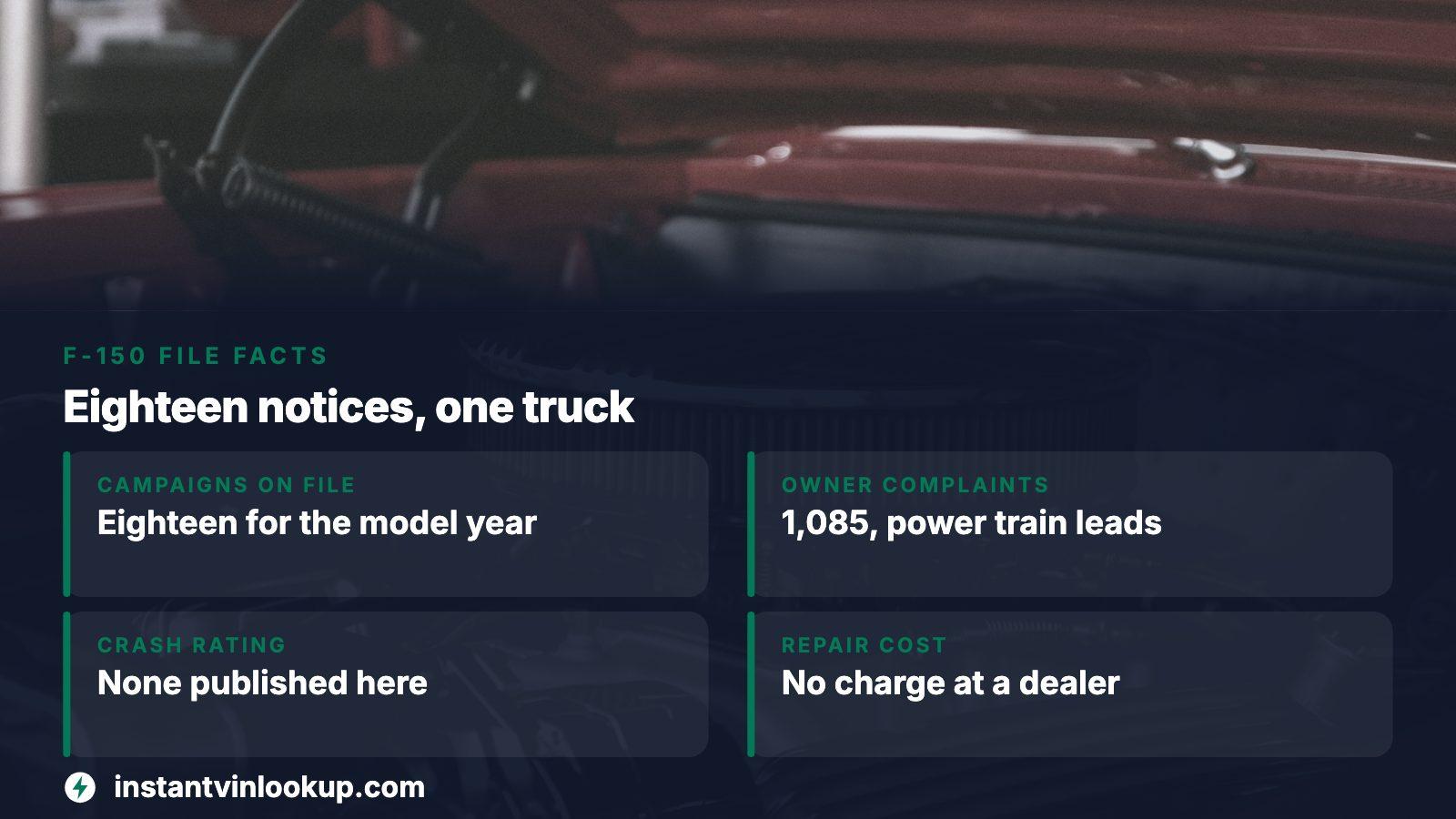
- 18 for the 2017 model year
- Owner complaints
- 1,085, led by power train at 27%
- Crash-test rating
- None published for this configuration
- Repair cost
- No charge at a franchise dealer
Eighteen campaigns, one truck: why the VIN decides
Search this model year and you get a pool of 18 campaigns. Each is written around a production span, a cab style or an option such as an engine block heater. One 2017 F-150 can sit inside several while a neighbor on the same lot sits inside only a couple, and the model year alone cannot say which.
That is the case for looking up the number instead of reading a list. Type the 17 characters into the lookup on this site and the free preview reports how many records are held for that truck. The full report then opens the detail.
From an NHTSA owner complaint
A 2017 F-150 owner told NHTSA that the air bag warning light came on and the dealer blamed the clock spring. The owner linked it to a campaign in that area, 23V847000, yet was told this truck's VIN was not covered. Ford offered no help by phone.
A campaign existed nearby and the truck was still left out, because notices follow VIN ranges. Only the number shows which side of the line a pickup sits on.
Running the lookup on a 2017 F-150, step by step
It takes a few minutes and goes best with the truck in front of you.
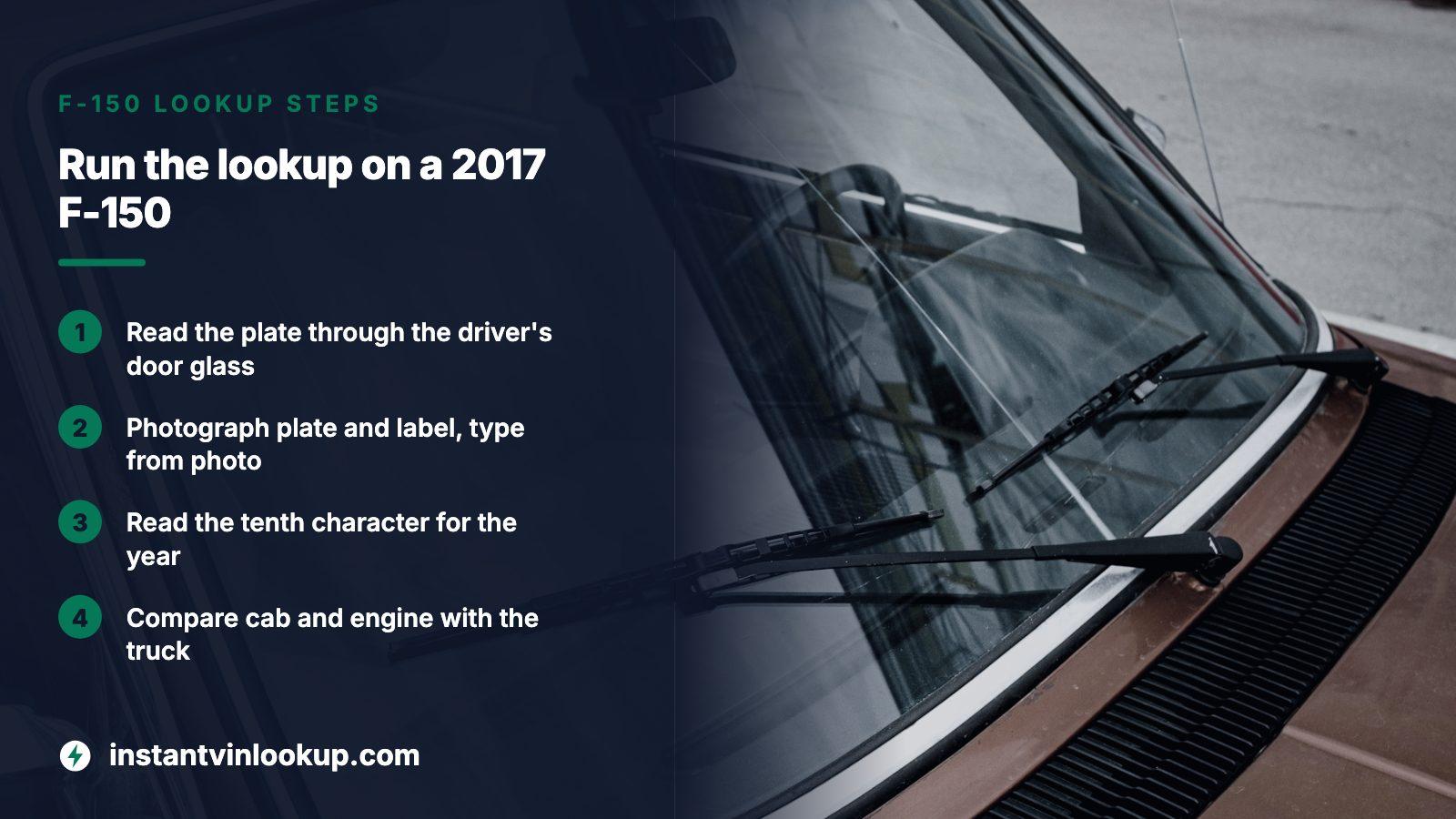
- Find the VIN. Stand outside the driver's door and look through the windshield: the plate sits in the dash corner. The label in the door jamb repeats it, and so do the title and the insurance card.
- Photograph the plate and the label, then type from the photos. The number has 17 characters and never contains I, O or Q.
- Read the tenth character, which encodes the model year, and check that the decode agrees with the listing.
- Enter the number in the lookup and read the preview before deciding anything else.
- Compare the decoded cab style and engine with the truck itself. Campaigns split on exactly those details.
The campaigns on record, grouped by what failed
Some notices below carry written descriptions; the rest are listed by component only.
| Campaign | System | What the notice says can happen |
|---|---|---|
| 17V529000 | Passenger air bag inflator | The inflator may rupture in a crash and throw metal fragments at occupants. Certain 2017 F-150 and Mustang. |
| 18V568000 | Front seat belt pretensioner | After a crash deployment, sparks can ignite carpet or insulation near the B-pillar. Regular Cab and SuperCrew. |
| 17V652000 | Door latches | A kinked cable, or a latch frozen with water inside, can let a door open while the truck moves. |
| 18V894000 | Engine block heater cable | Water in the splice connector corrodes it, which raises fire risk while the heater is plugged in. |
| 20V332000 and 25V236000 | Brake master cylinder | Filed under hydraulic brake foundation components. |
| 21E027000 | Front upper ball joint | Filed under the front suspension control arm. |
The other eleven include the repeat heater notice, seat recliner and seat items, rear seat belts, a second door latch campaign, four transmission items, brake power assist and the instrument cluster.
The block heater pair: check what was actually done
Two campaigns concern the block heater cable, and they are linked. The first, 18V894000, deals with corrosion at the cable splice. The second, 19V278000, exists because the first repair could itself have damaged the splice on some trucks. Ford's own reference numbers are 18S45 and 19S11.
Both remedies run in two stages: the dealer disables the heater, and a replacement cable follows once parts exist. From the driver's seat an unplugged heater looks the same as a repaired one, so ask whether a new cable went in and ask to see the invoice.
From an NHTSA owner complaint
One owner reported that the dealer finished Ford's transmission recall for limp mode and sudden downshifts, but "the fix did not work." On the return visit the dealer said the stored code did not qualify for the part replacement, which left the owner looking at a repair of about $1,200.
A closed recall proves a work order exists, not that the symptom is gone. On a test drive, listen for limp mode and sudden downshifts.
Reading the result: open, waiting on parts, or absent
A recall result for one VIN falls into three groups, and only the first two need action.
- Open: the campaign reaches this VIN and no repair is recorded. Book it with a Ford dealer. The work costs nothing.
- Waiting on parts: the campaign applies but the final fix has not shipped, as with the heater cables.
- Absent: the campaign is not listed for this VIN, either because it was repaired or because the truck sits outside its production range.
From an NHTSA owner complaint
An owner told NHTSA that a notice arrived for brake master cylinder campaign 25V236000, but several calls to the dealer brought only word that parts were on backorder. The owner paid an independent shop for the swap, and Ford refused reimbursement because parts were available.
Open and unrepairable can be the same state for a while, so ask the dealer whether parts exist. Answers from the seller that need a follow-up:
- Every recall is said to be done, but no dealer paperwork exists.
- An open air bag inflator campaign on a truck that has also had a collision.
- A block heater cord that is cut, taped or unplugged with no invoice.
The 1,085 complaints are a different file
A recall means the manufacturer itself admits a defect. A complaint is an owner report to NHTSA, unverified, and one incident can produce several. The 2017 F-150 has 1,085 of them.
Power train leads with 296 reports, about 27%, followed by engine with 266, about 25%. Across the set, 37 describe a crash, 19 a fire and 32 an injury. Read the numbers as a reading list for your mechanic, not a verdict on the truck.
The fire reports sit beside the heater campaigns, so inspect the wiring under the hood for scorching, softened insulation or hand-twisted repairs.
What a recall list cannot tell you about a used pickup
A recall list describes the factory, not the truck's life. It cannot say whether the F-150 was wrecked, rolled back on the odometer, branded, financed or worked hard for a living. The paid report on this site picks up where the recall file stops, and four of its sections matter most on a pickup.
- Use type: a work or fleet past ages a pickup differently from a commute.
- Odometer readings: set the reading beside the wear on the pedals and the driver's seat.
- Accident and damage records: the air bag and belt notices both describe what happens in a crash.
- Liens and title brands: they settle who can legally sell the truck.
Cost, and your next move once you have the answer
Looking at the preview costs nothing; buying the report is one payment. You can take a single report, or a 3, 5 or 10 pack if several F-150s are on your shortlist. No subscription is involved. Prices sit on the pricing page, and the preview always comes first.
- Open campaign: ask a Ford franchise dealer to book the repair, or make it a condition of the sale.
- Seller says it was done: ask for the dealer invoice and match the campaign number.
- Heater disabled, cable pending: ask whether the replacement has been fitted.
- Clean result: still have a mechanic check power train and engine first, because the complaint file points there.
Where this information comes from
- NHTSA: Recalls — The federal recall search, where the campaign numbers and notices for a VIN can be confirmed.
- NHTSA: Vehicle safety and consumer complaints — Where owner complaints are filed, and the source of the complaint counts used above.
- NHTSA: New Car Assessment Program ratings — The crash-test program behind star ratings, and why some configurations carry none.
- Department of Justice: NMVTIS vehicle history — The national title record, which holds the brands that a recall list never shows.
- NHTSA owner complaint 11763620 — owner experience, paraphrased
- NHTSA owner complaint 11772630 — owner experience, paraphrased
- NHTSA owner complaint 11773145 — owner experience, paraphrased
Sources and photos: Facts checked against the sources above in November 2026. Photos by Zoshua Colah, Max Tokarev and Victor Hughes on Unsplash; diagrams by InstantVINLookup.
Keep reading
- VIN Lookup: Check a VIN Number on a Car Before You BuyHow a VIN lookup works for any vehicle, and what the preview adds.
- Where Is the VIN Number? Find It in a Minute, Then Verify ItEvery place a VIN is stamped, for when the dash plate is hard to read.
- Airbag Deployed Check: Spot a Hidden Deployment From the VINHow to tell whether a truck's air bags have already gone off.
- NHTSA Investigation Check: Look Up a Model, Then Run the VINOpen federal investigations, a step before a recall exists.
Frequently asked questions
Which recall campaigns reach a 2017 F-150 pickup?
NHTSA lists 18 campaigns for the 2017 F-150, tied to production ranges, so one truck may fall under a few and another under more. A VIN lookup shows which apply to yours.
Does Ford charge to fix a recalled F-150?
No. Ford is obliged to correct a recalled defect without billing the owner, and the work happens at a franchise dealer. The repair follows the truck, so a notice a previous owner ignored is still open for you. Parts can lag, so ask about timing.
How was the 2017 F-150 rated in crash tests?
NHTSA gives this configuration no crash-test rating. It tests only a subset of configurations in a model year, so no rating means untested, not failed. The recall and complaint record is the federal safety information that exists for it.
How do I verify a seller's claim that the recalls are finished?
Ask for the dealer paperwork and match each campaign number against it. A mailed notice is not a repair, and a heater that was only disabled is a partial fix. Run the VIN before the test drive.
What else do owners report besides power train and engine?
Owners filed 135 reports under unknown or other, 104 under structure and 94 under electrical. Structure reports tend to arrive early: half were filed within three years of the model year, which puts many inside the original warranty.
Now check the car itself
The guide explains what to look for. The report shows what this VIN has on record.