THE SHORT ANSWER
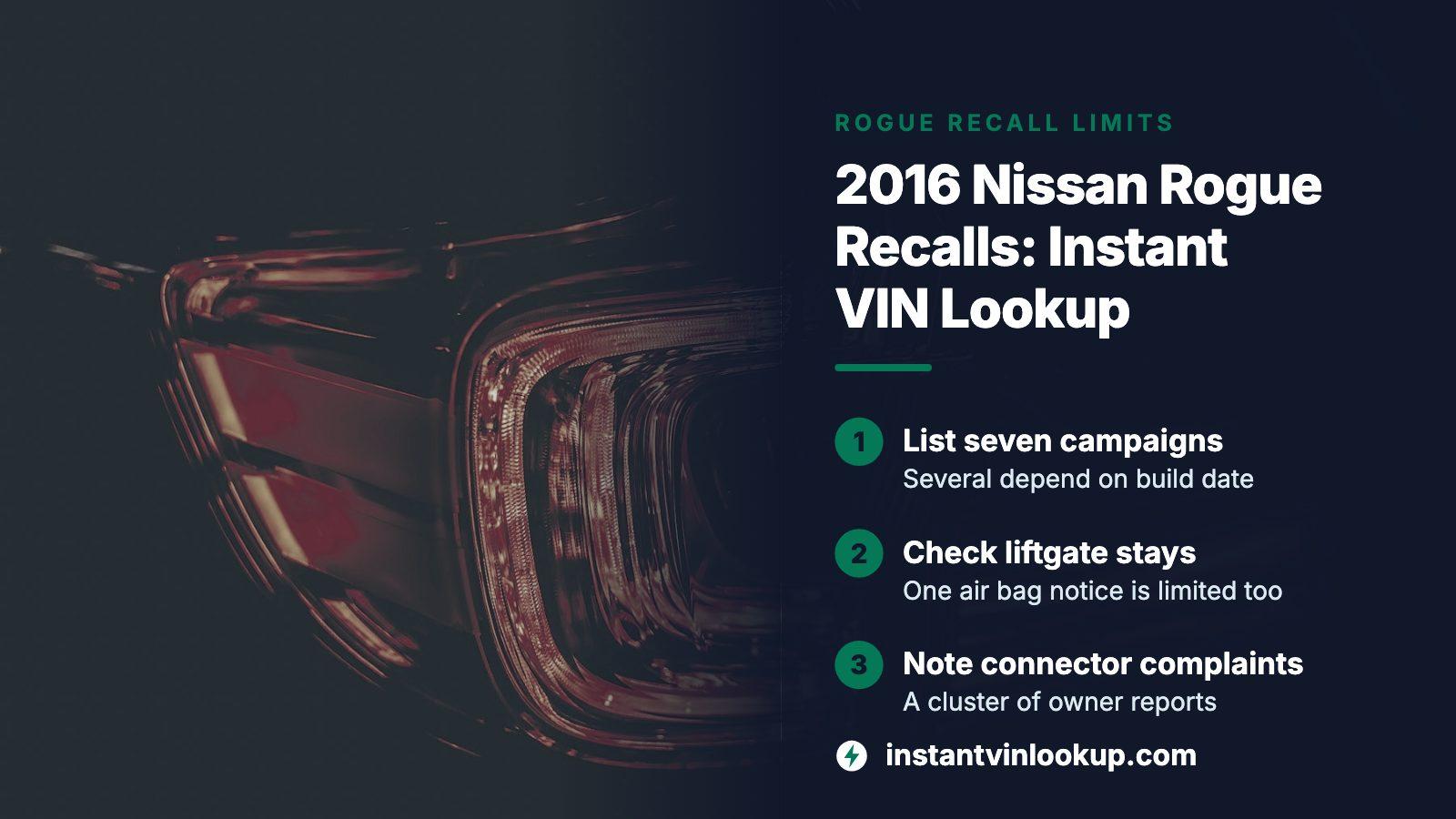
Seven campaigns cover the 2016 Rogue: seat frame welds in front, recliner welds in back, two on the passenger occupant sensor, liftgate support stays, a corroding under-dash connector and the folding ignition key. Build dates narrow some of them. Typing the VIN into a lookup tells you which reach one car and whether a repair is recorded. Dealers make these repairs without charging the owner.
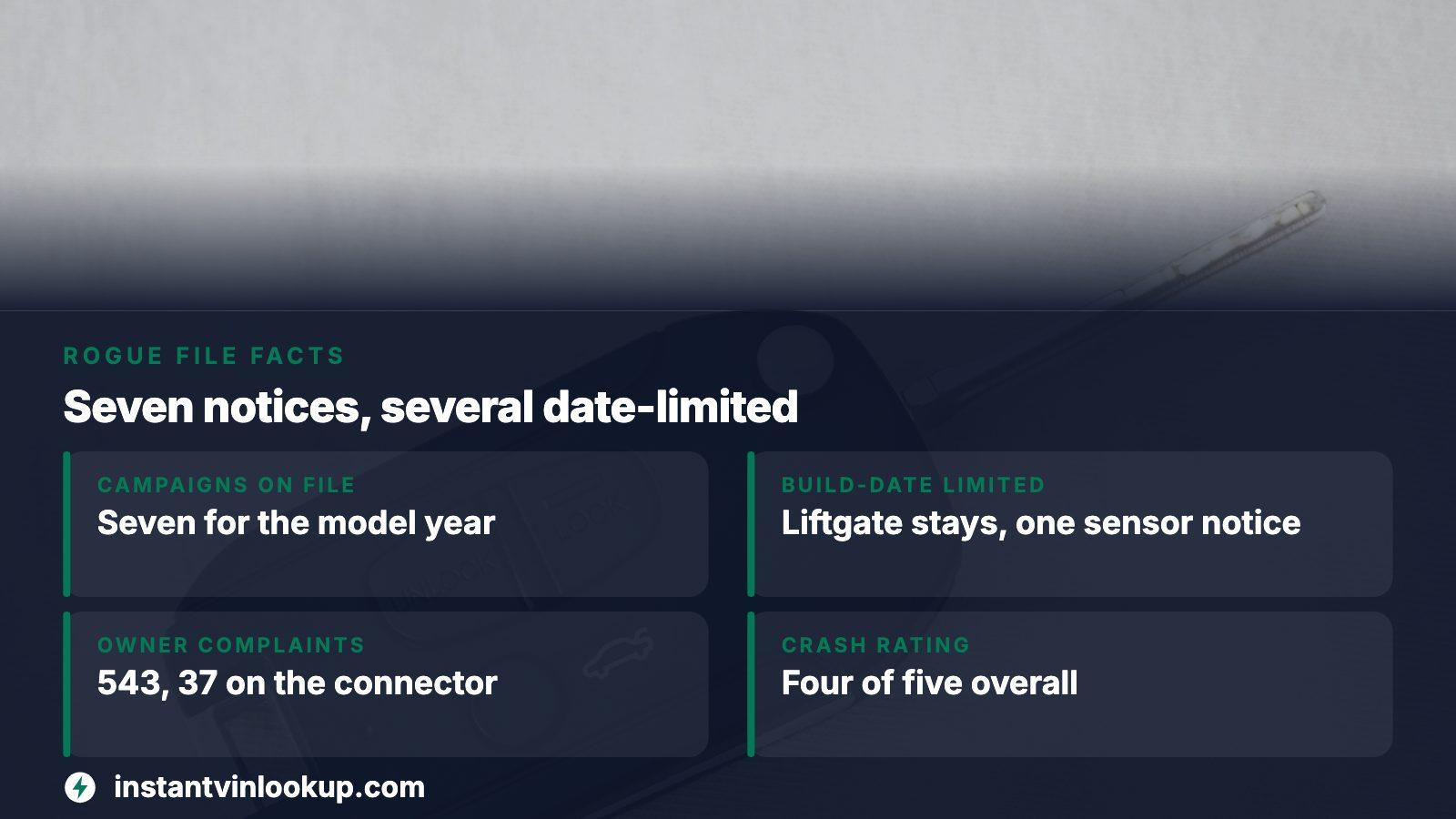
- Campaigns on file
- 7 for the 2016 model year
- Limited by build date
- Liftgate stays and one air bag sensor campaign
- Owner complaints
- 543, with 37 naming the connector campaign
- NHTSA crash rating
- 4 of 5 stars overall
The seven campaigns and the Rogues each one reaches
Each number works in NHTSA's recall search. Reach follows NHTSA's campaign records; whether one VIN sits inside is the lookup's job.
| Campaign | Problem | Reach |
|---|---|---|
| 17V716000 | Front passenger seat frame welded badly | Certain 2016 Rogues |
| 17V663000 | Rear recliner joints weakly welded | Certain 2016 and 2017 Rogues |
| 16V244000 | Passenger sensor may misclassify the occupant and switch off the front air bag | 2014 to 2017 Rogues and many other Nissan and Infiniti models |
| 16V911000 | Mismatched sensor unit and seat may misjudge the occupant | 2015 and 2016 Rogues built October 14, 2014, through August 12, 2016, plus some Altimas and Maximas |
| 16V219000 | Liftgate support stays corrode | 2014 to 2016 Rogues built July 31, 2013, through January 16, 2016 |
| 22V024000 | Under-dash connector corrodes after water and salt reach the driver's footwell | 2014 to 2016 Rogues |
| 23V093000 | Folding-style key may collapse while driving and stop the engine | 2014 to 2020 Rogues and 2017 to 2022 Rogue Sport models with that key |
Why the model year alone settles nothing
A listing that says 2016 Nissan Rogue describes a spread of cars, and campaigns are written against narrower spreads. The liftgate campaign stops at cars built January 16, 2016, so a later 2016 build sits outside it, while 16V911000 runs on its own dates.
From an NHTSA owner complaint
Filing in June 2021, an owner said the rear liftgate had come down on their head several times, with no warning first. The owner bought the car in July and read the liftgate campaign as ending in January 2016, so believed it was excluded. Nissan, the owner said, would not inspect it at its own cost once warranty ended.
The complaint cannot confirm whether that car truly sat outside the window, and a buyer should not guess. A lookup applies the production date to the VIN before money changes hands.
Running the lookup on a Rogue
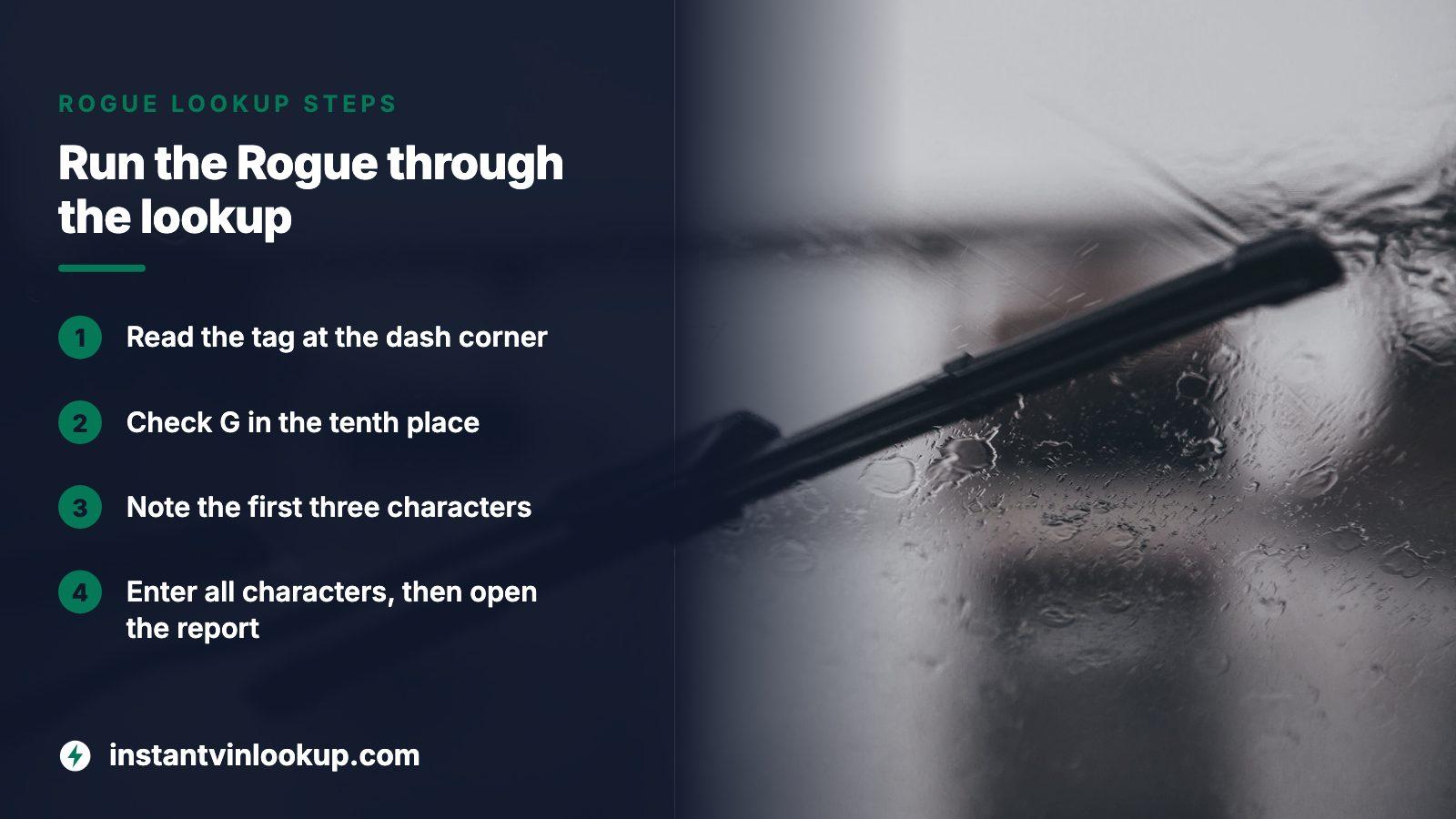
- Copy the Rogue's VIN off the small dashboard tag by the windshield, then check that it matches the sticker inside the driver's door. A mismatch is a reason to stop.
- Check the tenth character. A 2016 model shows G, as almost every VIN in NHTSA's complaint file for this year does. Another letter means a typo or a wrong listing.
- Note the first three characters. Most 2016 Rogues in that file start 5N1 or KNM and a smaller share start JN8, which points to more than one assembly source.
- Enter all 17 characters. The preview reports the open recall count and which record types exist, before any payment.
- Open the report if the preview looks promising: it names each open recall beside the title, damage and mileage entries.
Open, done or outside: what each answer means
- Open: the campaign reaches this VIN and no repair is recorded. Ring a Nissan service department, give the VIN plus the campaign number, and find out if parts are in stock.
- Done: a repair is recorded. Ask for the work order, and for the connector campaign find out what was replaced.
- Outside: the build date or model year falls beyond the campaign. That answers a paperwork question and says nothing about wear.
- Tied to equipment: the key campaign follows the key style, which a VIN cannot reveal. Inspect the key itself.
The wet-footwell connector campaign and what done really covers
Of the seven, 22V024000 is the one owners cite most: by a count of the text, 37 of the 543 complaints for this model year name it. The fault starts when water and salt reach a connector beneath the dash at the driver's footwell. NHTSA's record lists failing power windows and seats, a warning light for the all-wheel-drive system, a flat battery and, at worst, fire. The remedy is two new connectors, greased where needed.
From an NHTSA owner complaint
Filing in December 2022, an owner described a dealer visit for this campaign. A month on, the Rogue would not start; a new battery revived it, but a warning message appeared and the alarm kept going off. While the car warmed up, the owner's husband noticed a burning smell, then smoke from the driver's footwell and flames, which he smothered with a cloth and snow. No one was hurt. The owner said the repair had not worked.
A completed entry proves a dealer visit, not a dry footwell. On a test visit, press the carpet by the pedals, sniff for damp, and ask who did the connector work.
The folding-key campaign and a dealer who balked
Campaign 23V093000 covers Rogue and Rogue Sport models with a jackknife-style key that can fold shut while the car moves. A folded key can cut the engine, and the air bags may then fail to deploy. Dealers fit a spacer in the key's slot.
From an NHTSA owner complaint
Filing in February 2024, an owner said a dealer agreed to handle the key campaign, then decided the spacer would stop the car starting and quoted around $300 for a new key. The owner called the key only about three months old and blamed the campaign for both keys misbehaving. The dealer left things as they were.
The campaign follows the key, not the car, so a VIN cannot say whether the spacer went in. Check every key you are handed.
What a recall list leaves out about a used Rogue
Campaigns cover defects a maker has acknowledged; complaints show where else trouble turns up. In NHTSA's file for this year, the power train tops the count at 176 entries and the electrical system follows at 125, yet no campaign names the transmission or engine. Complaints are unverified, so read them as hints for a mechanic.
A clean campaign record also says nothing about the car's own past: a brand on the title, collision damage, mileage readings. A damp footwell can be the connector fault or a sign the car sat in water, and flood or salvage records would appear in those entries.
Repair cost and the 15-year cutoff
Under 49 U.S.C. 30120, a maker must fix a recalled car without charging for it, and that duty ends 15 years after the first retail sale. A 2016 Rogue is roughly ten years in. All seven campaigns were filed between 2016 and 2023.
A repair follows the VIN, so a used buyer stands where the first owner stood. A dealer asking payment on an open campaign inside the cutoff deserves a polite question.
What the lookup costs
Entering a VIN and reading the preview costs nothing, and NHTSA's own recall search is free as well. Payment comes only if you want the full report, which names open recalls and adds the title, damage and mileage entries. A report is tied to a single Rogue's VIN; shopping three or more? Sets of 3, 5 or 10 are sold too. It is a one-off purchase with no subscription behind it. Amounts sit on the pricing page.
What to do once the result is in
- List every open campaign with its number.
- Call a Nissan service desk, quote the VIN, and ask about parts and the wait for an appointment before you settle on a price.
- Ask for repair orders on anything marked done, connector work first.
- Read the title, damage and mileage entries, lift the liftgate to see if it holds, press the footwell carpet and examine every key.
- Book an independent mechanic for the power train, where most owner complaints land, before money changes hands.
Where this information comes from
- NHTSA: Recalls — The federal search where each campaign number above can be matched to a VIN.
- NHTSA: Ratings — The crash-test program behind the star ratings quoted in the FAQ.
- U.S. Code: 49 U.S.C. 30120, remedies for defects — The statute that puts repair costs on the maker and sets the 15-year cutoff.
- NMVTIS: National Motor Vehicle Title Information System — The national title record, which holds brands that no recall list carries.
- NHTSA owner complaint 11421366 — owner experience, paraphrased
- NHTSA owner complaint 11497090 — owner experience, paraphrased
- NHTSA owner complaint 11572886 — owner experience, paraphrased
Sources and photos: Facts checked against the sources above in November 2026. Photos by A n v e s h, Thibault Valjevac and Shadow Photography on Unsplash; diagrams by InstantVINLookup.
Keep reading
- 2015 Nissan Altima Recalls: Instant VIN Lookup for Each CampaignThe Altima shares both air bag sensor campaigns, so it shows how the same notice reads on a different model.
- Where Is the VIN Number? Find It in a Minute, Then Verify ItMore places a VIN is stamped, handy when the windshield plate is hard to read.
- NHTSA Investigation Check: Look Up a Model, Then Run the VINComplaints can lead to an investigation before any recall; this explains how to read one.
- VIN Lookup: Check a VIN Number on a Car Before You BuyHow the lookup and its preview work on any vehicle, not only this SUV.
Frequently asked questions
How many recalls cover the 2016 Rogue?
Seven, opened between 2016 and 2023: two on seats, two on the passenger air bag sensor, and one each on the liftgate, an under-dash connector and a folding key. A given car may fall under fewer, depending on its VIN and build date.
Is there a transmission recall on the 2016 Rogue?
No campaign here names the transmission or the engine. Power train is the biggest group of owner complaints, but complaints are unverified and do not bind the maker to repair anything.
Does a recall repair still apply if I buy the Rogue used?
Yes. A campaign attaches to the VIN, and dealers look the car up by that number, not by the owner. The repair costs nothing while the car is inside the federal 15-year limit.
How did the 2016 Rogue do in crash tests?
NHTSA's overall score is 4 of 5 stars: 4 for the frontal test, 5 for the side test, 4 for rollover. The ratings describe the model when new, not a repaired example, so read the damage and title entries for a past collision.
What does the preview show before I pay for a report?
It gives the open recall count and says whether title and auction records exist for the VIN. A report is one payment per VIN, with bundles of 3, 5 or 10 and no renewals.
Now check the car itself
The guide explains what to look for. The report shows what this VIN has on record.