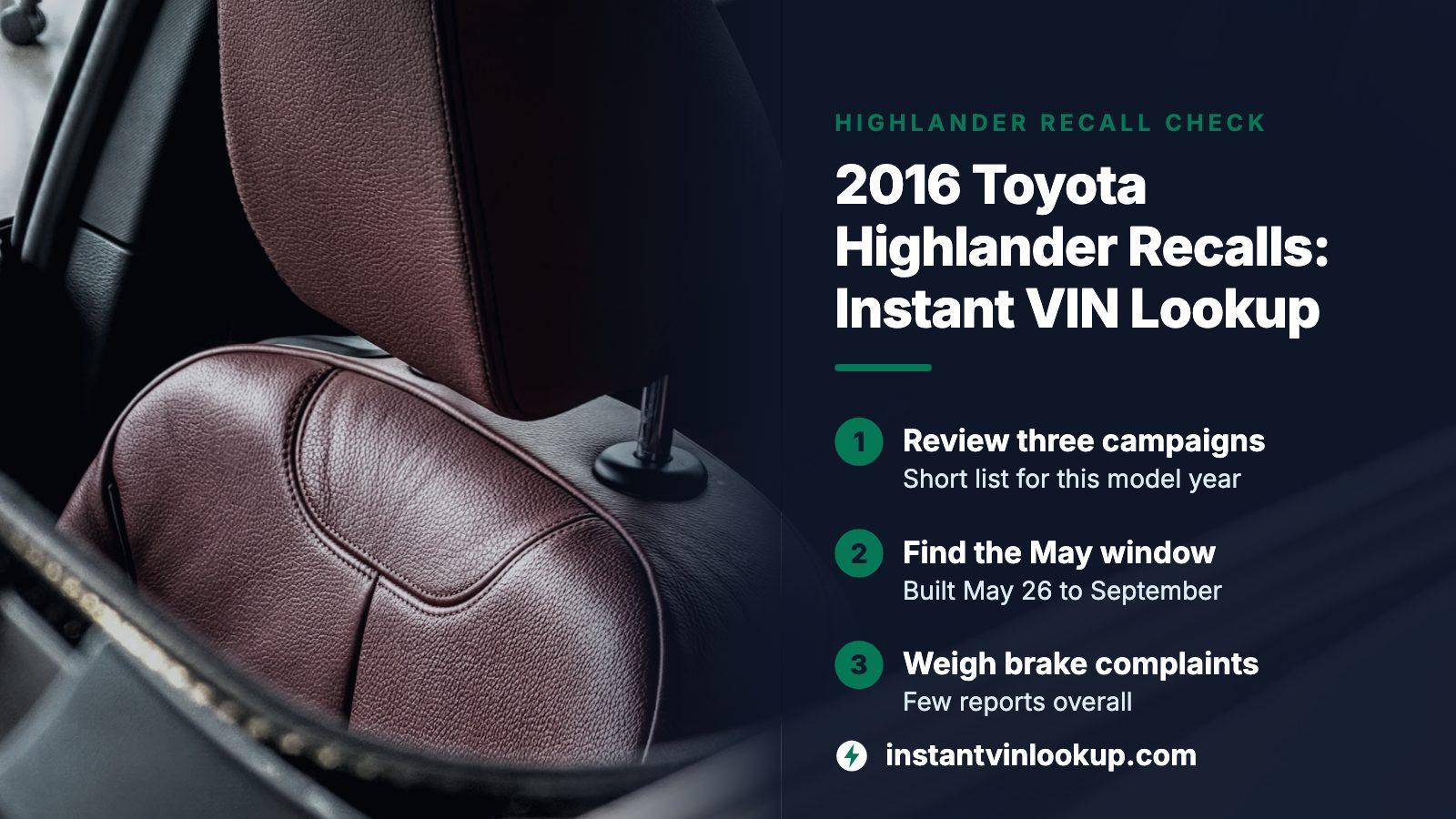
THE SHORT ANSWER
The 2016 Toyota Highlander carries 3 recall campaigns at NHTSA: a brake fluid sensor connector, aftermarket replacement windshields and a load capacity label. Only the brake notice is tied to a build window, May 26 to September 16, 2016, so the VIN decides whether a given SUV is inside it. No repair costs the owner anything. Run the 17 characters, then ask to see the dealer's repair invoice for any campaign the seller calls finished.
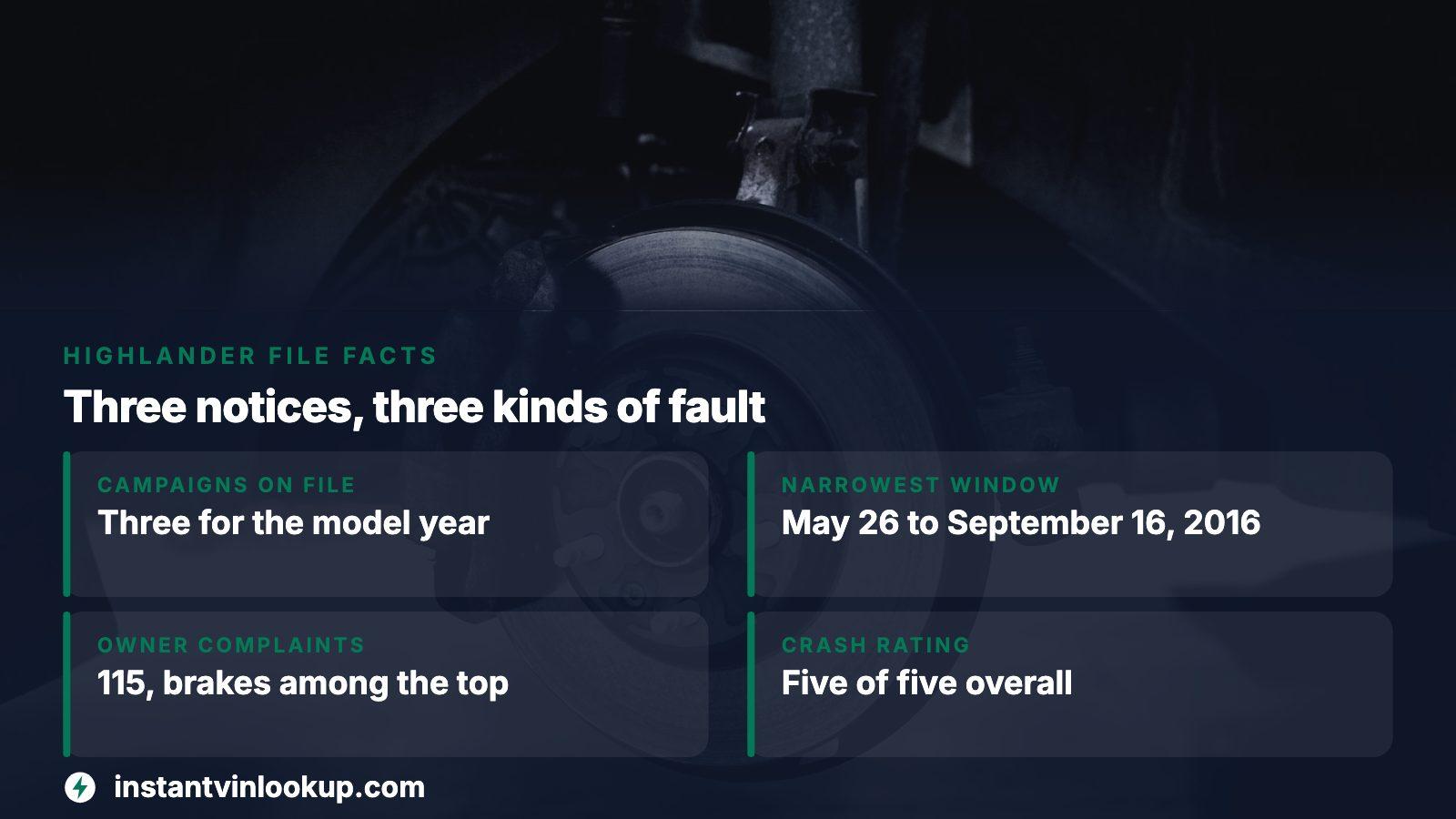
- Campaigns on file
- 3 for the 2016 model year
- Narrowest window
- 16V775000, built May 26 to September 16, 2016
- Owner complaints
- 115, with brakes and unknown or other at 22 each
- Crash-test rating
- 5 of 5 stars overall
Three campaigns on file, and three different kinds of problem
Search this model year and NHTSA returns three campaigns. They are not three versions of one fault: one is a factory wiring slip, one is a part sold after the SUV left the factory, and one is a sticker. The list says how many exist. Which belong to one Highlander is a VIN question.
| Campaign | Filed by | What the notice says | The repair |
|---|---|---|---|
| 16V775000 | Toyota | A brake fluid sensor can sit unplugged from the wiring, so low fluid goes unseen. Production ran May 26 through September 16, 2016. | Dealer inspects and plugs it in where needed |
| 18E107000 | Fujian Wanda Automobile Glass Industry | Non-factory glass sold for 2014 to 2018 Highlanders has a wire harness that water can enter, putting the engine control module at risk. | New windshield, plus an ECM inspection and swap if needed |
| 16V420000 | Southeast Toyota Distributors | The load carrying capacity label may misstate the weight of installed accessories. | A fresh label to stick over the faulty one |
None of the three repairs bills the owner.
The brake sensor notice is the one with a build window
Inside the production span for campaign 16V775000, a sensor may never have been connected, and a low brake fluid level then goes undetected. The notice says the affected SUVs fail the federal brake standard, FMVSS No. 135, and that weaker braking raises crash risk. The recall began on November 14, 2016.
A model-year search cannot separate a June build from a December build. Put the VIN through the lookup: the free preview counts what is on file for that car, and the report lists any open recall beside the title and accident entries.
From an NHTSA owner complaint
In a January 2017 filing, an owner said the Highlander reached them as a new-car sale with the brake sensor repair still outstanding. The filing names campaign 16V775 and Toyota's G03 code. It reports no crash and no injury.
The point to take from it is narrow and useful: even a new-car sale can slip past an open campaign, so check the VIN before you sign.
The windshield and label notices follow parts, not production dates
Campaign 18E107000 comes from the glass maker, not Toyota, and it matters only if the windshield was swapped after the SUV was built. Water can reach the attached harness and damage the engine control module, which can stall the engine. The recall began January 29, 2019. A VIN does not by itself say who replaced the glass, so ask the seller and look for the shop invoice.
Campaign 16V420000 is smaller. A regional Toyota distributor found that accessories added to certain cars were not reflected in the weight printed on the capacity label, which may tempt an owner to carry too much.
Running the lookup on a 2016 Highlander
- Find the metal plate on top of the dash at the driver's end, readable from outside the SUV. The label in the driver's door frame repeats the number and usually shows the build month.
- Photograph both and type from the photos. The number has 17 characters and never contains I, O or Q.
- Look at the tenth character. A 2016 model year shows a G, so any other letter means the listing is wrong about the year.
- Enter the number in the lookup and read the free preview, which comes back in seconds.
- Try the same VIN in NHTSA's own recall search for a second, official look.
From an NHTSA owner complaint
A Highlander driver who logs a lot of miles wrote to NHTSA in September 2020. Dealers had mentioned several earlier recalls, and the owner wanted to know whether any were still unresolved. The filing describes no defect, no crash and no injury, only that question.
A lookup settles that in minutes. Ask it of the VIN before the purchase, not after.
Reading what comes back, and the signs to pause on
- Open: the campaign reaches this VIN and no repair is on record. Book a dealer and ask for a date.
- Completed: a repair is recorded. Still ask for the invoice and match the campaign number.
- Not listed: the SUV sits outside the campaign, or the repair predates the record. The list alone cannot say which.
Pause and ask more questions if you see any of these:
- The seller says every recall is done and cannot produce paperwork.
- An open brake sensor campaign on a Highlander built inside the May to September 2016 window.
- A replacement windshield with no invoice and no explanation.
When the seller says the recalls were handled
By statute the maker, not the owner, pays, and the obligation follows the car through every sale. The duty lapses only if the notice arrives more than fifteen years after the first retail sale. Every notice here began between 2016 and 2019, far inside that line. A seller's word is not a record, though. The paperwork is.
From an NHTSA owner complaint
A January 2022 filing says none of the Highlander's recalls had ever been performed. Maintenance and tire pressure lights were on, fuel economy had dropped to about 9 mpg, and the dealer that sold the SUV would not service it. No crash or injury was reported.
Ask for the invoice before the deal closes, while there is still negotiating room on price.
Complaints and crash tests: the rest of the federal file
NHTSA holds 115 owner complaints for this model year. Service brakes and the unknown or other group tie at 22 each, about 19% apiece, with electrical next at 14 and air bags at 10. Owner reports are unproven and one incident can produce several, so use them as a list for a mechanic. The flags break down as 14 crashes, 1 fire and 11 injuries. Of the 15 model years the file covers, 2016 draws the fewest complaints, at 0.49 times the median year.
On the federal crash tests, the SUV earned five stars overall and five in the side test, with four in the frontal test and four for rollover, where the stated risk of rolling is 18.5%. The FWD and AWD builds were scored separately and matched. A rating describes a new SUV on a test day. It cannot see how collision damage on yours was repaired.
What it costs, and the next step for each result
The free preview comes first and shows what exists for the VIN. After that you pay once, for one report or for a 3, 5 or 10 pack if several Highlanders are on your shortlist. No subscription is involved, and the pricing page has the amounts. The report adds what a recall list never holds: accident and damage records, odometer readings, title brands and liens.
- Open brake sensor campaign: ask a Toyota dealer to book the repair, or make it a condition of the sale.
- Seller says it is done: ask for the invoice and match 16V775000, 18E107000 or 16V420000.
- Replacement windshield: ask for the invoice naming the glass maker, and if it matches the notice, have it replaced under the campaign.
- Clean result: still get an inspection, brakes first, since brakes top the complaint list.
Where this information comes from
- NHTSA: Recalls — The federal search where each campaign above can be matched to a VIN.
- NHTSA: New Car Assessment Program ratings — The crash-test program behind the star results quoted here.
- U.S. Code: 49 U.S.C. 30120, remedies for defects — The statute that puts the repair cost on the maker and sets the 15-year cutoff.
- NMVTIS: National Motor Vehicle Title Information System — The national title record, which holds brands the recall file does not.
- NHTSA owner complaint 10945504 — owner experience, paraphrased
- NHTSA owner complaint 11360096 — owner experience, paraphrased
- NHTSA owner complaint 11446735 — owner experience, paraphrased
Sources and photos: Facts checked against the sources above in November 2026. Photos by Obi, Cole Keister and ün LIU on Unsplash; diagrams by InstantVINLookup.
Keep reading
- Where Is the VIN Number? Find It in a Minute, Then Verify ItA fuller map of VIN locations, for when the windshield plate is dirty or scratched.
- VIN Lookup: Check a VIN Number on a Car Before You BuyHow the lookup works on any vehicle, and what the free preview adds.
- 2016 Toyota Sienna Recalls: Instant VIN Lookup for One MinivanAnother 2016 Toyota family vehicle, with its own campaign list.
- NHTSA Investigation Check: Look Up a Model, Then Run the VINOpen federal investigations, which can come before a recall exists.
Frequently asked questions
How many recall campaigns cover the 2016 Highlander?
Three sit in NHTSA's file for the model year: a brake fluid sensor connector, aftermarket replacement windshields and a load capacity label. Each reaches only certain vehicles, so the VIN tells you which apply to the SUV in front of you.
Is the Highlander brake recall limited to certain build dates?
Yes. Campaign 16V775000 names Highlanders built from May 26 to September 16, 2016, and a car built outside that span is not named. The driver's door frame carries a label with the build month, and a VIN lookup shows whether the campaign is open on that car.
Does Toyota charge for a recall repair on a used Highlander?
No. The maker pays whoever owns the car, with a cutoff of 15 years counted from the first retail sale. For the windshield notice, the glass maker pays through its own service centers.
How did the 2016 Highlander do in crash tests?
Overall, NHTSA scored it five stars, with five for side impact and four apiece for frontal impact and rollover resistance. The FWD and AWD builds were rated separately and both earned five overall. The scores describe the model as tested, not repairs done to a used car.
What is the difference between a recall and a complaint?
Under a recall the maker has to fix a flagged problem at no cost to the owner, while a complaint is only an unverified account that one owner filed with NHTSA. This model year has 3 recalls and 115 complaints. Recalls call for action, and complaints guide what a mechanic inspects.
Now check the car itself
The guide explains what to look for. The report shows what this VIN has on record.