THE SHORT ANSWER
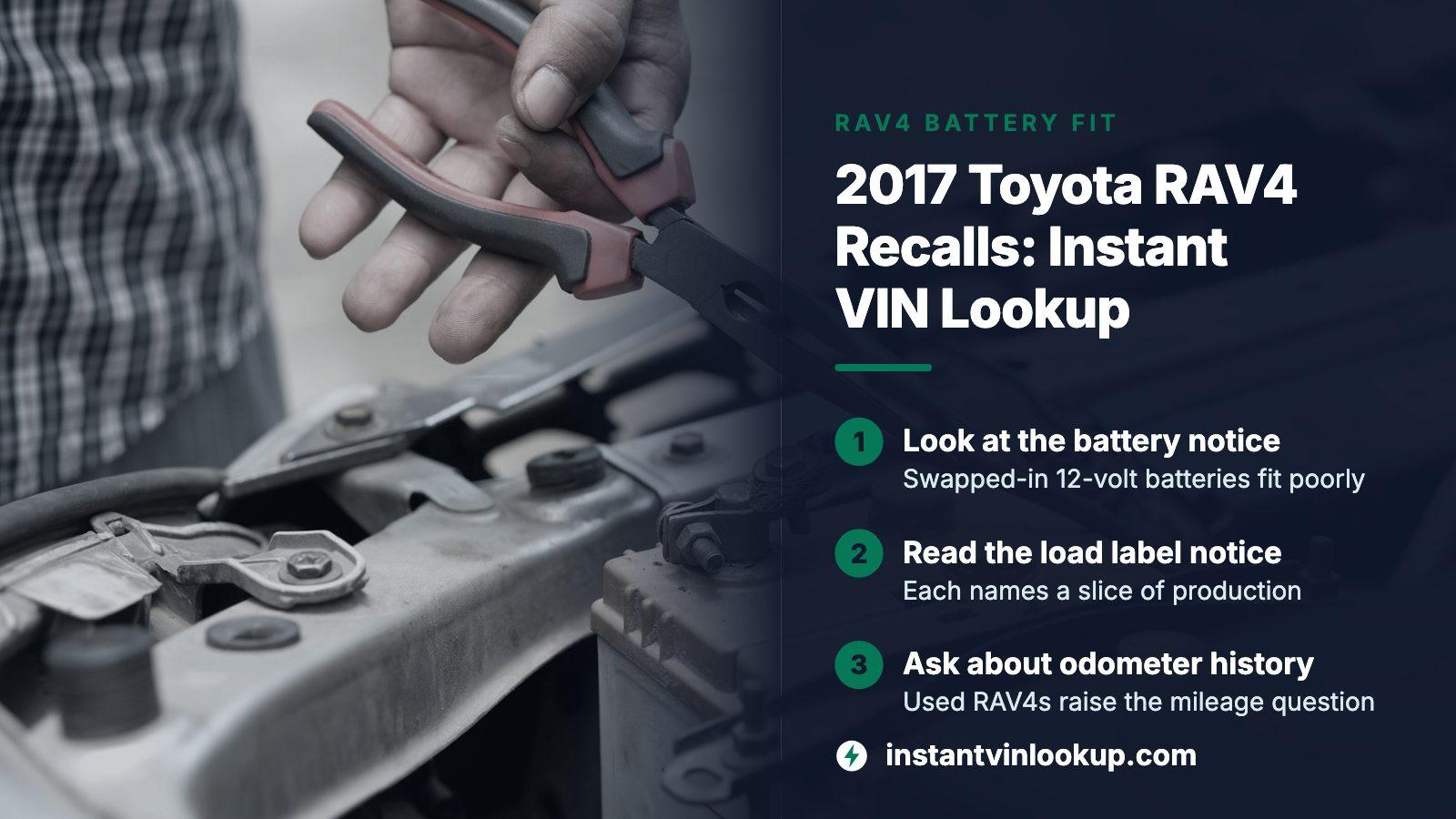
The 2017 Toyota RAV4 has 3 recall campaigns on record with NHTSA: 17V295000 for spare tire pressure, 19V503000 for an incorrect load label and 23V734000 for swapped-in 12-volt batteries that can fit the tray poorly. Each repair is free at a Toyota dealer. Each notice names a slice of the production run, which makes the VIN your tiebreaker for one particular SUV. The VIN preview comes first and costs nothing.
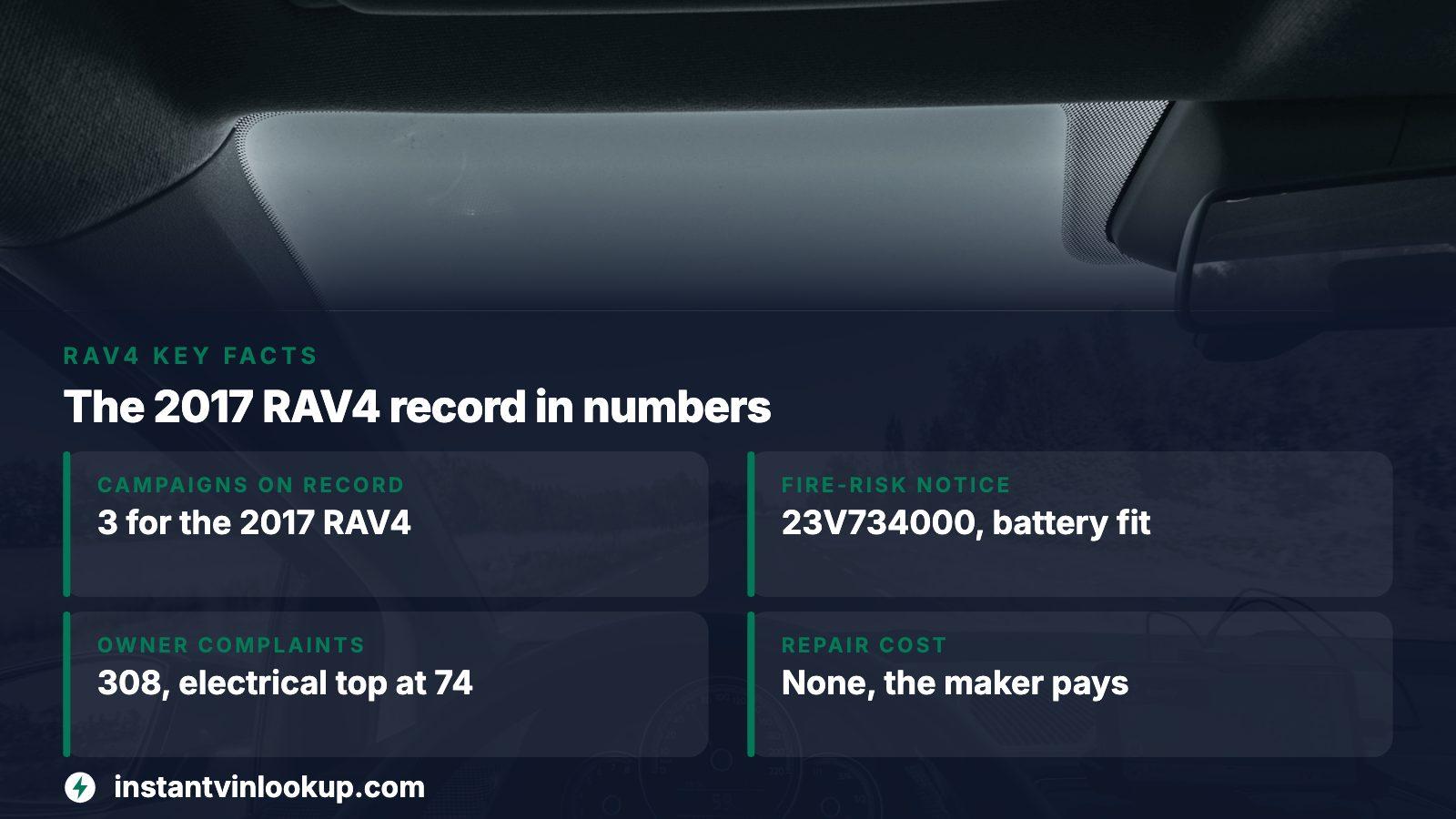
- Campaigns on record
- 3 for the 2017 RAV4 name
- Fire-risk notice
- 23V734000, replacement battery fit
- Owner complaints
- 308 filed, electrical the top group at 74
- Cost of the repairs
- None, the maker pays
The three campaigns filed under this model year
Pulling the 2017 RAV4 from NHTSA's recall data returns exactly 3 campaigns. The Hybrid trim and the electric RAV4 EV returned nothing for 2017 under their own model names, so a hybrid shopper is still best served by a VIN check rather than by assuming the list is empty.
| Campaign | Filed | Problem | Remedy |
|---|---|---|---|
| 17V295000 | May 2, 2017 | Spare tire not set to the pressure on the placard | Dealer checks and corrects the spare, no charge |
| 19V503000 | June 28, 2019 | Load capacity label on the factory floor mats may be wrong | Corrected label placed over the old one, no charge |
| 23V734000 | November 1, 2023 | Certain swapped-in 12-volt batteries sit badly in the tray and can short | New clamp, tray and terminal cover, no charge |
Two of the three are minor in what they ask of an owner. The third is the one that decides how you treat a 2017 RAV4 that has had a battery swap.
Why the battery notice deserves a closer look
Campaign 23V734000 names 2013 to 2018 RAV4s, and it is about replacement batteries, not the one that left the factory. Toyota says certain replacement units can sit loose, drift until they touch the bracket that clamps them, and arc across it. That is a fire hazard. The campaign as a whole lists 1,853,568 vehicles that could be affected, across every model year it covers.
This notice, as NHTSA files it, carries no instruction to leave the car parked or to keep it away from buildings. The repair swaps the clamp, the tray and the cover on the positive terminal. Owner letters went out in phases that began in December 2024 and continued into the summer of 2025, so a car can be affected long before the letter reaches the current registrant.
From an NHTSA owner complaint
An owner of a 2017 RAV4 filed in July 2025 that the car drained its battery on start and threw a check engine light. A parts store fitted a new battery. The dealer, meanwhile, said the recall part was not available yet, and the car left unrepaired. Toyota's own line advised trying a different dealer.
The takeaway: an open notice can sit unrepaired for causes outside the owner's control, so ask a seller if the work was done, and not merely if a letter showed up.
Running the lookup on a specific RAV4
The lookup needs the full 17-character VIN. Crouch beside the RAV4, peer in toward the lower left corner of the windshield, or swing the driver door open and read the label on the pillar. Paperwork carries it too: the title, the registration and the insurance card. Copy it from the papers, then compare it with the car, since two different numbers are a finding in themselves.
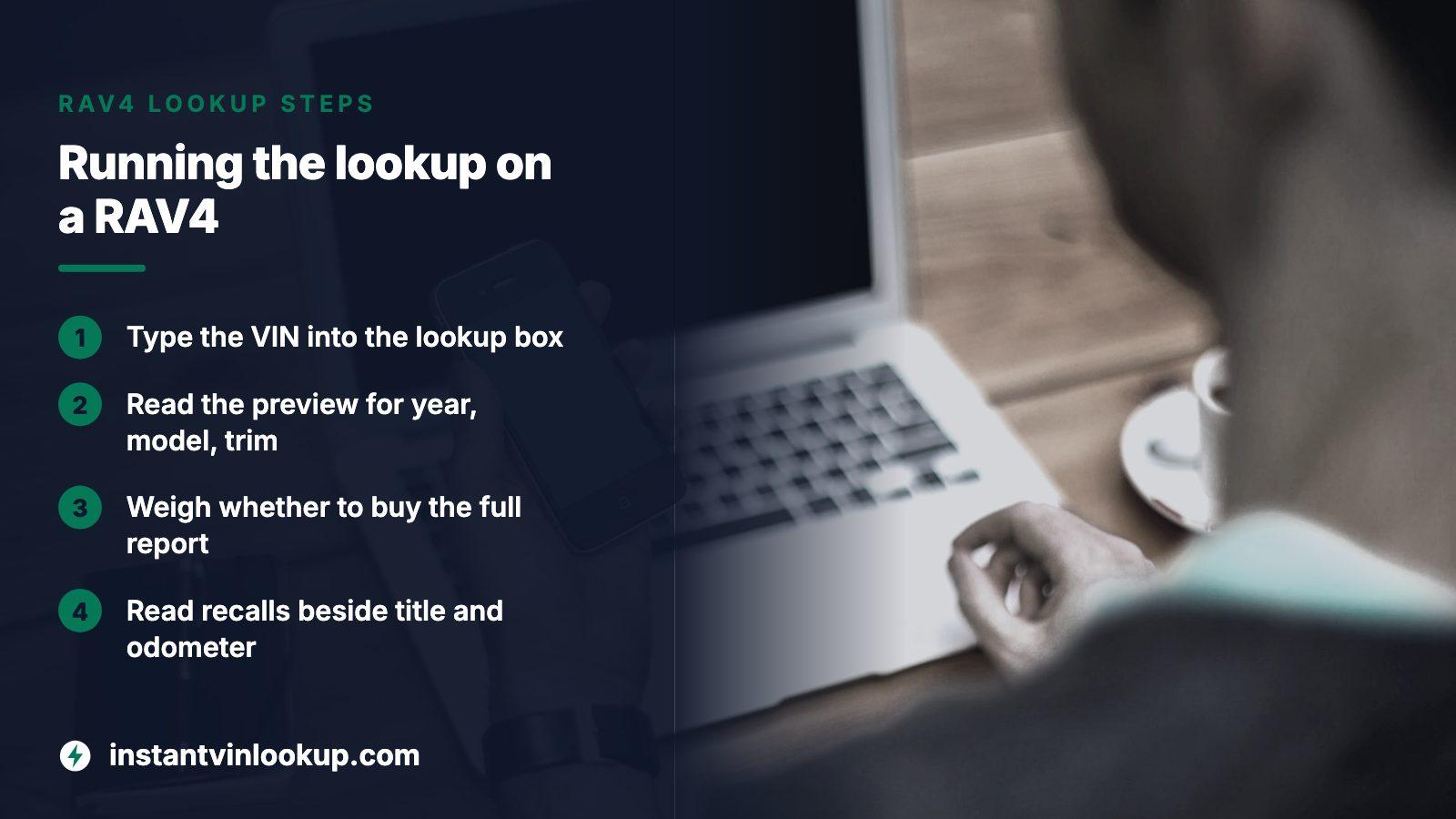
- Type the VIN into the lookup box on this site.
- Read the free preview, which confirms the decoded year, model and trim.
- Weigh up whether this particular RAV4 justifies buying the full report.
- Open the report and read the recall section alongside the title and odometer sections.
Recalls are tied to build ranges, so two 2017 RAV4s can return different answers. The VIN is the only input that settles it.
What 308 owner complaints add to the recall list
Recalls are the problems a maker admitted. Complaints are what owners report on their own, and NHTSA holds 308 of them for the 2017 RAV4. They are unverified, so treat them as a pointer to where to look during a test drive, not as a ruling.
- Wiring and electrical: 74 complaints, far ahead of anything else
- Brakes: 24
- Lighting outside the car: 25
- Engine and air bags: 10 each
- A further 38 filings fall under unknown or other
Of the 308, 33 describe a crash and 24 describe a fire. Those flags reflect how the owner filed the report, and one event can produce more than one filing. Still, the electrical lead lines up with the battery campaign, and that is a reasonable reason to have a mechanic look at the battery, its tray and the terminals before you buy.
Beyond recalls: the mileage question on a used RAV4
A recall lookup tells you about the car's design faults. It says nothing on whether the dash number is honest. Complaint files for this model year include buyers who caught odometer problems after the sale, which is why a recall check on its own is half a job.
From an NHTSA owner complaint
One buyer filed that a dealer sold a 2017 RAV4 with a dash reading of 85,887. When the car was registered, records put the figure at 237,660. The complaint is titled odometer fraud.
The Department of Justice's title system, NMVTIS, holds odometer readings, brand labels such as salvage and flood, and total loss history, and it names odometer fraud as a reason to look. It does not hold recalls. A combined report closes that gap by putting open campaigns and title history side by side for one VIN.
Red flags when the results come back
- Campaign 23V734000 open on a car with a replacement battery, especially if the battery looks swollen or sits at an angle
- A mileage reading that drops between two dates in the history
- A title brand next to a story that the car was never in trouble
- A seller who waves off an open notice as paperwork instead of booking the free fix
- Recall repairs marked done with no dealer record to match
An open recall does not kill a deal. Free repairs belong to the car, not to the person who owned it when the letter was mailed. But the price should reflect the trip to the dealer, and a seller who has ignored a fire-risk notice may have ignored other upkeep too.
If a notice is open on the car you want
Book the repair at a Toyota dealer with the VIN in hand and ask them to confirm the part is in stock before you drive over. Owners in the complaint file describe being turned away or told to wait because the part had not arrived. Keep a written record of the date you called and what the service desk said.
If you are still negotiating, ask for the repair to be done before the sale or for the price to move. Since the record carries no park-it instruction, a viewing and test drive are reasonable; just stay alert around the battery until it is repaired.
What the check costs
The preview is free. If you want the full report with the recall section and the title and odometer history behind it, that is one payment for one report, with no subscription. Prices live on the pricing page, and packs exist for anyone comparing several RAV4s.
The federal recall data is public, so you can always look at the NHTSA record for free. The reason to pay is the rest of the file: damage, liens, odometer readings and ownership that the recall database was never built to hold.
Where this information comes from
- NHTSA recalls API: 2017 Toyota RAV4 — campaign numbers, dates, components and remedies
- NHTSA recall campaign 23V734000 — battery notice, vehicles affected, owner letter phases
- NHTSA complaints API: 2017 Toyota RAV4 — complaint count and component breakdown
- NMVTIS: understanding a vehicle history report — what the federal title system holds and what it leaves to private reports
- NHTSA owner complaint 11675883 — owner experience, paraphrased
- NHTSA owner complaint 11678566 — owner experience, paraphrased
Sources and photos: Facts checked against the sources above in November 2026. Photos by Towfiqu barbhuiya, Alejandro Escamilla and Sander Jeurissen on Unsplash; diagrams by InstantVINLookup.
Keep reading
- 2014 Toyota RAV4 Recalls: Instant VIN Lookup for One CarThe earlier RAV4 year, with its own campaign list.
- VIN Lookup: Check a VIN Number on a Car Before You BuyHow the VIN lookup works for any vehicle.
- 2016 Toyota Highlander Recalls: Instant VIN Lookup for One SUVAnother Toyota SUV, for comparison shopping.
- NHTSA Investigation Check: Look Up a Model, Then Run the VINOpen federal investigations that come before a recall.
Frequently asked questions
How many recalls does a 2017 Toyota RAV4 have?
NHTSA lists 3 campaigns under the 2017 RAV4 name: 17V295000, 19V503000 and 23V734000. That is the count of notices on the model year, not the number open on one car. Plenty will have been repaired long ago; the VIN shows what remains outstanding.
Is the 2017 RAV4 battery recall dangerous?
The notice says a poorly fitting replacement battery can short against the hold-down bracket and raise the risk of a fire. NHTSA's record carries no park-it instruction. The risk applies to replacement batteries, so ask whether the battery was ever changed and whether the dealer repair was done.
Do I pay for a RAV4 recall repair?
No. All three notices on this model year call for a free repair by a Toyota dealer. If the dealer wants to charge you for the recall work itself, ask for the campaign number and call Toyota's customer service line listed in the notice, which you can read on NHTSA's record.
Does a recall check show if the odometer was rolled back?
No. Recalls come from the maker and NHTSA, while odometer readings come from title and service records. A full report puts both in front of you for the same VIN, which is how a mileage drop between two dates becomes visible before you buy.
Where do I find the VIN on a 2017 RAV4?
One copy sits in the lower left of the windshield and another on a label in the driver door pillar. Registration, insurance and title documents repeat it. Type it from the documents and confirm it matches the car.
Now check the car itself
The guide explains what to look for. The report shows what this VIN has on record.