THE SHORT ANSWER
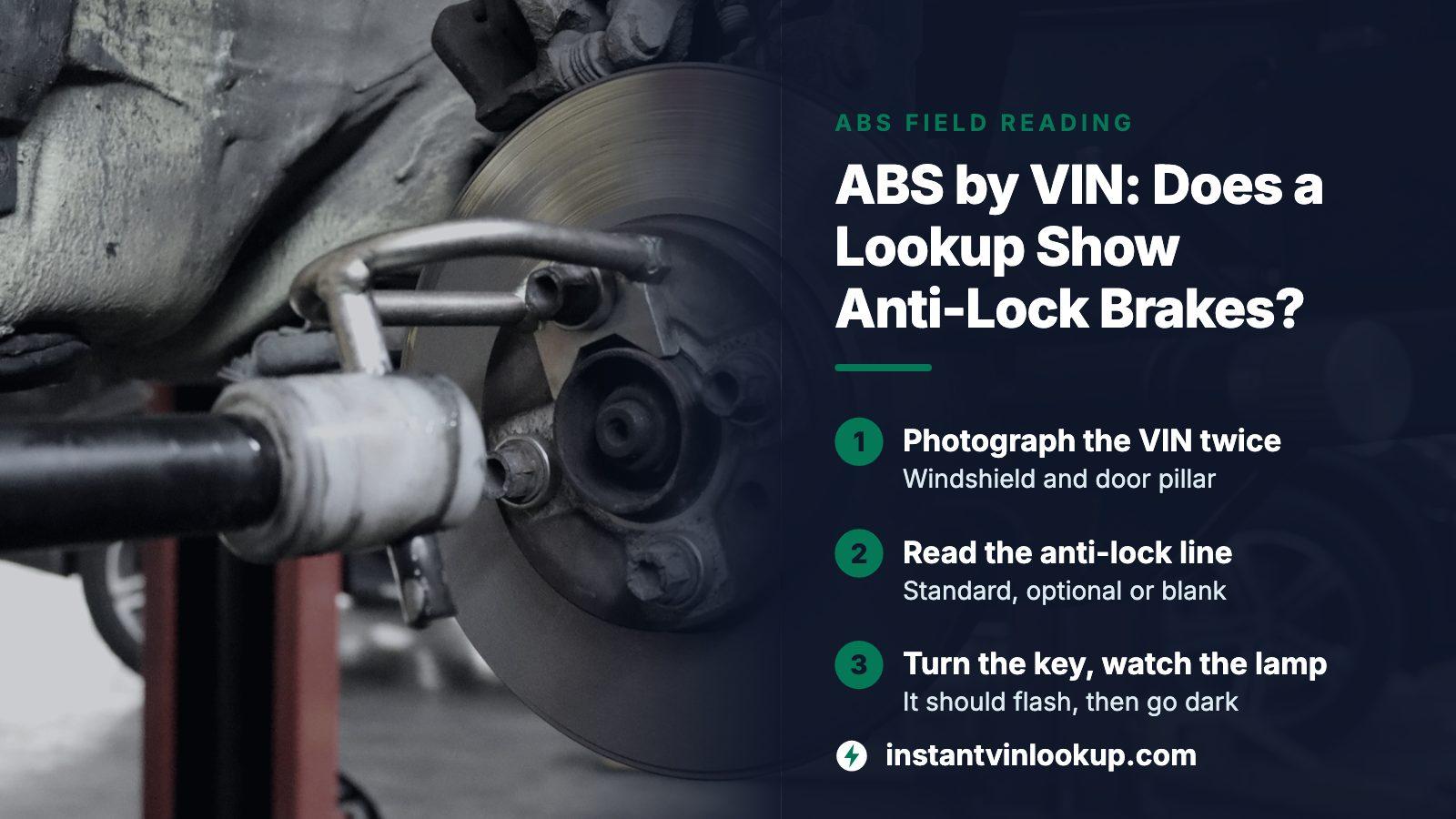
A decoder built on NHTSA's catalog has an ABS field with three possible entries: standard, not available and optional. Makers supply the data, and a VIN rule for passenger cars does not list the brake system among the attributes the number must reveal, so blanks happen. Treat the lookup as a claim about how the car was built, then confirm on the dash and under the hood that the system still works.
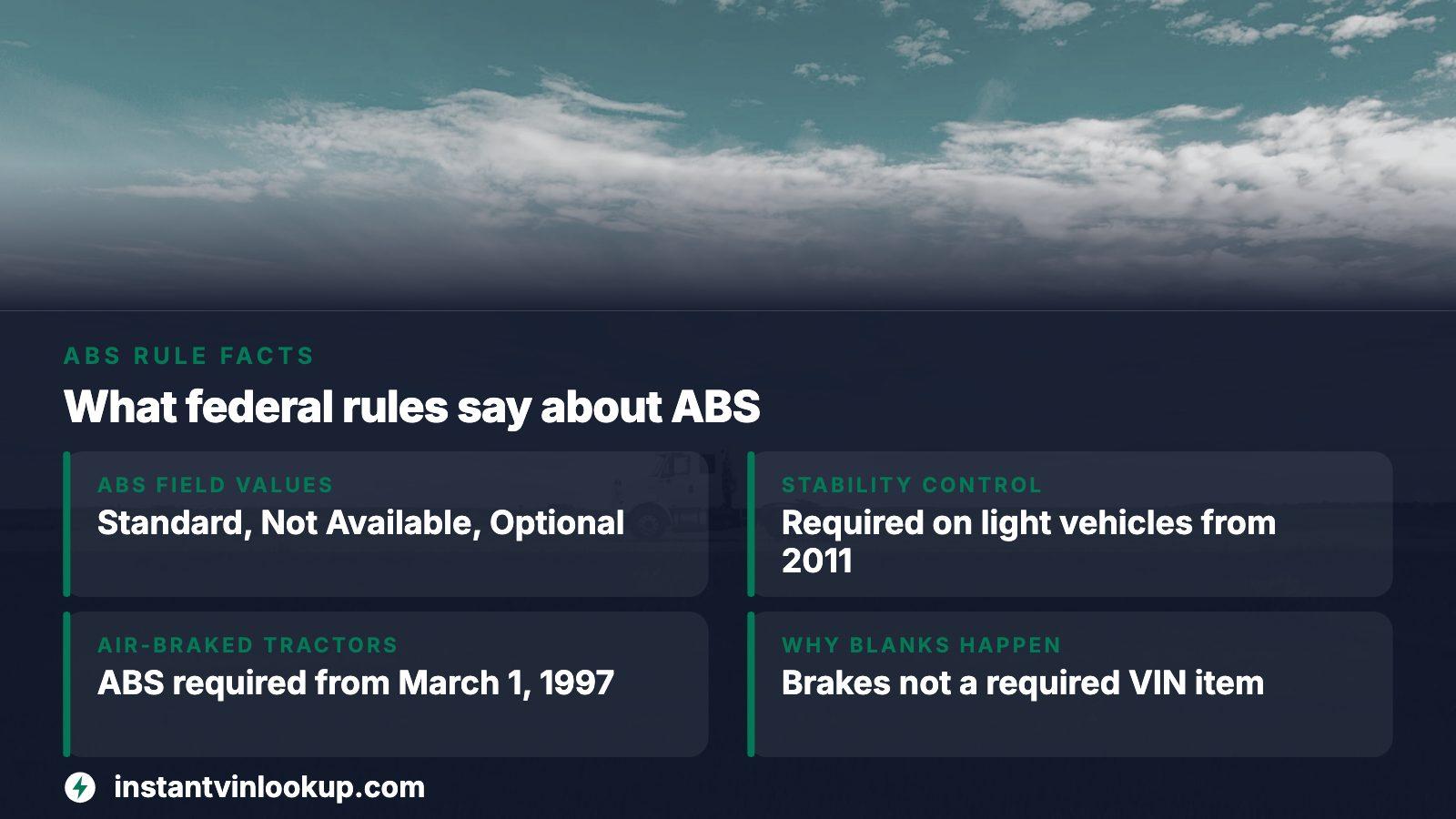
- ABS field values
- Standard, Not Available, Optional
- Stability control mandate
- Every light vehicle from September 1, 2011
- Air-braked trucks
- ABS required on tractors from March 1, 1997
What an instant lookup reports about ABS
A VIN decode starts from the factory build, and brakes are part of that build. NHTSA's catalog carries an anti-lock field, a stability control field, a traction control field and a brake type field in the same record. The anti-lock field takes one of three entries: standard, optional or not available. The brake type field is a separate item that names air, hydraulic, a mix of the two, electric or mechanical.
The agency defines the system as the part of the service brakes that senses how fast each wheel turns, passes that signal to a controller, and has a modulator ease or release brake force at a wheel that is about to lock. A lookup tells you the car left the factory with that hardware, or that the maker could offer it. It cannot tell you the pump still works.
Running the lookup for brakes, step by step
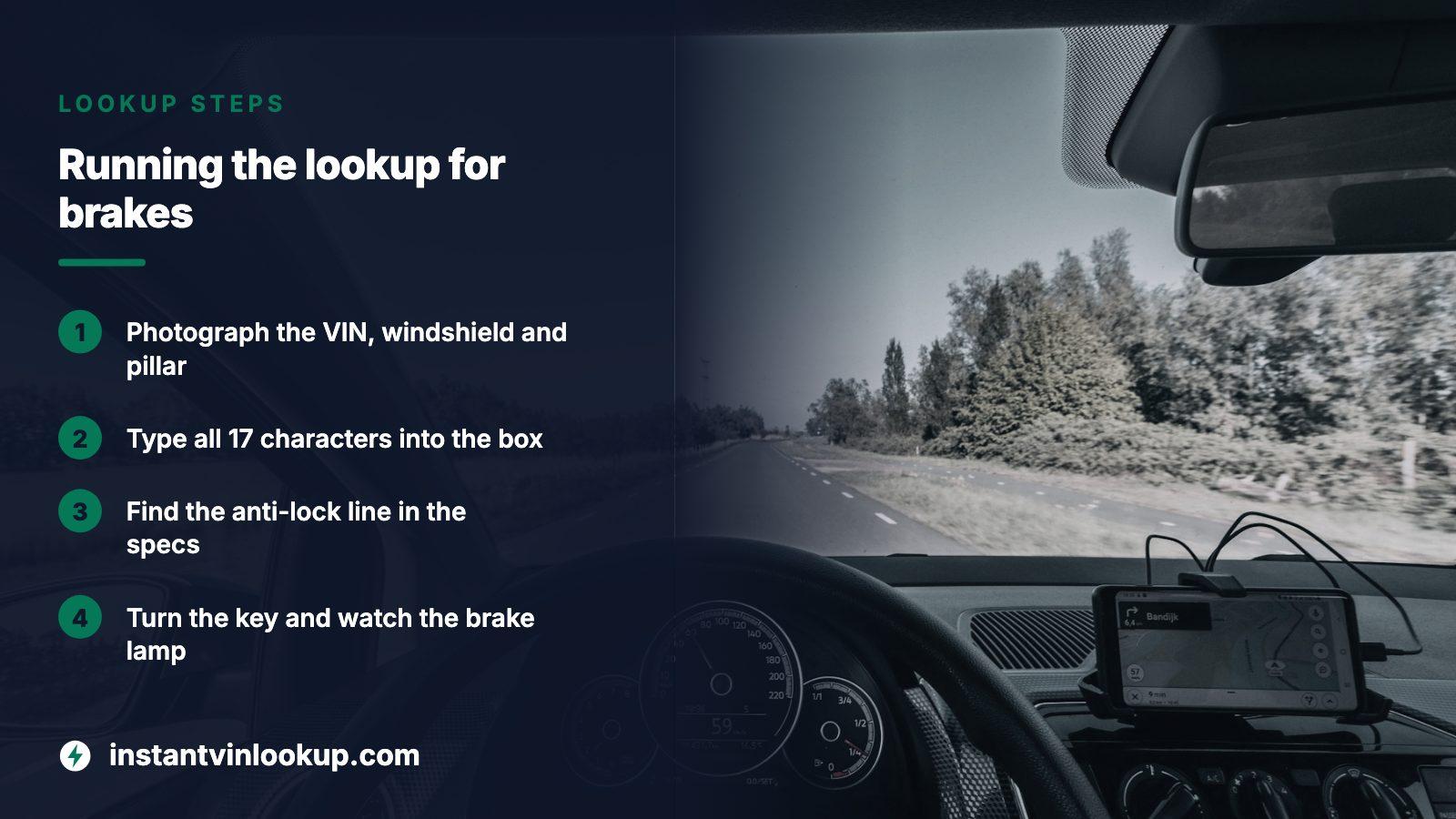
- Photograph the number twice, once through the windshield and once on the door-pillar sticker. Two different strings mean the conversation with the seller ends or changes.
- Type every one of the 17 characters into the box. Leave any out and the decode is partial, which leaves the anti-lock field empty.
- Open the factory specifications and find the brake entries. Write down whether the anti-lock line says standard, optional or nothing.
- At the car, turn the key to run without cranking the engine. A brake lamp should flash on for a moment and go dark.
- When the lookup says optional, the lamp is your proof, since the first owner may or may not have ordered it.
The preview costs nothing and shows how many records exist for the number.
Four answers and what each one means
| Field shows | Usual meaning | What to do |
|---|---|---|
| Standard | The maker built the model with anti-lock brakes | Check the dash lamp behaves normally |
| Optional | The system was a factory choice on that model | Confirm on the car; the lookup cannot say which way it was ordered |
| Not available | The maker did not offer it on that vehicle | Fine on an old base model, a question on anything newer |
| Empty | The data holds no answer for that number | Read the dash and the manual; an empty field is a gap, not a defect |
The last row causes most of the confusion. An empty entry is not a warning about the car. It means the tool had nothing to say, which is also what happens when the VIN is typed incompletely.
Why the field is sometimes empty
Federal regulation 49 CFR 565.15 fixes what the middle five characters of a VIN must let someone work out. The row for a passenger car names the model line, series, body, engine and seat restraints. Brakes are absent from the car row and from the multipurpose row. Trucks, buses and incomplete vehicles do get a brake entry, but it names the kind of brakes fitted, not whether anti-lock hardware sits on top.
Past those required items, each maker decides what the characters mean. NHTSA says its catalog rests on patterns manufacturers file, for model years 1981 and later. Where a maker never encoded the brakes, the field stays blank, and a different tool may show nothing as well.
What federal rules say about ABS on different vehicles
- Light vehicles: the passenger-car brake standard, FMVSS 135, speaks of anti-lock brakes as equipment a car might have, and never orders them by itself.
- Stability control: FMVSS 126 requires it on cars and light trucks of 10,000 pounds or less, phased in from the 2008 production year and required on all of them from September 1, 2011. It must brake each wheel individually and keep working while ABS is active, so a car with it almost certainly has anti-lock hardware.
- Heavy hydraulic vehicles: FMVSS 105 requires anti-lock brakes on any vehicle with a GVWR over 10,000 pounds.
- Air brakes: FMVSS 121 requires them on each truck tractor from March 1, 1997 onward, and on single-unit air-braked trucks from March 1, 1998.
In practice, a car built before the stability mandate is where the optional and not available entries matter most.
When the warning light is on
A lookup describes the build. The dash describes today. Federal brake rules require a yellow indicator for an electrical failure in the anti-lock system, labeled Antilock, Anti-lock or ABS, and stability control must have its own malfunction lamp. A lit lamp means the extra protection is off.
From an NHTSA owner complaint
The owner of a 2013 Ford Explorer reported that the ABS, brake and traction control lamps were lit. The dealer found the ABS module had failed. The part was first described as backordered, then as discontinued, and the SUV was left unrepaired at about 147,719 miles.
The takeaway: a lit lamp on a used car is a repair bill with an unknown date. Ask what the shop quoted, and whether the module is still sold, before you agree on a price.
Recalls that involve the anti-lock system
Recall status matters here because ABS software and wiring have been the subject of campaigns. Number 13V483000 covers certain 2014 Jeep Grand Cherokees built from January 8, 2013 through August 20, 2013. Loose alternator ground wires and disrupted computer communication could light several warning lamps, darken the instrument cluster and cost the driver both ABS and stability control. The remedy is a software update to the ABS and cluster modules plus tightening the ground wire, free of charge.
Number 10V039000 covers certain 2010 Toyota Prius and Lexus HS250h cars, where the brake pedal could feel inconsistent after the system acted on rough or slick pavement. Dealers reprogram the ABS control unit. Both fixes cost the owner nothing, so search NHTSA's recalls first.
From an NHTSA owner complaint
An owner of a 2012 Chevrolet Equinox wrote that the ABS and traction control lamps came on during a rainstorm, and the front end began to slide in a corner at 35 mph. Control was kept, but the owner felt a higher speed would have ended differently.
The takeaway: lamps on in the rain are a good reason to test-drive on a wet day, not only a dry one.
Cost, and what the report adds beyond a spec line
NHTSA's decoder and recall search cost nothing, so start with them. The first look at an ABS-equipped VIN here is free as well. After that, the full report is a single purchase for one car or a group of them, with no renewal, and current amounts are on the pricing page.
The specification section may name the brakes when the maker supplied them. Other sections answer what a spec line cannot: brands on the title, damage and auction records, mileage readings and unfixed recalls. A car with a sound anti-lock decode can still carry a flood or accident record, so run it before a deposit.
Where this information comes from
- 49 CFR 565.15: VIN content requirements — the table of vehicle attributes a VIN must reveal, with brake system listed for trucks and buses but not passenger cars
- NHTSA vPIC API: ABS values — the three entries the anti-lock field can hold
- NHTSA vPIC: VIN decoder — scope of the decoder: manufacturer patterns, model years from 1981
- FMVSS 126: electronic stability control — coverage, phase-in dates and the malfunction lamp
- FMVSS 135: light vehicle brake systems — ABS treated as optional equipment on light vehicles, plus the indicator wording
- NHTSA recalls data: 2014 Jeep Grand Cherokee — campaign 13V483000 details and remedy
- NHTSA owner complaint 11709342 — owner experience, paraphrased
Sources and photos: Facts checked against the sources above in November 2026. Photos by Media Digital, Sander Jeurissen and Peter McCrae-Hokenson on Unsplash; diagrams by InstantVINLookup.
Keep reading
- VIN Lookup: Check a VIN Number on a Car Before You BuyHow the lookup works and how to read a full result.
- Airbag Locations by VIN: Instant Lookup of Where Each Bag SitsThe next safety item a decode may or may not name.
- Where Is the VIN Number? Find It in a Minute, Then Verify ItFind the number on the car before you decode it.
- 2014 Jeep Grand Cherokee Recalls: 19 Campaigns to Check by VINEvery recall on the model used as the example above.
Frequently asked questions
Can I tell if a car has ABS from the VIN?
Often, not always. A decoder can report anti-lock brakes as standard, optional or not available when the maker supplied that data. If the field is empty, look for the ABS lamp that lights briefly at ignition, then read the owner's manual. Optional means you must confirm it on the car.
Does an empty ABS field mean the car has no ABS?
No. It means the tool had nothing to report for that number, which also happens with a mistyped or incomplete VIN. Recheck all 17 characters, then judge by the dash lamp and the manual. A decoder returns not available only when the data says the system was never offered.
Do all cars have ABS now?
Most modern ones do, though no light-vehicle brake standard orders it directly. Stability control has been mandatory on all light vehicles since September 1, 2011, and that system works through the brakes at each wheel, so late-model cars almost always carry the hardware.
What does a lit ABS lamp mean on a used car?
The anti-lock function has detected a fault and switched itself off. Ordinary braking usually remains, but the added protection is gone. Common causes include a failed module or wheel sensor. Get a written quote before you buy, and ask whether the part can still be ordered.
Is the ABS lookup free?
Previewing the VIN is free. Only the full report is charged, as a one-time fee with no recurring billing, and the pricing page shows what it costs. NHTSA's decoder and recall search are free too, so begin there and keep the report for a car that is still a candidate.
Now check the car itself
The guide explains what to look for. The report shows what this VIN has on record.