
THE SHORT ANSWER
No VIN lookup returns a bolt pattern directly, because the 17 characters describe the build and carry no wheel data. The decode gives you the year, model and engine. From that, the pattern is a published figure, written like 5x114.3 for five lugs on a 114.3 millimeter circle. Confirm it in the owner's manual, on the wheel already on the car, or in a retailer's fitment tool before you order anything.
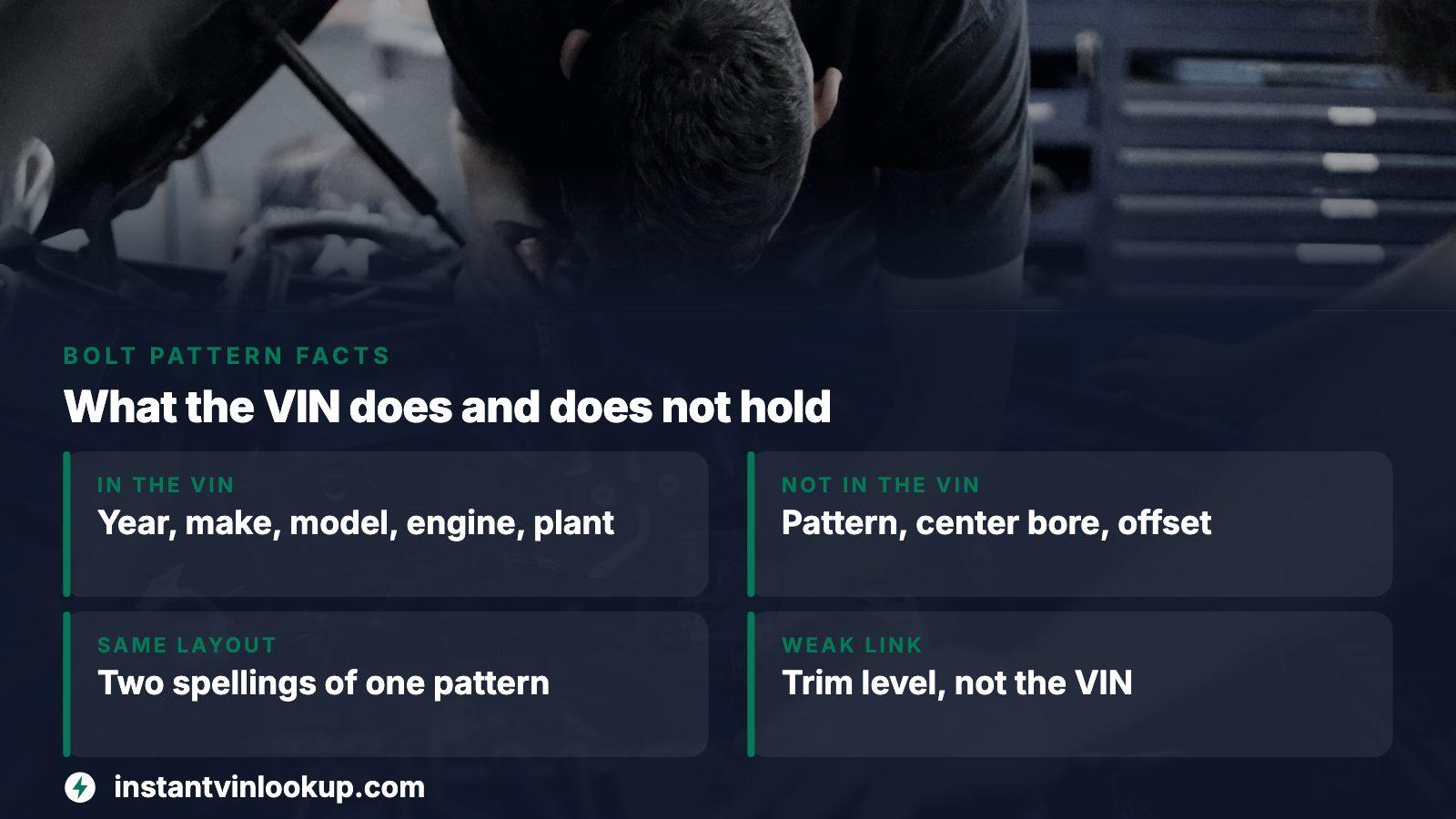
- In the VIN
- Year, make, model, engine, plant
- Not in the VIN
- Pattern, center bore, offset
- Same layout, two spellings
- 5x114.3 and 5x4.5
What a VIN lookup settles in the first ten seconds
Enter the number and the decode returns year, make and model, then the body, the engine, the driven wheels and the plant that built it. Those fields matter because a bolt pattern belongs to a vehicle configuration, not to a number stamped on a dash plate.
| Item | In the VIN decode? | Where to get it instead |
|---|---|---|
| Year, make, model | Yes | Nothing more needed |
| Engine and drive type | Yes | Compare against the listing |
| Trim level | Only if the maker encodes it | The badge, the paperwork, the hardware on the car |
| Bolt pattern | No | Manual, back of the wheel, fitment catalog |
| Center bore and offset | No | The wheel itself or its maker's spec sheet |
| Lug nut thread and seat | No | The manual, or a shop that inspects the studs |
NHTSA's decoder lists wheel size among its variables and nothing about pattern, bore or offset, so a government lookup has the same gap as a private one.
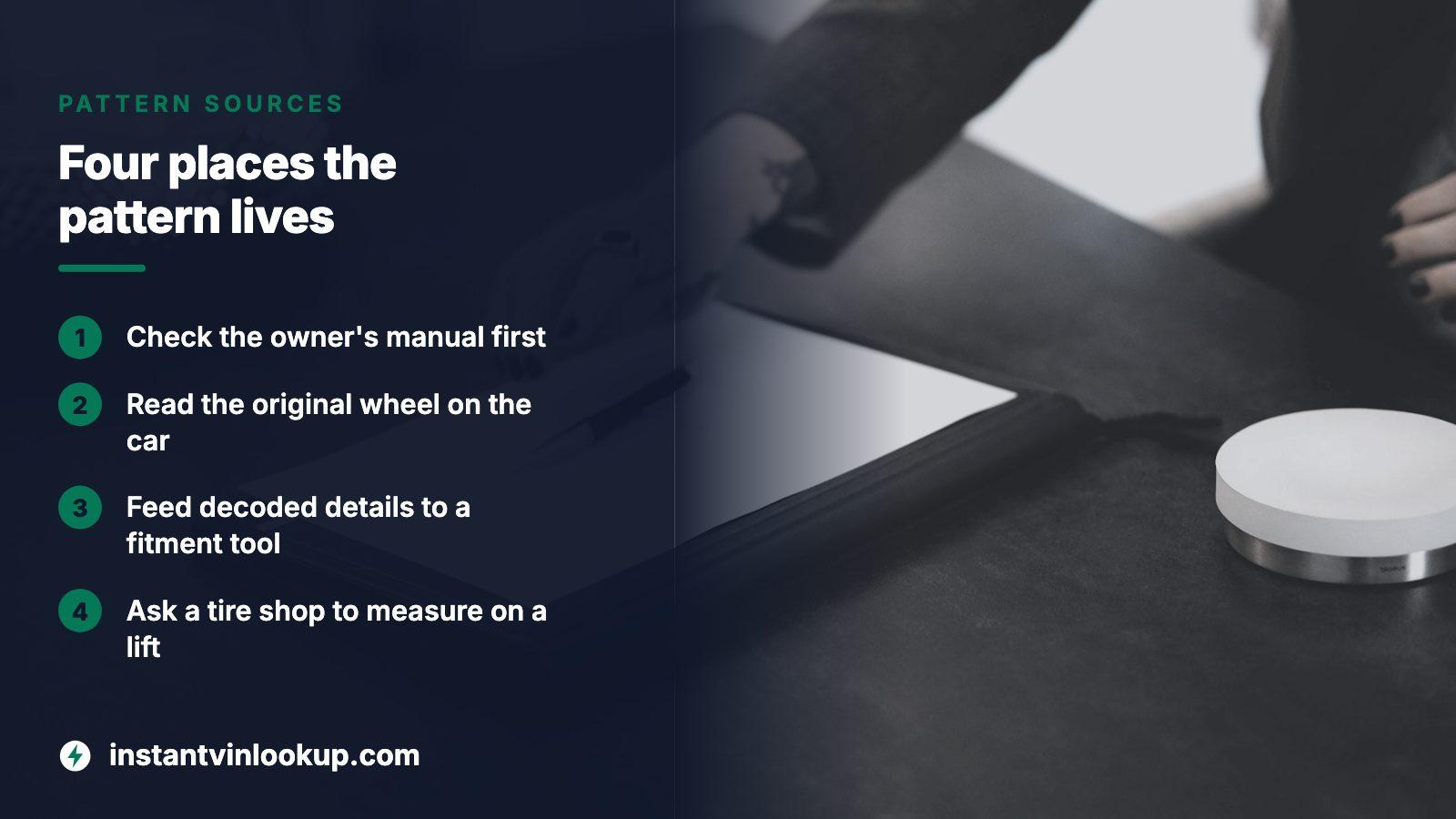
Four places the number lives, best source first
- The owner's manual, which carries the factory wheel details for your model.
- The wheel on the car now, if it is the original. Pattern, offset and bore are frequently marked on the back face of the wheel.
- A retailer's fitment tool, fed the decoded year, model and engine instead of a guess. These behave well when the trim is right.
- A tire shop with the car on a lift, the only route that checks clearance and fastener seat on your actual vehicle.
If two of the four disagree, believe the part you can hold over the one you can search, and find out which source is wrong before anything gets bolted on.
Reading 5x114.3 without a tape measure
The first figure counts the lugs. The second is the width of the circle drawn through their centers, in millimeters. Some listings give that circle in inches, so 5x4.5 and 5x114.3 are one layout written two ways.
With four, six or eight lugs you can measure from one hole straight across to its opposite. A five-lug wheel has no opposite hole, so measuring one with a ruler produces confident wrong answers. Use the published figure.
Nearly equal is not equal
A wheel that almost fits, or sits with the studs off-center in the holes, is not being forgiving. Treat a near miss as a no and send the wheel back.
Why trim, not the VIN, is the weak link
Within a single model year, wheel hardware can change with the trim. A sport package or a bigger brake kit may bring a different offset, and sometimes a different bore, while the engine code in the VIN reads the same.
Some makers leave trim out of the VIN altogether, so a decode may show a blank or fill the line from another source. When trim is blank, do not let a retailer's tool guess. Look at the car: the badge on the trunk lid, the brakes visible behind the spokes and the marks on the wheel.
The lug nut that fits the stud but not the wheel
Pattern decides whether a wheel mounts. On most modern cars the hub, not the studs, then centers the wheel and carries the weight, and the fasteners have three jobs of their own: seat shape, thread and length of engagement. Seats come as a cone with a typical angle of 60 degrees, a rounded ball, or a flat face that takes a washer. A nut with the wrong seat will turn, reach its torque and still grip on a thin ring of contact.
From an NHTSA owner complaint
A 2014 Nissan Frontier owner reported a vibration from the front tires at 40 mph. The dealer said the truck carried the wrong lug nuts and that the threads had come apart as a result. Every lug nut, stud and tire was replaced, and the report puts the failure at 12,000 miles.
The takeaway: the symptom was a shake, the kind most people blame on wheel balance, and the cause was hardware. After a wheel change, check the nuts before paying for a balance.
- Match the seat first, then the thread, then the length.
- A new set may ship with its own hardware; the old nuts might not suit it.
- Tighten to the figure in your manual, then check again after a short drive.
Spacers and adapters change more than the stance
A spacer pushes the wheel outward for looks or clearance, and it also moves the wheel away from the studs. With the original fasteners, a thicker stack leaves fewer threads engaged, and a nut that reaches torque on a few threads is not clamping the way the number suggests. Anything stacked between wheel and hub is one more part to center and hold.
From an NHTSA owner complaint
Someone driving a 2008 Jeep Wrangler reported that a front wheel spacer failed on the road and the wheel came off. Nobody was hurt, but the front end was damaged and the Jeep sat on the highway for hours. The report says the part gave no warning and that the company that sold the spacers had no interest in investigating.
The lesson: a spacer is a safety part with no dashboard light. If a car you are buying has spacers, ask who fitted them and have a shop inspect them.
Shopping for a used car on non-original wheels
Aftermarket wheels are not a defect, and plenty are fitted properly. They do raise a question the factory set never does, and asking costs nothing. Walk around the car before the test drive:
- Ask whether the original wheels come with the car. Missing originals are a bargaining point and sometimes a clue.
- Look at the nuts. A matched set is reassuring; a mixed handful is not.
- Look behind wheels with an oversized center hole for centering rings.
- Feel for vibration at speed that the seller already blames on balancing.
- Check clearance at full steering lock and over bumps.
This is also the natural moment to run the VIN. A history report does not list wheels, but it shows collision and damage records, odometer readings and title brands, which tell you whether the story behind a modified car holds up. The preview takes seconds and is free; the full report is bought once.
A five-minute routine before you order wheels
- Read the 17 characters off the car itself and compare them with the registration.
- Run the decode and write down year, model, engine and drive type.
- Search the NHTSA recall lookup with the same number. It costs nothing and takes a minute.
- Take the pattern from the manual or the original wheel, then confirm it in a retailer's tool using the decoded details.
- Match center bore, offset and nut seat as well, not the pattern alone.
None of this needs a paid report. The report earns its place when you are buying the car, not its wheels.
Where this information comes from
- NHTSA: VIN decoder (vPIC) — shows which fields the federal decoder returns: wheel size appears, pattern, bore and offset do not
- NHTSA: recall lookup by VIN — a no-cost open-recall search to run alongside the decode
- Discount Tire: hub-centric vs lug-centric wheels — how the two ways of locating a wheel differ
- US Patent 5,056,870: wheel nut assembly — describes the tapered seat and its typical 60 degree angle
- NHTSA owner complaint 10715134 — owner experience, paraphrased
- NHTSA owner complaint 11641616 — owner experience, paraphrased
Sources and photos: Facts checked against the sources above in November 2026. Photos by Joan, Annika Wischnewsky and Mustafa Sheikhmouss on Unsplash; diagrams by InstantVINLookup.
Keep reading
- VIN Lookup: Check a VIN Number on a Car Before You BuyHow to run the lookup itself and read what comes back.
- Parts by VIN: Run the Instant Lookup Before You OrderThe same decode-first method applied to other parts.
- Drivetrain by VIN: What an Instant Lookup Shows and When It Is BlankConfirms drive type, one of the fields wheel tools ask for.
- Where Is the VIN Number? Find It in a Minute, Then Verify ItWhere to read the number before you decode it.
Frequently asked questions
Can I find my car's bolt pattern from the VIN?
Not directly. The VIN identifies the build, not the wheels. Decode it to get the exact year, model and engine, then look up the pattern for that configuration in the manual or a fitment tool. A site that shows a pattern after you enter a VIN is working from the decoded model, so the trim caveat still applies.
How do I read a designation such as 5x114.3?
The 5 counts the lug holes, and 114.3 is the millimeter width of the circle through their centers. In inches the same layout reads 5x4.5. Two wheels with one designation can still differ in center bore, offset and seat shape, so it only tells you whether the studs line up.
If two cars share a bolt pattern, do their wheels swap?
Sometimes, but the pattern is only the first test. The bore must match the hub or be filled with rings, the offset must clear brakes and arch, and the nuts must suit the seat. Different makers often share a pattern by coincidence, so a match is a reason to check the rest.
Can the old nuts go back on a new set of wheels?
Only if the seat shape matches: cone, ball or flat. Aftermarket wheels often ship with their own hardware for that reason. Whichever you use, tighten to your manual's figure and check again after a short drive, because a nut that loosens is the usual first sign of a mismatch.
Does a vehicle history report show wheel or tire changes?
No. A history report shows what was reported about the car, such as title brands, accidents and mileage. A wheel swap rarely reaches those databases unless an insurance claim followed. Inspect the wheels yourself, and use the report for what the car has been through.
Now check the car itself
The guide explains what to look for. The report shows what this VIN has on record.