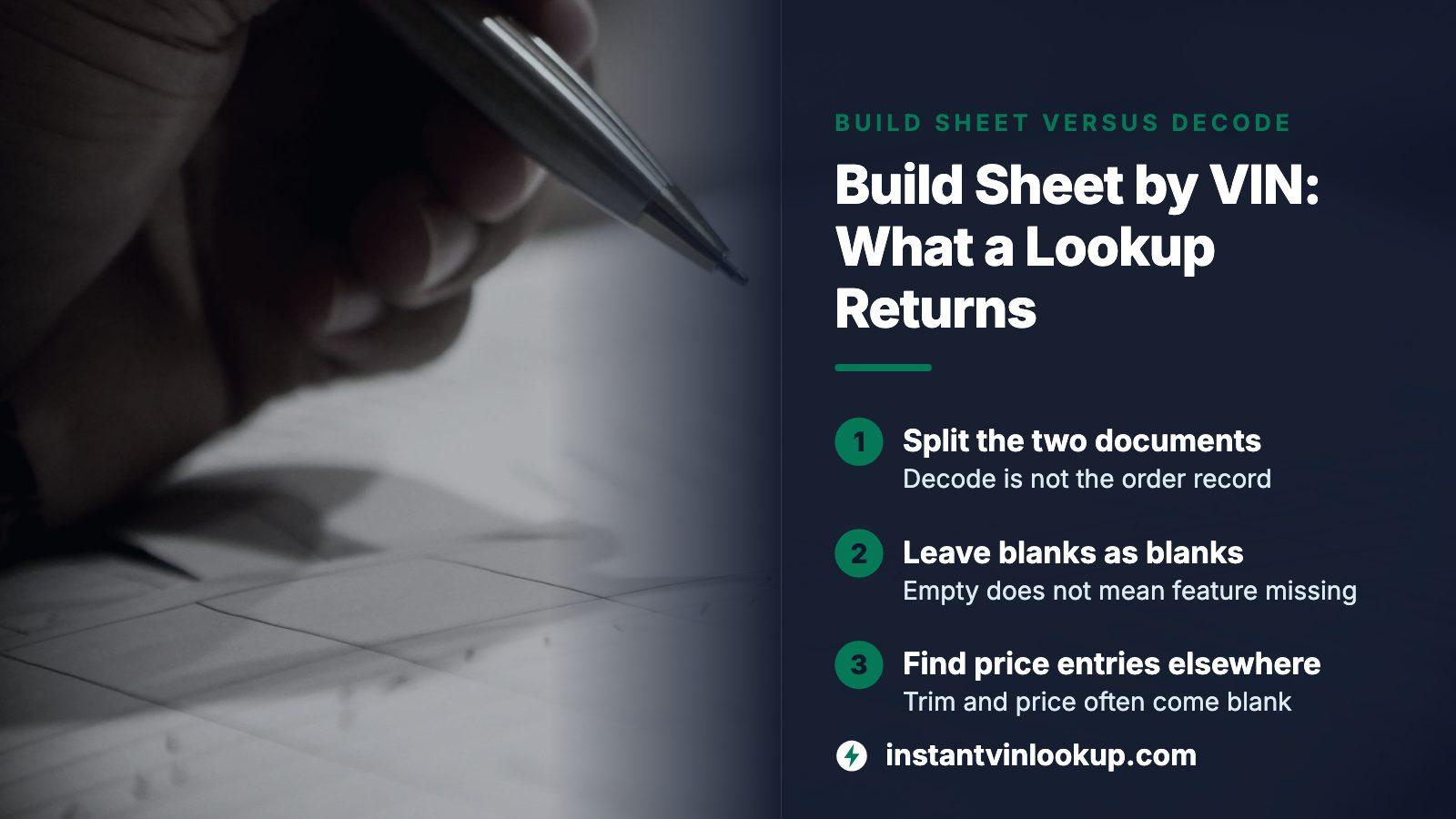
THE SHORT ANSWER
Searching a build sheet by VIN usually ends at a decode. The decode comes from the same maker-supplied key federal regulators use, and it fills in engine, body style, drivetrain and assembly plant. Trim, price and the itemized option list often come back empty, because those sit in the maker's own order record. Use the lookup to check what the car is, then ask the seller for paperwork on the rest.
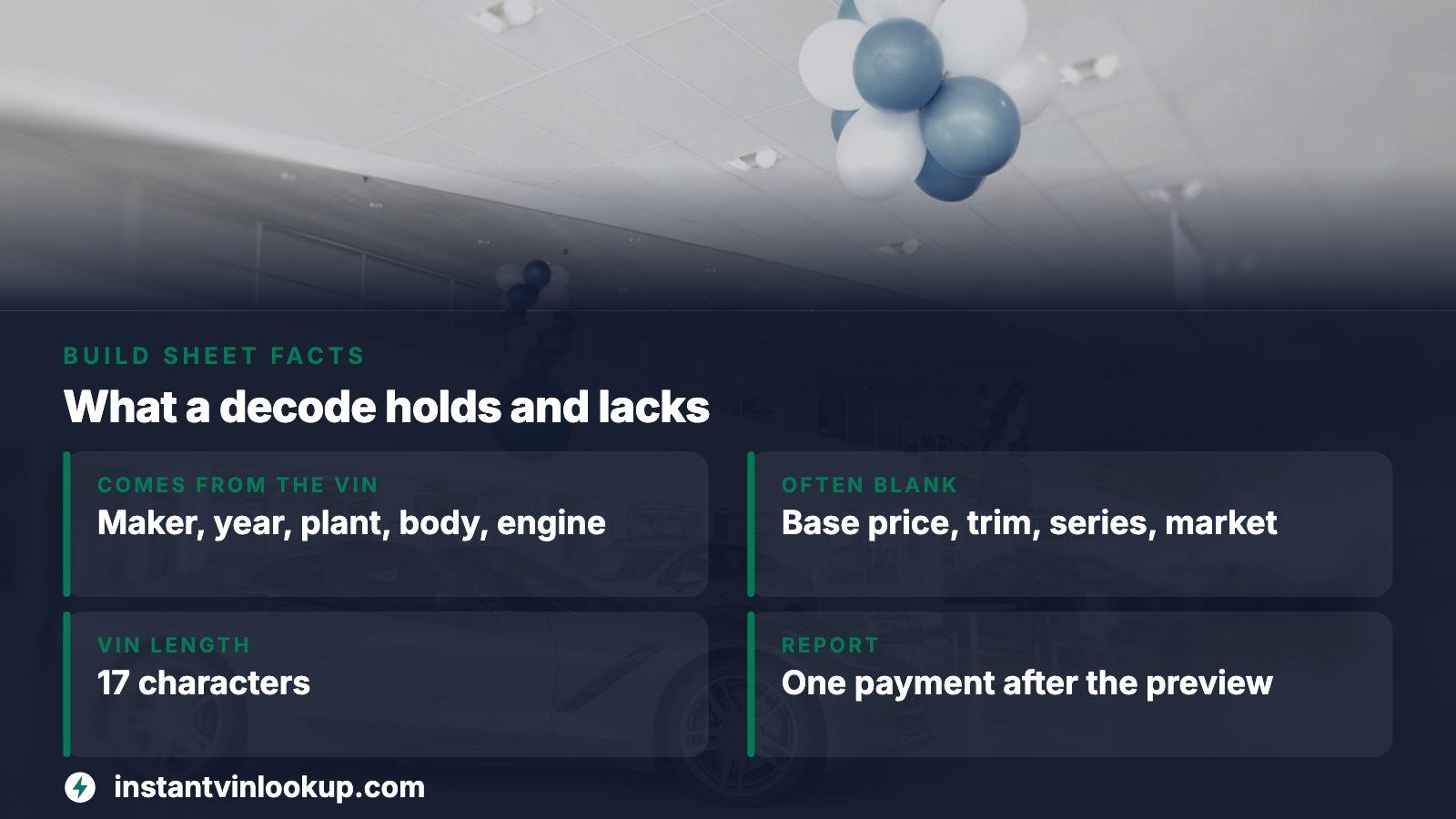
- Comes from the VIN
- Maker, model year, plant, body, engine
- Often blank
- Base price, trim, series, market
- Preview
- Free; the report is one payment
- Length of a VIN
- 17 characters
Two documents share one nickname
People type build sheet by VIN when they want to know exactly how one vehicle left the factory. The phrase covers two different things. One is a decode of the number itself, which is public and comes back in seconds. The other is the maker's internal order record for that car, listing each box ticked at the time of ordering, and that record is the maker's property.
A lookup site reads the first kind. It takes the 17 characters, matches them against the pattern the maker filed with NHTSA, and prints what that pattern says: engine size, body class, drive type, the plant, the model year. For a careful buyer that is already useful, because it tests whether the car in the driveway matches the ad. It is just not a replica of the maker's sheet, and a page that implies otherwise is overselling.
Field by field: decode versus order record
The table sorts the details buyers ask about by where they can realistically be read from.
| Detail | From a VIN decode | From the maker's order record |
|---|---|---|
| Maker, model, model year | Yes | Yes |
| Assembly plant | Yes, city and country | Yes |
| Engine size, cylinders, fuel | Usually | Yes |
| Drive type and body class | Usually | Yes |
| Trim or series name | Sometimes blank | Yes |
| Itemized optional equipment | Rarely | Yes |
| Suggested retail price | Blank in the samples tested | Yes |
Read the middle column as a ceiling, not a promise. Vehicles differ in how much of that column the maker's filing lets the decoder fill in.
What the 17 characters actually hold
Federal rules in 49 CFR Part 565 fix the layout, and the layout explains where a decode runs out. The opening trio names the maker and vehicle type, and a 9 in the third spot signals that the maker identifier carries on at positions 12 to 14. The middle block describes vehicle attributes, position nine is a check digit, and position ten marks the model year.
- Position 11 points to the plant that built the car.
- Positions 12 to 17 hold the serial number the maker gave it on the line.
- The check digit comes from a weighted sum divided by 11, with an X written when the remainder is 10.
- Nothing in the layout carries a price or a list of dealer-ordered extras.
That last point is the whole story. The structure was designed to identify and describe a vehicle, not to itemize an order.
A real decode, with the blanks left in
A sample 2013 Ford F-150 number went through NHTSA's vPIC service as a test. The answer described a crew cab pickup, a V-shaped 3.5 L six rated at 365 hp, direct-injected gasoline, four-wheel drive, assembled in Dearborn, Michigan. A partial 2011 BMW X3 number gave a different shape of answer: xDrive35i trim, a 3.0 L six at 300 hp, all-wheel drive, a Munich plant.
On the truck, four fields stayed empty: base price, trim, series and destination market. The output also carried an error note saying the ninth character failed its arithmetic, plus a warning that the year might be off. Both are reasons to verify each character before trusting a field.
Read the flags in the output
An error note about the ninth character or a short number deserves attention. One mistyped character can return another engine or another year, so match the number on the car against the title before leaning on any field.
A blank field does not mean the feature is missing
NHTSA attaches a caution to its own results. An empty value means the agency has nothing on that variable, and nobody should read it as proof the feature is missing. Single vehicles leave plenty of fields blank, battery details and curb weight among them.
In practice, treat an empty cell as unknown. If a listing claims a tow package or a premium trim and the decode is silent, that is neither confirmation nor contradiction. It is a prompt to look at the car, check the door-jamb label, and ask for the original paperwork. Where the decode does speak, such as a six-cylinder engine on a car advertised as an eight, believe the decode and push back on the seller.
Where the price and option entries live
The Automobile Information Disclosure Act, at 15 U.S.C. 1232, obliges the maker of every new automobile to stick a label on the car's glass before it ships to a dealer. Apart from make, model and number, that label carries the point of final assembly, the receiving dealer, the delivery town, how the car was shipped, the suggested retail price, each extra with its own price, the freight charge and a grand total.
That is the paper that records what was ordered, and it belongs to the maker and the selling dealer, not to the VIN alphabet. If the itemized list matters to your decision, the seller's original paperwork is the first place to ask. I could not confirm a working maker lookup for it; the support pages I tried for window-sticker tools would not load usable content, so none is recommended here.
Four moves from number to answer
- Take the VIN from the vehicle itself and make sure it agrees with the title or registration.
- Paste it into the search field on this site and read the free preview that appears.
- Hold the engine, drive type and body style up against what the advertisement says.
- If everything matches, open the report to see the history sitting behind those specs.
Seventeen characters leave no margin for a slip, so read them twice. Modern numbers skip the letters I, O and Q altogether, so spotting one is a quick tell for a typo.

When the specs and the car disagree
The most telling result is a mismatch. A decode that says one thing while the vehicle shows another points to a swapped engine, a re-badged trim, a number that belongs to a different car, or a plain typing error. Each of those deserves a question before money changes hands.
- Engine size or cylinder count that differs from the ad.
- A plant or country that contradicts the seller's story.
- A model year that does not fit the body style on the lot.
- A check digit failure on a number copied from the car.
A clean spec match does not clear the car. It only says the vehicle is what it claims to be, and the history is a separate question.
Price, then the records behind the specs
Nobody is billed for the preview. The report is a single purchase, available for one vehicle or as a multi-report pack when several cars are on your list, and no recurring charge follows. Exact rates are printed on the pricing page, so read them there instead of in an article.
A sensible order is to confirm the specs, then look at the records behind them: title brands, accident and odometer entries, and open recalls. The spec check tells you what the car is. The rest tells you what has happened to it.
Where this information comes from
- NHTSA vPIC API documentation — Describes how a number is decoded, how partial numbers are handled, and what the maker-filed catalog feeds.
- eCFR: 49 CFR Part 565 — Sets what the positions of a 17-character number stand for and how the check digit works.
- 15 U.S.C. 1232 on the new-car label — Lists what a maker must print on the label of a new automobile.
Sources and photos: Facts checked against the sources above in November 2026. Photos by Masjid MABA, Alejandro Escamilla and Richard R on Unsplash; diagrams by InstantVINLookup.
Keep reading
- Options by VIN: What an Instant Lookup Can Tell YouNarrows in on the equipment fields a decode fills or skips.
- VIN Lookup: Check a VIN Number on a Car Before You BuyThe everyday lookup, from the first search to the paid step.
- What Does a VIN Check Tell You About a Used Car?Walks through each report section and its limits.
- Where Is the VIN Number? Find It in a Minute, Then Verify ItLocate the number on the vehicle before entering it.
Frequently asked questions
Can I get a build sheet by VIN?
You can get a decode of the number, which gives engine, body, drive type, plant and model year. The maker's own order record, with each option and its price, is not part of that decode. Treat the lookup as a check on what the car is, and ask the seller for original paperwork on the extras.
Why did my VIN decode leave trim blank?
The decoder fills only what the maker's filing lets it match, so trim and series often stay empty even when the car has one. NHTSA treats an empty value as no data rather than absence, which means the car and its paperwork are the better check.
Does the VIN show the factory price?
No. The characters describe and identify the vehicle, and the base price field came back empty in the samples tested. The suggested retail price appears on the label the maker affixes to a new car, which is a separate document.
Is the lookup free?
Nobody is billed for the preview. The report is a single purchase, for one vehicle or as a multi-report pack, and no recurring charge follows. Current rates are on the pricing page.
What if the decode disagrees with the listing?
Recheck the number against the car and the title first, since one wrong character changes everything. If the number is right and the engine, drive type or year still clash with the ad, put the question to the seller and wait for a straight answer.
Now check the car itself
The guide explains what to look for. The report shows what this VIN has on record.