THE SHORT ANSWER
A VIN lookup returns the equipment the maker declared for that VIN pattern: engine, body, restraints and driver-assist features flagged standard or optional. It cannot confirm which optional items a particular car received, because federal rules never require the VIN to encode option packages. Use the lookup to rule out mismatches with the listing, then check the car itself.
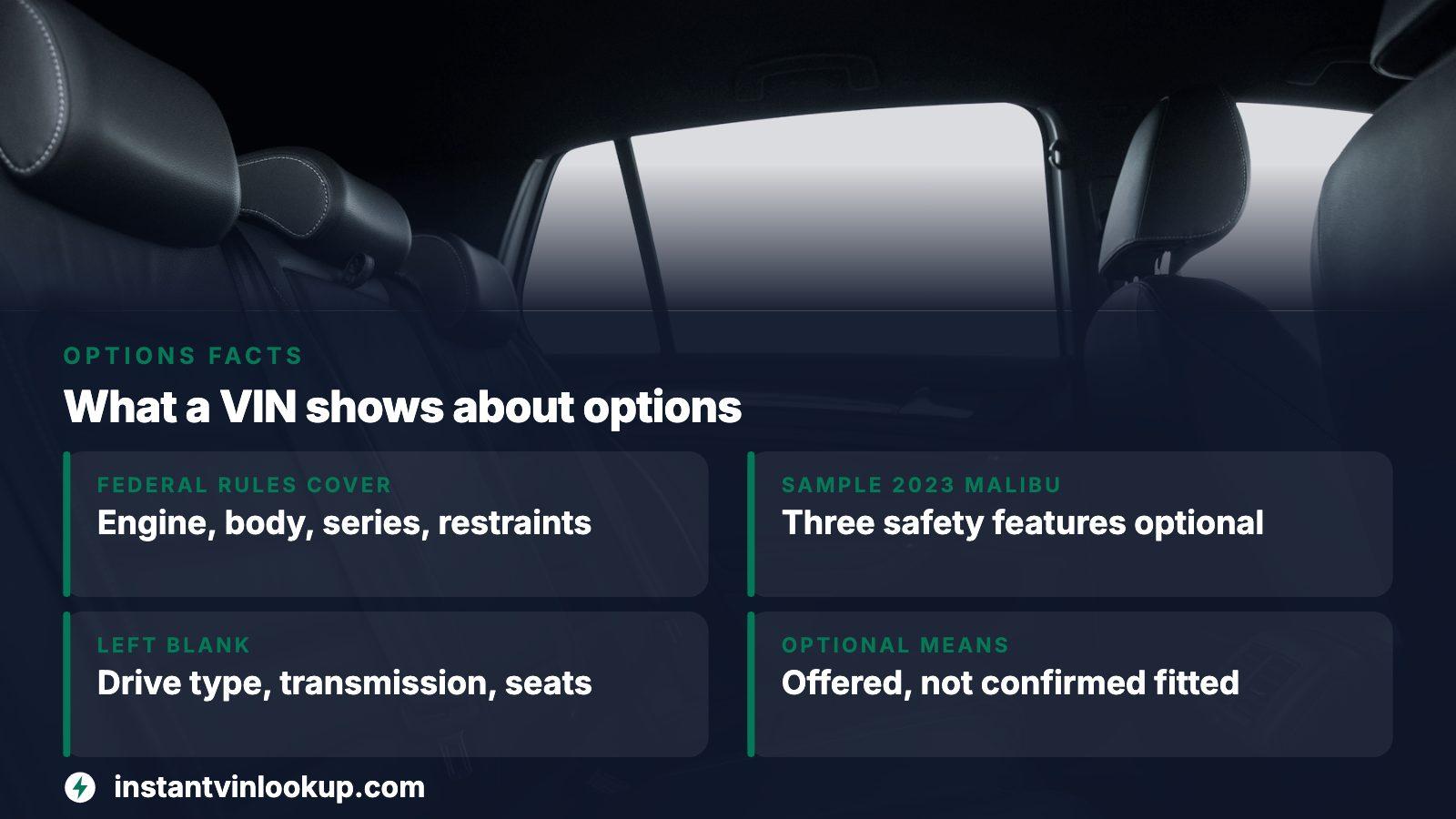
- What federal rules require
- Engine, body, series and restraints are decipherable from VIN positions 4 to 8
- Sample 2023 Malibu
- Three safety features flagged Optional, not confirmed fitted
- Same sample, left blank
- Drive type, transmission, seats, horsepower
What the lookup returns for a real car
We ran a 2023 Chevrolet Malibu through the federal decoder to see what an options query turns up. The record named the car as an LT (1LT) sedan with a turbocharged 1.5 L four-cylinder, built in Kansas, then went on to grade a long list of equipment. Air bags were described by location: front, side, curtain and knee.
| Feature | Status in the record |
|---|---|
| Forward collision warning | Standard |
| Pedestrian automatic emergency braking | Standard |
| Lane keep system | Standard |
| Keyless ignition | Standard |
| Blind spot monitoring | Optional |
| Rear cross traffic alert | Optional |
| Auto reverse system | Optional |
That is the nearest thing to an options list a VIN can give you. It is equipment the maker declared, sorted by how it was offered.
Why a VIN cannot hold the full order sheet
Federal rule 49 CFR 565.15 tells makers what positions 4 through 8 must make decipherable. For a car, the rule's table names the brand, the model line, the series, the body shape, the engine and every restraint with its location. Trucks add cab type, brakes and the gross weight rating. A sunroof, a premium speaker package or a set of 19-inch wheels appears nowhere in that table.
Makers choose their own characters inside those five positions, and they hand NHTSA the key to read them. That key is what powers the decoder. So the decode is only as detailed as what the manufacturer chose to file, and anything beyond the required attributes is a bonus.
Standard, optional and blank mean three different things
- Standard: the filing says every car in that VIN pattern carries the feature. You can usually rely on it unless a part was removed or swapped.
- Optional: the feature was offered on that pattern. The listing may or may not have it, and the VIN alone cannot settle it.
- Blank: the maker filed nothing. A blank is not a no. Every car has a drivetrain and a transmission, even when the lookup shows neither.
The trap with Optional
A seller who reads Optional as Included can overstate a car by one feature at a time. When the lookup marks blind spot monitoring as Optional, look for the indicator light in the mirror and the setting in the menu before you count it.
On our Malibu sample, drive type, transmission style, seat count and horsepower all came back empty, so even the basics needed a second source.
Powertrain choices are a separate list
When a shopper says options, they sometimes mean engine and gearbox pairings. The EPA's fueleconomy.gov service lists those by year, make and model. For a 2022 Ford F-150 4WD it returned four entries, all ten-speed automatics, split between 2.7 L and 3.5 L turbo V6 engines with and without stop-start. A 2018 Toyota Camry returned two: a 2.5 L four and a 3.5 L six, both eight-speed automatics.
Use that list to narrow what the car could have, then let the VIN decode pick the engine that matches. A pickup whose decode shows a V8 when the EPA list shows only V6 engines for that year and 4WD variant deserves a conversation with the seller.
Run the lookup in four steps
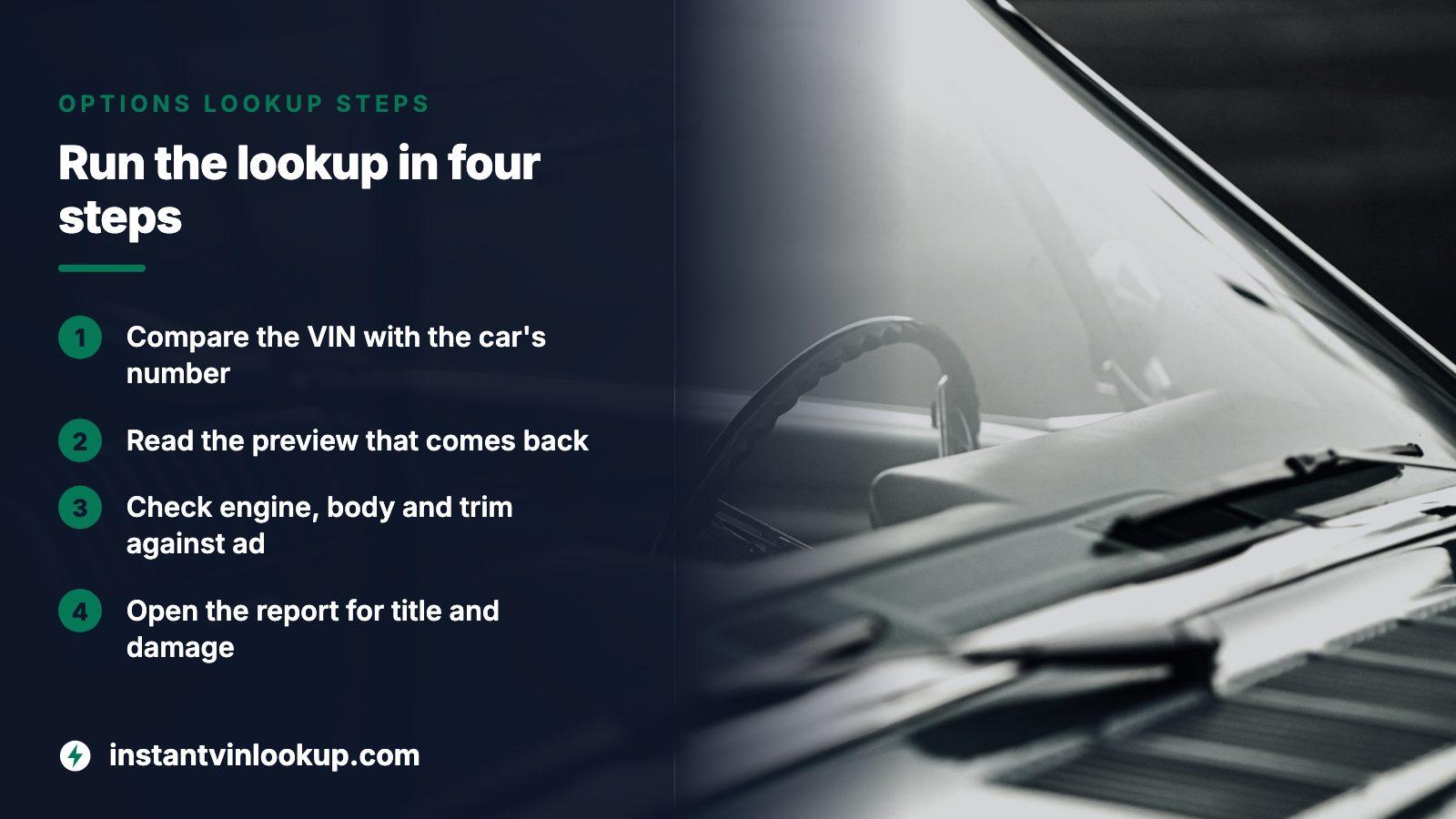
- Copy the 17 characters from the listing and compare them with the number on the car, which must be readable through the windshield on the driver's side.
- Type the number into the lookup field here and read the preview that comes back at no charge: it names the vehicle and hints at what a full report adds.
- Check the decoded engine, body and trim against the ad. A different engine or body is a stop sign.
- Open the full report for the history behind the equipment: title, damage and odometer records.
A VIN with a bad check digit gets flagged by the decoder. In our wildcard test of a Ford F-150 pattern, the response warned that the check digit did not calculate and that the model year might be wrong.
Confirm the options on the car itself
Treat the lookup as a filter, then verify in person. Bring the printout and walk the car with it.
- Test each feature the ad advertises: heated seats, cameras, the driver-assist switches and the keyless entry.
- Look at the dash after you turn the key. Missing warning lights for a listed feature can mean a part was removed.
- Ask for the original dealer paperwork if the seller has it. It is the only record of what was ordered.
- Compare the tire size on the sidewall with the size on the door placard.
Equipment added later by a previous owner will never show in a decode, and neither will equipment taken out.
Paying for the report, and the move after the decode
Looking up the VIN costs nothing at the preview stage. Going further means one payment, covering one vehicle or several in a bundle, and no billing repeats afterward; the pricing page carries the current figures. Equipment matters less once the title shows a brand or the odometer record has gaps, which is why the report is worth running after the decode looks right.
When the decode and the records line up with the ad, a mechanic's inspection is the sensible next stop. When they clash, raise it with the seller before any deposit changes hands.
Where this information comes from
- NHTSA vPIC API: VIN decoding — How the decoder works, including partial VINs and the maker-supplied key behind it.
- eCFR: 49 CFR Part 565, VIN requirements — The attributes positions 4 to 8 must make decipherable, and where the VIN sits on the car.
- EPA fueleconomy.gov web services — The source of the engine and transmission variants listed by year, make and model.
Sources and photos: Facts checked against the sources above in November 2026. Photos by Dennis Eusebio, Dylan Michaud and Erik Andersson on Unsplash; diagrams by InstantVINLookup.
Keep reading
- Build Sheet by VIN: What an Instant Lookup ReturnsThe document that records what was actually ordered, and where a decode stops.
- What Does a VIN Check Tell You About a Used Car?A wider look at everything a VIN check can and cannot report.
- Drivetrain by VIN: What an Instant Lookup Shows and When It Is BlankOne of the fields that most often comes back blank.
- Where Is the VIN Number? Find It in a Minute, Then Verify ItFind the number on the car before you type it in.
Frequently asked questions
Can you find the factory options on a car with just the VIN?
Only in part. A decode tells you the engine, body and the safety features the maker declared for that VIN pattern, each marked standard or optional. It does not say which optional packages were ordered on your car, so confirm the rest by testing the car or asking for the original paperwork.
Why does the lookup say Optional instead of yes or no?
Because the filing describes the pattern shared by many cars, not one individual car. Optional means the item was offered. Whether yours has it depends on what the first buyer ordered, so the VIN alone cannot confirm it.
Does the decode show the trim level?
Often, but not always. Our 2023 Malibu sample returned the trim as LT (1LT), while a wildcard F-150 pattern returned only a body label, SuperCrew. Treat a trim as a starting point and compare the badges and interior with the listing.
What if the options in the ad do not match the lookup?
Check the VIN you typed first, because a single wrong character changes the decode. If the number is right, ask the seller where the feature came from. Aftermarket additions and removals are the usual explanation, and a mismatched engine or body deserves a firmer answer.
Is the VIN preview on this site free?
Yes. The preview names the vehicle and shows what the full report would add. The full report is a one-time purchase instead of a plan, and the pricing page has the current options. Run the preview first and decide after you see the decode.
Now check the car itself
The guide explains what to look for. The report shows what this VIN has on record.