THE SHORT ANSWER
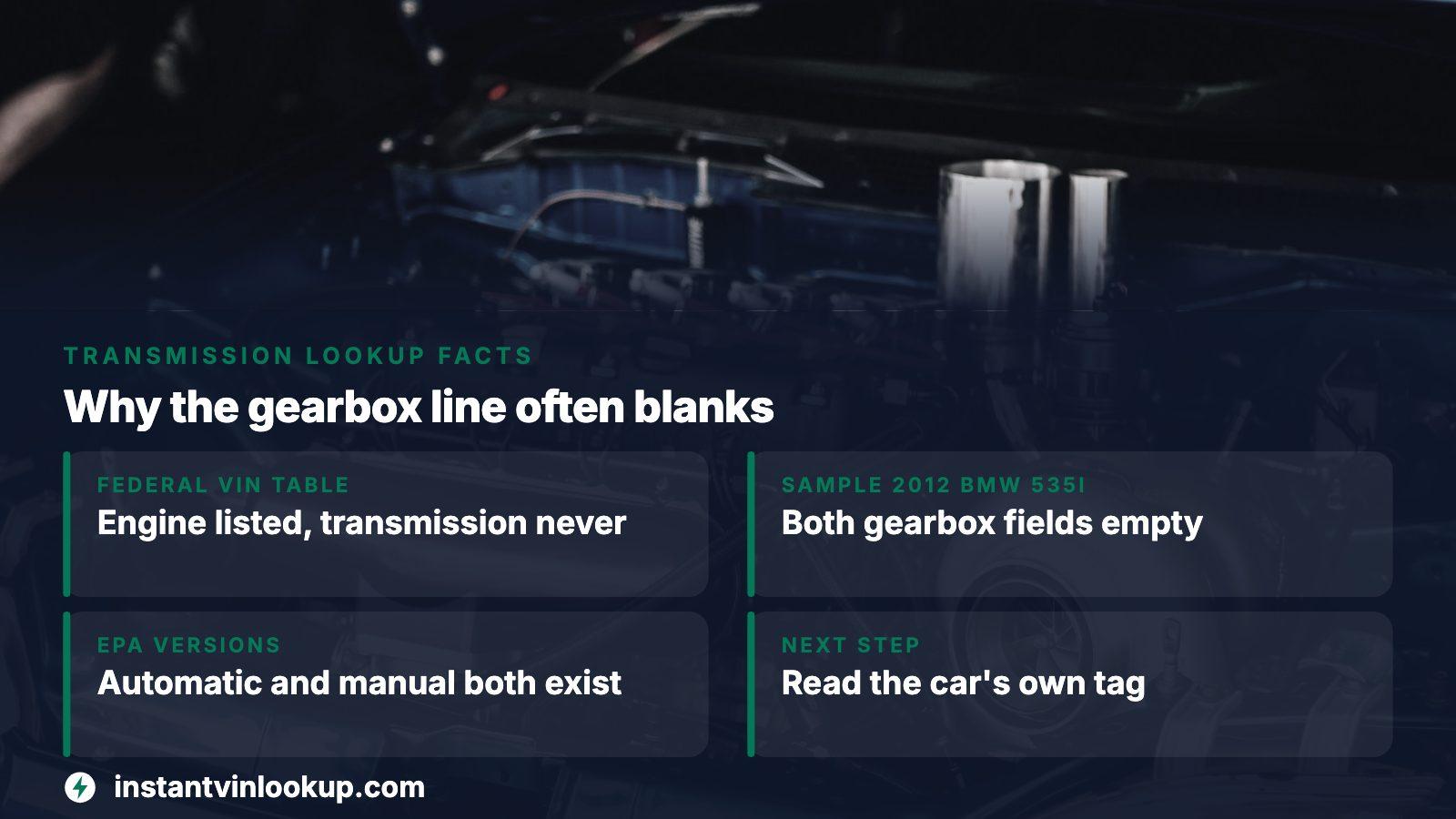
Sometimes. The lookup reads NHTSA's decoder, which has a transmission style field and a speeds field. Makers fill them in by choice, because the federal table of required VIN attributes lists an engine and never a transmission. This site's sample car, a 2012 BMW 535i, decodes cleanly with both fields empty. Treat a blank as a gap to close on the car itself, not as an error in the number.
- Federal VIN table
- Engine type listed, transmission never
- Sample 2012 BMW 535i
- Clean decode, both transmission fields empty
- EPA versions of that engine
- Automatic (S8) and Manual 6-spd
The two entries a lookup can fill in
NHTSA's decoder carries a transmission style field and a transmission speeds field. Speeds is a plain number, such as 6 for a six-speed. Style comes from a short list that also includes Direct Drive, and the lookup passes along whichever entry the maker filed.
| Style entry | What it tells you |
|---|---|
| Automatic | A conventional automatic; if the speeds field is filled, it gives the gear count |
| Manual/Standard | A gearbox the driver shifts by hand |
| CVT, e-CVT | Continuously variable, with an electronic version listed as its own entry |
| Automated Manual (AMT) | A manual-type gearbox with automated shifting |
| Dual-Clutch (DCT) | A gearbox built around two clutches |
Why so many results come back blank
A blank is rarely a malfunction. Federal rule 49 CFR 565.15 sets out what the characters in positions four through eight of a VIN must let you work out. Its Table I names the engine type for passenger cars, multipurpose vehicles, trucks, buses and motorcycles. No row mentions a transmission.
Makers choose which characters to use and where, provided the listed items can be worked out from the information they send NHTSA. Everything else is optional. NHTSA states that the decoder's output is supplied by the vehicle maker, so a maker that never filed gearbox data leaves the fields blank.
One blank, shown on the sample car
Take this site's sample VIN, WBAFR7C57CC811956, a 2012 BMW 535i. A decode run on 5 November 2026 came back clean with the check digit correct: a sedan with a six-cylinder, 3.0 L gasoline engine, built in Dingolfing, Germany. Both transmission fields were empty.
| Source | What it lists for the gearbox |
|---|---|
| NHTSA decoder, sample VIN | Nothing in either transmission field |
| EPA FuelEconomy.gov, same year, model and 3.0 L engine | Two versions: an automatic listed as S8, and a six-speed manual |
| NHTSA decoder, 2003 Honda Accord V6 pattern | Automatic, 5 speeds |
The contrast is the lesson. One decode says nothing, yet the same engine was sold with two quite different gearboxes. A listing that says automatic may be right, but the blank cannot confirm it. The Honda row shows the fields do fill for some makers.
Running the lookup on the car in front of you
- Take two photos of the number, one off the car and one off the paperwork, and check they agree character by character.
- Enter the number in the lookup field at the top of the page. Nothing is charged for the preview that opens first.
- Open the specifications and note the style and speeds entries, or the lack of them.
- Compare them with the listing, which may say automatic, manual or CVT. A mismatch is a finding. A blank is a gap.
- Put the same number into NHTSA's recall search before you leave to view the car.

Closing a blank without guessing
- Find the identification tag, sticker or stamped code on the gearbox case. It describes the unit in the car now, not the one the factory fitted.
- Read any label on the vehicle. NHTSA notes that a label attached to the vehicle may hold more than the decoder shows.
- Ask a franchise parts counter to read the maker's build record against the full VIN. That record shows what left the assembly line.
- Look up the year, model and engine on EPA's FuelEconomy.gov to see which gearboxes were offered, then match one to what you find.
- Be wary of any tool that never returns a blank for a model sold with more than one gearbox.
Drive it as well. Hesitation before the gear engages, a flare between gears or a shudder at light throttle can say more than any entry.
Red flags: a gearbox that is not the original
A decode describes the build. It cannot say what a shop fitted in year nine, and an older car with high mileage can be running its second gearbox. Four signs are worth a look.
- The tag's build date is later than the car's own build date.
- Clean bolts or fresh sealant on an otherwise grimy case.
- A seller who turns vague when asked if the gearbox was ever swapped out or overhauled.
- No invoice, when a remanufactured unit usually comes with paperwork and a transferable warranty.
From an NHTSA owner complaint
A 2013 Ford Focus owner wrote that the car would not move when put in reverse and a gearbox warning lamp lit. An independent mechanic traced it to failed solenoids and advised another replacement. By the owner's account, an earlier swap had happened in June 2023, at 114,000 miles on the clock, and this failure came at 147,000. The manufacturer, they said, offered no help.
The takeaway: a swapped gearbox is not a clean slate. Ask who fitted it, when, with what part, and who stands behind it in writing.
What the transmission line cannot show: title and warranty
A gearbox entry is a build detail. Brands on the title, odometer accuracy and damage on file all live in separate history records tied to the VIN.
From an NHTSA owner complaint
The owners of a 2016 Nissan Altima wrote that they bought it second-hand in February 2017, when the odometer read 2,356. In late 2020 it shuddered and lost power, and the CVT gave out before the car reached 35,000 miles since new. They said the dealer told them the maker's policy voids the new-car warranty on a branded title, and the maker turned down their case.
Treat it as one owner's account, not a finding. The lesson stands: a branded title and a gearbox warranty are linked questions. A report from this site lists title brands, damage and odometer readings for the VIN, so you can see them before paying and ask the maker in writing what coverage applies.
Recalls follow the VIN, so search with all 17 characters
NHTSA's VIN search answers one question: does this car carry a recall that is still unrepaired. Gaps to know about: recalls already repaired drop out, brand-new recalls may not have every VIN assigned yet, anything past 15 years is excluded unless the maker extends coverage, and small manufacturers are skipped. Non-safety campaigns and international vehicles are not covered either.
The VIN search can also surface maker-supplied recall details that NHTSA has not posted yet, and NHTSA suggests checking twice a year. One search takes up to 100 VINs, which suits a long shortlist. Searching by year, make and model produces general results for that model, not an answer about your car.
What the preview shows and what the report costs
The preview is a record count for your VIN and costs nothing. The report is a one-time purchase: a single report, or a multi-report bundle if you are weighing a shortlist. There is no subscription, and the pricing page lists each amount.
A transmission entry is one line in the specifications. The reason to buy the report is what sits around it: title brands, damage and odometer entries. It lists only what was reported, so a mechanic's inspection still comes first. Sensible order: preview, recall search, then a look at the gearbox.
Where this information comes from
- eCFR: 49 CFR 565.15, VIN content requirements — supports the table of attributes a VIN must make decipherable and the maker's freedom over the characters
- NHTSA: VIN decoder (vPIC) — supports manufacturer-reported results, partial VINs and the note about labels on the vehicle
- NHTSA: vPIC API documentation — supports the transmission style and speeds fields and the decode of the sample VIN
- EPA FuelEconomy.gov: 2012 BMW 535i, two versions — shows the automatic and manual versions listed for the sample car's engine
- NHTSA: check for recalls — supports what a VIN recall search shows, what it leaves out and the 100-VIN limit
- NHTSA owner complaint 11377573 — owner experience, paraphrased
- NHTSA owner complaint 11614501 — owner experience, paraphrased
Sources and photos: Facts checked against the sources above in November 2026. Photos by Shadow Photography, Michal Biernat and Willian Cittadin on Unsplash; diagrams by InstantVINLookup.
Keep reading
- VIN Lookup: Check a VIN Number on a Car Before You BuyThe full walk-through of what an instant lookup returns and how to read it
- Transmission Fluid by VIN: What an Instant Lookup Shows and Leaves OutOnce the gearbox type is known, how the fluid choice follows from it
- Drivetrain by VIN: What an Instant Lookup Shows and When It Is BlankAnother build detail the decoder fills only when the maker filed it
- Parts by VIN: Run the Instant Lookup Before You OrderWhy a parts order needs the full VIN and not just the model year
Frequently asked questions
Is the VIN enough to tell automatic from manual?
Sometimes. If the maker filed it, the style entry reads Automatic or Manual/Standard. If the field is blank, look at the car itself: a clutch pedal and a shifter settle it faster than any lookup, and EPA's FuelEconomy.gov shows which versions a given year and engine came in.
Why did one decoder show my transmission and another show nothing?
Decoders replay what makers filed. If the maker filed gearbox data, the result carries it; if not, the field stays empty. A tool that fills the blank anyway may be guessing, so trust the tag on the gearbox over either result.
Does a blank transmission field mean I typed the VIN wrong?
No. A typing slip tends to break the check digit, whose job under the federal rule is to verify transcription. The sample 2012 BMW 535i passed that test and still left both transmission fields empty, so a blank in one field is a gap, not a typo.
Can I find the right transmission fluid from a VIN?
The lookup can name the transmission style, which a fluid choice depends on first, but it holds no fluid specification. Use the owner's manual or a franchise parts counter, and confirm the style before buying anything, since the right fluid differs from one modern unit to the next.
Does the lookup cost anything?
Only the report is paid for, in one payment, with no renewal. Multi-report bundles are offered for a long shortlist. The preview runs on the VIN alone and costs nothing. See the pricing page for amounts. NHTSA's decoder and recall search are free to use on their own, so run them first.
Now check the car itself
The guide explains what to look for. The report shows what this VIN has on record.