THE SHORT ANSWER
To get EV range by VIN, identify the model year, trim and battery from the number, then find that exact version in the EPA's ratings, each of which lists a driving range. NHTSA's decoder returns battery and charger fields for many electric cars but no range field. The EPA figure describes a new car, so a used one needs a fully charged test drive to see what is left.
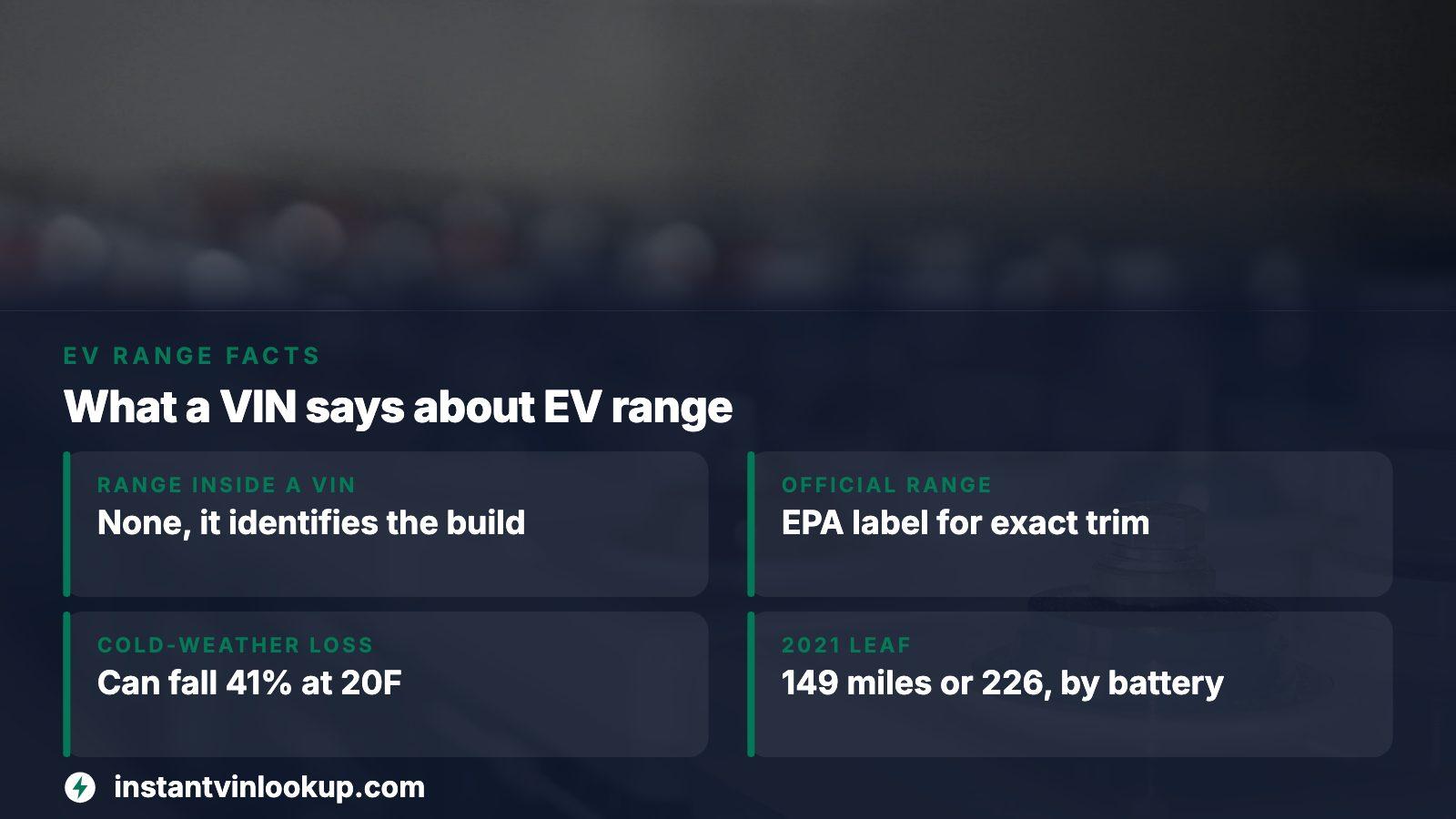
- Range inside a VIN
- None; the number identifies the build only
- Official range
- EPA label value for the exact trim and battery
- Cold-weather loss
- Range can fall 41% at 20F with the heater on
- Same model, different range
- 2021 Leaf: 149 miles with 40 kW-hr, 226 with 62 kW-hr
Why the number cannot hold a range
The seventeen characters tell you who built the car, where, in which model year, and a set of coded details about body, motor and battery. Range is a different kind of fact. It is a test result tied to one configuration, and it lives in a federal ratings database.
The honest way to ask is as a chain of two lookups. Step one, done instantly here, converts the VIN into a description of the build. Step two carries that description to the official record. Wrong figures usually come from skipping step one, because a single model name often spans several batteries.
What an instant decode gives you on an electric car
The federal decoder draws on filings from the manufacturers themselves, so each brand's output is only as detailed as what it supplied. For two electric models I tried made-up numbers that pass the check-digit test and follow real model patterns. None belongs to an actual car, and the answers were uneven.
| VIN pattern decoded | Fields returned |
|---|---|
| 2021 Nissan Leaf SV | Battery electric, electric fuel, 40 kW charger power, 4x2 drive; battery capacity left blank |
| 2022 Tesla Model 3 | Battery electric, 79.50 kWh lithium-ion battery, single motor, Level 3 DC charging entry |
Neither result had a range field, because the decoder has none. Where battery capacity is filled in, it helps you pick the right EPA entry. Where it is blank, you read the trim and pack from the car or the listing.
One model name, three EPA records
The EPA lists the 2021 Nissan Leaf as separate entries by battery, and the gap is large enough to change whether a car suits your commute.
| 2021 Nissan Leaf record | EPA range | City / highway range |
|---|---|---|
| 40 kW-hr battery pack | 149 miles | 163.2 / 131.3 |
| 62 kW-hr battery pack | 226 miles | 245.0 / 202.2 |
| SV/SL, 62 kW-hr battery pack | 215 miles | 233.7 / 192.5 |
Even two entries with the same pack differ by 11 miles. An ad that says only Leaf, or a seller who quotes the best of the three, leaves you guessing, which is why the decode comes first.
Walking one candidate through it
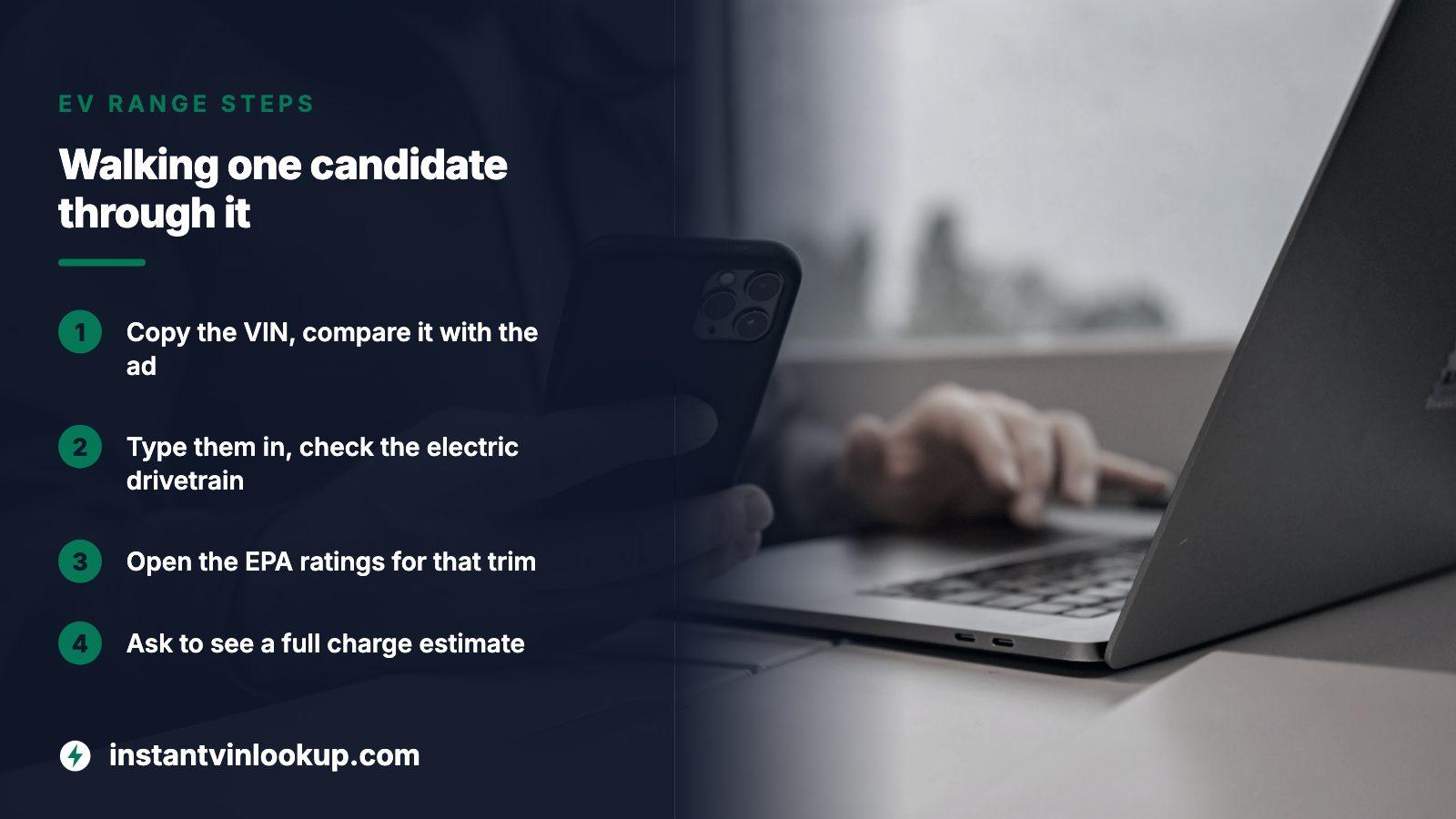
- Get the seventeen characters from the title or registration, or from the vehicle, and set them beside the ad.
- Type them into the box at the top; the free preview should echo the year, model and electric drivetrain the seller described.
- Open the EPA ratings for that year and model and pick the entry that fits the trim and battery.
- Note the label range, then ask the seller to show the car fully charged and read the estimate on the dash.
If the decoded trim and the entries you are offered disagree, pause. A mistyped VIN, a different trim than advertised and a swapped pack each change the number.
Reading the range line and its neighbors
On the EPA label, driving range is the estimated distance from a full battery, mixing city and highway driving. Beside it sit two figures worth reading: MPGe, which lets you compare an electric car with a gasoline one, and kilowatt-hours per 100 miles, which tracks electricity cost more directly.
Treat it as a comparison tool
The EPA describes its ratings as a yardstick across vehicles, not a forecast for any single driver. Use the figure to rank candidates, then use a test drive to judge the specific car in front of you.
Where the miles go in daily use
Cold is the biggest swing the EPA documents. At 20F, EV range can drop by 41% in mixed driving, and roughly two thirds of the added draw is the heater. Leave the heater off and the loss is still about 12%. Hills, freeway speed and heavy loads add their own cuts.
- Test the car in the weather you will drive in, not only on a mild day.
- Compare the dash estimate after a full charge with the label figure for that trim.
- Ask how the car was charged, and how old it is, before trusting any single reading.
What owners describe when a used pack has aged
The label tells you about a new car. Owners' complaints filed with NHTSA show what a tired battery looks like later.
From an NHTSA owner complaint
An owner of a 2015 Nissan Leaf reported a pack that topped out at 55 miles of range, on a car showing 85,000 miles. Nissan declined to help because the car was beyond a 7 year warranty, although the owner's book said 8. The owner said charging happened only at home, and the car once stopped on the highway.
From an NHTSA owner complaint
A 2018 Leaf owner saw range fall from 150 miles EPA to 80 to 100 at freeway speeds. Nissan first blamed Arizona heat. Then the car would not start, and the dealer found bloated cells from overheating and replaced the battery under warranty.
The takeaway is practical: a range shortfall can be age, heat or a fault, and the warranty position decides who pays. Get that in writing before you buy.
What the history report adds to a range check
Range tells you what the battery can do today. The vehicle's past tells you what may have happened to it. A crash that touched the pack, a salvage brand or an odometer reading that does not fit the wear all matter more on an electric car, because the battery is the most expensive part.
- Branded titles, plus salvage and auction records that include photos.
- Accident and damage records, plus any theft or insurance entries.
- Odometer history, so you can weigh the mileage against the range you saw.
- Open recalls, which can touch the battery itself.
One example from NHTSA's recall data is campaign 24V700000. It applies to certain 2019 and 2020 LEAF cars fitted with a fast-charging port, because the battery may overheat while fast charging. Dealers fix it with a battery software update, free of charge.
Cost, and the sensible next step
Begin with the free preview, which confirms the build before you spend a Saturday driving to see the car. Should you want the whole history, you pay one time and nothing renews; the pricing page lists the packs.
Decode, match the EPA record, then test the car on a full charge. Keep the paid report for a car you are close to owning. When the numbers and the paperwork agree, you negotiate from facts.
Where this information comes from
- FuelEconomy.gov: Electric vehicle label — What the driving range, MPGe and kWh per 100 miles lines mean.
- FuelEconomy.gov: Fuel economy in cold weather — EV range and efficiency losses in cold weather, with and without the heater.
- FuelEconomy.gov: Web services and data — EPA records are chosen by year, make, model and options, and carry a range field.
- NHTSA: vPIC Vehicle API — The VIN decoder, built from manufacturer submissions.
- NHTSA recalls API: 2019 Nissan Leaf — Campaign 24V700000 and its remedy.
- NHTSA owner complaint 11661505 — owner experience, paraphrased
- NHTSA owner complaint 11555512 — owner experience, paraphrased
Sources and photos: Facts checked against the sources above in November 2026. Photos by smart-me AG, Anastasiia Nelen and Vanya Smythe on Unsplash; diagrams by InstantVINLookup.
Keep reading
- Battery Size by VIN: What a Lookup Tells You and What It SkipsA different battery question, for the 12-volt battery that starts ordinary cars.
- MPG by VIN: Find a Car's Fuel Economy From Its 17 CharactersThe same two-step method for gasoline cars, where mpg replaces range.
- VIN Lookup: Check a VIN Number on a Car Before You BuyHow a VIN lookup works and what it can return.
- What Does a VIN Check Tell You About a Used Car?The record types a history report covers, beyond specs.
Frequently asked questions
Can I find an electric car's range from the VIN alone?
Not directly. The VIN identifies the model year, trim and build, and the EPA range belongs to that build. Decode the number, then find the matching battery and trim in the EPA ratings. The result is the official estimate for a new car, not a measurement of the one you are considering.
Does NHTSA's free decoder show range?
In the test decodes I ran, it returned battery electric status, fuel type and charger details, and for one pattern the battery capacity, but no range. It is useful for confirming the build before you look up the rating, not as a source of mileage figures.
Why is the range on my used EV below the label figure?
Cold weather, speed, hills, tire condition, battery age and charging habits all pull it down. The EPA says its numbers compare vehicles rather than predict yours. A large gap on a used car deserves a battery check and a look at warranty terms.
What if the decode leaves out the battery size?
Check the trim name on the car or in the listing, then pick among the EPA entries for that year. If two remain, plan around the lower range until the seller shows you which pack is installed, ideally with the car on a full charge.
Is a range check enough before I buy a used EV?
No. Range says nothing about a branded title, an earlier crash or a rolled-back odometer. The free preview shows how many records exist; read it first, and weigh the full report before you commit any money to the car.
Now check the car itself
The guide explains what to look for. The report shows what this VIN has on record.