THE SHORT ANSWER
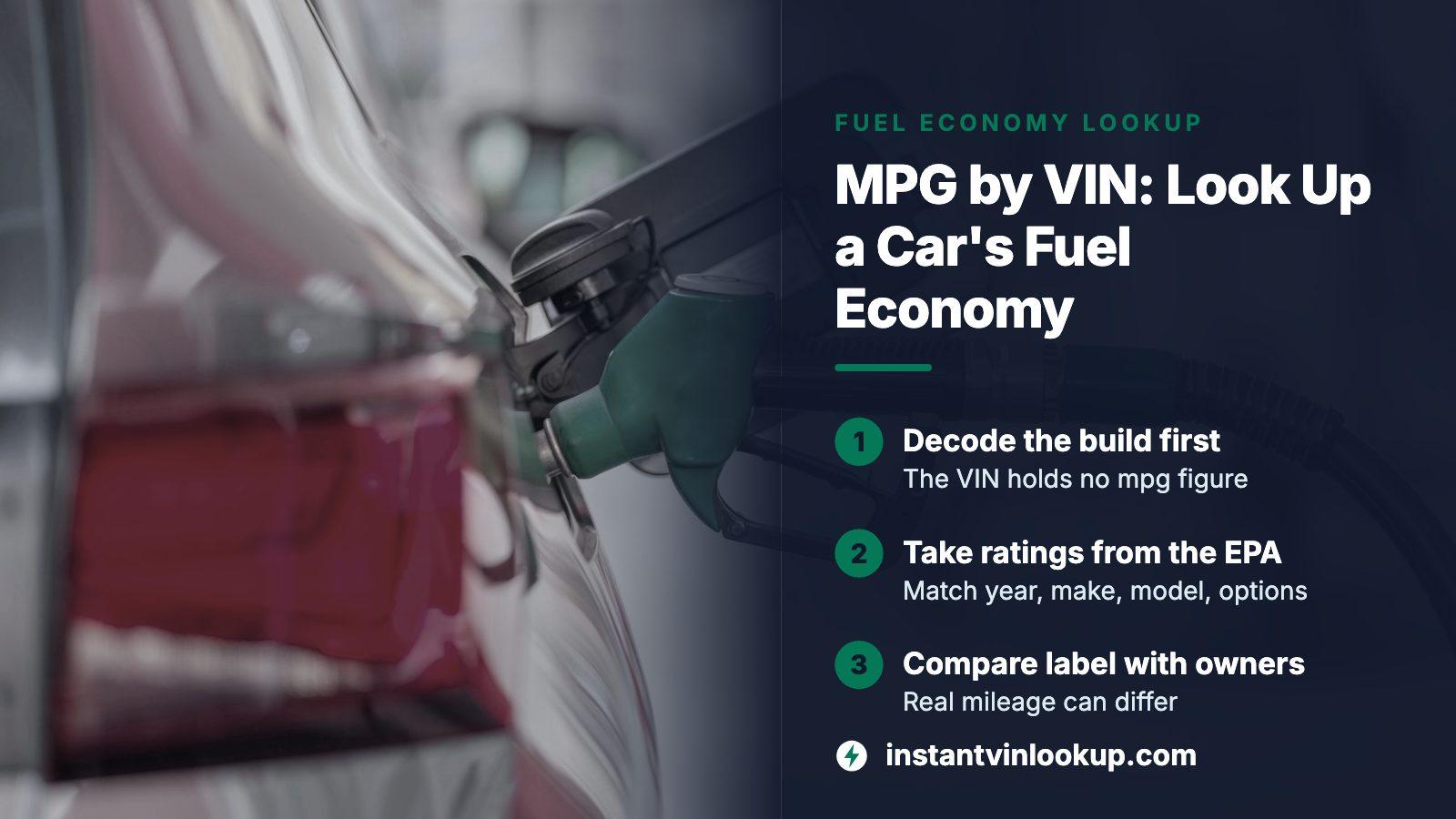
To find mpg by VIN, decode the number to model year, engine, transmission and drive type, because the EPA rates each of those combinations separately. Then look up that exact combination on FuelEconomy.gov. NHTSA's VIN decoder returns engine and fuel fields but no mpg figure. Treat the rating as a comparison tool, since real mileage depends on driving, condition and fuel.
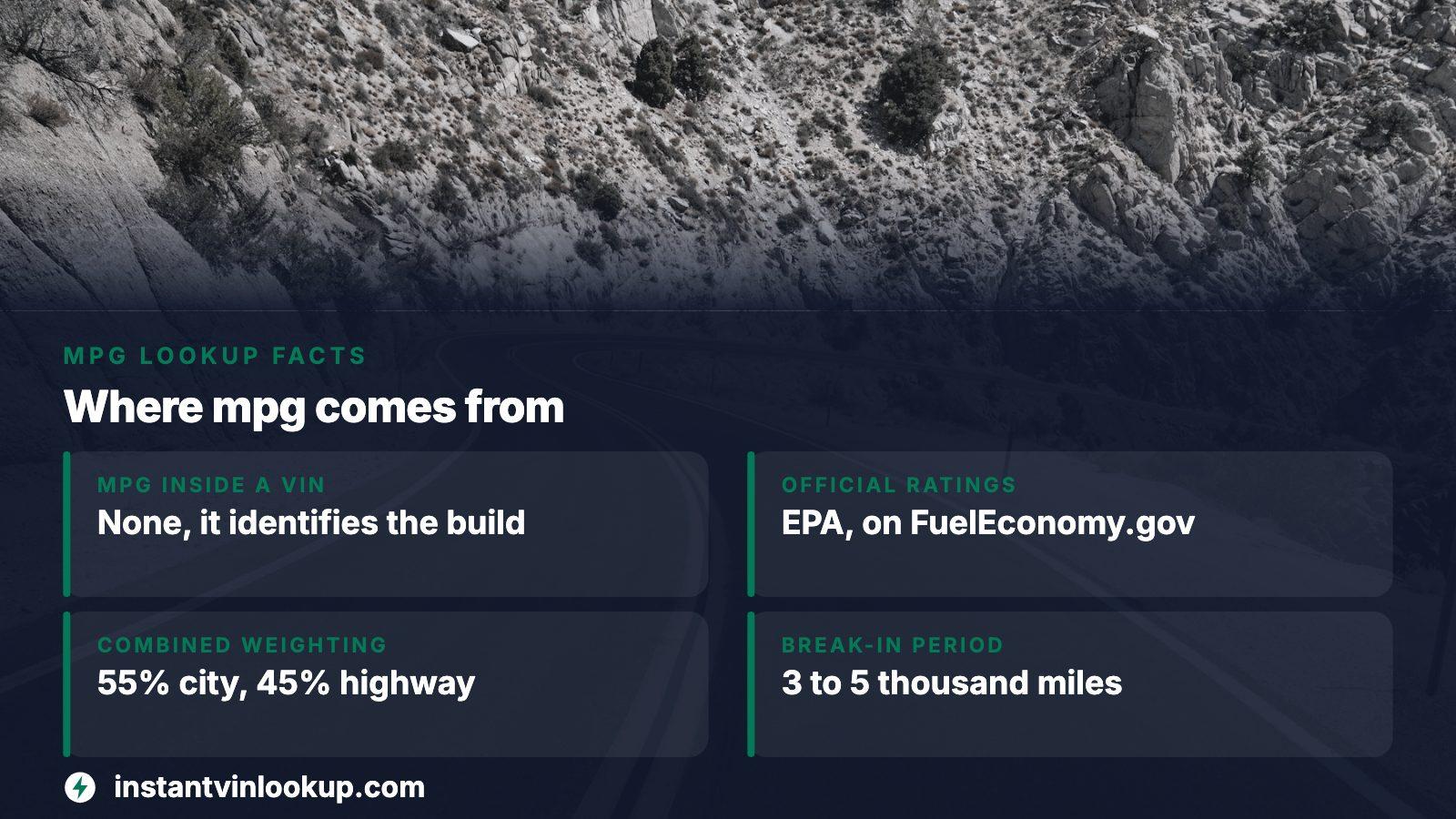
- Mpg inside a VIN
- None; the number only identifies the build
- Official ratings
- EPA, published on FuelEconomy.gov by year, make, model and options
- Combined mpg weighting
- 55% city, 45% highway
- Break-in period
- A new engine may need 3 to 5 thousand miles
Why the VIN gets you to the rating but is not the rating
Seventeen characters name a vehicle: who built it, where, the model year, and coded details about the body and engine. Fuel economy is a test result that the EPA attaches to a specific configuration, and that result lives in a separate database. So a search for mpg by VIN really means two lookups chained together.
The first lookup, which this site does at the top of the page, turns the VIN into a build description. The second takes that description to the federal ratings. Skipping the first step is where most wrong numbers come from, because a model name alone covers several different powertrains.
One model, several ratings: the numbers behind the warning
FuelEconomy.gov lists a vehicle only after you choose a year, make, model and an options row, and the options row is where the spread shows up. Two real entries show how far apart two trims of one model can sit.
| Vehicle (EPA record) | City / Highway / Combined |
|---|---|
| 2012 Honda Fit, 1.5 L, automatic with 5 speeds | 28 / 35 / 31 |
| 2012 Honda Fit, 1.5 L, manual 5-speed | 27 / 33 / 29 |
| 2015 F-150 two-wheel drive, smaller turbo six | 19 / 26 / 22 |
| 2015 F-150 two-wheel drive, larger turbo six | 17 / 24 / 20 |
A gap of two mpg on a small car or a pickup is small per tank and large across years of ownership. It is also exactly the sort of difference a seller may gloss over when the ad quotes only the model.
What the decode hands you, and what it leaves out
NHTSA's decoder is built from data that manufacturers submit, and it can return cylinders, displacement, the primary fuel, the drive type and a weight class. In a test decode of a pickup VIN it returned a gasoline 2.7 liter six and a four-wheel-drive layout. It listed fuel type and fuel system fields, and not one of them carried an mpg value.
- Model year and exact model name, needed to pick the right EPA entry.
- Engine size and cylinder count, which separate the entries in the example table above.
- Drive type, because the EPA runs its tests on four-wheel-drive models with only two wheels driven.
- Fuel type, to tell gasoline from diesel, flex-fuel or plug-in cars before you compare labels.
Transmission is the field decoders fill in least reliably. If the decode leaves it blank, check the car itself or the build listing before choosing among the options rows.
Walking a specific car through both lookups
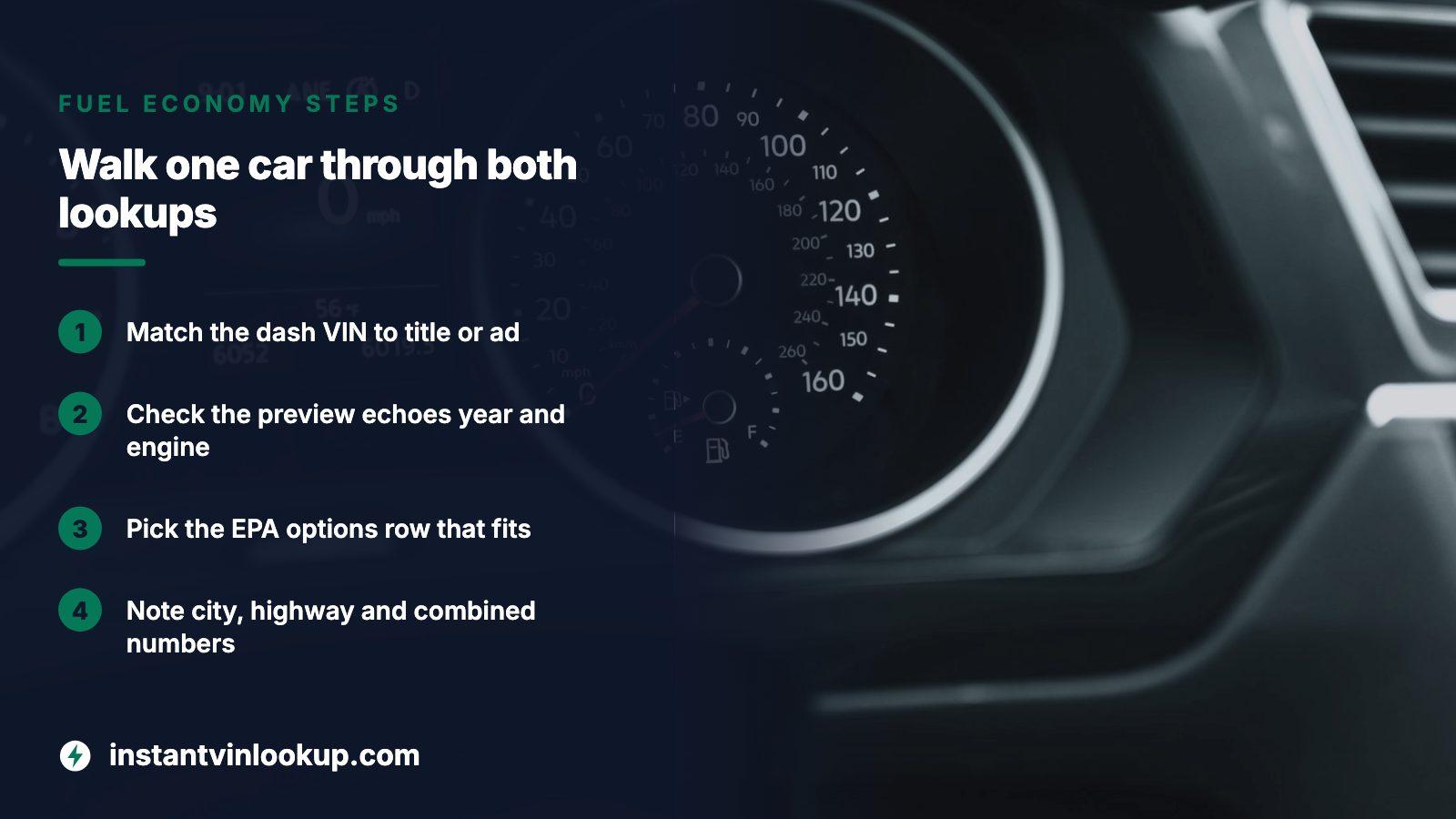
- Take the VIN off the dash plate or door-jamb sticker and match it against the title or the ad.
- Type it into the lookup above; the free preview should echo the year, engine and body style the seller claimed.
- Open FuelEconomy.gov, choose that year, make and model, then pick the options row that matches the engine and transmission.
- Note the city, highway and combined numbers, and the fuel type the label lists.
If the decoded engine does not match the options you are offered, stop and ask why. A swapped engine, a different trim or a mistyped VIN each change the rating.
Reading the rating without being fooled by it
The combined figure on a gasoline label weights city driving at 55% and highway at 45%, so it suits mixed commuting and flatters neither extreme. Hybrids without a plug are labeled as gasoline cars. Plug-in hybrids, diesel, flex-fuel and electric cars carry different label formats, and cars that run on electricity show MPGe, a gasoline-equivalent measure.
Gallons per mile tells the truer story
The EPA label also lists consumption per 100 miles because mpg can mislead. Moving from 10 to 15 mpg saves about 33 gallons over 1,000 miles, while moving from 30 to 35 saves only about 5. Compare gallons when two candidates sit close together.
What owners actually report against the label
The EPA says its numbers come from standardized tests and may not predict what one driver gets. Complaints filed with NHTSA show the gap in practice, including on cars with a strong rating.
From an NHTSA owner complaint
An owner who leased a 2010 Toyota Prius tracked mileage at every fill-up from the first week and saw 39 to 41 mpg, roughly 390 to 410 miles per tank. The dealer found no fault and said it should improve after 10,000 miles, while the car had over 5200. Another 2010 Prius owner described 48 mpg when new and 30 mpg at 130,000 miles, recovering to 35 after cleaning the injectors.
Use the rating as a baseline, then ask the seller for fill-up records or take a long drive yourself. A low figure on a used car can signal wear, not only habits.
Why a checked VIN still will not guarantee your mileage
Official guidance lists the usual reasons the number on the screen and the number at the pump disagree. Hard acceleration, braking and speeding can take 15% to 30% off highway mileage, with city crawling hurting even more at up to 40%. Air conditioning on its Max setting costs somewhere between 5% and 25%.
- Tires that are misaligned or low on air, a poorly tuned engine and dragging brakes.
- Fuel with 10% ethanol, which lowers economy by 3% to 4%.
- Cold weather, short trips, hills, roof cargo, towing and four-wheel drive.
- A new engine that has not yet gone through its 3 to 5 thousand mile break-in.
Tests also assume a light load and flat roads, so heavy use pushes real figures below the label.
When the full report earns its place
Fuel economy is rarely the reason a car turns out to be a bad buy. If the mileage numbers look right and you are leaning toward the car, the history is the next risk to close. A brand on the title, mileage that jumps backward, or an earlier crash can cost far more than a point or two of mpg.
The preview is the free part: it tells you how many records exist for the number. If you go further, the report is bought once with nothing recurring; the pricing page has the choices. Preview before you drive out to see a car, and spend on the report only for one you would really own.
Where this information comes from
- FuelEconomy.gov: Your Mileage Will Vary — Why EPA estimates compare vehicles but may not match one driver's mpg.
- FuelEconomy.gov: Factors That Affect Fuel Economy — Percentages for driving style, air conditioning, ethanol and the break-in period.
- FuelEconomy.gov: Learn more about the gasoline label — How combined mpg is weighted and what MPGe and consumption mean.
- FuelEconomy.gov: Web services and data — Ratings are selected by year, make, model and options, not by VIN.
- NHTSA: vPIC Vehicle API — The VIN decoder, filled from manufacturer submissions.
- NHTSA owner complaint 10369393 — owner experience, paraphrased
- NHTSA owner complaint 11048514 — owner experience, paraphrased
Sources and photos: Facts checked against the sources above in November 2026. Photos by engin akyurt, Nathan Dumlao and Will Truettner on Unsplash; diagrams by InstantVINLookup.
Keep reading
- Engine Code by VIN: Get the Engine Family in SecondsThe engine decides which rating row applies, so confirm it first.
- Drivetrain by VIN: What an Instant Lookup Shows and When It Is BlankDrive type changes how a car is tested and how it performs.
- Transmission by VIN: What an Instant Lookup Shows for Your CarAutomatic versus manual moved the Fit's rating, and decoders are weakest here.
- EV Range by VIN: Check a Used Electric Car's Real Range Before You BuyFor plug-in and electric cars, range replaces mpg.
Frequently asked questions
Can I get the exact mpg of my car from the VIN alone?
Not directly. A VIN identifies the model year and build, and the EPA rating belongs to that build. Decode the number, then find the matching engine and transmission on FuelEconomy.gov. The result is the official estimate, not a measurement of your particular car.
Does NHTSA's free decoder show fuel economy?
In the test decode I ran, it returned engine, fuel type and drive fields but no mpg field. It is useful for confirming the build you then look up with the EPA, and it is not a source of mileage figures itself.
Why is my real mileage lower than the VIN-based number?
Driving style, short cold trips, ethanol blends, tire condition, towing and hills all pull results down from the label. A new engine may also need a few thousand miles to settle. If the gap is large on a used car, have the engine and tires checked.
What if the decode gives no transmission or trim?
Look at the car itself, the window listing or the owner's manual, then choose among the EPA options rows. If two rows remain, note both ratings and use the lower one when budgeting fuel until you can confirm which applies.
Is checking a VIN for mpg enough before I buy?
No. Mileage tells you running costs, not whether the car has a branded title, a rolled-back odometer or accident damage. Use the free preview here to see what records exist, then decide whether to open the full report before paying for the car.
Now check the car itself
The guide explains what to look for. The report shows what this VIN has on record.