THE SHORT ANSWER
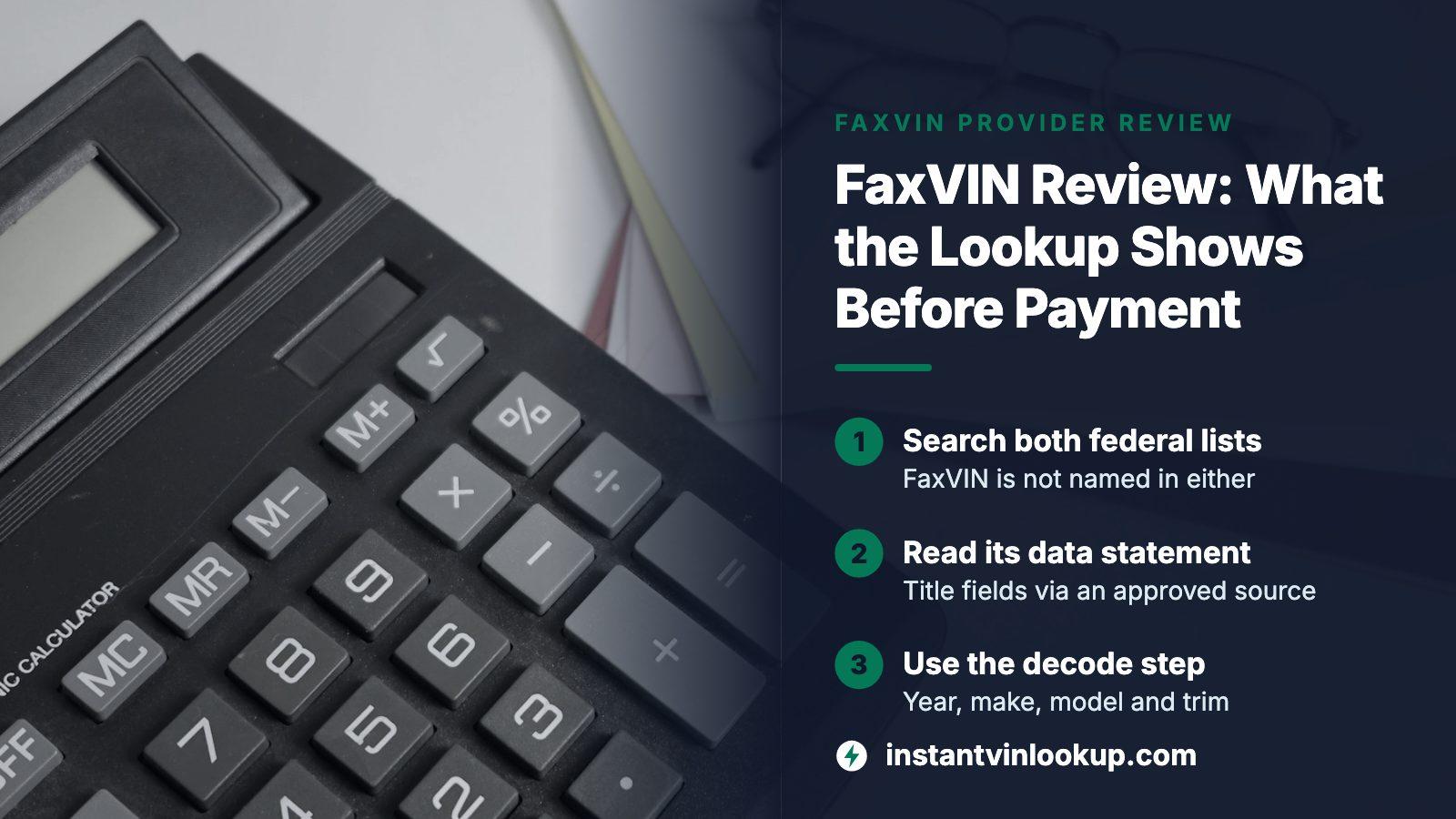
FaxVIN is a real lookup with a free decode and a paid report. Checked on 5 November 2026, its name was absent from the Justice Department's approved NMVTIS provider list. Its own disclaimer says its federal title fields arrive through an approved provider, without saying which. Treat the decode as identification, ask who supplies the title data before you pay, and keep a mechanic's inspection in the plan.
- Justice Department list
- FaxVIN not named in either group, checked 5 November 2026
- Its data statement
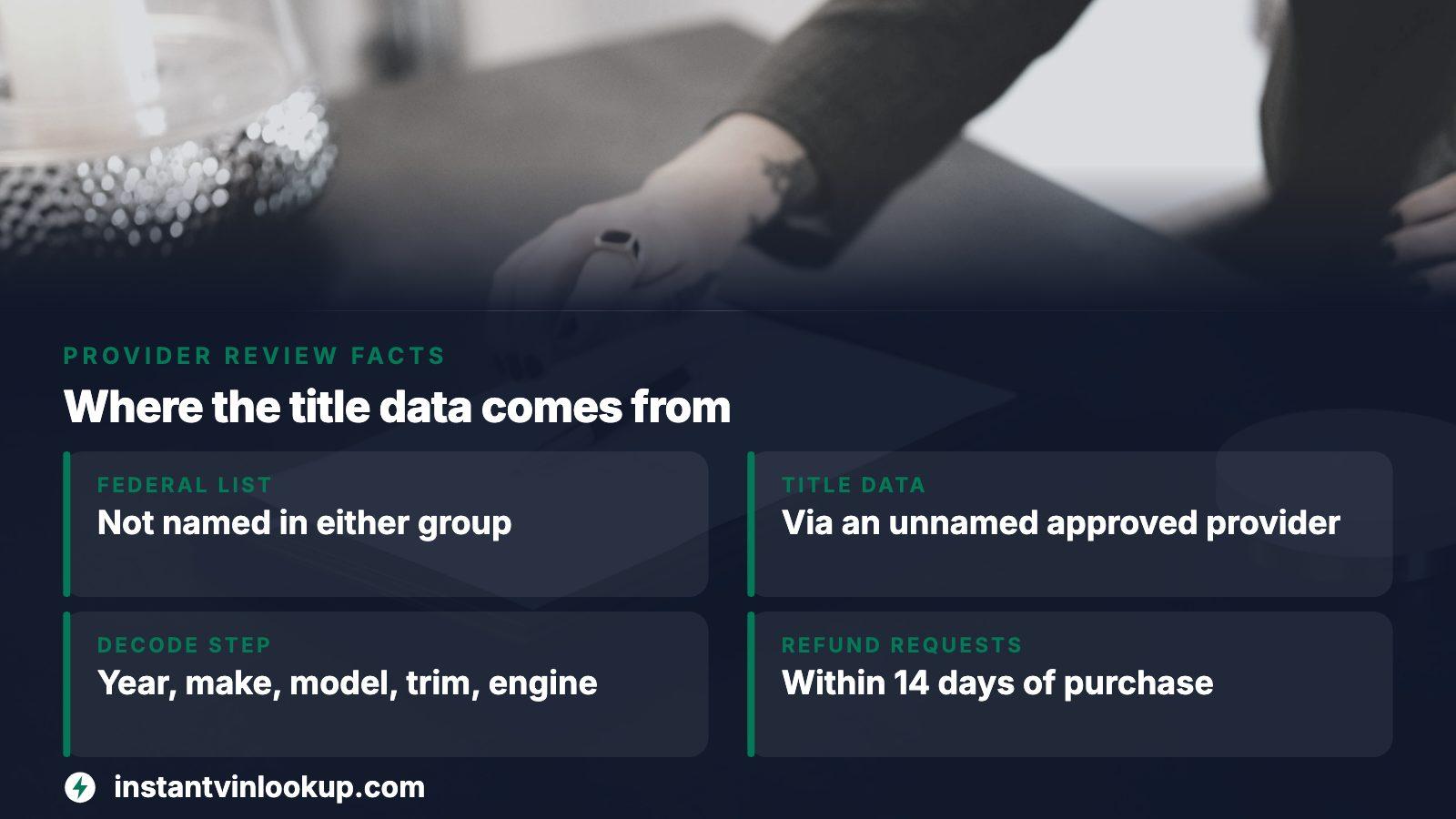
- Title fields come via an approved provider it does not name
- The free step
- A decode of year, make, model, trim and engine
- Refund requests
- Within 14 days of purchase, per its refund page
What happens after you type a VIN into FaxVIN
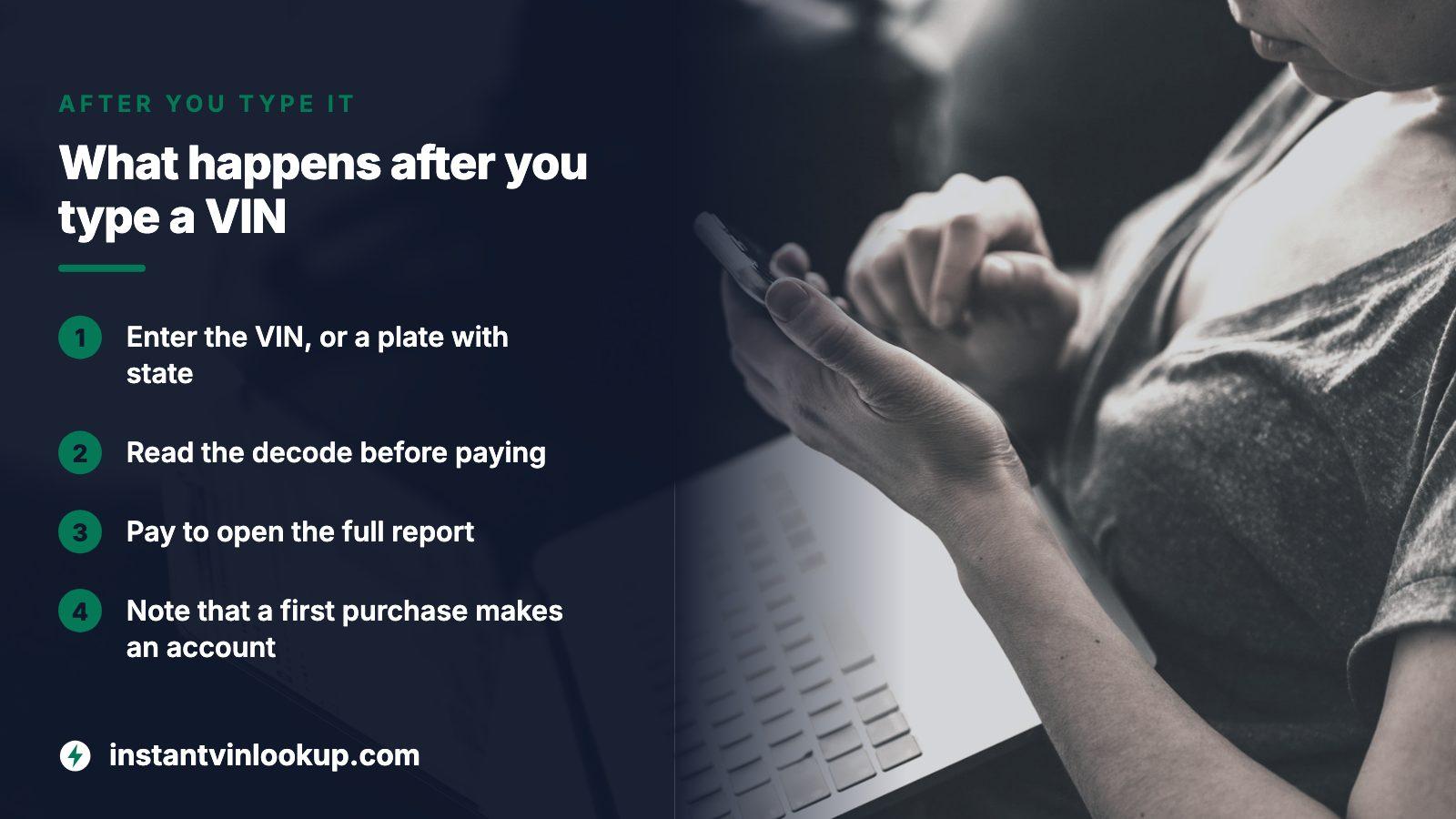
The home page asks for a VIN, or for a plate plus a state when you lack the number. From there it runs in a few moves, and only the first two cost nothing.
- Enter the 17 characters, or a plate with its state.
- Read the free decode. It says the decode confirms year, make, model, trim and engine, and it signals whether a paid history file is available for the car.
- Pay to open the full report. Cards run through Stripe, with Apple Pay and Google Pay offered.
- A first purchase creates your account automatically, and an email delivers the report link plus a password.
Neither the home page nor the refund page showed a price, so confirm the figure on the payment screen before you commit.
The free decode next to the government's own decoder
A free decode is the part of an instant lookup that any site can offer, because the manufacturer data behind it is public. To see how much FaxVIN's adds, the example VIN printed in its own search box went through NHTSA's decoder, which answered with no key or login.
| Detail | FaxVIN says its decode confirms | NHTSA decoder returned |
|---|---|---|
| Year, make, model | Yes | 2022 Toyota Corolla |
| Trim | Yes | SE |
| Engine | Yes | 2.0 L four-cylinder gasoline, 169 hp |
| Build plant | Not mentioned on the home page | Takaoka plant, Toyota City, Aichi, Japan |
| Check digit | Not mentioned on the home page | Reported as correct |
Both cover the basics. The federal decoder also gave the transmission type, safety equipment and a verdict on the ninth-position check digit, a quick test of whether the number is plausible. Use the free step to confirm the listing matches the car. Nothing in it tells you about the vehicle's history.
Where its title data comes from, and the list it is not on
The Justice Department page naming approved NMVTIS data providers has two groups: businesses serving both the public and commercial buyers, and a shorter group serving commercial customers only. Checked on 5 November 2026, FaxVIN appears in neither.
That is half the story. FaxVIN's own NMVTIS disclaimer, updated in February 2026, states that its title and brand fields are supplied by an approved provider. It leaves that provider unnamed.
Two statements that can both hold
A missing listing and an approved supplier fit together if FaxVIN buys the data from a listed business. Only FaxVIN can say which one. Ask its support before paying, then look the name up on the government page and match the spelling.
What the paid report promises, and what backs each line
FaxVIN describes the report on its home page and again in its FAQ. Put together, the records it promises are:
- Title status, brands and lien status, including lenders and release papers
- Odometer readings compared over time to flag rollbacks and gaps
- Accident and damage history drawn from police, insurers and auctions
- Recalls by VIN, with a note on whether dealer repairs were done
- Service and inspection entries, plus earlier use as a rental or taxi
- Theft records checked against national databases
The disclaimer says the NMVTIS portion covers titles, brands, the latest mileage and total-loss or salvage entries, and that data from elsewhere carries a label. Look for those labels, and weigh service and accident detail by how specific it is. The same page says consumer reports omit owner names and contact details, so an owner or lienholder question belongs with the state titling agency.
Reading the result: what to take seriously and what to doubt
| What the screen shows | How to read it |
|---|---|
| A notice that no records exist for the VIN | FaxVIN says it warns you before purchase. Recheck the number first, then ask whether another source holds records. |
| A salvage, junk or similar brand | States define brands differently, so read the exact wording and which state issued it. |
| A total-loss entry on a title that looks clean | An insurer can report a total loss the state never branded, the disclaimer says. Ask the seller for the repair paperwork. |
| Mileage readings with long gaps | Set each reading against the car's age and the seller's story. A gap leaves room for a rollback. |
| A clean result | The Justice Department warns a federal search can come back falsely clean. A clean screen reports an absence of records. It cannot vouch for the car. |
The FTC points out that reports tend to cover crashes and flood damage and rarely say anything about mechanical faults. A weeping seal or a tired suspension never reaches a database.
Cost, refunds and the checks to make before paying
No price appeared on the pages read, so this review prints none. Its refund policy, effective February 2026, asks for a written request within 14 days of purchase. Three cases may qualify for a remedy: a report that could not be delivered and stayed unavailable after you contacted support, a delivered report holding only decode and specification data, and a duplicate purchase or double charge. Other cases are decided one at a time.
An approved case ends in a credit for a future report or the money returned to the card used, your choice. It aims to answer within 48 hours, weekends and holidays excluded. Before paying, settle these points:
- Is this one payment, or does anything recur?
- Which lines in the report come from outside NMVTIS?
- Do you hold the transaction ID, VIN and purchase date that a refund request needs?
A similar name is not a shared database
FaxVIN sounds close to a far larger brand, and some visitors assume the two are linked. Nothing on the pages read for this review says they are. On the Justice Department page, Carfax sits in the commercial-only group, with NMVTIS data offered to commercial customers in California only, and the page adds that the public cannot buy NMVTIS reports from it. FaxVIN is a separate case: absent from the list, with a disclaimer pointing to an unnamed approved provider. Judge a seller on what it discloses, not on a name that rhymes.
An instant-lookup routine, and where this site fits
- Decode the VIN and compare year, trim and engine with the ad.
- Look up open recalls for the VIN on NHTSA's own site; that service costs nothing.
- Query NICB's VINCheck for theft reports and total-loss records from member insurers.
- Open the preview on this site to see whether records exist for that VIN.
- Buy a report only for the car you would actually buy, then pay a mechanic to inspect it.
This site is not FaxVIN and has no connection to it. Previewing costs nothing and returns the year, make, model and trim, any photos available, the open recall count, and tallies of title and auction entries. The report gathers title brands, crash and damage records and mileage readings for the VIN. Purchase a single report or pick a multi-report bundle; no recurring charge applies. The pricing page lists current options. Compare the VIN stamped on the vehicle with the title paperwork prior to running it.
Where this information comes from
- Department of Justice: approved NMVTIS data providers — The two provider groups, FaxVIN's absence on 5 November 2026 and the Carfax entry.
- Department of Justice: NMVTIS for consumers — The false-negative warning and the points on total-loss labels and state differences.
- FTC: Buying a used car from a dealer — Why a history report does not stand in for an independent inspection.
- NHTSA: vPIC VIN decoder — The free federal decoder used to test the example VIN from FaxVIN's home page.
- FaxVIN: NMVTIS disclaimer — Its statement about an approved provider, labeled non-NMVTIS data and owner privacy.
- FaxVIN: refund policy — The request window, the listed remedy cases and the response times.
- FaxVIN: home page — The lookup steps, the free decode, the report contents and the source list as it describes them.
Sources and photos: Facts checked against the sources above in November 2026. Photos by Cht Gsml, Michal Biernat and Annika Wischnewsky on Unsplash; diagrams by InstantVINLookup.
Keep reading
- VIN Lookup: Check a VIN Number on a Car Before You BuyFind the number, run the preview and see what records exist before you pay.
- EpicVIN Review: What This Paid VIN Lookup Does and Doesn't ShowA provider on the federal list, judged on the same questions for a fair comparison.
- NICB VIN Check: What the Instant Theft and Salvage Lookup ShowsThe theft and total-loss screen to run beside any paid report.
- Sample reportSee what a finished report looks like before you buy one.
Frequently asked questions
Is FaxVIN legit?
It is a working service: a free decode, then paid reports. Nothing read for this review suggests otherwise. The checkable points are narrower. Its name was not on the Justice Department's approved NMVTIS list on 5 November 2026, and its disclaimer says an approved provider feeds its title fields without naming one. Ask which before paying.
Is FaxVIN free?
Only the decode, which it says confirms year, make, model, trim and engine and shows whether a full report is on offer. The history report needs payment. The pages read showed no price, so confirm the amount on the payment screen and read the refund terms first.
Does FaxVIN show accidents and salvage records?
It lists accident and damage history and title brands among the report's records. This review ran no purchase, so it cannot say what any particular VIN returns. The Justice Department notes that federal title searches can come back falsely clean, and damage that never produced a claim or a brand will not appear anywhere.
Can I get my money back from FaxVIN?
Its policy allows requests within 14 days of purchase. It names failed delivery, a report with no historical records and duplicate purchases as cases for a remedy, and reviews others one by one. Approved cases get credit toward a later report or a card refund. Reread the page before buying.
Is FaxVIN related to Carfax?
Nothing read for this review says so. The names sound alike, but the Justice Department page lists Carfax as serving commercial customers in California only and says consumers cannot get NMVTIS reports from it. FaxVIN is not on that page at all. Treat each on its own disclosures and ignore the similar sound.
Now check the car itself
The guide explains what to look for. The report shows what this VIN has on record.