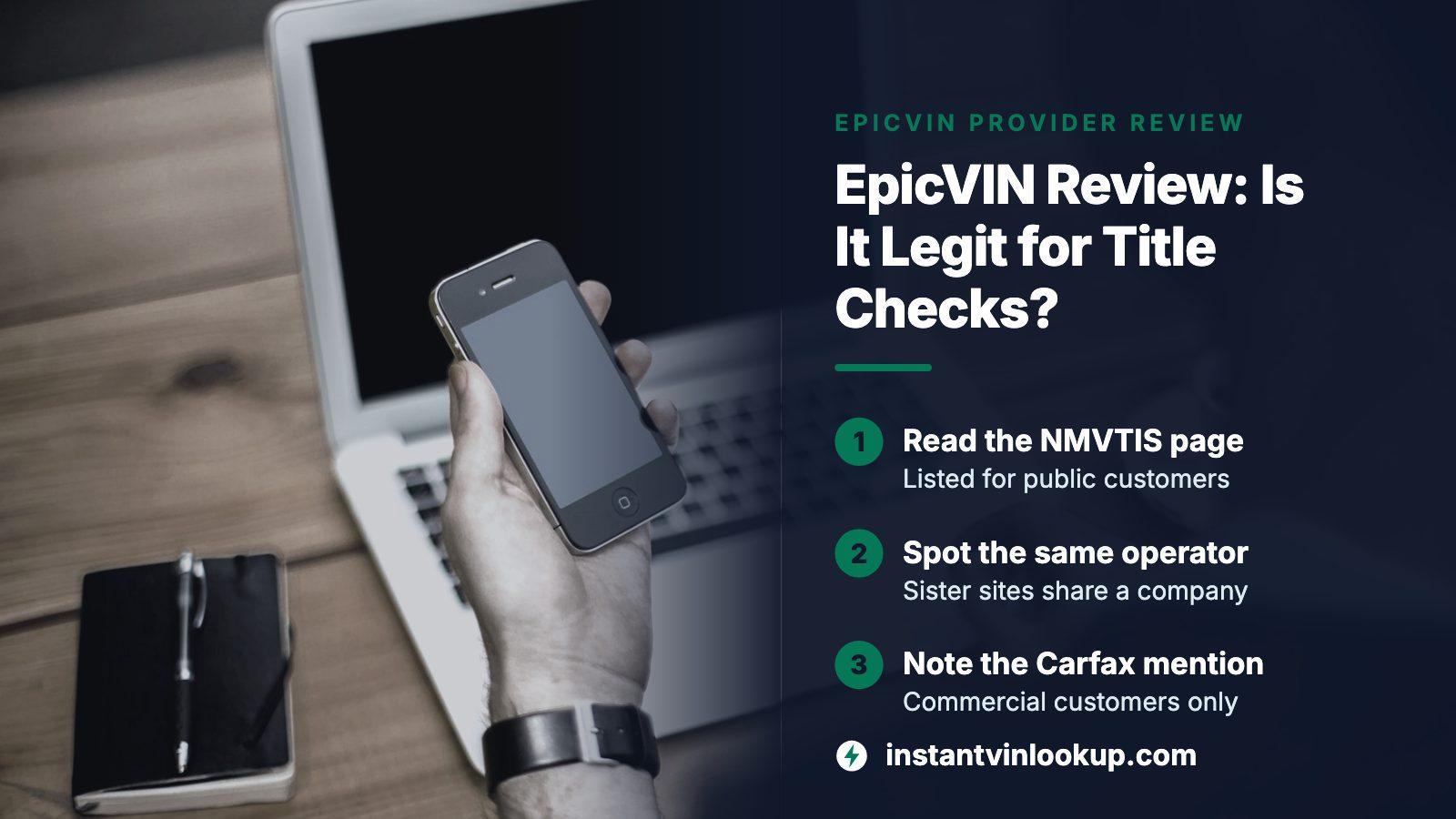
THE SHORT ANSWER
Yes, on the one measure anyone can check. In November 2026 the Department of Justice's NMVTIS page listed EpicVin.com as an approved provider serving the public, along with two sister sites it owns, VinGurus.com and Vininspect.com. That backs its title brand and salvage lines. It does not back every claim in a report, and it cannot reveal damage nobody filed. Use it as a title screen, then inspect the car.
- DOJ NMVTIS page
- EpicVin.com listed for public customers, read November 2026
- Same operator
- VinGurus.com and Vininspect.com are named as its additional sites
- Carfax on that page
- Commercial customers only, with NMVTIS data offered in California
Three different products hide behind the words VIN lookup
Searches for a VIN lookup or VIN check cover three separate products, and mixing them up is how people overpay or under-check. A decode turns the 17 characters into the factory build. A title record shows what states and insurers filed against the car. A commercial history adds service visits and other private feeds. EpicVIN is built around the middle one.
| Layer | Where it comes from | Where EpicVIN fits |
|---|---|---|
| Decode and recalls | Manufacturer data and NHTSA, open to anyone | Factory specifications appear in the report; confirm open recalls on NHTSA's own lookup |
| Title record | NMVTIS, the federal title database | The core of the product and the reason for its listing |
| Service and repair history | Private networks fed by shops and dealers | Light, and dependent on what its data suppliers happen to hold |
Every one of these answers in seconds. How quickly a page responds says nothing about where its records came from, and the source is the thing to question.
Checking the Department of Justice listing yourself
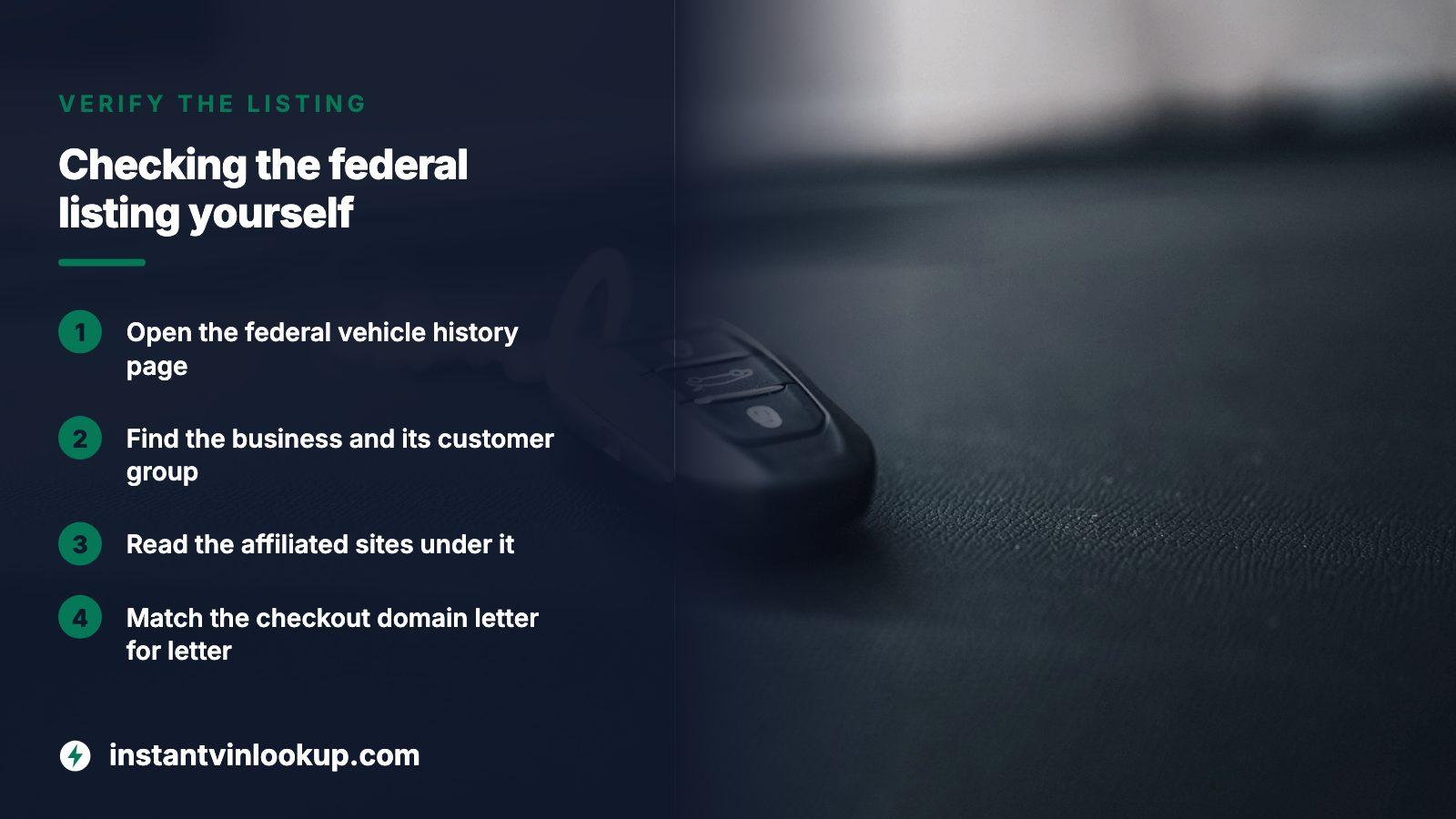
The one claim about EpicVIN that needs no trust in a reviewer is its federal status. The Department of Justice publishes a page naming businesses approved to sell NMVTIS reports, split between those serving the public and those serving only commercial customers. Read in November 2026, it showed EpicVin.com in the group that serves the public.
- Open the NMVTIS vehicle history page run by the Bureau of Justice Assistance.
- Find the business name, then note which customer group it sits in.
- Read the sites shown beneath a provider, because affiliated brands are named there.
- Match the domain on the checkout page, letter for letter, with the one on the list.
- Repeat the exercise for every other seller you are comparing.
The page says its entries run alphabetically and imply no preference among providers. Approval means a company may sell the federal record to consumers. It does not rate customer support, how refunds work or what extra records a company has collected itself.
One operator, three storefronts
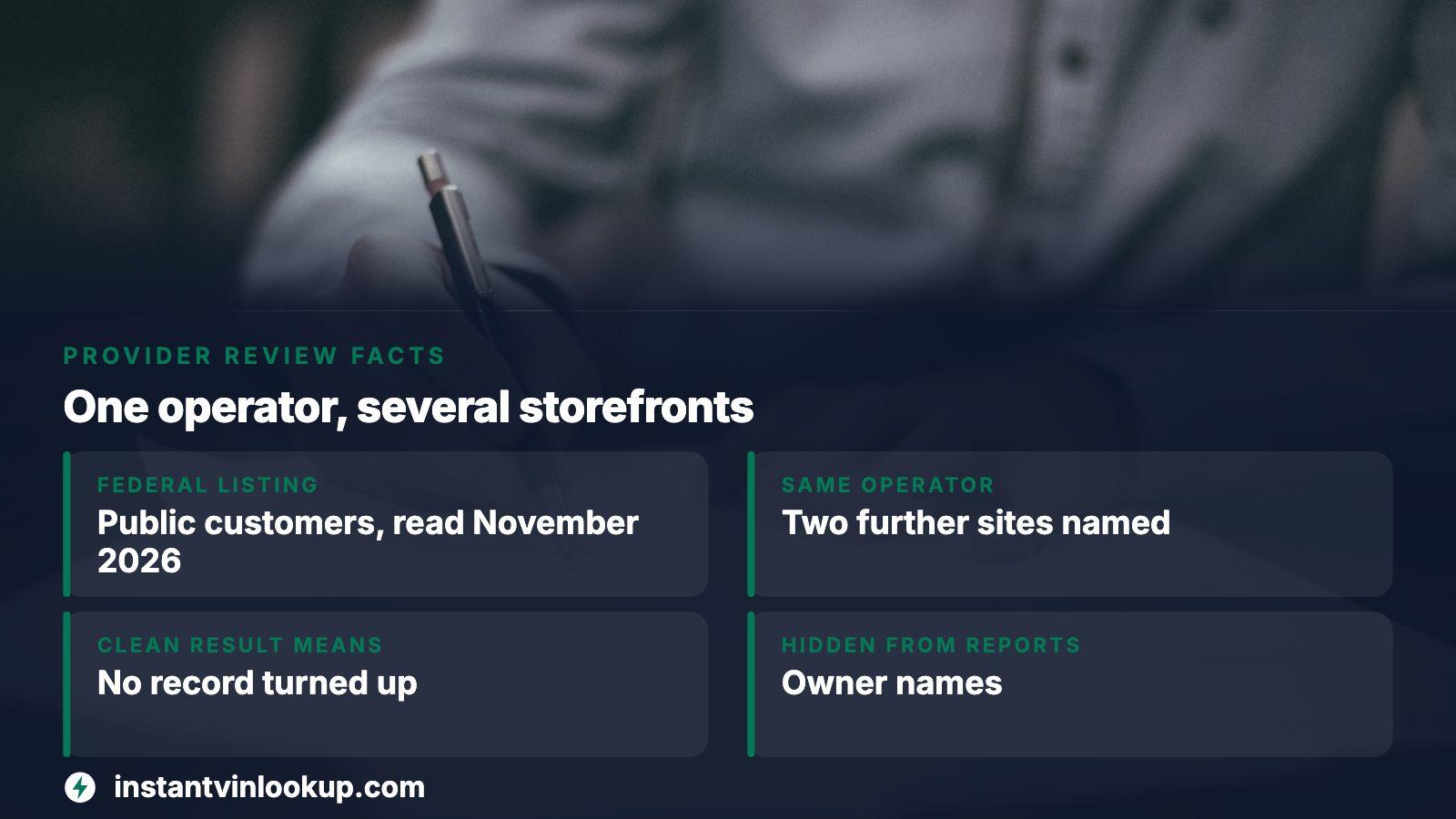
The same Department of Justice entry names two more sites that EpicVin owns and that sell reports containing NMVTIS data: VinGurus.com and Vininspect.com. Keep that in mind before paying twice for a second opinion. Two reports from one operator draw on the same title source, so they can only agree with each other.
A real cross-check comes from a different provider on the Department of Justice list, or from a different kind of source altogether, such as the NICB theft and salvage screen or a mechanic's inspection. Comparing brand names tells you little when one company can run several.
What an EpicVIN report is built to show
Going by how the service describes itself, this is a title-first document. Each line below comes with the use a buyer can make of it and the limit to keep in view.
| Report line | Use for a buyer | Limit to remember |
|---|---|---|
| Title brands | Reveals salvage, rebuilt, flood and similar brands filed in reporting states | Only what a reporting agency actually filed |
| Salvage and total loss | Entries from insurers and salvage yards | A car repaired privately may never appear |
| Odometer readings | Mileage logged each time the title was touched, a clue to rollbacks | Long gaps between events leave room for error |
| Auction and listing data | Shows where the car has been offered for sale | Coverage follows whichever feeds the provider buys |
| Factory specifications | Checks trim, engine and body against the seller's ad | Describes how the car was built, not how it is now |
EpicVIN also advertises a search by plate in supported states. The report on this site works from the VIN alone, so check that the VIN on the car, the paperwork and the ad all agree before running either kind.
What a clean result cannot prove
Every vehicle-history product shares one blind spot: it can only repeat what somebody filed. A fender-bender paid for in cash leaves no insurance claim, no police report and no title event, so it appears nowhere.
- Unreported accidents and private repairs never enter any database.
- Owner names are withheld from every consumer report, since federal privacy law bars them.
- Mechanical condition is invisible, so brakes, leaks and tired suspension need a person under the car.
- A clean result means no record turned up, which is weaker than proof the car is undamaged.
Reading silence correctly
No brand and no salvage entry narrows the risk of a hidden title problem. It does nothing for the risk of a worn-out car. The FTC makes the same point about reports in general: they usually do not show mechanical problems and are no substitute for an independent inspection.
EpicVIN next to Carfax
The two are strong in different places, and the Department of Justice page shows one reason. Carfax appears there in the commercial-only group, with NMVTIS data offered in California only, while EpicVin.com sits in the group serving the public. Someone after the federal title record itself should start with a provider approved for the public.
Carfax is known for service entries reported by dealers and repair shops, so a car with a long maintenance life may show more there. A buyer eyeing a pricey late-model car with a complicated past might add a premium report on top. For a car you may never drive, the cheaper title record is a sensible first purchase.
Price, and the checkout questions that apply to any seller
EpicVIN sells single reports and bundles, and its promotions change often, so this page prints no figure. Read the current number on its own site. For scale, an NMVTIS report from an approved provider generally costs a few dollars, so a price far above that should come with extra data you actually want. Put these questions to the checkout page:
- Is the first charge a single payment, or does it convert into a recurring plan?
- Where is the cancel option, and how many steps does it take?
- What does the refund policy say, and for how long does it apply?
- Is the price shown before the card form, or only on it?
This review did not run a purchase through EpicVIN's checkout, so it makes no claim about the current terms. Read them yourself, and save a screenshot before you pay.
A shortlist routine, and where this site's preview fits
- Decode each VIN and read the factory specifications against the listing.
- Look up open recalls on NHTSA's lookup, the authoritative free source.
- Run NICB's VINCheck on the cars that survive, for theft and salvage flags.
- Run the preview on this site to see whether records exist for the car before spending anything.
- Buy a title-record report for the finalist, then pay a mechanic to inspect it.
This site is not EpicVIN and has no connection to it. Its preview is free, and the report that follows is one payment with no renewal. The report covers salvage and auction entries with photos, title brands, accident and damage records, and mileage readings. The pricing page lists the options.
Where this information comes from
- Department of Justice: NMVTIS approved providers — The public list where EpicVin.com, its additional sites and Carfax's commercial-only entry were read.
- Bureau of Justice Assistance: NMVTIS overview — The federal program behind the title database that approved providers resell.
- FTC: Buying a used car from a dealer — Why a history report does not replace an independent mechanic's inspection.
- NICB: VINCheck — The theft and salvage screen to run before paying for any report.
Sources and photos: Facts checked against the sources above in November 2026. Photos by Alejandro Escamilla, Bence Balla-Schottner and Scott Graham on Unsplash; diagrams by InstantVINLookup.
Keep reading
- VinAudit Review: An Instant VIN Lookup, Judged on What It ShowsAnother approved provider, weighed on the same questions.
- ClearVIN Review: What an Instant ClearVIN Lookup Gives YouA second provider on the federal list, for a real cross-check.
- NICB VIN Check: What the Instant Theft and Salvage Lookup ShowsRun the theft and salvage screen yourself and learn to read a hit.
- VIN Lookup: Check a VIN Number on a Car Before You BuyFind the number, test it, and read the preview before you pay.
Frequently asked questions
Is EpicVIN legit?
In the narrow sense that matters for title data, yes. The Department of Justice page, read in November 2026, lists EpicVin.com as an approved NMVTIS provider serving the public. That says its title records come through the federal channel. It says nothing about support, refunds or billing, so read those terms separately.
Is EpicVIN the same company as VinGurus or Vininspect?
They share an operator. The Department of Justice entry names VinGurus.com and Vininspect.com as additional sites that EpicVin owns. Buying a report from two of them gets you the same title source twice, so pick a different provider if you want a true second opinion.
Will an EpicVIN report show every accident?
No report will. It shows what its sources hold: title records, salvage and total-loss entries, and whatever its auction and listing feeds contain. An accident that produced no claim, no police report and no title event leaves nothing to find. A mechanic's inspection covers that gap.
Is EpicVIN better than Carfax?
They suit different jobs. On the Department of Justice page, EpicVIN sits in the public group while Carfax sits in the commercial group, with NMVTIS data offered in California. For service entries reported by dealers and shops, Carfax is known for depth. Neither replaces an inspection.
How much does an EpicVIN report cost?
It sells single reports and bundles, and promotional pricing moves, so any figure printed elsewhere ages quickly. Check its site on the day you buy, and read whether the charge is a one-time payment or a plan that renews. Compare it against the few dollars an NMVTIS report usually costs.
Now check the car itself
The guide explains what to look for. The report shows what this VIN has on record.