THE SHORT ANSWER
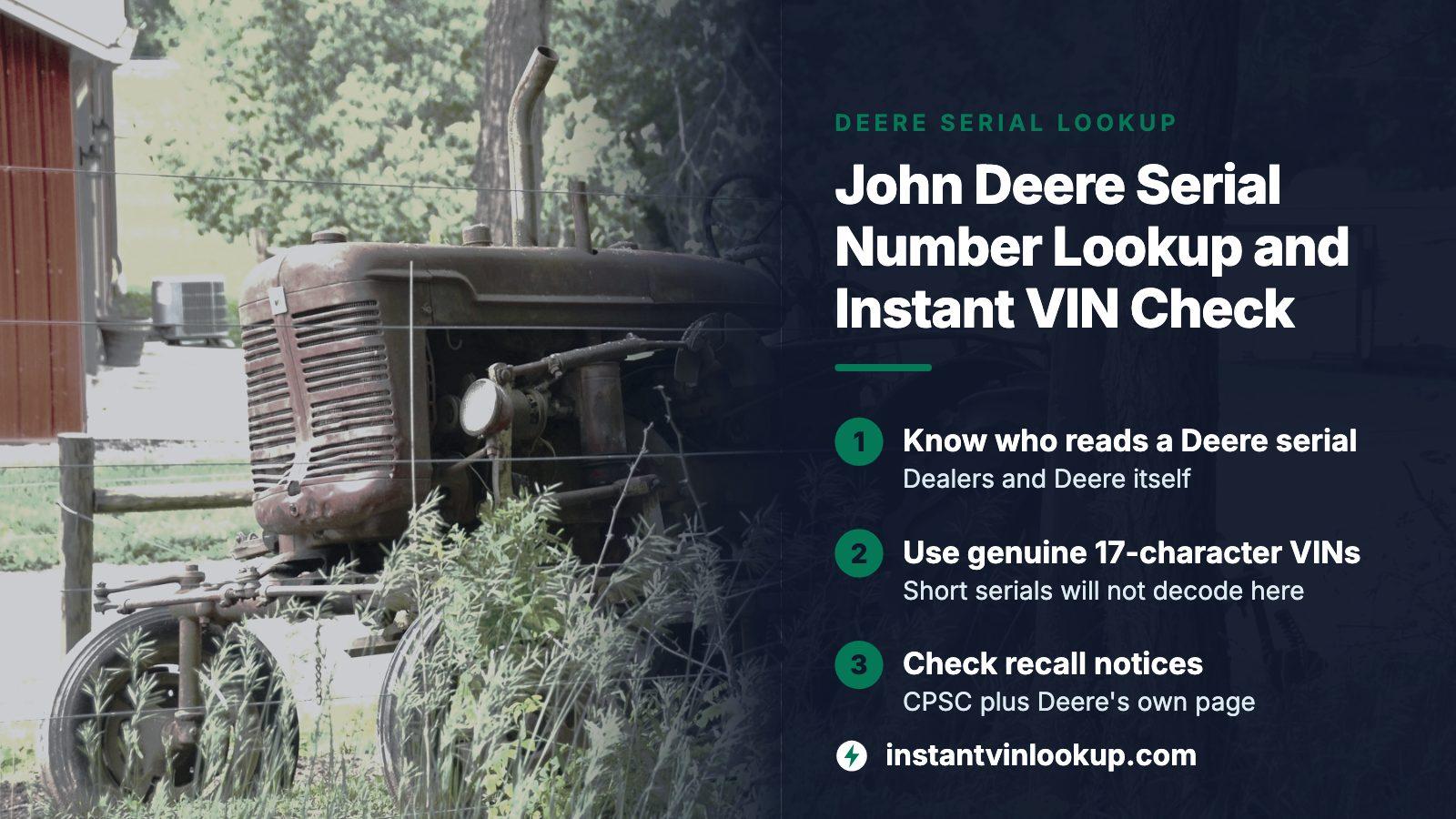
Find the metal identification plate on the frame, photograph it, and give the number to a Deere dealer or to Deere's own parts and recall pages, since those systems read it. A VIN lookup usually returns nothing for it because the number is not a VIN. The preview on this site helps only when a road-legal unit carries a genuine 17-character VIN. Recalls for this equipment come from the CPSC, not NHTSA.
- Who reads a Deere serial
- A Deere dealer and Deere's own parts and recall pages
- This lookup reads
- Genuine 17-character VINs only
- Recall notices
- CPSC, plus Deere's recall page
- Cost here
- Preview free, report one payment
What an instant lookup does with a Deere number
An instant lookup matches 17 typed characters against records filed for road vehicles and shows a preview. NHTSA's public decoder describes its reach as regulated vehicle types sold in, or brought into, the United States, and its page never mentions tractors.
Deere numbers its tractors, mowers and loaders under its own scheme. Enter one in a VIN box and nothing comes back, which reflects the tool's limits and says nothing against the machine.
| What you typed | What the lookup does | What it means |
|---|---|---|
| A 17-character VIN from a road-legal unit | Runs, and the preview counts what is on file | Normal result; read it, then decide on the report |
| A Deere product number, any length | Returns nothing | Wrong tool; use the dealer and recall routes below |
| A number with a plus sign in the middle | Will not decode | An equipment number, not how a car's VIN looks |
Read the plate before you type anything
Deere machines carry a metal identification plate on the frame. Dirt and repainting bury it, so bring a rag and a wire brush. Its position depends on the machine.
- Compact utility tractors: the front right of the frame, near the engine, according to the CPSC notice on the 2024 brake linkage recall.
- Gator utility vehicles: on the frame, right of the rear hitch receiver, as the CPSC notice for the XUV590 line puts it.
- Riding mowers and lawn tractors: commonly under the seat or on a frame rail, so lift the seat first.
- Skid steers and compact loaders: usually in the cab or on the main frame by the door opening.
- Excavators and larger machines: the main frame, often near the cab entrance.
Photograph both plates
Photograph the machine plate and the engine's own plate, and keep the files off the machine. Every parts order and recall check starts from that number.
Thirteen characters, seventeen, or a plus sign
Length alone will not tell you what you have. Older machines often carry a shorter equipment number, frequently thirteen characters; newer ones often carry seventeen, a length that invites confusion with a VIN. If a seventeen-character number fails a lookup, that does not make the machine suspect.
| On the plate | What it usually is | Next step |
|---|---|---|
| 13 characters | An older equipment number | Dealer parts desk or Deere's parts system |
| 17 characters in Deere's own style, sometimes with a plus sign | A newer equipment number, such as 1M0590MA+PM060654 in a CPSC Gator notice | The same dealer route |
| 17 letters and digits on a unit built for roads | A genuine VIN | Run it through the instant lookup |
Where a Deere serial actually gets read
Equipment makers can change a component mid-run without touching the model name, so two machines of the same model and year may need different parts. Parts catalogs are sorted by serial range, and a parts counter asks for the serial first.
- Build year and factory configuration, from a dealer reading the serial
- The parts that fit that serial range, instead of a list with caveats
- Open campaigns from the maker, which the dealer matches to the number
The engine is numbered separately, on the block or its own tag, and engine parts are ordered against that figure. Write both down together.
Recalls: Deere's page and the CPSC, not NHTSA's search
Deere's recall page lists consumer product recalls and links each entry to a Consumer Product Safety Commission notice. The compact utility tractor entry from September 2024 has a serial checker built into the page, and the page sends you to the CPSC for older recalls.
These notices work by serial. The June 2023 Gator XUV590 notice prints the affected ranges, while the 2024 tractor notice prints none and sends owners to Deere's page. In both, an authorized dealer does the work, and Deere says it contacts known buyers directly.
Two lists, so check both
CPSC recalls and Deere's own service campaigns are separate records. An empty result on one proves nothing about the other, so ask the dealer to run the serial for campaigns too.
The CPSC search filters by category, and Tractors, Garden Tractors, Riding Lawn Mowers and Utility Vehicles are all listed there.

When the instant lookup does apply
Some machines are built for the road and wear a genuine VIN. For those, the lookup behaves as it does on any car. Run it in this order.
- Read all 17 characters off the plate or label and photograph them.
- Enter them in the lookup on this page and read how many records the preview finds.
- Compare what comes back with what the seller told you.
- Buy the report only for a machine you are serious about.
For such a unit the report can show title brands, liens, theft entries and salvage or auction history. A clean result means no reports were filed, not that the machine is sound; much equipment is never titled or insured.

Hours stand in for miles on used equipment
Wear on equipment is counted in engine hours, and no federal disclosure rule stands behind the hour meter. Treat it like a car's odometer when the seller gives no mileage statement: informative, unconfirmed, worth testing against the machine itself.
- Ask whether the meter is original or was ever swapped.
- Look at the seat, pedals and controls; hard wear on them contradicts low hours.
- Ask what work it did; a weekend mower and a daily commercial machine wear at different rates.
Plates, paperwork and theft: the checks on the seller
Off-road machines are generally not titled, so the sale paperwork and the machine serial carry the weight a title would on a car. A minority of states register some equipment classes, so look up your own state's rule.
- Look over the plate for grinding, new rivets, a mismatched finish or a crooked fit.
- Get a bill of sale showing the machine serial, the date and both parties, with each attachment's serial listed separately.
- Ask outright whether money is still owed. Financed equipment is common, and a private sale does not always erase a lender's claim.
- Match the seller's name to the paperwork, and treat a low price with no documents as a warning.
Why the photo pays off
Equipment sits in open yards and is easy to move; without a serial it is hard to trace. A photo of each plate, kept away from the machine, is your proof of what you own.
Cost, and the order to run things
The preview costs nothing and needs a real VIN. After that, one payment covers a single report or a pack, nothing renews, and each price sits on the pricing page. A Deere with no VIN gives the report nothing to read, so the dealer call and the recall searches are the whole job.
- Photograph both plates before you travel to see the machine.
- Decide which number you have: a Deere number or a genuine VIN.
- Deere number: call a dealer with the serial, then search the CPSC and Deere's recall page.
- Genuine VIN: run the preview here, then decide on the report. Either way, settle the bill of sale and any lien first.
Where this information comes from
- CPSC: Recalls and product safety warnings — The recall search, with filters for category, including tractors, riding mowers and utility vehicles.
- CPSC: John Deere compact utility tractor recall — Gives the plate position on those tractors and sends owners to Deere's page to check serials.
- CPSC: John Deere XUV590 Gator recall — Gives the plate position on the Gator and lists affected serial ranges in Deere's own format.
- Deere: Recall information — The maker's list of consumer product recalls, with a serial checker on one entry.
- NHTSA: vPIC VIN decoder — Describes the public decoder's reach as regulated vehicle types sold or imported for the United States.
Sources and photos: Facts checked against the sources above in November 2026. Photos by Roger Starnes Sr, Masjid MABA and Nina Mercado on Unsplash; diagrams by InstantVINLookup.
Keep reading
- VIN Lookup: Check a VIN Number on a Car Before You BuyHow the instant lookup works on a road vehicle, and what the preview adds.
- Polaris VIN Lookup: Instant Check for RZR, Ranger and SportsmanThe same split between equipment numbers and real VINs, applied to side-by-sides and ATVs.
- Where Is the VIN Number? Find It in a Minute, Then Verify ItWhere the VIN sits on vehicles that do carry one, for when the plate is unreadable.
- NICB VIN Check: What the Instant Theft and Salvage Lookup ShowsHow the theft and total-loss screen works for a unit with a genuine VIN.
Frequently asked questions
Where do I find the number on a John Deere machine?
On a metal plate attached to the frame. A compact tractor has it at the front right near the engine, a Gator beside the rear hitch receiver. Clean the plate and photograph it so you are not copying a worn number by hand.
Can I run a John Deere serial number through a VIN check?
Usually not. A VIN lookup reads genuine 17-character VINs, and Deere equipment normally carries the maker's own product number. Only a road-legal unit with a real VIN produces a preview. For everything else, the dealer's parts system and the recall pages read the number.
Is a 13-digit John Deere serial number a VIN?
No. A VIN has 17 characters, so thirteen points to an older equipment number that no public vehicle decoder reads. A dealer parts desk can. If a 17-character number also fails, do not assume it is fake, because equipment numbers can run that long.
Does a used tractor or mower come with a title?
Often not, since off-road machines are usually treated as personal property. That puts the weight on your paperwork. Ask for a detailed bill of sale listing the serial, check whether your state registers that class, and ask the seller whether any finance is outstanding.
Where do I check John Deere recalls?
Start with Deere's recall page, which links to the CPSC notices, then search the CPSC by category. The serial decides whether a given machine is included. A dealer can also check the number against maker campaigns that never reach a federal list.
Now check the car itself
The guide explains what to look for. The report shows what this VIN has on record.