THE SHORT ANSWER
No lookup returns a transmission fluid specification. NHTSA's public decoder has a field for transmission style and another for speed count, none for fluid, and both can come back empty on a clean decode. Use the result to learn whether the car has a conventional automatic, a CVT, a dual-clutch or a manual, then read the manual's fluid chart or have a dealer's parts counter look up the exact fluid for your number.
- NHTSA decoder fields
- Transmission style and speeds, none for fluid
- 2013 Honda Accord, EPA
- 2.4 L variable-ratio automatic, 3.5 L 6-speed
- Sample car, 2012 BMW 535i
- Clean decode, transmission fields empty
What a lookup can and cannot say about transmission fluid
Enter a VIN and the factory build comes back: model year, make, model, engine, body style and recalls on file. When the maker filed the data, the build also names a transmission style and a gear count. That is the reach of it. NHTSA's public decoder offers a style field and a speeds field, and nothing in its list of variables concerns fluid.
The search therefore has two halves. The lookup settles the hardware: automatic, CVT, dual-clutch or manual, and how many speeds. The paperwork that came with the car, or a parts counter holding the build record, settles the product name. Keeping the halves apart saves an afternoon of squinting at bottle labels.
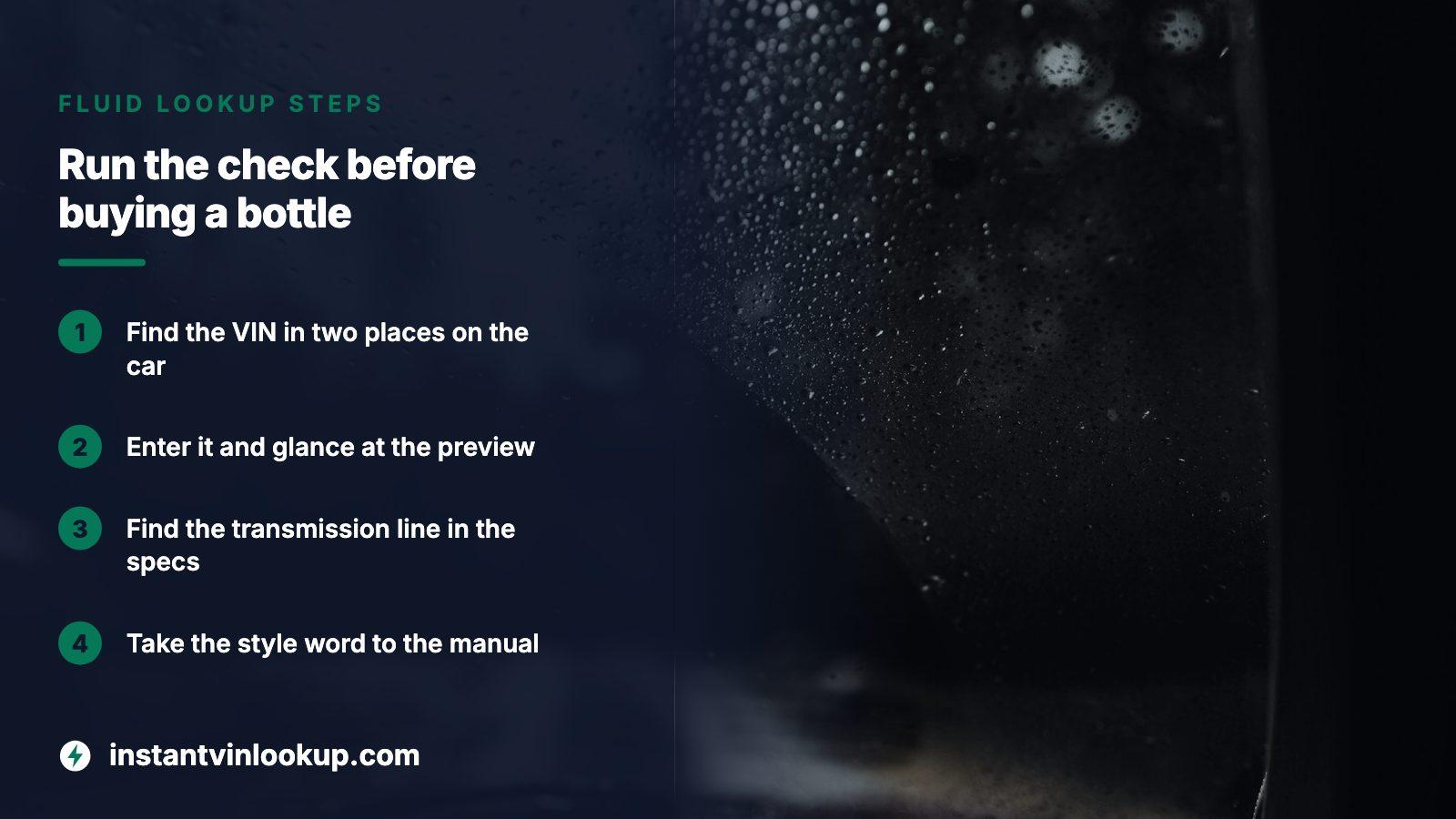
Running the check before you buy a bottle
- Locate the VIN in two places on the car, the dash plate and the label on the door pillar, and check that both read the same.
- Enter it in the lookup box and glance at the preview, a first look that tallies title and auction records.
- In the report's factory specifications, find the transmission line, if the maker supplied one. Note the style word and speed count as printed.
- Hold that line against the ad and against how the car drives. A CVT where the listing says plain automatic deserves a question.
- Read the open recalls on the same screen, since some campaigns are written for a single transmission type.
- Take the style word to the manual or a dealer's parts counter and ask for the fluid name and the service interval.
Reading the transmission line, including an empty one
| Line in the decode | What it implies for fluid | Your move |
|---|---|---|
| Automatic, with a speed count | A conventional automatic, which takes the automatic fluid its maker specifies | Find the named fluid in the manual |
| CVT | A belt-and-pulley design that wants its own fluid; ordinary automatic fluid is the wrong product | Buy only the fluid the maker names for the CVT |
| Dual-clutch | A clutch-based unit with a formulation of its own | Use the maker's fluid, bought at a dealer counter |
| Manual | A hand-shifted gearbox with a fluid requirement of its own | Check the manual instead of borrowing an automatic's |
| Empty | The maker did not file transmission data for that pattern | Ask a dealer to read the build record; a blank is no defect |
Blanks are ordinary. This site's sample car, a 2012 BMW 535i, decodes cleanly on NHTSA's tool with both transmission fields empty. NHTSA's complaint records carry the first 11 characters of each car's VIN. Fed to the same decoder, the prefix from a 2015 Subaru Outback record returns a CVT, while the prefix from a 2013 Ford Escape record returns nothing for the transmission.
One model year, three gearboxes: the 2013 Accord
EPA's fuel economy listings show the 2013 Honda Accord with a 2.4 liter four-cylinder and an automatic described as variable gear ratios. The 3.5 liter six-cylinder appears with a 6-speed automatic and, on its own entry, a 6-speed manual. Same nameplate, same year, and a fluid answer that shifts with the engine under the hood.
Recalls split the same way. NHTSA campaign 20V769000, widened in 2025 by 25V422000, covers 2013 Accords with the four-cylinder and a continuously variable transmission, sold or registered in a listed group of states. The stated cause is a driveshaft lubricant that may have weakened the shafts' protective coating. A decode reading CVT keeps your car in the frame for that campaign, and a V6 falls outside it.
The badge says Accord. Only the decode says which gearbox.
From gearbox type to the name on the bottle
Engine oil carries a grade that an outside body licenses. Transmission fluid has no such referee: each maker writes its own specification, and a bottle claiming to suit many cars vouches only for itself. So the maker's paperwork outranks the shelf.
- The owner's manual names the specification and separates normal from severe service. Towing and heavy stop-and-go heat often land in the severe group.
- A dealer parts desk, given the VIN, resolves the exact unit and the fluid listed for it.
- The back label should carry the specification by name. A front label saying universal proves nothing.
- Before any service, ask the shop which product it will pour and have it written on the invoice.
From an NHTSA owner complaint
A 2017 Nissan Rogue owner told NHTSA the transmission slipped on and off, then gave out. Coverage was then denied over the tint of the fluid, the owner said, and nobody at the dealership would state which fluid the maker recommends.
The takeaway: color is a poor judge of fluid. Ask for the maker's fluid name in writing before service, and keep the invoice.
What the wrong fluid looks like from the driver's seat
A mix-up rarely announces itself. The car drives off normally, and trouble surfaces later as a shudder when pulling away gently, a shift that arrives late and hard, a pause before the car engages, or a CVT that whines and drones under load.
From an NHTSA owner complaint
The owner of a 2015 Subaru Outback told NHTSA the car lost power at 60 mph with transmission and engine warning lamps lit. An independent shop called the CVT failed. A Subaru dealer then diagnosed a fluid mix-up, meaning the wrong product was in the unit, and the car went unrepaired at 74,000 miles.
The takeaway: on a CVT car, ask the seller what was poured in, on what date and by which shop, and request the paperwork.
Used cars with no dipstick and no service records
Many newer transmissions have no dipstick. Reading the level can mean a level car at a set fluid temperature and a plug removed, which is shop work. On a used car, the useful evidence is paperwork plus a test drive.
From an NHTSA owner complaint
A 2013 Ford Escape owner told NHTSA that a shop found no transmission dipstick, then reported slipping from a worn clutch pack and limp mode. The shop gave a flush only a slim chance of buying time, since the fluid was loaded with material shed from the clutches, which meant a full replacement.
The takeaway: with no dipstick you cannot read the fluid yourself, so dated service invoices count for more. Where none exist, treat the transmission as unknown history, and be most careful with a CVT or dual-clutch.
What the lookup costs and what the report adds
The preview comes first, and it is free. After that the report is a one-time payment, single or in a pack, and nothing renews. Amounts are on the pricing page. NHTSA's decoder and recall search cost nothing, so run those first.
A transmission line says nothing about how the car was used. The report adds odometer readings to hold against the manual's intervals, ownership and use type, title brands, damage and salvage records, and open recalls. It holds no shop invoices, so fluid service history still comes from the seller's receipts. Buy it for a car that has passed your first screening.
Where this information comes from
- NHTSA vPIC: decoder variable list — shows the transmission style and speeds fields and no fluid variable
- EPA fueleconomy.gov: 2013 Honda Accord 2.4 L — the four-cylinder listed with a variable gear ratio automatic; the 3.5 L entries sit on neighboring pages
- NHTSA recalls data: 2013 Honda Accord — campaigns 20V769000 and 25V422000, written for the four-cylinder CVT
- NHTSA owner complaint 11507208 — owner experience, paraphrased
- NHTSA owner complaint 11280899 — owner experience, paraphrased
- NHTSA owner complaint 11748007 — owner experience, paraphrased
Sources and photos: Facts checked against the sources above in November 2026. Photos by Mustafa Sheikhmouss, Justin Cron and Hidde van Esch on Unsplash; diagrams by InstantVINLookup.
Keep reading
- Transmission by VIN: What an Instant Lookup Shows for Your CarThe neighboring question: what a decode says about the gearbox itself.
- VIN Lookup: Check a VIN Number on a Car Before You BuyHow the lookup works and how to read a full result.
- 2013 Honda Accord Recalls: Instant VIN Lookup for This Exact CarA worked example of one model year splitting by transmission.
- Oil Type by VIN: What an Instant Lookup Returns, and What It Can'tThe other fluid question buyers ask after this one.
Frequently asked questions
Which transmission fluid does my VIN say to use?
Not by name. The decode holds no fluid field, but it can state the transmission style and speed count when the maker filed them, which narrows the fluid family. For the exact product, read the manual's fluid chart or have a dealer's parts staff look up your number.
Why did my VIN decode leave the transmission blank?
The decoder only repeats what the manufacturer submitted for that VIN pattern. A clean decode with an empty transmission field is common, and this site's sample 2012 BMW 535i is one. Check the owner's manual, or ask a dealer to read the build record for your number.
Is ordinary automatic fluid safe in a CVT?
Never assume so. A CVT drives through a belt or chain gripping its pulleys, so its fluid is made for that grip, while ordinary automatic fluid suits a different mechanism. Pour only what the maker names for your unit, and get the product written on the invoice.
Does lifetime fill mean the fluid is never changed?
Lifetime fill is a statement about the design life the maker had in mind for the car. It is no promise to a later owner who keeps the car far longer. Some shops service the fluid anyway on cars with high mileage or hard use; the manual's normal and severe schedules show which applies to you.
Can a history report tell me when the fluid was last changed?
No. Reports are assembled from title, damage, odometer, salvage and similar entries, and shop invoices are not among them. Mileage and use type hint at how hard the car lived, and open recalls are listed too. Ask the seller for receipts.
Now check the car itself
The guide explains what to look for. The report shows what this VIN has on record.