THE SHORT ANSWER
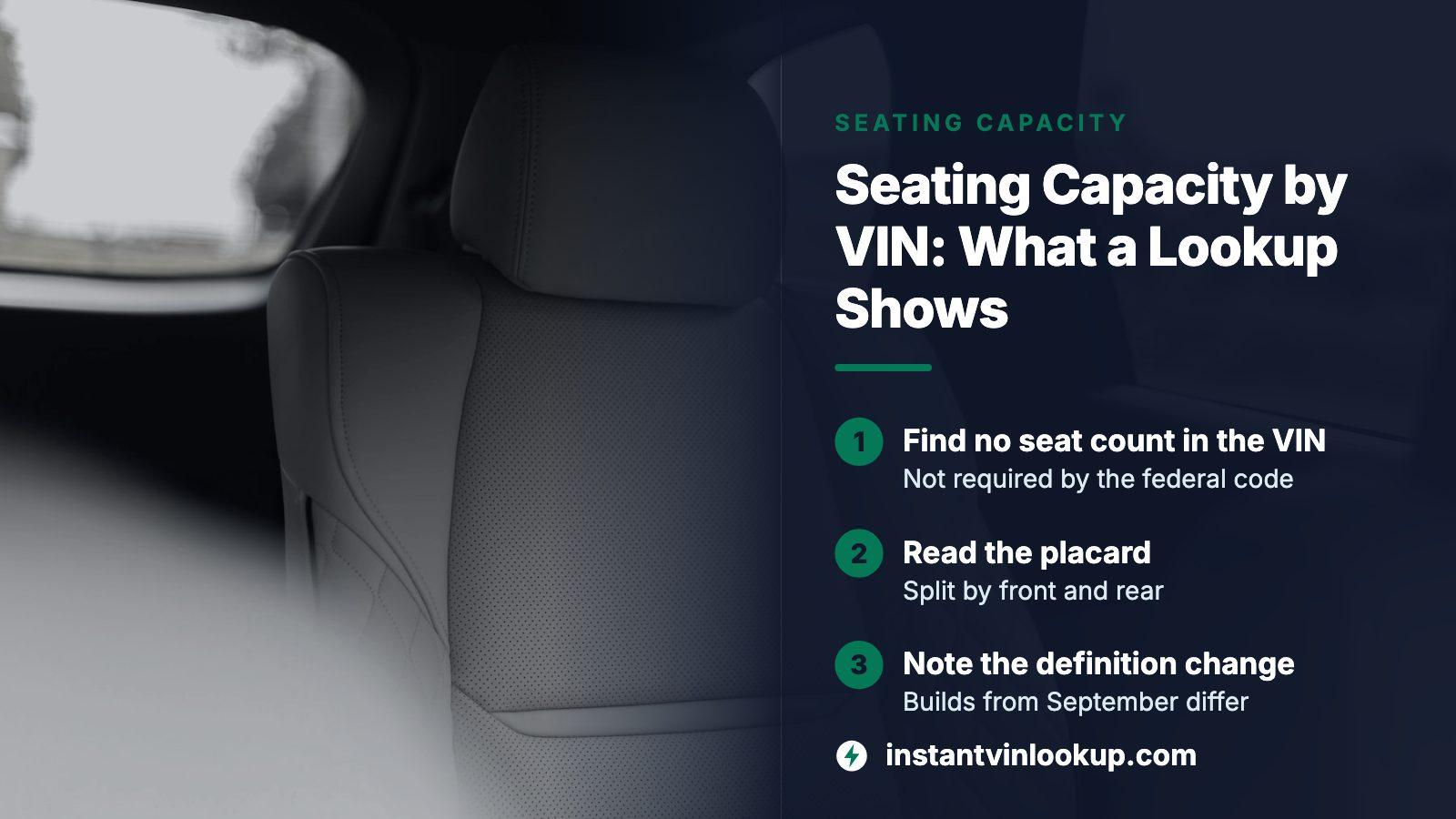
A lookup by VIN returns the factory build of the car, and a seat count only when the maker reported one to NHTSA, which many did not. The legal number is printed on the placard at the driver's side door pillar, as an overall figure plus a front and rear breakdown. Neither one shows seats removed or added later, so count what is installed before relying on either.
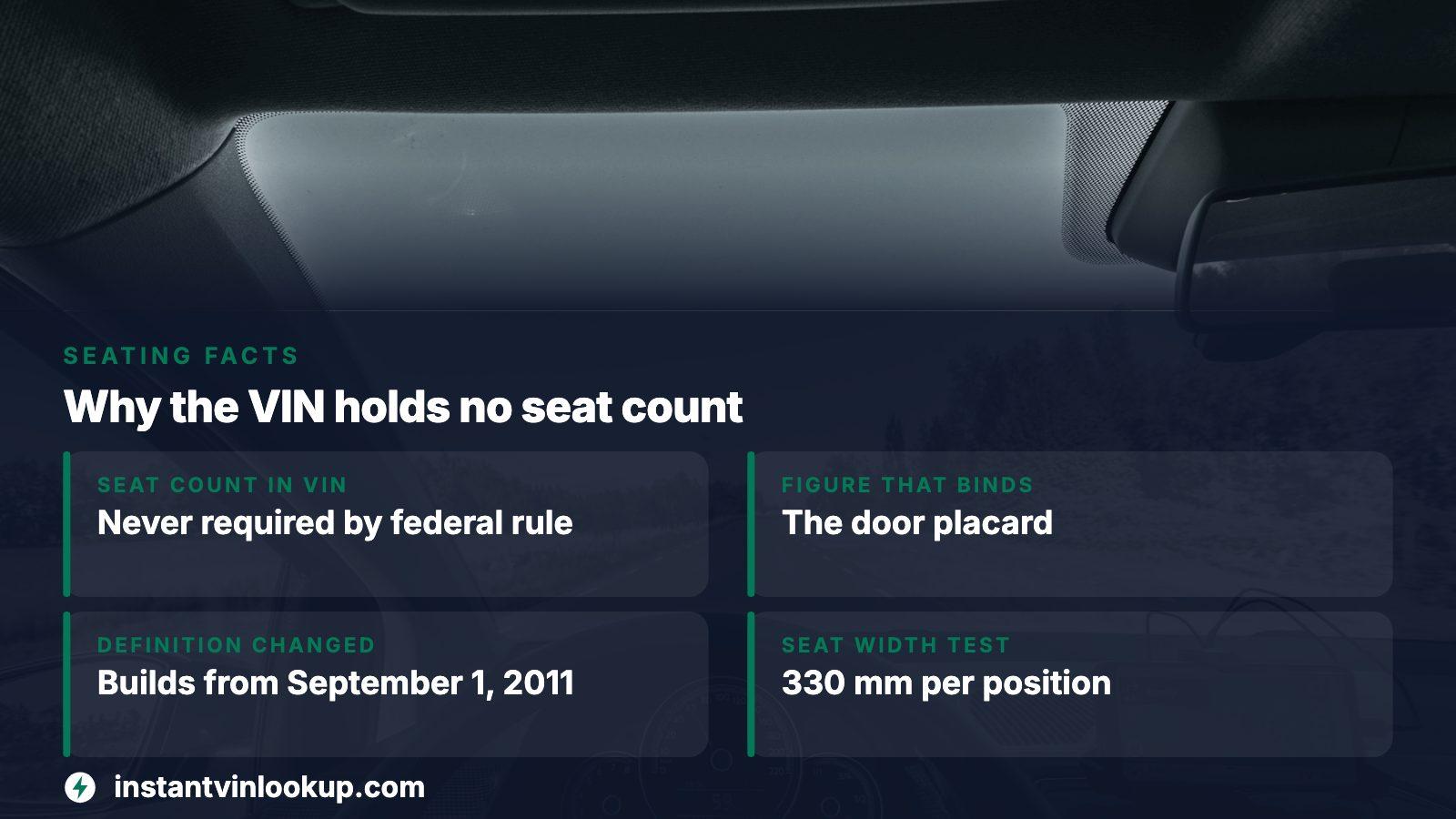
- Seat count in the VIN
- Never required by the federal VIN rule
- Figure that binds
- Placard, split by front and rear
- Definition changed
- Vehicles built from September 1, 2011
- Seat width test
- 330 mm (13 in) per position since then
What an instant lookup returns when the question is seats
Paste the VIN and the lookup matches it to a vehicle: model year, make, model, body style and engine. Seats are a different matter. The answer to a seating question is spread across five places, and only some of them can be reached from a search box.
| What you want to know | Where it lives | Reachable by lookup? |
|---|---|---|
| Body style and vehicle class | The factory build record | Yes, in the first result |
| Seats the maker reported | A seat field in NHTSA's decoder | Sometimes, since the field is often empty |
| Legal seated capacity | The placard on the vehicle | No, you read it in person |
| Seats installed today | The interior itself | No, you count them |
| Open seat and belt recalls | NHTSA's recall search | Yes, with the same 17 characters |
Why the 17 characters hold no seat count
Federal rules decide what a VIN has to describe, and the list stops short of a head count. A passenger car's list names its make, its line and series, the body type, the engine type, and the restraints fitted, with their positions. Trucks and multipurpose vehicles add a weight rating. No class is asked for seats, seat rows or capacity.
Character nine exists to catch typing errors, ten encodes the model year and eleven the plant. The rest is a serial, so nothing in the string says how many people the interior holds.
Decoder spot check
NHTSA's decoder has fields for the number of seats and the number of seat rows, filled from what makers submitted. A spot check of nine decoded model-year patterns found both filled for one: a 2017 Honda Odyssey came back with 8 seats in 3 rows. The 2016 Odyssey returned nothing, and so did a 2013 Sienna, a 2015 Tahoe and a 2015 Transit.
The placard on the car is the figure that binds
The federal standard on tire selection and loading makes the manufacturer attach a label to the vehicle, on the driver's side door pillar. A body with no usable pillar gets fallback spots on the door edges or the interior surface beside the driver's seat. The label is titled Tire and Loading Information and states:
- Designated seated capacity as a total, then the occupants for the front and rear seating locations
- A weight limit for people and cargo together
- Original tire sizes and cold inflation pressures
The seat line is not decoration. The standard builds a vehicle's capacity weight by taking its cargo and luggage allowance and adding 68 kilograms for each designated seat, so the weight line on the label grows out of the seat line above it.
The September 2011 line and the 50-inch bench
A seat is a regulatory unit called a designated seating position, and the test for it depends on build date. Two interiors that look identical can be counted differently if they sit on opposite sides of the line.
| Built | How a position is counted | In a used car |
|---|---|---|
| Before Sept. 1, 2011 | A place that could hold someone at or above the 5th percentile adult female in size and is likely to be used in motion. A bench with more than 50 inches of hip room counts as at least three. | A wide bench is a three-seater unless a console or the seat design blocks the middle. |
| On or after Sept. 1, 2011 | Seat locations whose surface measures at least 330 mm (13 in) across, counted by a set procedure. | The tape measure decides. |
Exceptions exist. Trucks and multipurpose vehicles rated above 10,000 pounds, along with police cars, fire apparatus, ambulances and motor homes, can have a labeled seat location left out of the count.
When the record and the car disagree
A build record describes the day the vehicle left the factory. Seats are among the parts changed most often afterward, so the gap between paper and metal opens quickly:
- A third row comes out for cargo room and never goes back in
- A passenger van is converted to haul freight, sometimes with the floor mounts left behind
- A work vehicle loses its rear bench for a flat load floor
- A damaged seat is replaced with one from a different trim
From an NHTSA owner complaint
The owner of a 2015 Ford Transit told NHTSA that a seat belt recall notice, campaign 16V111000, had arrived for the van. The owner asked to be taken off the recall list because of "not having rear seats in vehicle", and said the local dealer and Ford had been contacted. The complaint reports no answer.
Take this from it: a record keyed to a VIN follows the vehicle whatever its interior has become. That recall covered Transits built with rear passenger seats, so the notice alone says nothing about what a particular van holds today.
Where the count stops being a preference
For most shoppers the number answers one question, whether the family fits. Three situations turn it into a limit.
- Load: seating more people than the label allows takes the vehicle past its rating, and the tire pressures printed beside the count assume the same loading.
- Child restraints: a seating position existing does not prove it has the anchors a given restraint needs, and the owner's manual says which positions do.
- Use: passenger-carrying rules for commercial work can hinge on a seat threshold and differ from state to state, so the placard is the paper to bring when someone asks what the vehicle is rated to carry.
Running the lookup, then checking the car
The order matters, because each step corrects the one before it.
- Copy the 17 characters from the title or listing, then match them to the car itself at the dash plate and the label inside the driver's door.
- Run the lookup and note year, make, model and body style. Any mismatch with the ad is your first finding.
- If the result shows a seat count, write it down as the as-built figure and go no further with it.
- Read the placard inside that door: total seats, the front and rear split, the weight limit.
- Count the seats in place, noting a center spot a console has claimed and any missing third row.
- Search NHTSA's recalls with the same VIN, since seat and belt campaigns sit in that database.

The preview, the report and what they will not settle
Type the VIN into the lookup box and a preview appears, costing nothing, with a summary of what turned up for that car. A report that goes deeper is bought once, as one report or in a pack, and nothing renews. The pricing page has the options.
For a seating question, read the factory specifications in the report, plus the title, accident and odometer entries that hint at whether the interior was disturbed. No report can certify how many seats are fitted today. A damage entry, or a use type that points to heavy work, is a reason to look harder at which seats were replaced or taken out.
Where this information comes from
- 49 CFR 565.15: VIN content requirements — The table of attributes a VIN has to make decipherable, with no entry for seats.
- FMVSS No. 110 (49 CFR 571.110): tire and loading placard — Where the placard goes, what it states about seats and weight, and how vehicle capacity weight is defined.
- 49 CFR 571.3: designated seating position — Both versions of the seat definition, before and after September 1, 2011, and the vehicles it carves out.
- NHTSA vPIC: decode a VIN — How the federal decoder works from maker submissions and from partial VINs.
- NHTSA: Recalls — The government search for open recalls by VIN, including seat and belt campaigns.
- NHTSA owner complaint 11765940 — owner experience, paraphrased
- NHTSA recall 16V111000: Ford Transit rear seat belt buckles — The recall record behind the notice, which covers vans that have rear passenger seats.
Sources and photos: Facts checked against the sources above in November 2026. Photos by Crosby Hinze, Cole Keister and Sander Jeurissen on Unsplash; diagrams by InstantVINLookup.
Keep reading
- VIN Lookup: Check a VIN Number on a Car Before You BuyRun the lookup itself and see what the free preview shows for your car.
- Vehicle Identification Number: What an Instant Lookup Reads From ItWhat each of the 17 positions encodes, and what none of them does.
- Drivetrain by VIN: What an Instant Lookup Shows and When It Is BlankAnother factory spec the VIN names only some of the time.
- Sample reportSee a finished report before deciding whether to open one for your car.
Frequently asked questions
Can you find the seating capacity from a VIN?
Not from the characters, since the federal VIN rule never asks for a seat count. A lookup can identify the car and sometimes shows a seat figure the maker submitted to NHTSA. For the number that counts, read the placard and count the seats installed.
Where do I find the official seat count on a vehicle?
On the loading label, normally at the driver's side door pillar. It gives total designated seated capacity and the occupants for front and rear locations, beside a weight limit covering people and cargo. If the pillar cannot hold it, the rule names fallback spots on the door edges.
Why does the decoder show nothing for seats on my car?
Usually the maker did not report a seat figure for that pattern, which says nothing against your VIN. If you suspect a typo, check character nine: it is a check digit, and the decoder reports whether it works out. Then fall back to the placard and your own count.
Does the seat count change if a row is removed?
Neither the label nor the build record updates itself. The label is the maker's statement from the build, and the record describes the factory configuration. Pulling a row changes the interior and leaves both as they were, so the car in front of you has the last word.
Does seating capacity affect how much a vehicle can carry?
In how the label's weight limit is built, yes. Federal rules count 68 kilograms for each designated seat on top of the cargo and luggage allowance. Read the seat line and the weight line together as a pair.
Now check the car itself
The guide explains what to look for. The report shows what this VIN has on record.