THE SHORT ANSWER
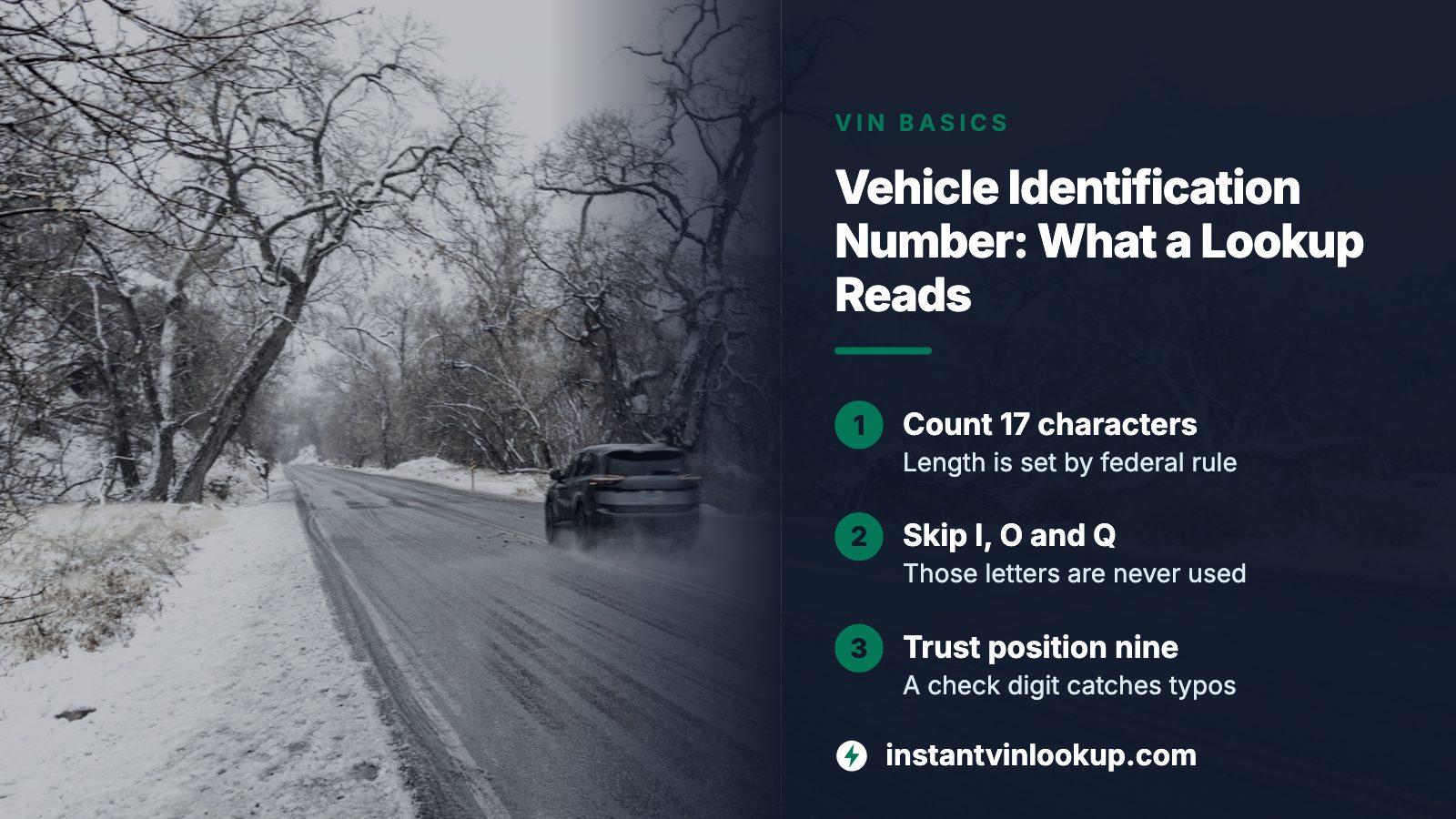
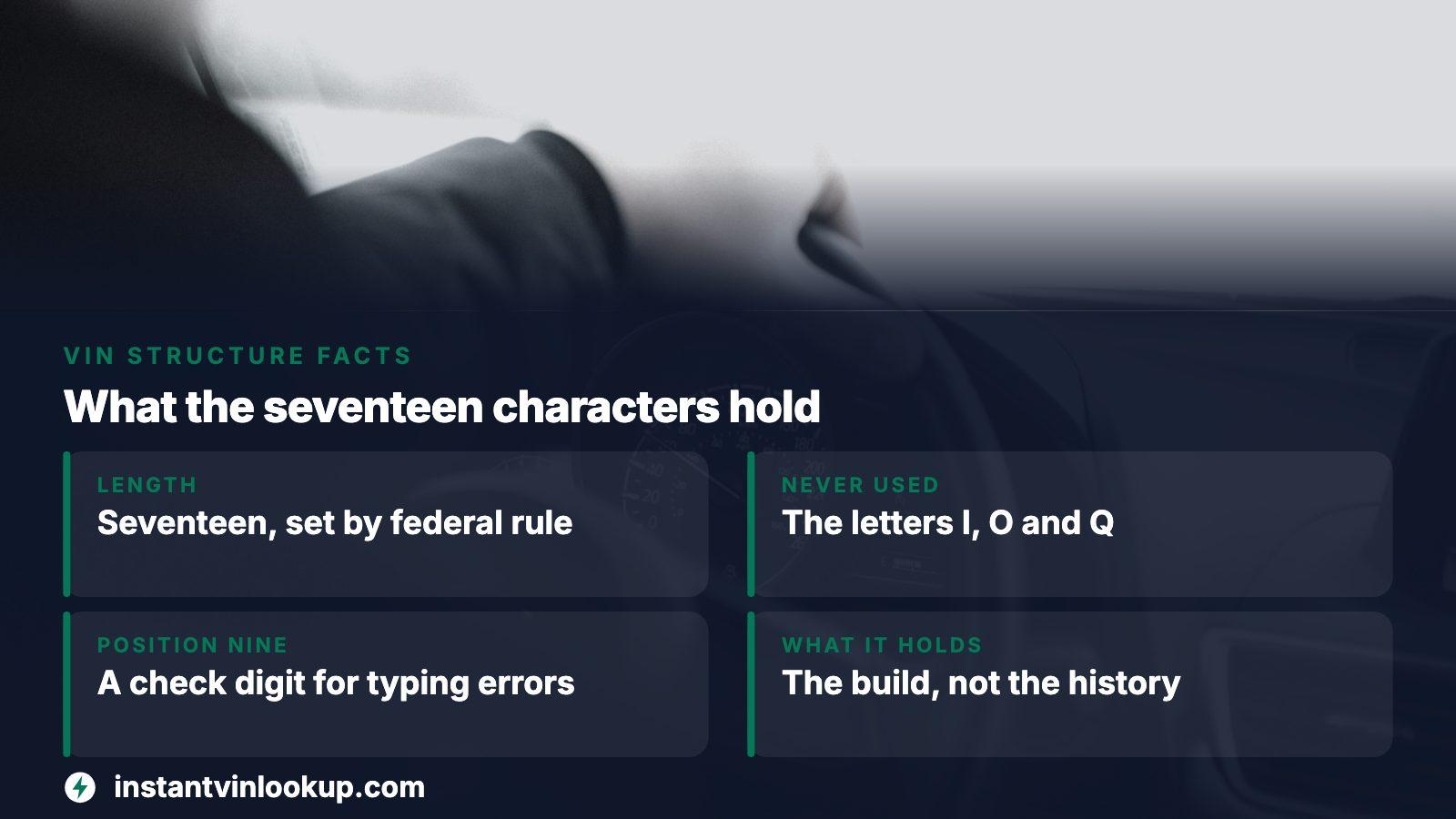
A VIN is a 17-character code laid out by federal rule 49 CFR Part 565. The alphabet omits I, O and Q; position 9 holds a check digit that exposes typing errors; position 10 codes the model year. A lookup decodes the characters with the key the maker filed with NHTSA, then matches the number to title, odometer and recall records that hold the car's real history.
- Length
- 17 characters, set by federal rule
- Never used
- The letters I, O and Q
- Position 9
- A check digit that catches typing errors
- What it holds
- The build and a serial, not the car's history
Every lookup does two jobs, and only one is read from the number
Paste a VIN into a lookup box and two things happen on one screen. The decode reads the characters and turns them into a build description, which is why it appears at once: nothing is searched, only interpreted. The record match sends the same 17 characters to databases that store events, and those databases know nothing about how the car was built.
| Question | From the number | From records |
|---|---|---|
| Make, body style, engine | Yes | Not needed |
| Model year | Yes | Not needed |
| Branded or salvage title | No | Yes |
| Odometer history | No | Yes |
| Open safety recalls | No | Yes |
Keep the halves apart and most surprises make sense. A VIN can decode flawlessly and still belong to a scrapped or flooded car, because the decode answers only what was built.
What each stretch of the 17 characters stands for
Federal rule splits the number into blocks. NHTSA's own decoder returns the results below for 1HGCM82633A004352.
| Positions | What they stand for | Result for 1HGCM82633A004352 |
|---|---|---|
| 1 to 3 | Manufacturer and vehicle type | American Honda, passenger car |
| 4 to 8 | Line, body, engine and other attributes the maker filed | Accord, two-door coupe, six cylinders |
| 9 | Check digit | 3, which passes the arithmetic |
| 10 | Model year code | 3, read here as 2003 |
| 11 | Plant where the maker affixed the number | A, Marysville, Ohio |
| 12 to 17 | Production sequence | 004352 |
The final six characters are a production sequence, and a passenger car's number must end in five digits. Federal rule also keeps a number from repeating on any covered vehicle for 60 years, counting from the 1980 model year.
Three missing letters and a ninth character that polices your typing
The permitted alphabet skips I, O and Q, which are easy to mistake for 1 and 0, so a lookup that meets one has found a copying slip, not a rare car. Position 9 is stricter still. It holds a digit or the letter X worked out from the other characters, each weighted by its place, so a wrongly copied number usually stops adding up.
NHTSA's decoder shows the effect. Change the last serial character of the Honda number above and it still names a 2003 Accord, but flags a check digit error. Swap a zero for the letter O and it reports invalid characters and marks the bad position. A nine-character stub is called incomplete.
Heed the warning, not the result
An error-flagged decode can still print a plausible make and model year. Treat it as a guess, recopy the number from the vehicle and run it again.
Position 10 gives the year, and position 7 says which era
Model year is a single character. Letters start at A for the 2010 model year and run through Y for 2030, after which numerals return, so a character such as 3 can mean 2003 or 2033. Position 7 breaks the tie on cars and lighter trucks: a numeral there places the year between 1980 and 2009, a letter between 2010 and 2039. The Honda above has a 2 in that slot, hence 2003.
The year code names the model year, which the rule treats as independent of the calendar year of assembly.
The five middle characters mean what the maker said they mean
Manufacturers choose the characters in positions 4 to 8 and decide where each attribute goes. The rule only demands that they send NHTSA the key. The agency's decoder, vPIC, is built from those submissions, so a decode is only as detailed as the filing behind it. It targets model years 1981 and later and vehicles built for the US market, so a classic or a foreign-market car may come back thin.
- When a field comes back empty, NHTSA simply has nothing on file for it. The car may still have the feature.
- A decode reflects the car at the factory door, so an engine swap or repaint done later never shows.
- Compare trim, engine and body style with the advertisement. A mismatch is the cheapest warning you will get.
What the record half adds, and the limits of a federal title report
NMVTIS, the federal title system, keeps its report short on purpose: the state of title and last title date, brands from state agencies, a mileage reading, total loss records and salvage records. Repair and recall data are extras that private providers may add.
An InstantVINLookup report builds on that. After the free preview, one payment covers title brands, mileage readings, damage records and open recalls for the exact number you typed. The pricing page lists the options.
From an NHTSA owner complaint
An owner who bought a new 2014 Chevrolet Silverado told NHTSA that the dealership never mentioned an engine-fire recall. Days after delivery the owner typed the VIN into the maker's and NHTSA's recall pages and found the campaign about a month old and flagged as not yet serviced. The sales manager knew nothing about it.
The lesson: recall data is filed under the VIN, not under whatever a seller remembers to say, so run the number yourself before money changes hands.
A lookup is a dated snapshot, so keep the date
Records change after you look: a recall gets filed, a repair gets logged, and a dealer updates its own system on a different schedule. Save every result with its date and the exact characters you typed.
From an NHTSA owner complaint
Another owner of a 2014 Silverado reported that one VIN produced two answers. A dealership said two recalls applied, so a visit was booked. On arrival its system showed nothing under that number, although the federal and maker recall pages still listed the issue as unresolved.
When a shop's system and a lookup disagree, show the dated result and ask them to retype the number from the car's plate. Rerunning the lookup on the day you pay beats relying on one from the week you first saw the ad.
Copy it from the car itself, then run it
On a car or light truck the rule puts the number in the passenger compartment, where a person outside at the left windshield pillar can make it out through the glass in daylight, with characters at least 4 mm tall. It is marked indelibly on a part that stays put during repairs, or on a plate attached to such a part. Paperwork can carry a typo. The metal is the reference.
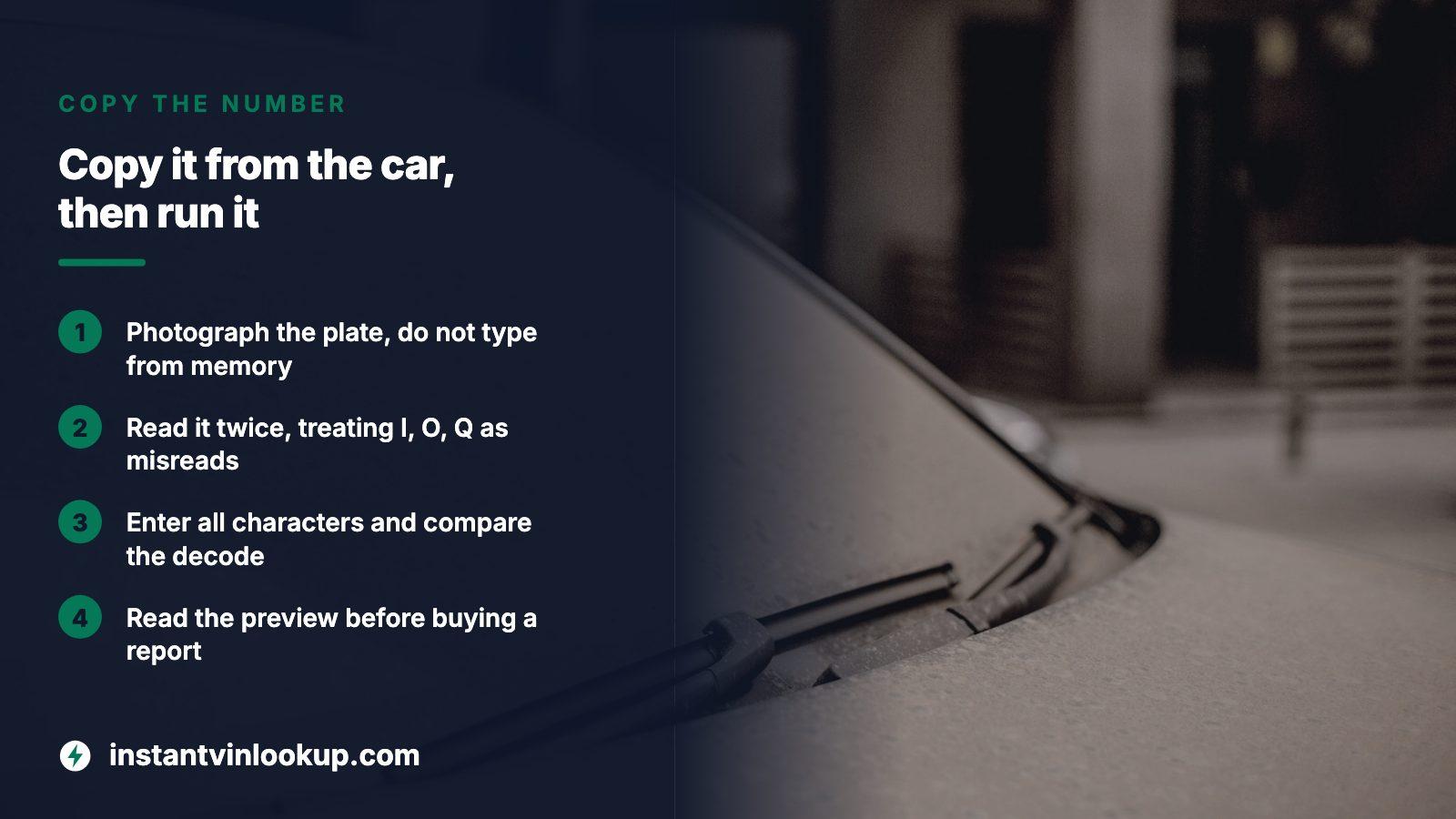
- Photograph the plate instead of typing from memory.
- Read it twice, treating any I, O or Q as a misread numeral.
- Enter all 17 characters, then compare the decode with the advertisement: year, body style and engine.
- Run the free preview first, and pay for the full report only when the car is still on your list.
A car brought in from abroad may carry a second label reading 'SUBSTITUTE FOR U.S. VIN' beside the maker's number. The rule requires that on certain certified imports, so ask the seller for the import paperwork.
Where this information comes from
- eCFR: 49 CFR Part 565, VIN requirements — character set, check digit, position meanings, year codes, location and import label
- NHTSA vPIC: VIN decoder — what the decoder returns and its 1981-and-later scope
- NHTSA vPIC: API — partial decoding and data drawn from maker submissions
- NMVTIS: understanding a vehicle history report — the five items a federal title report covers
- NHTSA owner complaint 10565496 — owner experience, paraphrased
- NHTSA owner complaint 10956334 — owner experience, paraphrased
Sources and photos: Facts checked against the sources above in November 2026. Photos by Zoshua Colah, JavyGo and Miles Loewen on Unsplash; diagrams by InstantVINLookup.
Keep reading
- VIN Lookup: Check a VIN Number on a Car Before You BuyThe step-by-step lookup once you have the number in hand.
- Where Is the VIN Number? Find It in a Minute, Then Verify ItEvery spot the number appears, and how to confirm it matches.
- NICB VIN Check: What the Instant Theft and Salvage Lookup ShowsA theft and salvage lookup to run after the decode.
- Sample reportWhat the record half looks like on a finished report.
Frequently asked questions
What is a vehicle identification number?
It is the code, always 17 characters long, that a maker puts on a single vehicle under 49 CFR Part 565. It identifies the car and records how it was built, but accidents, owners and mileage sit in other databases that use the number as a filing key.
Why does a lookup say my VIN is invalid?
Usually one of three causes: too few characters, an I, O or Q that should be a 1 or 0, or a ninth character that fails the check-digit arithmetic after a miscopied digit. Re-read the plate on the car and retype it slowly.
Is the VIN the same as a serial number?
Only partly. On a mainstream car the last six characters are a production sequence, while the first eleven say who built it, what it is, its model year and its plant. All 17 together form the VIN.
Can I find a car's history from the VIN alone?
Yes, because records are filed under the number, though the number holds none of them. InstantVINLookup shows a free preview first, then sells the report as a single purchase that never renews. The pricing page has the options.
Is it safe to share or post my VIN?
It is not a secret, since the rule makes it readable through the windshield, and it names the car without carrying your name or address. Keep photos of titles and registrations private, though, since they carry details the VIN does not.
Now check the car itself
The guide explains what to look for. The report shows what this VIN has on record.