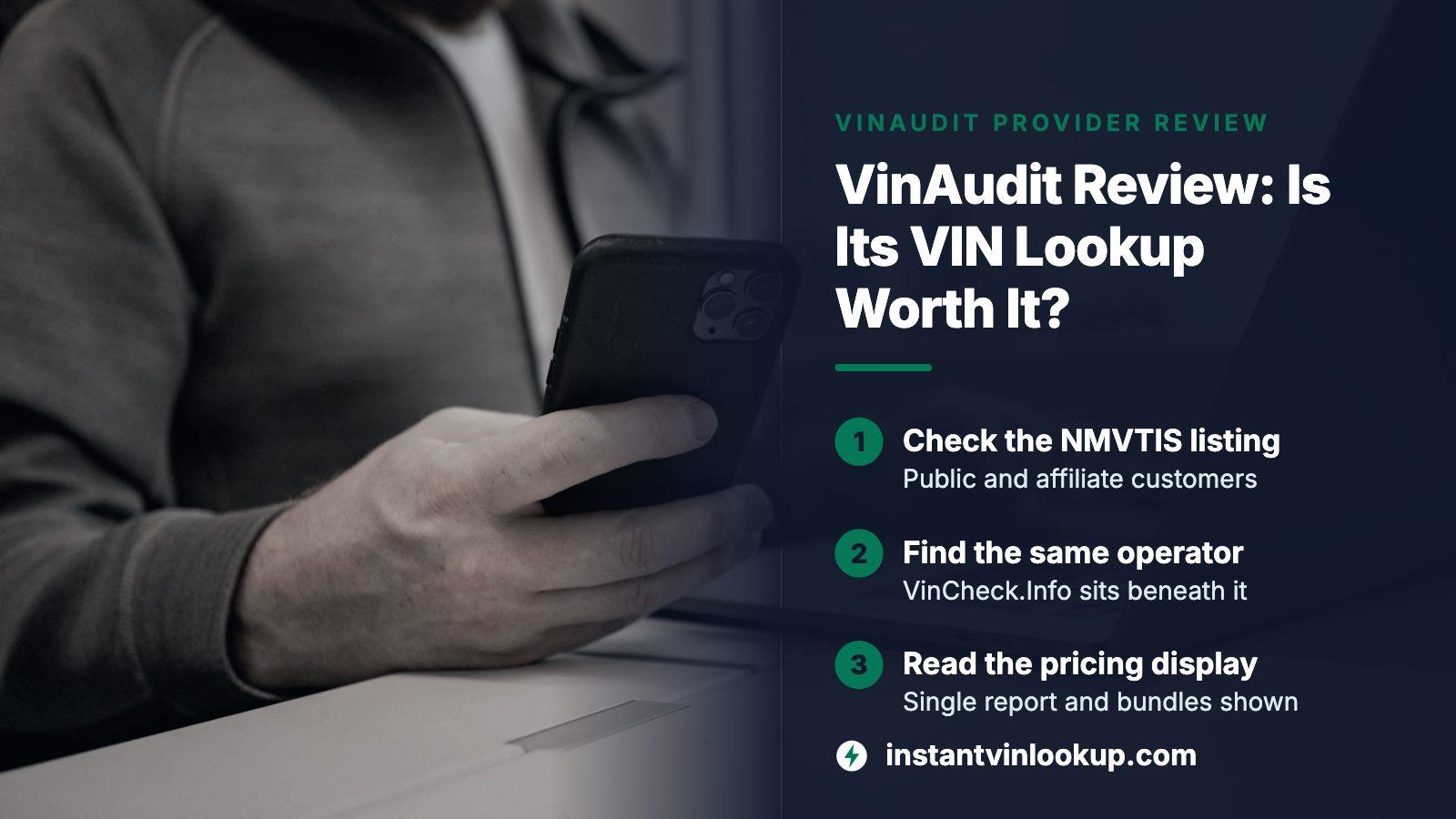
THE SHORT ANSWER
Yes, on the one point anyone can verify. The Department of Justice's NMVTIS page, read in November 2026, put Vinaudit.com in the group for public and commercial customers and named VinCheck.Info as a second site under the same ownership. Expect title, salvage and mileage records from the federal system, not repair visits. Treat a clean result as no record found, then have the car inspected.
- DOJ NMVTIS page
- Vinaudit.com listed for public and commercial customers, read November 2026
- Same operator
- VinCheck.Info is named under it as an additional site
- Home page pricing
- Single report and bundles shown, a snapshot dated 5 November 2026
How a VinAudit lookup runs, step by step
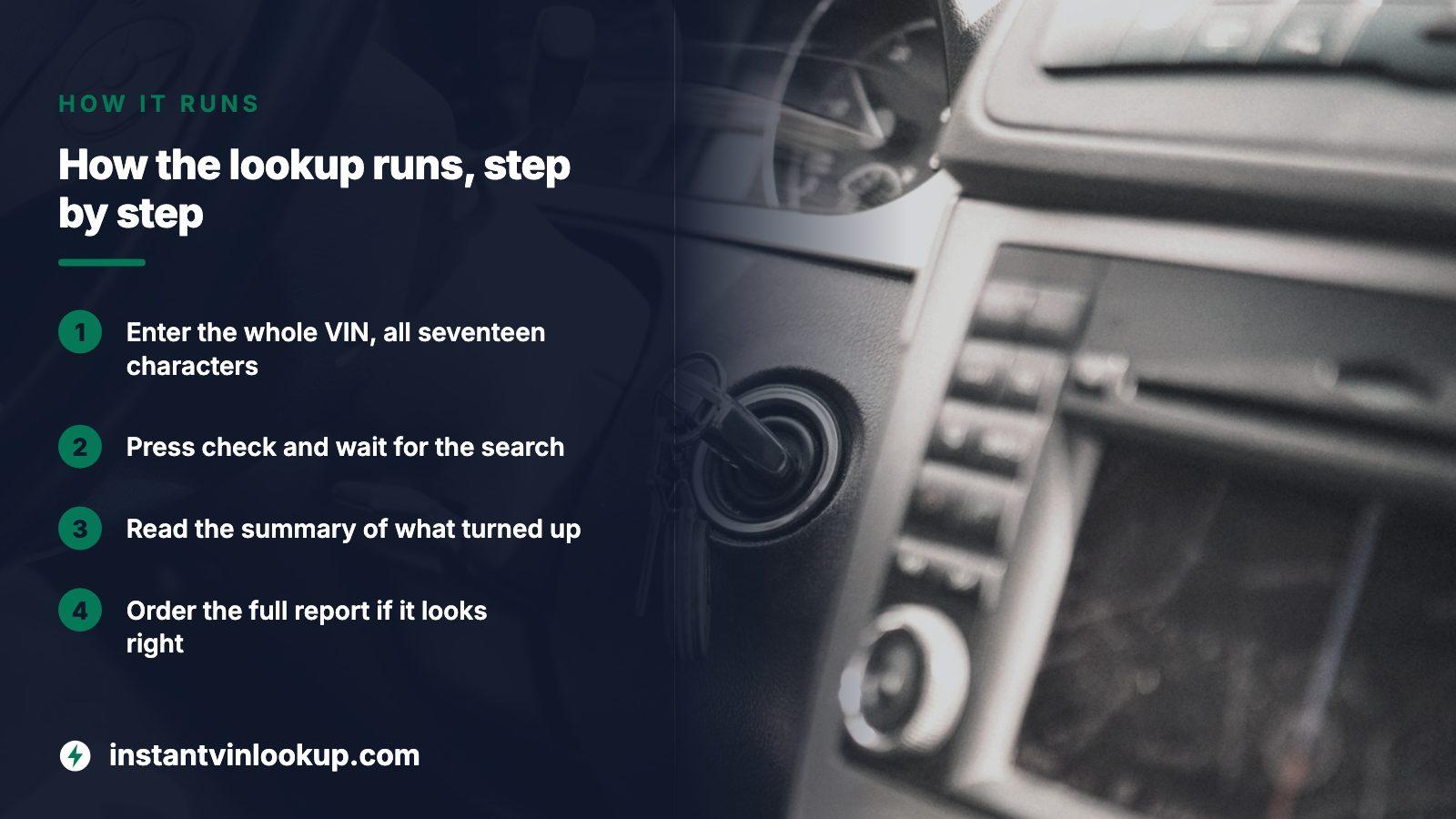
The draw of an instant lookup is speed, and VinAudit's home page describes a short path from VIN to report:
- Enter the whole VIN in the search field, every one of the 17 characters, with no letter standing in for a look-alike digit.
- Press the check button and wait while the site searches for records tied to that number.
- Read the free summary of what turned up.
- Fill in the order form to pay for the full report, which opens straight away.
Take the VIN from the vehicle itself, not from the listing. The dashboard plate by the windshield, the label in the driver's door opening and the title should all match. If they do not, stop before paying anyone, because a lookup on a mismatched number returns a report for some other vehicle.
What the federal listing proves, and what it leaves open
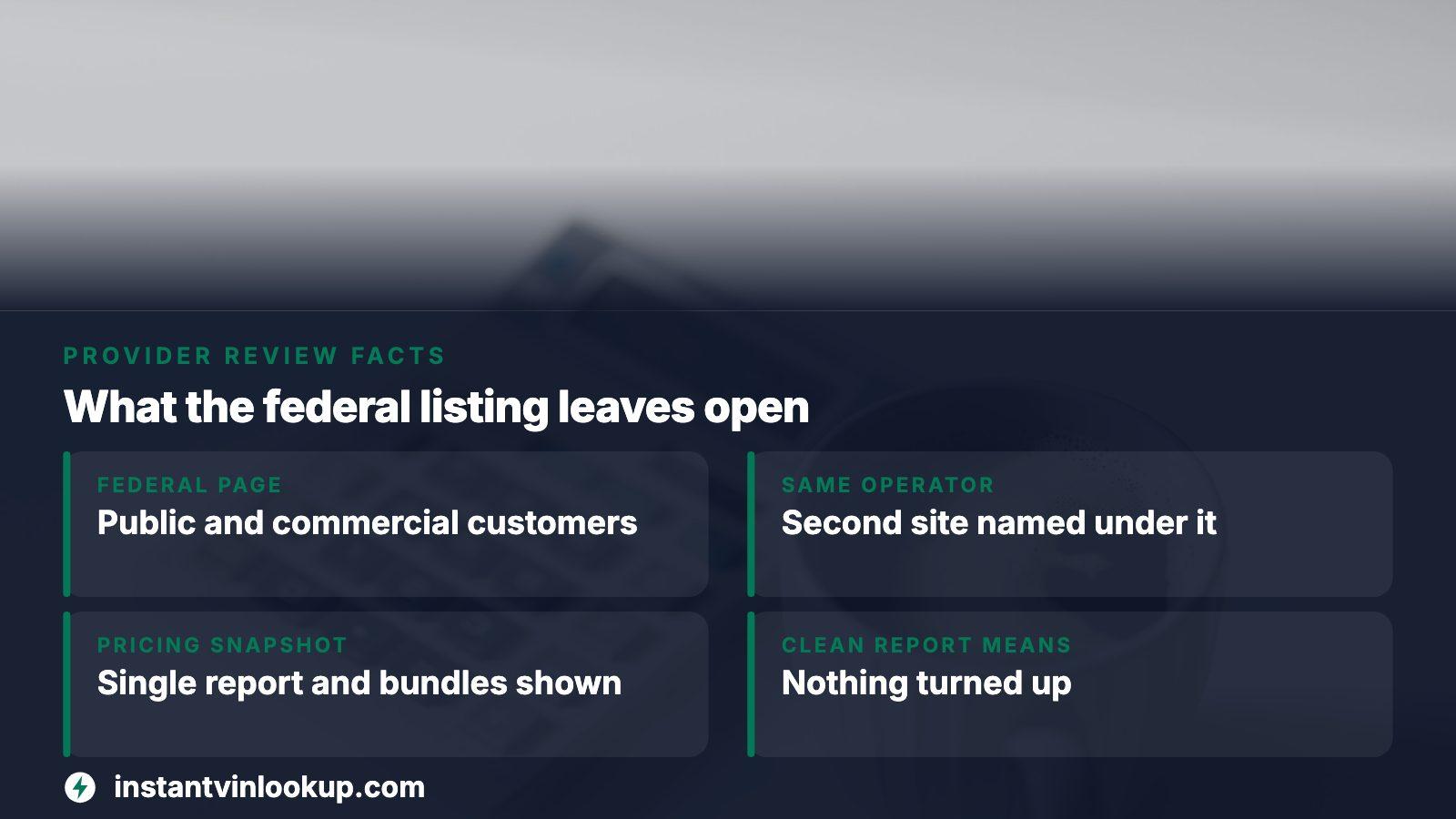
VinAudit calls itself an approved NMVTIS data provider, and you need not take its word for that. The Department of Justice keeps a public page of approved sellers, split between those who serve consumers and those who serve businesses only. Read in November 2026, it placed Vinaudit.com in the group listed for both public and commercial customers. The page orders its entries alphabetically and says the order shows no preference.
So the listing settles one question: may this company sell the federal title record to ordinary buyers? It may. The listing does not grade the checkout, the refund terms or how readable the report is. Before typing a card number, compare the web address on the order page with the one on the federal list, letter by letter.
VinCheck.Info and VinAudit: two names, one operator
Under the Vinaudit.com entry, the same federal page names a second site, VinCheck.Info. The page says the approved provider owns that site and that it is authorized to sell NMVTIS reports. A buyer who runs one lookup on each site has put the same question to the same company twice.
A second opinion that is really a second source
Other providers on that page carry affiliated sites too, so matching brand names prove little. Set a title report beside NHTSA's recall lookup, which shows open safety recalls, and NICB's VINCheck, a theft screen. Each draws on a separate database, so agreement among them carries weight that two storefronts run by one operator cannot.
What a title-based report is built from
NMVTIS grew out of a 1992 federal law aimed at car theft and fraud, and a 1996 reauthorization put the Department of Justice in charge. The department's consumer page says a report covers only five key indicators tied to stopping fraud and theft, and VinAudit's own FAQ describes its report in similar terms.
| Record | What it tells a buyer | Where it stops |
|---|---|---|
| Title data and brand history | Junk, salvage or flood brands recorded against the VIN | Only brands a state actually recorded |
| Latest odometer reading | A mileage figure tied to a title record, useful against rollbacks | Gaps between events leave room to hide |
| Insurer total-loss decision | Proof an insurer wrote the car off | A car repaired privately never creates one |
| Transfer to a junk or salvage yard | A sign the car left the normal resale chain | Depends on the yard reporting it |
The same page adds that some reports carry historical theft data. VinAudit separately offers a market value check, which is an estimate and not a record, so treat it as a negotiating aid.
Coverage gaps the Department of Justice spells out
A low-cost federal lookup is only as complete as the federal database. The department's consumer page puts 87 percent of the nation's vehicles inside NMVTIS, says over half the states send it data, and counts around 20 million entries for salvage or total-loss cars. It also cautions that a search can wrongly come back clean for a car that carries a brand or a salvage past.
- A clean report says only that nothing turned up, which falls short of proof that the car is sound.
- The federal system carries just a slice of a state's file, and the consumer page links to where the complete state title record can be requested.
- VinAudit's own site concedes that state rules and reporting practices can leave some details missing or thin.
- Damage fixed out of pocket, with no insurer, police officer or title office involved, leaves nothing for any provider to find.
The same page urges buyers to check NMVTIS before purchase, flood and junk or salvage cars most of all.
What VinAudit charges, and how that compares
On its home page, read on 5 November 2026, VinAudit showed a single report at $9.99, five reports at $19.99 and ten at $29.99. It adds that current pricing and bundle options appear once records are found and ready to buy, and the page mentions no subscription. Treat those figures as a dated snapshot and confirm them on the order form.
| Point | VinAudit | This site |
|---|---|---|
| First step | Free summary after a VIN search | Free preview of whether records exist |
| Payment | Single report or bundle, per its home page | One payment for a report or a pack, no subscription |
| Where to read the price | The order form on its own site | The pricing page |
A report earns its cost only if its records answer your question about this car. For title brands, salvage entries and mileage, one report per finalist is a sound use of money. A second report from the same operator adds nothing.
Who it suits, and what to run beside it
VinAudit fits a buyer working down a shortlist, or a private sale where a pricier report would eat into the savings. It fits less well when the car is expensive and recent and you want documented maintenance. A sensible order of checks:
- Match the VIN on the car, the paperwork and the listing.
- Look up open recalls on NHTSA's own site.
- Query NICB's VINCheck to see whether the car was reported stolen.
- Order a title report on each car still in the running; VinAudit and other approved sellers offer one.
- Have an independent mechanic examine the car, and ask for the verdict in writing.
What the FTC says about inspections
The agency calls a report on a car's past no stand-in for a mechanic's own look, and notes that reports typically leave out mechanical problems. If a dealer refuses to allow the inspection, it suggests looking at another dealer.
Running the lookup on this site instead, or as the next step
This site is not VinAudit and has no connection to it. The front end works the same way: enter the VIN, read the preview, then decide. The preview is free; the report that follows is bought once, with nothing to cancel later, and the pricing page sets out the single report beside packs of 3, 5 or 10.
Photos from salvage auctions, damage and accident entries, title brands and mileage readings are what most often change a decision. If the preview shows records, the full report has something to say about that car. If it shows none, you have kept your money for the next candidate.
Where this information comes from
- Department of Justice: approved NMVTIS providers — The public list where Vinaudit.com and its additional site VinCheck.Info were read.
- Department of Justice: NMVTIS for consumers — The indicators a report covers, the coverage figures and the false-negative warning.
- Bureau of Justice Assistance: NMVTIS overview — Why the title system exists and which agency now runs it.
- FTC: Buying a used car from a dealer — Why a history report does not stand in for a mechanic's inspection.
- VinAudit: home page — Its own description of the lookup steps, pricing and data limits, read November 2026.
Sources and photos: Facts checked against the sources above in November 2026. Photos by Anastasiia Nelen, tim and Ben Wicks on Unsplash; diagrams by InstantVINLookup.
Keep reading
- VIN Lookup: Check a VIN Number on a Car Before You BuyRun the number through the preview and see what records exist before you pay.
- EpicVIN Review: What This Paid VIN Lookup Does and Doesn't ShowAnother approved provider judged on the same questions, for a true cross-check.
- NICB VIN Check: What the Instant Theft and Salvage Lookup ShowsThe theft screen to run beside any paid report, and how to read a hit.
- Sample reportSee what a finished report looks like before you buy one.
Frequently asked questions
Is VinAudit legit?
On the point that can be checked, yes. Read in November 2026, the Department of Justice's list of approved NMVTIS providers placed Vinaudit.com in the group for public and commercial customers. That speaks to where its title data comes from. It says nothing about support, refunds or how the report reads, so read the order terms before paying.
Are VinAudit and VinCheck.Info the same company?
They share an operator. The federal provider page lists VinCheck.Info under the Vinaudit.com entry as a site the approved provider owns. A report from each draws on the same title access, so two matching results are not independent confirmation. Pick a different system for a real cross-check.
How much does a VinAudit report cost?
Its home page, read on 5 November 2026, showed $9.99 for a single report, $19.99 for five and $29.99 for ten, and said current options appear when records are ready to buy. Prices can move at any time, so confirm them at checkout.
Does a VinAudit report show accidents?
Only those that left a trace in its sources. The federal record covers title brands, insurer total-loss decisions, salvage-yard transfers and mileage readings. Cosmetic work done off the books never reaches any database, so pair the report with a mechanic's inspection.
Is a VinAudit report enough before buying a used car?
It covers the title side, where the costliest surprises hide. The Federal Trade Commission, though, calls a history report no stand-in for hands-on inspection by an independent mechanic, since reports usually leave out mechanical faults. Let the report eliminate weak candidates, then have a mechanic go over the survivor.
Now check the car itself
The guide explains what to look for. The report shows what this VIN has on record.