THE SHORT ANSWER
VinCheckPro's free instant lookup is plausible for what it mostly assembles: open recalls, factory specifications, safety ratings, and theft and salvage flags, all published at no cost by NHTSA and NICB. In November 2026 it was not among the approved NMVTIS providers published by the Department of Justice, so do not treat it as the federal title record. Use it as a quick screen, then confirm title history with an approved provider before you pay a seller.
- Advertised model
- VIN or plate in, report on screen or by email
- DOJ NMVTIS page
- Not shown, affiliates included, when read in November 2026
- Public at the source
- Recalls, specs and ratings from NHTSA; theft and salvage flags from NICB
Instant lookups are fast because the data is already public
People who type VIN check or VIN lookup into a search box usually want an answer in seconds. VinCheckPro promises that: enter a VIN or a license plate, and a multi-page report shows up on screen or in your inbox. The site says its data comes from reputable government and industry sources, and the menu it advertises is long:
- Theft checks and junk or salvage indicators
- Flood damage and accident history
- Safety ratings and recalls or defects
- Odometer readings and vehicle specifications
- Title brands
Speed is not the hard part of a VIN lookup, since public databases answer in a second or two. What separates one result from another is which database sat behind each line, so that is the question to put to any instant report.
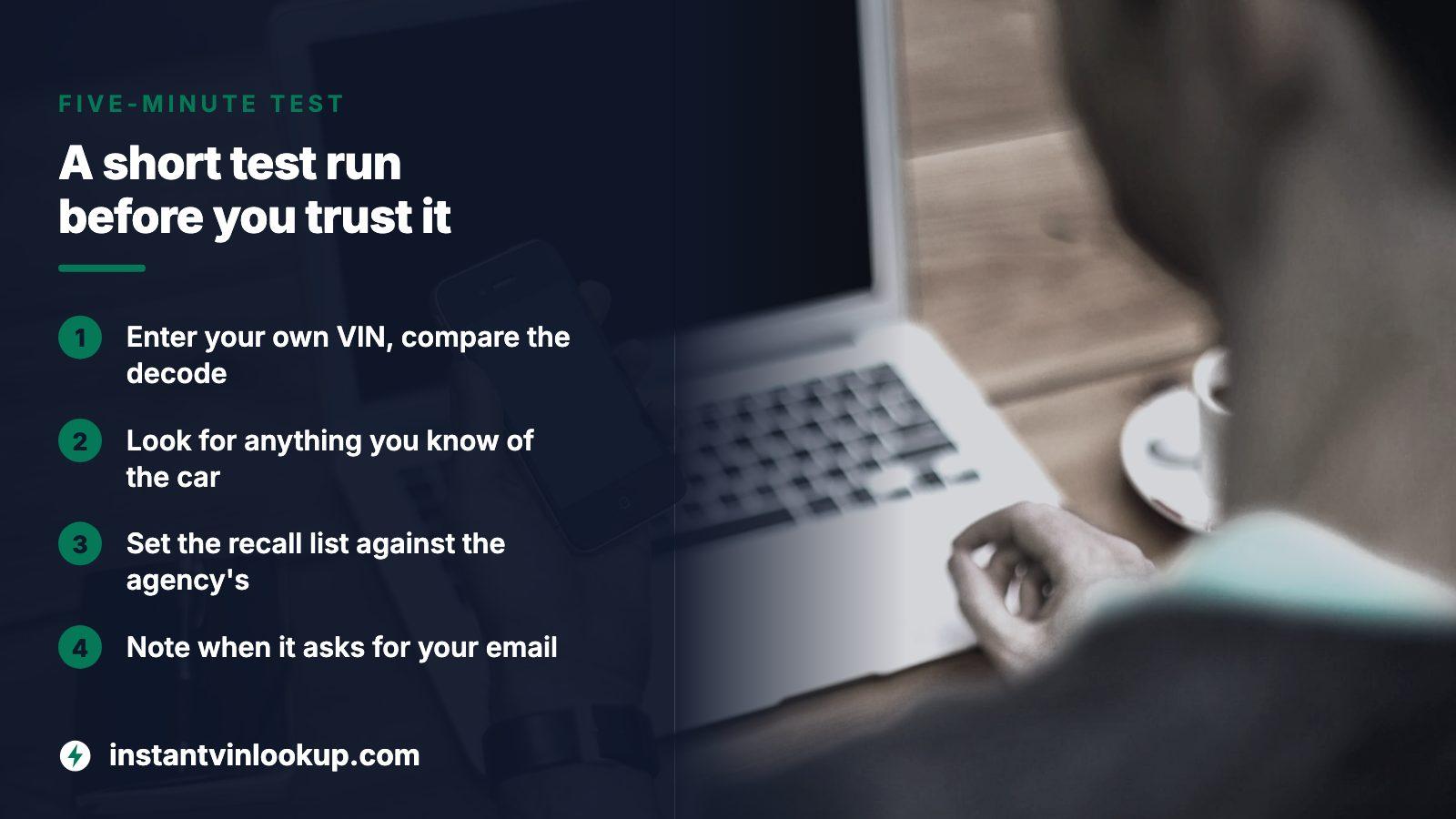
A five-minute test run before you trust any free lookup
You do not have to take a review's word on how a lookup behaves. Spend five minutes feeding it a car you already know well, ideally your own, and judge the output against what you can see.
- Enter your own VIN and compare the decoded year, engine and body style with the car in your driveway.
- Look for anything you personally know about the car's past, such as a reported claim or a repair, and see whether the report mentions it.
- Put the recall list beside the NHTSA recall lookup. The two should agree.
- Note when the page asks for an email address: before the result, or after.
- Read what it says about where title brands come from, and whether it names the provider.
A lookup that matches your own car on the first three points is at least handling public data properly. The last two tell you how it makes money and how far to trust its title line.
Sorting the report into free, paid and unavailable
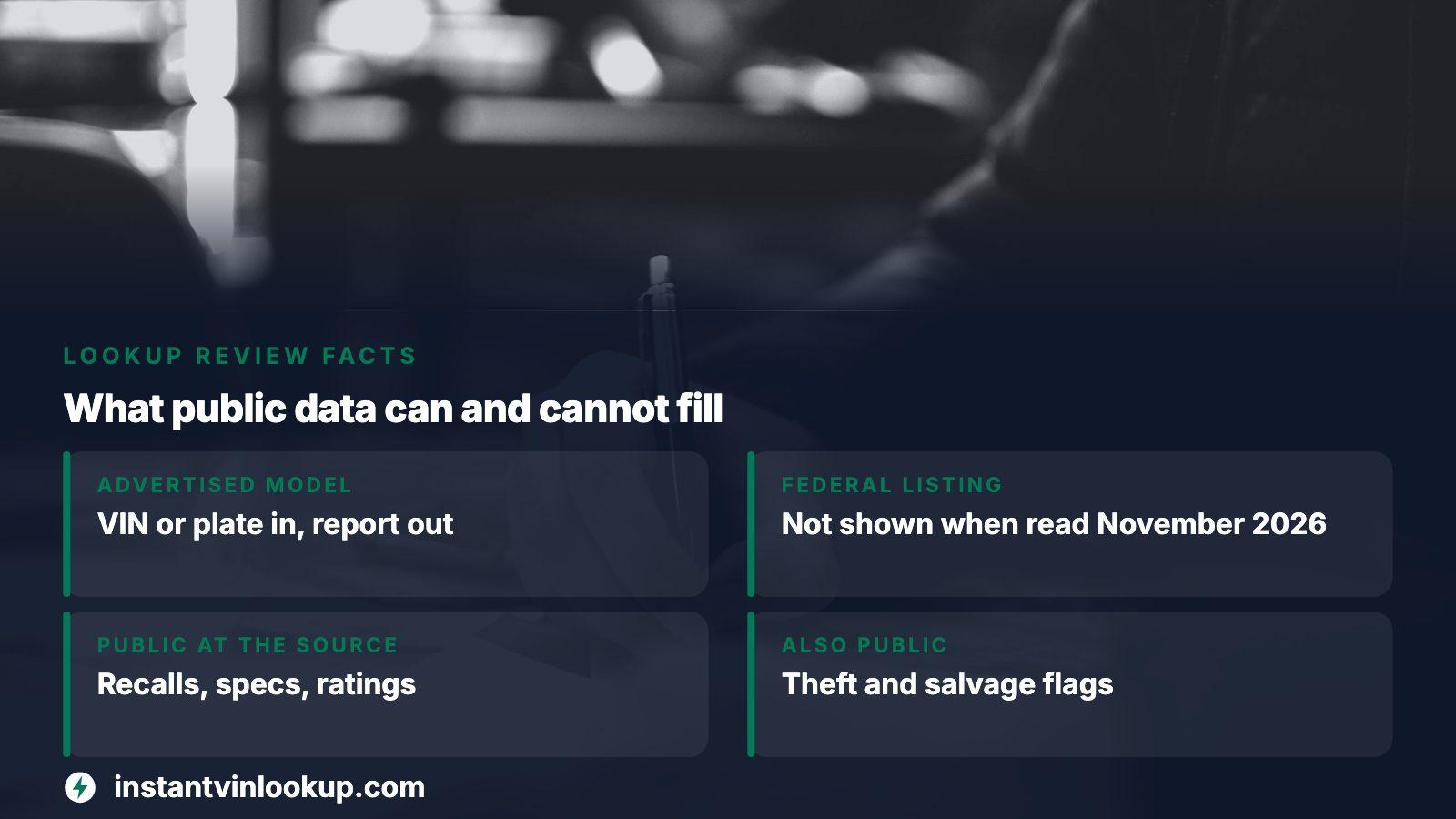
NHTSA runs a recall lookup by VIN, a decoder called vPIC that returns factory specifications, and a crash test program. NICB runs VINCheck, which reports theft records and salvage-title records that participating insurers contributed. That covers most of the menu.
| Report line | Who holds the record | Cost of access |
|---|---|---|
| Open recalls and defects | NHTSA, searchable by VIN | Nothing, open to anyone |
| Factory specifications | NHTSA vPIC decoder | Nothing |
| Safety ratings | NHTSA crash tests, per model rather than per car | Nothing |
| Theft flag | NICB VINCheck, built from insurer reports | Nothing |
| Junk and salvage flags | NICB for a screen; NMVTIS for the fuller record | Paid only on the NMVTIS side |
| Brands and title history | NMVTIS, reached through approved providers | Paid, report by report |
| Accident history | No single complete source exists | Nobody can sell it whole |
A free report that gathers the first rows into one page is not a trick. It saves three browser tabs, and that is a fair thing to offer.
Why a free report cannot carry the federal title record
NMVTIS is the national title database, and approved providers pay for access report by report. That is the reason a legitimate provider charges a few dollars rather than nothing. Anything that hands out the same record at no charge would be covering the cost of every lookup itself.
Read the claim, not the price
Free is not the warning sign. The warning sign is a free page that says its title brands came from the federal database while the business behind it is absent from the approved providers. Those two statements do not fit together, and the second one can be checked in seconds.
Checking the Department of Justice page yourself
The Department of Justice publishes the providers cleared to sell NMVTIS reports, with affiliates shown under each primary provider. Reading that page in November 2026 turned up no entry for VinCheckPro, whether as a provider or under another provider's name. That is a checkable statement, so check it instead of relying on this page.
- Open the Department of Justice page from the sources below.
- Search for the exact name of the service, then scan the affiliate names listed under each provider.
- Match the spelling letter for letter. A near match can belong to a different business: VinCheck.Info, for example, is shown as an affiliate of another provider.
- Note the date you looked, since a page like this can be updated.
A missing entry says one thing: the service is not an approved source of the federal title record. It does not say the recalls, specs or theft flags are wrong.
Accident history: the line no report fully fills
Treat the accident claim with the same care at every price. A collision settled privately, with no police report and no insurance claim, lands in no database, so no service holds a complete accident history, free or paid. What a report can show is crashes that were reported, plus damage tied to insurer, auction and salvage entries.
Read a clean accident line as nothing reported, which is not the same as nothing happened. Then walk around the car: uneven panel gaps and paint that shifts from one panel to the next are worth a question to the seller.
How a free VIN lookup pays its own way
Free products need a business model, and the usual ones here are advertising, affiliate referrals to a paid provider, and collecting email addresses. None of that is improper. It does shape the page: a report can end with a nudge toward something paid, and an emailed report is also a way for a site to build its list. Four questions sort the pages quickly:
- Does the result load before it asks for an email address, or only after?
- Does the page keep what it knows about the car apart from what it wants to sell next?
- Is each source named, or only called reputable?
- Does it say which records come from NMVTIS, and through which provider?
Verdict, and where this site's lookup fits in
A quick public-data page suits a shopper screening several cars who would rather read one page than visit three agency sites. It does not suit someone about to hand over cash, where the title record is the thing that matters. A sensible order:
- Screen every car on the shortlist with a quick lookup.
- Confirm recalls on the NHTSA lookup, the definitive free source.
- Run the NICB theft and salvage screen on the cars that survive.
- For the last one or two, pull a report from a provider the Department of Justice lists.
- Have an independent mechanic inspect the car you want.
This site is not VinCheckPro and has no tie to it. Its own lookup fits just before step four: type in a VIN and a free preview shows how many records exist for that car, so you know whether a report is worth buying. The report is a single purchase with odometer readings, title brands, damage and accident records, auction and salvage entries with photos, liens, theft and open recalls. The pricing page lists the options, and nothing renews.
Where this information comes from
- Department of Justice: NMVTIS approved providers — The public page for checking a service by name, with affiliates shown under each provider.
- NHTSA: Recalls — The open-recall lookup by VIN that any report pulls from.
- NHTSA: vPIC VIN decoder — The public source of factory specifications behind a decode.
- NICB: VINCheck — The theft and salvage-title screen built from insurer reports.
Sources and photos: Facts checked against the sources above in November 2026. Photos by Ben Wicks, Alejandro Escamilla and Owen Michael Grech on Unsplash; diagrams by InstantVINLookup.
Keep reading
- NICB VIN Check: What the Instant Theft and Salvage Lookup ShowsRun the theft and salvage screen yourself and learn how to read a hit.
- ClearVIN Review: What an Instant ClearVIN Lookup Gives YouAn approved title-record provider, weighed on the same questions.
- GoodCar Review: The Instant Lookup, the Federal Listing and the BillingAnother approved provider, to compare against what a free page offers.
- VIN Lookup: Check a VIN Number on a Car Before You BuyHow to find the number, test it, and read the preview before you pay.
Frequently asked questions
Is VinCheckPro free to use?
The site advertises a free VIN check, with the report shown on screen or sent by email. The lines it lists are mostly published at no cost by NHTSA and NICB, so a zero price is believable for that part. Read the page for what it asks in return, such as an email address.
Is VinCheckPro an approved NMVTIS provider?
Not according to the Department of Justice page, read in November 2026. It shows no entry among the primary providers or the affiliates beneath them. The page is public, so you can confirm that in seconds before you rely on any claim about title history.
Does that mean the data is wrong?
No. Approval status speaks only to NMVTIS title records. Recalls, specifications and theft flags are public data that any service may re-present. Judge each line on its own merits, and confirm the ones that decide your purchase at the source.
What can I look up from the government myself?
NHTSA gives you open recalls, decoded specifications and crash test ratings. NICB's VINCheck adds theft and salvage-title flags. None of them needs an account or a payment, and each answers one narrow question rather than the whole history.
Where do I get the title record before buying a car?
From a provider on the Department of Justice page. Reports from those providers typically cost a few dollars, which makes them the cheapest route to federal title and brand history. Run one before money changes hands, and compare the VIN with the number on the title.
Now check the car itself
The guide explains what to look for. The report shows what this VIN has on record.