THE SHORT ANSWER
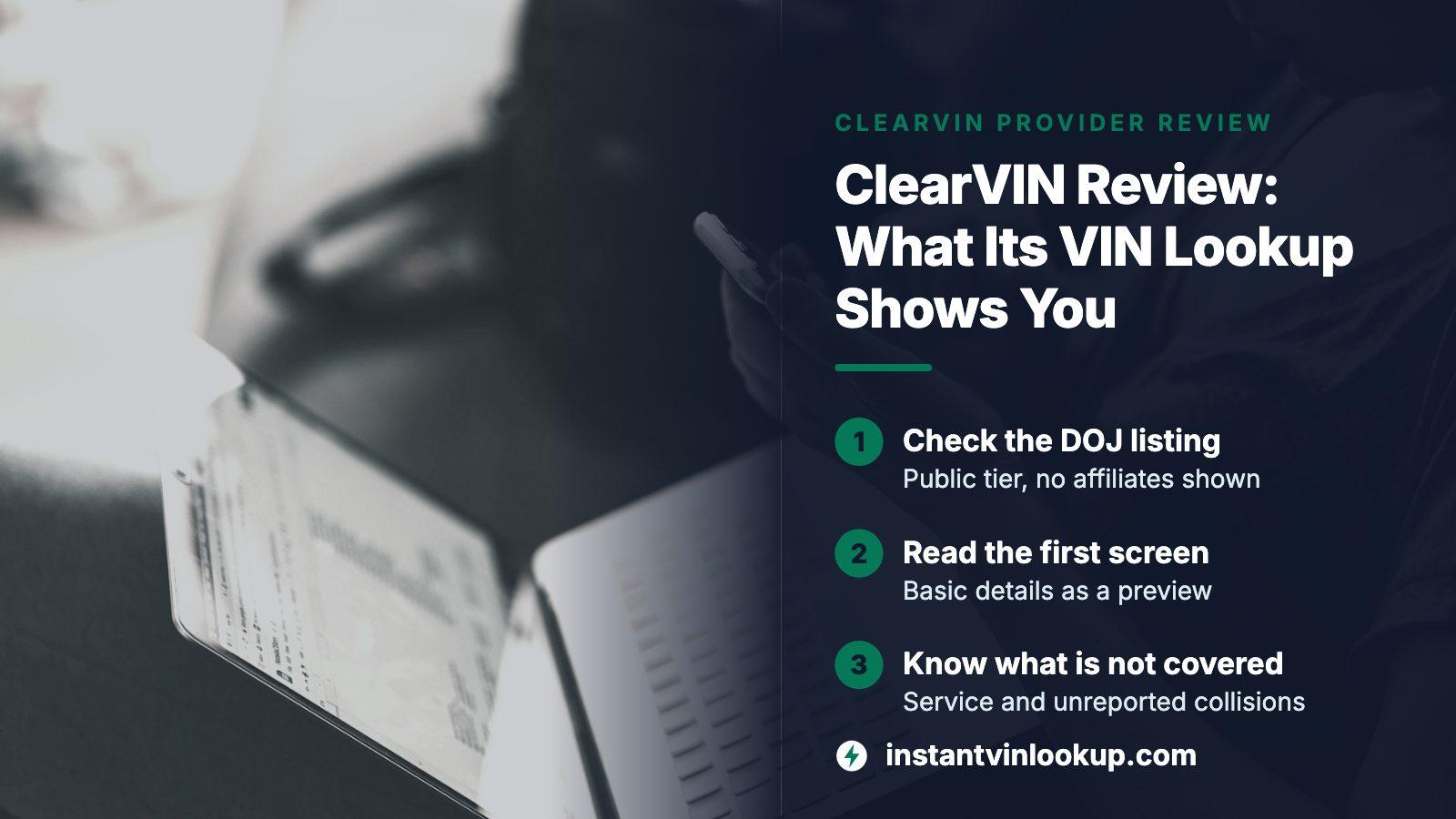
ClearVIN is a legitimate source of the federal title record. The Department of Justice lists it in the tier that sells to the public, and when read in November 2026 its entry had no extra storefronts attached. Expect brand, total-loss, odometer and lien data, not a service history or unreported accidents. Run the free recall and theft screens first, then pay for the title record on the cars still on your list.
- DOJ listing
- Public tier, no affiliate sites shown, read in November 2026
- First screen
- Basic VIN details as a preview, full report after payment, per ClearVIN's help pages
- Not covered
- Service records and collisions that were never claimed
What happens after you type a VIN into ClearVIN
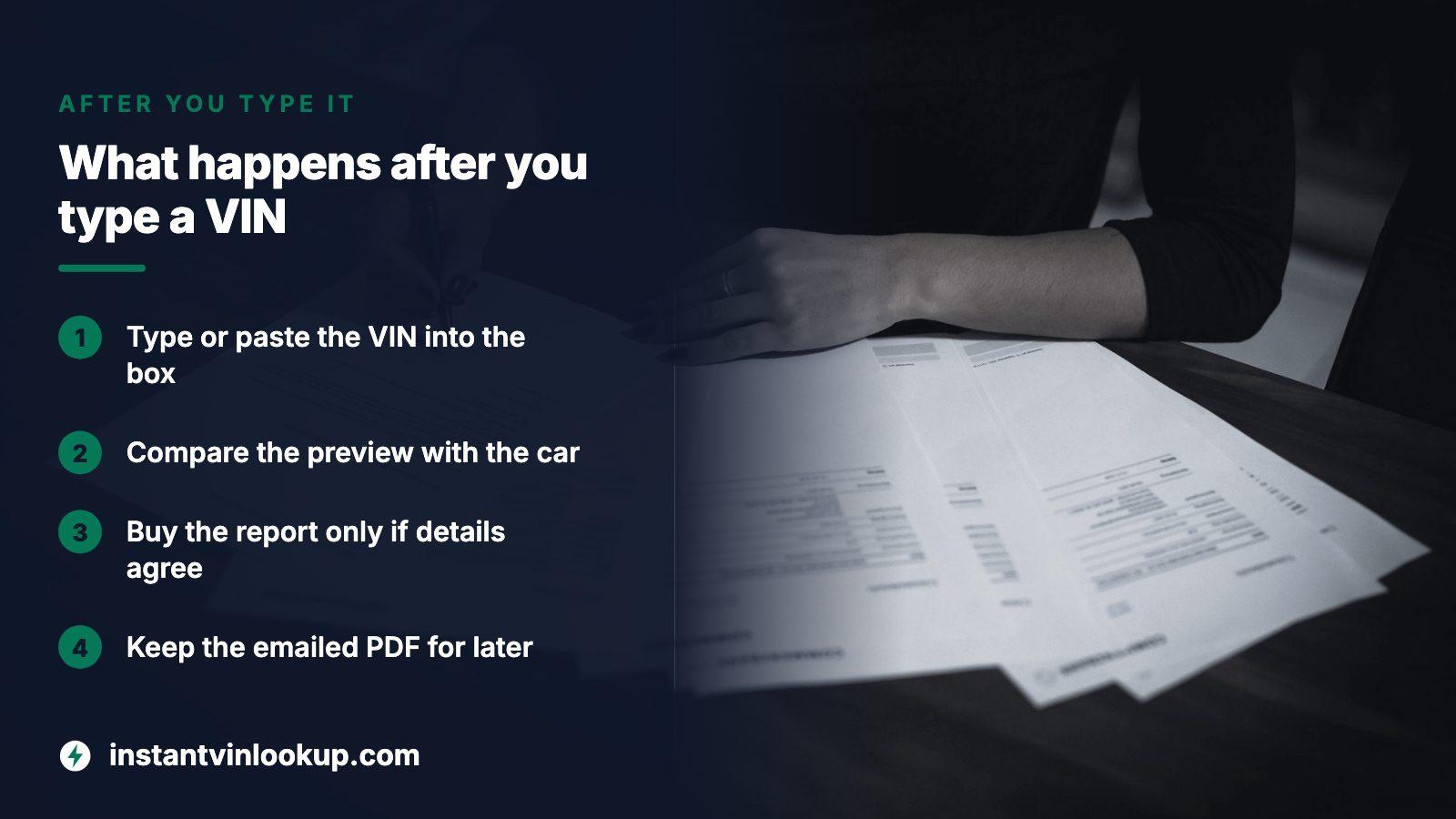
The flow, as ClearVIN describes it in its own help pages, is short. You enter a VIN on the main page and get basic vehicle details as a preview. Paying opens the full report on the next page, and a PDF copy is emailed to you. The help pages do not say how long the report takes to arrive, so treat any promised delivery time as unconfirmed. This review rests on those help pages and the government list, not on a purchased report.
- Type or paste the 17-character VIN into the search box.
- Compare the preview's year, make and model with the car you are standing beside.
- Buy the full report only when those details agree.
- Keep the emailed PDF, since a seller or a mechanic may want to see it.
The second step is where a mistyped number or a swapped plate shows up, before any money has moved.
Why a fast answer says little about quality
Anyone searching for a VIN lookup wants an answer in seconds, and almost every service delivers one, because decoding a VIN is a quick database call. Speed separates nothing. What separates one result from another is the record behind each line and who may sell it. For brands and total-loss entries, that record is NMVTIS, the federal title database, and selling it to the public takes approval from the Department of Justice. So the useful question about ClearVIN is not how fast the page loads. It is whether that approval exists.
Reading ClearVIN's entry on the Department of Justice list
The department publishes approved providers in two groups: those that may sell to commercial and public customers, and those limited to commercial customers. Read in November 2026, the first group held 12 providers, and ClearVIN was one of them. Its entry carried no additional websites. Five providers in that group are shown with extra sites of their own, so a single clean entry means you are not comparing ClearVIN with a second brand running on the same approval.
| What the page shows | ClearVIN's entry |
|---|---|
| Customer group | Commercial and public customers |
| Additional websites listed | None |
| Ranking of providers | None, the page states no preference is indicated |
What approval proves
Approval means the federal title data in a report is genuine and came through a licensed channel. It is not a grade for support, refunds or presentation. Open the government page yourself before paying, because it is the copy that changes when approvals do.
What a ClearVIN report lists
ClearVIN's help pages describe a report built from the federal title record plus other sources such as insurers, recyclers, salvage yards and auctions. The list it gives:
- Current and earlier title states, with registration dates
- Junk and salvage brand history
- Insurer total-loss records
- Liens and impound entries
- Odometer events and an average-miles figure
- Sales history with prices, plus vehicle photos
- A stolen-vehicle summary, recalls and emission tests
Owner history is an estimate of how many owners appear on title records. ClearVIN says it does not release personal details about current or past owners, so a report will never tell you who to call.
Where the record stops
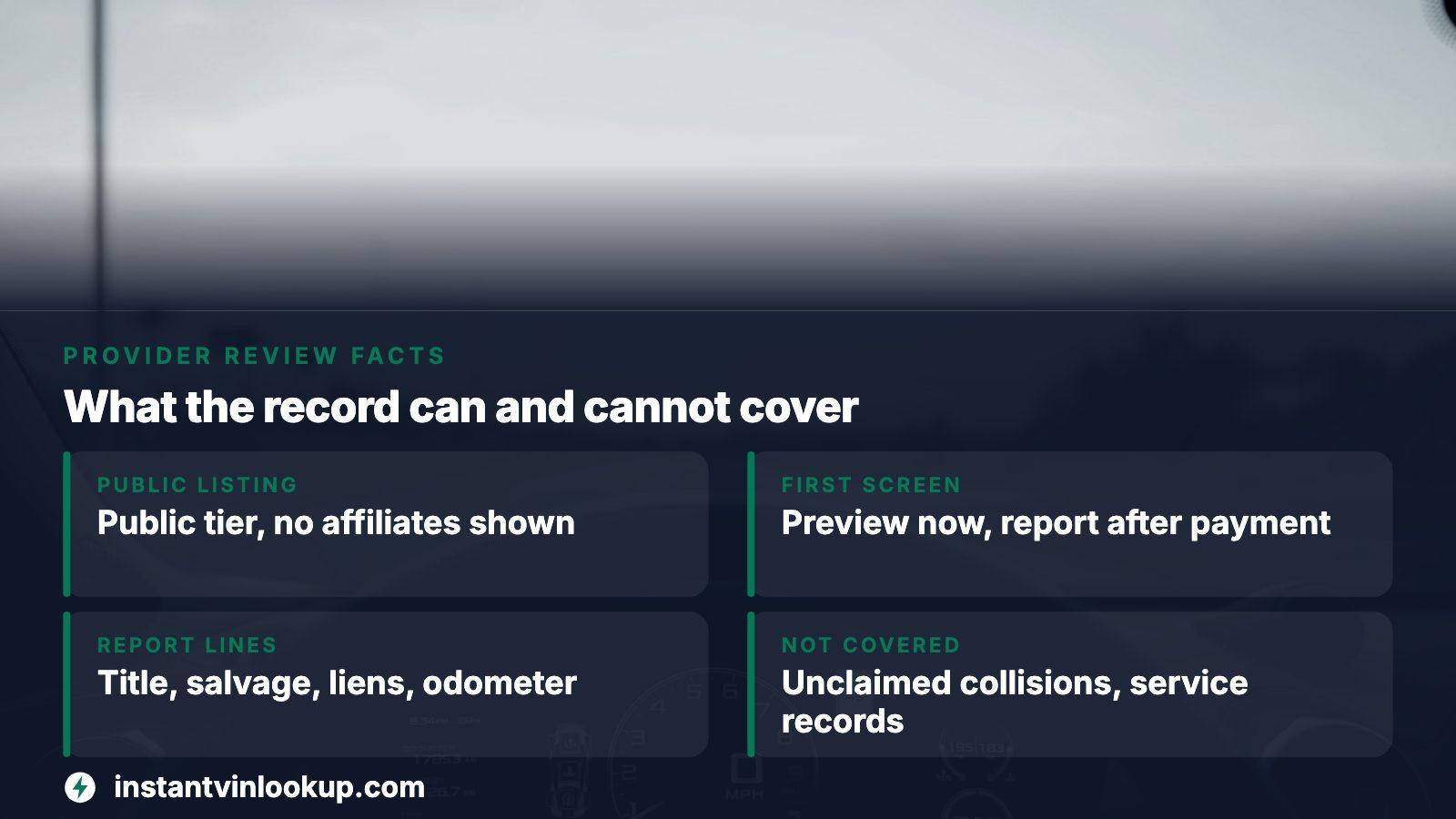
Every report built on the federal title record shares the same blind spots, and ClearVIN's refund rules admit as much: no refund for information it cannot reach, such as unreported accidents or title events from states that do not report into the system.
| What you want to know | What a title-record report can tell you |
|---|---|
| A salvage, flood or rebuilt brand | Yes, when a state applied it or an insurer or yard reported it |
| An insurer wrote the car off | Yes, even where no state brand followed |
| Mileage at each titling | Yes, one reading per title event |
| A collision fixed without a claim | No, it leaves no record |
| Oil changes and repairs | No, no government system collects them |
| Who owns it now | No, personal details are withheld |
Read a clean report as nothing found, which is different from nothing happened. A pre-purchase inspection covers the rest.
Three free screens to run before any paid report
The title record costs money to query, but the layers around it do not. Work through these in order, and some cars drop off the list before you spend anything.
- Decode the VIN with NHTSA's vPIC tool and confirm the build matches the seller's description.
- Run the same VIN through NHTSA's recall search and write down any open campaign.
- Check theft and insurer salvage flags with the NICB VINCheck screen.
- Buy the title record only for the cars still standing.
None of the first three is improved by a paid report, and a mistyped VIN is cheapest to catch at step one.
Reading the result against the car in the driveway
A report is a set of claims about one car, so test the claims against the car. Lay the PDF beside the title paper the seller shows you and go line by line.
- The title state on the report should match the paper, or the seller needs a clean explanation for the move.
- A brand in one state followed by a clean title in the next is the pattern called title washing. Stop and ask.
- Mileage that drops between two title events is a rollback signal, not a typo to excuse.
- A total-loss record with no brand calls for an inspector, not a discount.
- An open lien can stop the seller from passing you a clear title.
Auction photos deserve a few minutes too. Compare the damage in them with the panels and paint you can see.
ClearVIN next to Carfax: a title question or a history question
Searchers often set ClearVIN against Carfax as if they were rivals, but the Justice Department page files them in different groups. ClearVIN is in the group that serves the public. Carfax is listed with commercial-only providers, and its note says the federal data goes only to commercial customers in California. Carfax gathers service and reported-accident records from commercial sources, which is a separate dataset. Settle which question you are asking: a brand or a write-off points to the federal record, while maintenance points to a commercial report.
Where this site's lookup fits
This site is not ClearVIN, and this page is an independent review. Put a VIN into the lookup here and the free preview gives a first look at the car's records before you commit. The report that follows is a single payment covering brands, damage and crash entries, mileage readings, auction and salvage photos, liens, theft flags and open recalls. Nothing recurs, and the pricing page sets out the options.
Where this information comes from
- Department of Justice: NMVTIS approved providers — The public list where ClearVIN's tier, affiliate sites and the no-preference statement were read.
- ClearVIN: helpful information — The vendor's own description of its preview, report contents and refund terms, so these are its claims.
- NHTSA: vPIC VIN decoder — The free decode of factory build to run before any purchase.
- NHTSA: Recalls — The free open-recall lookup by VIN.
- NICB: VINCheck — The free theft and insurer salvage screen.
Sources and photos: Facts checked against the sources above in November 2026. Photos by Michal Biernat, Dimitri Karastelev and Dennis Eusebio on Unsplash; diagrams by InstantVINLookup.
Keep reading
- VIN Lookup: Check a VIN Number on a Car Before You BuyHow to find the number, test it and read the preview before you pay.
- NICB VIN Check: What the Instant Theft and Salvage Lookup ShowsRun the theft and salvage screen yourself and learn what a hit means.
- VinAudit Review: An Instant VIN Lookup, Judged on What It ShowsAnother approved provider, weighed on the same questions.
- Where Is the VIN Number? Find It in a Minute, Then Verify ItFind the VIN on the car so the number you search is the right one.
Frequently asked questions
Is ClearVIN legit?
The Justice Department's approved NMVTIS provider list includes ClearVIN, in the group serving commercial and public customers. That makes it a licensed route to federal title data, and the government page confirms it in a minute. Approval shows the data is genuine. It does not rate support or guarantee a result for any particular car.
Is a ClearVIN report free?
ClearVIN's help pages describe basic VIN details as a preview before payment and the full report as a paid step. No approved provider gives federal title data away, since each query carries a cost. The free layers sit elsewhere: NHTSA's decoder and recall lookup, and the NICB VINCheck screen, none of which ask for payment.
Does a ClearVIN report show accidents?
Partly. The title record captures damage that led to a brand or an insurer's total-loss declaration. ClearVIN also lists sale history and photos, which can show damage visually. A collision repaired without a claim usually leaves nothing, and ClearVIN's refund terms exclude unreported accidents for that reason. An inspection covers what paper cannot.
Can I get a refund on a ClearVIN report?
ClearVIN's help pages say refunds are available for internal errors, such as an empty report, a duplicate charge or a data discrepancy caused by its own database. You request one by email with the VIN and proof of the problem. Information ClearVIN cannot reach is excluded. Read the current terms on its site before paying, because policies change.
Is ClearVIN better than Carfax?
They sit in different groups on the Justice Department list. ClearVIN holds approval to sell federal title data to consumers, while Carfax is shown with commercial-only providers and a note limiting that data to California commercial customers. Carfax holds service and reported-accident records from commercial sources. Choose by question: title and write-offs, or maintenance.
Now check the car itself
The guide explains what to look for. The report shows what this VIN has on record.