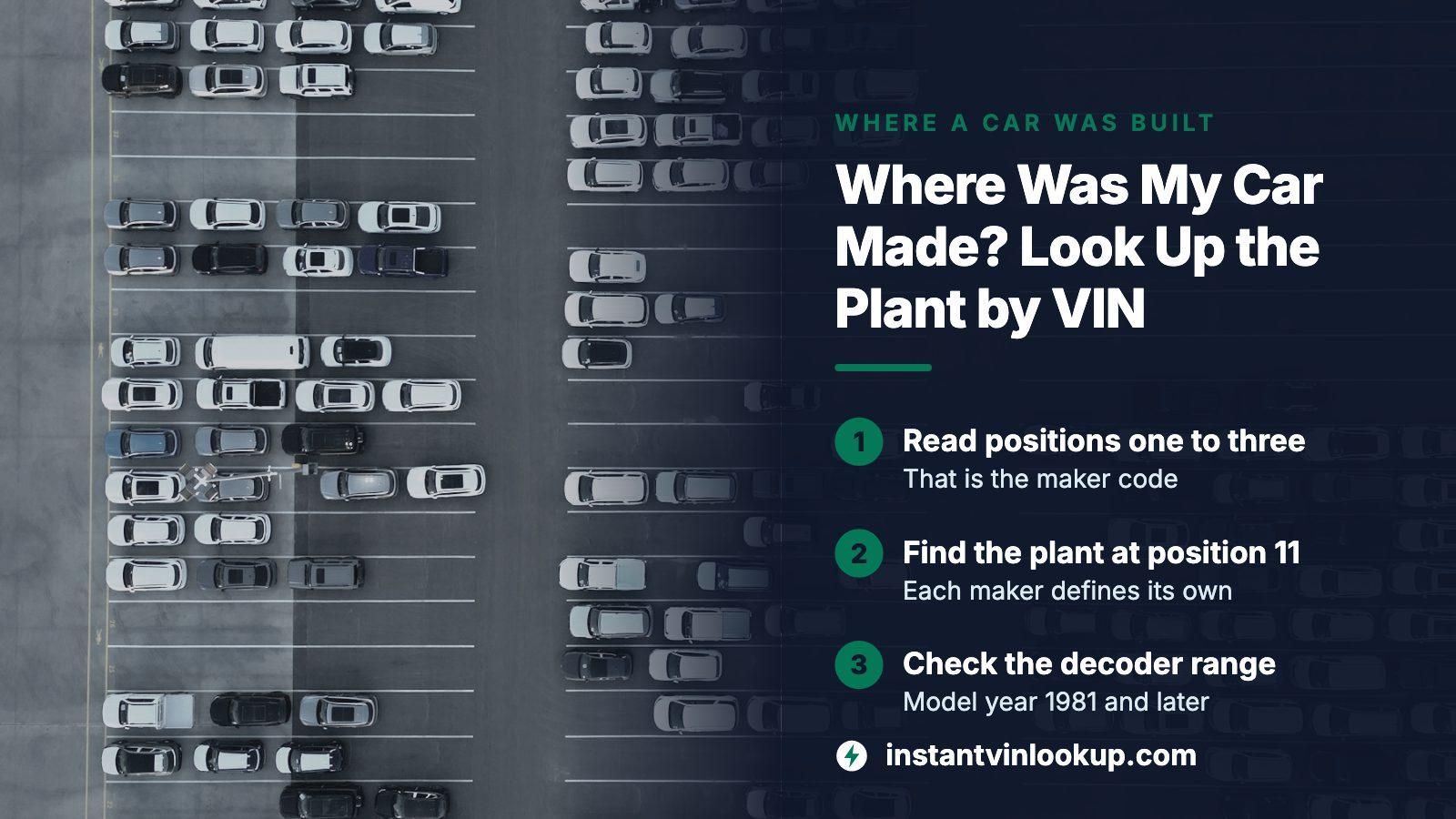
THE SHORT ANSWER
Enter all 17 characters into NHTSA's decoder and read the plant lines: city, state or province, country and company. They name the site where the maker affixed the VIN. In the number itself, the first three characters point to the maker and the eleventh is the plant code, a symbol each maker defines for itself. Never judge origin by the badge, because one brand builds the same model in several countries.
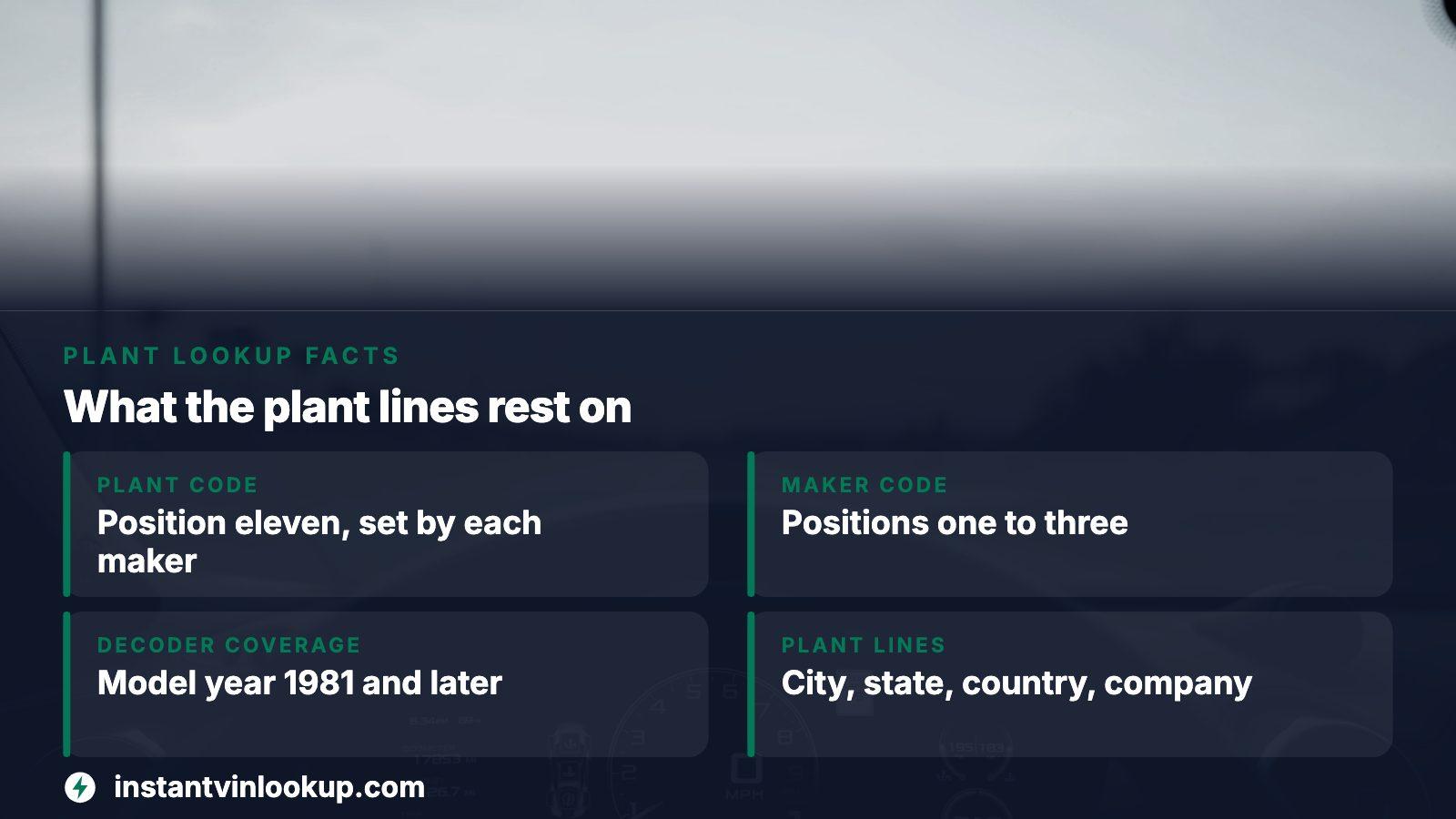
- Plant code
- Position 11, defined by each maker
- Maker code
- Positions 1 to 3
- Decoder coverage
- Model year 1981 and later
- Plant lines
- City, state or province, country, company
Run the lookup first and read four lines
Start with the whole number. Copy all 17 characters from the plate or label on the car itself, not from an advert, because the plant answer is only as good as the characters you feed in.
- Paste the VIN into NHTSA's vPIC decoder.
- Leave the model year box empty on the first pass. If you fill it in, the decoder ignores the year coded into the VIN.
- Scroll to the plant lines near the bottom: city, state or province, country and company.
- Hold those lines up against the listing, the seller's story and the door label.
The result lists the manufacturer on a separate line, so company and factory sit side by side. NHTSA's decoder costs nothing, and its data comes from the makers; the agency sends questions about a particular result back to them.

What each plant line actually describes
NHTSA's definitions are narrower than most readers assume. Each plant field describes the site where the manufacturer affixes the VIN. That is a good proxy for the assembly plant, but it speaks about where the number went on, not where every part was made.
| Result line | What it holds |
|---|---|
| Plant city | City of the plant that applies the VIN |
| Plant state | State or province within that country |
| Plant country | Country of that plant |
| Plant company name | Owner of that plant |
| Manufacturer name | The vehicle maker, on its own line |
Expect gaps. The Hyundai Sonata pattern 5NPE24AF*FH returned an Alabama plant and an owner's name but no city. A blank means nothing was on file, so lean on the door label instead.
Same badge, different countries: six decodes
A partial VIN with an asterisk for the check digit is enough, and NHTSA's decoder accepts it. These six came back from its API.
| VIN pattern | Decoded as | Plant returned |
|---|---|---|
| 5UXKR0C5*F0 | 2015 BMW X5 | Greer, South Carolina |
| 4JGDA5HB*FA | 2015 Mercedes-Benz ML-Class | Vance, Alabama |
| WDDGF8AB*EA | 2014 Mercedes-Benz C-Class | Sindelfingen, Germany |
| 1VWBN7A3*CC | 2012 Volkswagen Passat | Chattanooga, Tennessee |
| 3VWDX7AJ*CM | 2012 Volkswagen Jetta | Puebla, Mexico |
| KMHDH4AE*EU | 2014 Hyundai Elantra | Ulsan, South Korea |
Read down the last column. A BMW and a Mercedes-Benz turn up with plants in South Carolina and Alabama, while another Mercedes-Benz came from Germany. One Volkswagen is from Tennessee, the other from Mexico.
Change only position 11 and the plant moves
Rule 49 CFR 565.15 assigns the plant of manufacture to position 11, the second slot of the fourth section. It never says which character means which factory; each maker files its own key with NHTSA. To see how much that one character carries, a Honda Accord pattern, 1HGCR2F3*F, was run with all 33 allowed characters in the slot.
| Position 11 | Plant returned |
|---|---|
| A | Marysville, Ohio |
| C | Sayama, Japan |
| H | Alliston, Ontario, Canada |
| G | El Salto, Jalisco, Mexico |
| U | Swindon, United Kingdom |
Thirteen of the 33 returned a plant, across Ohio, Alabama, Indiana, Japan, Mexico, Canada and the United Kingdom. The letter carries meaning only through that maker's own table, so a chart lifted from one brand misleads on another. The decoder repeats whatever the table holds, so treat a named plant as a lead to confirm against the door label.
The first three characters: maker first, country as a hint
For a high-volume maker, those three alone name the builder and the type of vehicle. A low-volume maker leans on characters 12 to 14 as well. A 9 in third position tells a decoder the identifier is six characters long, so it needs more than the front of the number.
The rule itself lists no countries. In the decodes run for this guide, the leading character tracked the plant: 1, 4 and 5 went with United States plants, while a 2 meant Canada, a 3 Mexico, a K South Korea and a W Germany. Take that as a hint. NHTSA's own documentation sample, 5UXWX7C5*BA, starts with a 5 yet decodes to a 2011 BMW X3 with a Munich, Germany plant.
SAE International, under contract to NHTSA, hands these identifiers to U.S. makers at no charge.
Check the decode against the car's own labels
Hardware on the car can confirm or contradict a decode. The certification label fixed by the driver's door (49 CFR 567.4) must read Manufactured By and give the actual assembler's full name, plus the month and year work finished at the main assembly site. It is riveted or permanently fixed, so removing it destroys it.
- Door label: assembler name, build month and year
- Decoder: plant city, state or province and country
- New-car parts-content label: final assembly city and country, plus the countries of the engine and the transmission
The last one comes from 49 CFR 583.5 and applies to cars built from October 1, 1994. Dealers must keep it only until a retail sale, so a used car may no longer have it. Engine and transmission origin get their own lines there, so ask whether the original paperwork survives.
Built abroad is ordinary; privately imported is another case
NHTSA states that the decoder covers vehicles meant to be sold in, or imported into, the United States, that other vehicles return limited results, and that it targets model year 1981 and later. A car built to another country's specification and brought in on its own may therefore decode thinly.
Importers must keep the VIN the original maker assigned (49 CFR 565.14). When a Registered Importer certifies a car whose VIN falls outside the U.S. format, a plate in the passenger compartment reads Substitute for U.S. VIN and repeats the original number, placed so it covers nothing original. The importer's name then appears under the assembler's on the door label.
On an import, do three things
Take the original maker's number from the substitute plate, run it through the decoder, and ask to see the import paperwork. The plant says where the car was built, not how it came into the country.
Where the answer pays off in practice
- Parts: plants can supply different components, so give the counter the full VIN and the plant, not just year and model.
- Recalls: some are plant-specific, so check yours in NHTSA's recall lookup, entering the whole VIN.
- Specs: equipment varies by market, so an ad written for another market may describe a different build.
- Claims: a seller who names a country can be tested in a minute.
None of this costs anything: NHTSA's decoder and recall lookup are free.
What the plant cannot tell you, and the natural next step
A plant line describes the factory and nothing after it. No title brand, accident entry, mileage reading or lien appears there, because those records start once the car leaves the lot. A well-built car from any plant can still have been flooded, rebuilt or rolled back.
When you are weighing a particular used car, run its VIN through the preview on InstantVINLookup. It costs nothing and shows which kinds of record exist for that car. The report itself is a one-off charge for a single car, and shortlists can use a pack of 3, 5 or 10. Nothing renews, and today's rates are on the pricing page.
Order of operations
Decode the VIN first, since it takes a minute and shows whether the seller's story holds. Run the history preview second, before you travel to see the car.
Where this information comes from
- NHTSA vPIC: VIN decoder — partial VINs, the optional year box and where the plant lines appear in a result
- NHTSA vPIC: home page — coverage of vehicles intended for U.S. sale or importation, and model year 1981 onward
- NHTSA vPIC: API documentation — how the API decodes a VIN with an asterisk standing in for a missing character
- 49 CFR part 565: VIN requirements — positions 1 to 3, position 11, SAE's role and the substitute plate on imports
- 49 CFR part 567: certification label — what the door label must say about the assembler and the build date
- 49 CFR part 583: parts content labeling — the new-car label listing final assembly point, engine and transmission origin
Sources and photos: Facts checked against the sources above in November 2026. Photos by Iain, Anastasiia Nelen and Dennis Eusebio on Unsplash; diagrams by InstantVINLookup.
Keep reading
- Where Is the VIN Number? Find It in a Minute, Then Verify ItFind and read the number on the car before you decode it.
- VIN Lookup: Check a VIN Number on a Car Before You BuyHow to run the lookup and what a history report adds afterwards.
- Imported Car VIN Check: What an Instant Lookup Shows and MissesThe extra checks a car brought in from abroad calls for.
- Parts by VIN: Run the Instant Lookup Before You OrderHow the plant and the numeric tail change which part fits.
Frequently asked questions
How do I find out where my car was made?
Enter all 17 characters into NHTSA's decoder and read the plant city, state or province, and country. Then compare that with the door label, which names the assembler and the build month. If the two disagree, ask the seller why before going further.
Which character in the VIN shows the factory?
Position 11, which 49 CFR 565.15 calls the plant of manufacture. It is a code, and each maker defines its own letters, so one character can point to different factories on different brands.
Can I tell the country from the first character?
Only as a hint. In the decodes here a 3 went with Mexico, a K with South Korea and a W with Germany, yet NHTSA's own sample starting with 5 resolved to Munich. The plant lines settle it.
Why does the decoder show no plant for my car?
The plant lines are filed by the maker, and NHTSA says its data is aimed at vehicles meant for U.S. sale or import, model year 1981 onward. A blank means nothing was on file. Check the door label or ask the maker.
Does the plant show whether a car was imported privately?
No. It shows where the car was built, not how it arrived. Look for a plate reading Substitute for U.S. VIN, an importer's name on the certification label, and the import paperwork.
Now check the car itself
The guide explains what to look for. The report shows what this VIN has on record.