THE SHORT ANSWER
An imported car VIN check decodes the 17-character number and, once you buy the report, adds title brands, damage, odometer and recall records. A foreign-market chassis code instead returns errors and almost no data, which is itself a finding. No lookup shows Customs entry papers, the declaration that was filed or whether a bond was released. Lookup first, import documents second, inspection last.
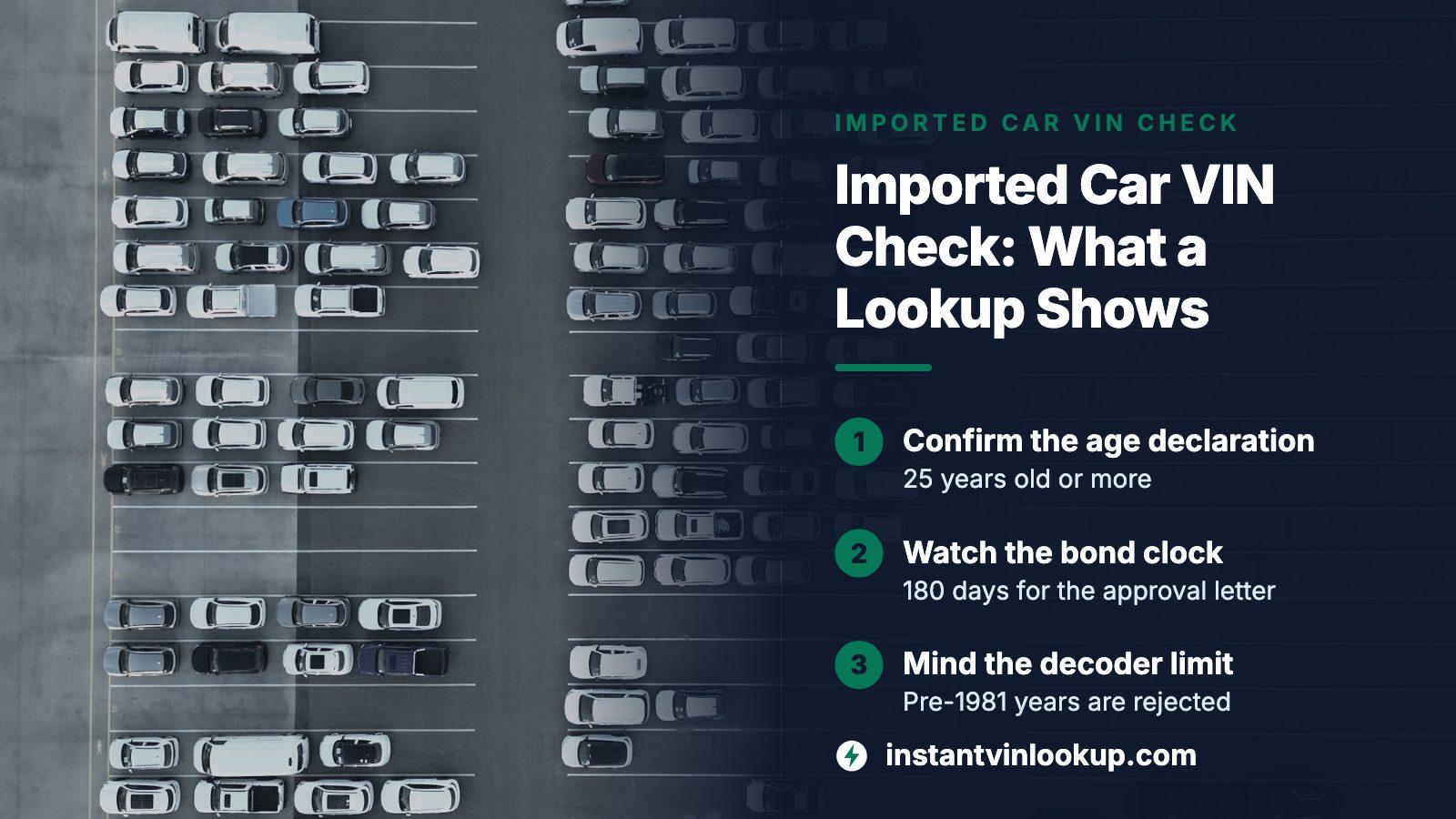
- Age declaration
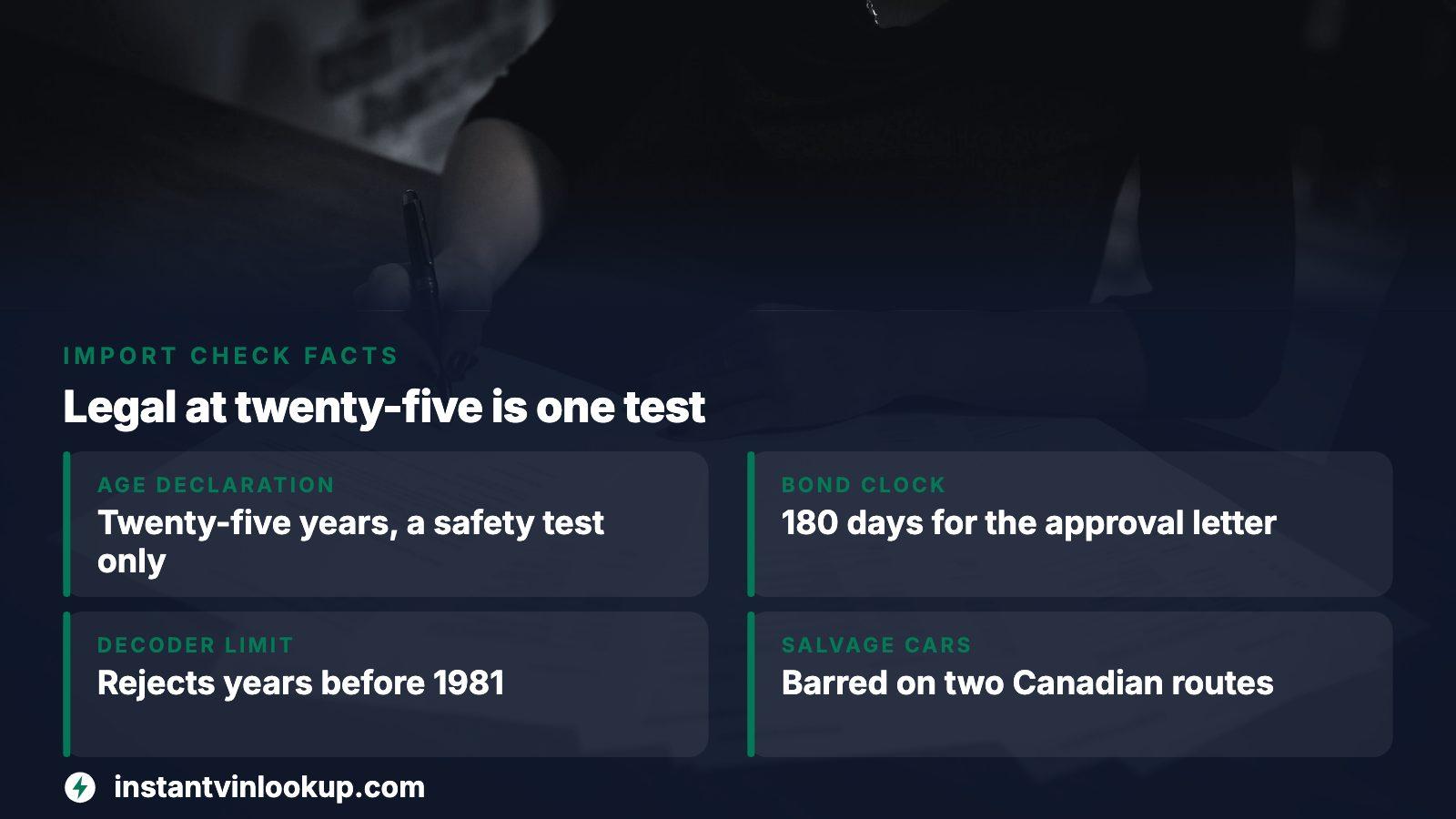
- 25 or more years old, an NHTSA test only
- Bond clock
- 180 days to get the approval letter to Customs
- Decoder limit
- Model years before 1981 are rejected
- Salvage cars
- Barred on the Canadian personal-use and bonded routes
What an instant lookup returns for an imported car
Speed is the strength of a lookup, so use it where it has an answer. Within seconds you learn who built the car, in which year and country, and the free preview shows how many records exist for it. How much that tells you depends on the kind of import.
| Car in front of you | What the lookup does | What it leaves open |
|---|---|---|
| 17-character VIN from a maker that sells in the U.S. | Decodes to make, year and plant country, and history records can attach to it | How this car was entered, and on which legal basis |
| Foreign-market chassis code, Skyline-style | Returns errors and no make or model | Everything, so get documents before any money moves |
| Car built before the 1981 model year | The federal decoder rejects the year | Build date and identity, which sit on the plate and in the papers |
| Canadian-certified car entered for personal use | Title brand and salvage records carry the most weight | The maker's certification and the entry papers |
Notice the pattern. The more foreign the car, the less the number can say, and the more weight falls on paper.
Running the check in four moves
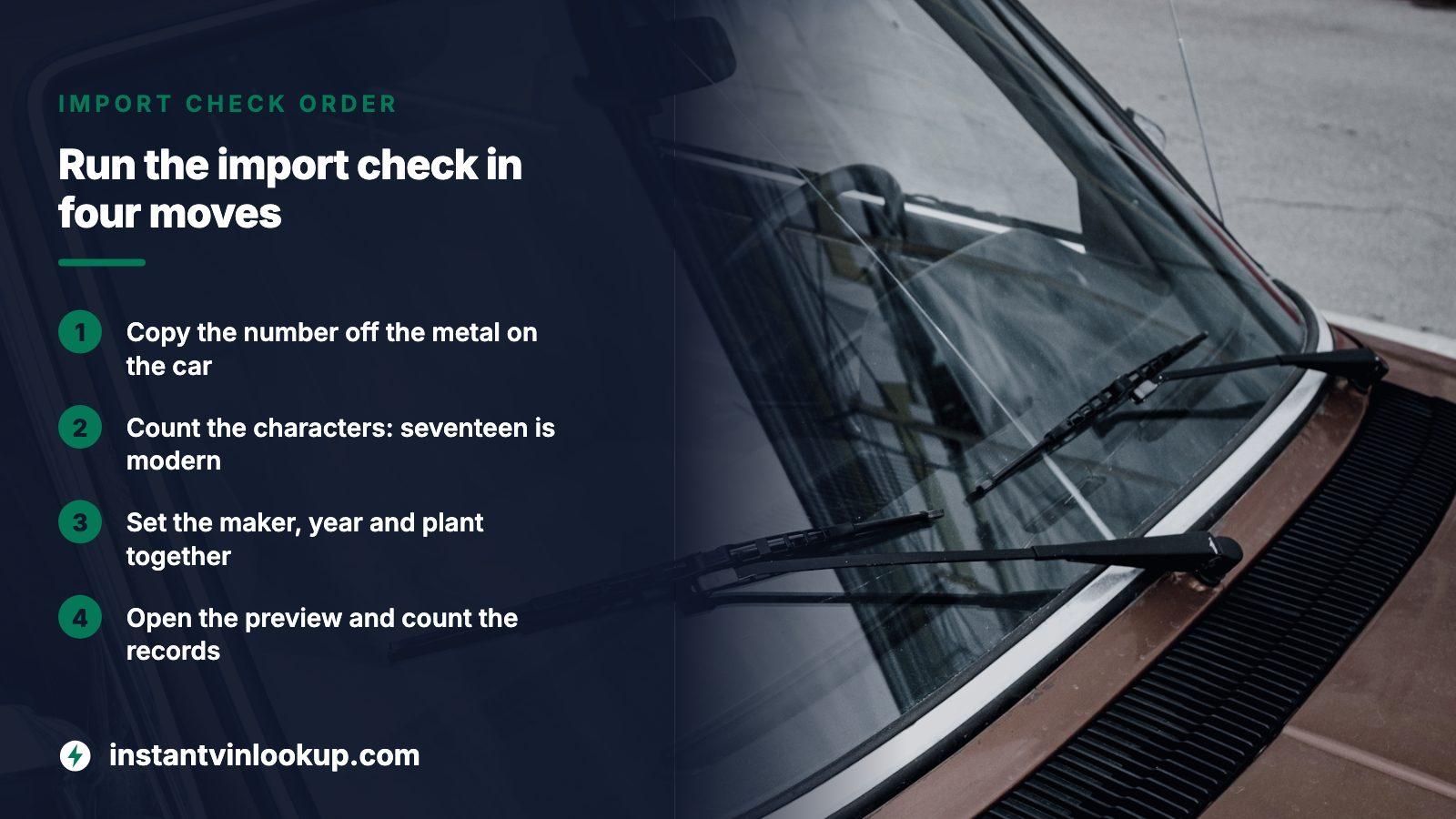
- Copy the number off the metal on the car, not the advertisement, and compare it with the title. Photograph both so you can type from the picture.
- Count the characters. Seventeen means the modern format. A shorter code with a hyphen belongs to another numbering system, and the federal decoder rejects codes of that shape.
- Run the decode and set the maker, year and plant country beside the listing. A car sold as one thing that decodes as another has already ended the conversation.
- Open the preview to see how many records exist. If records show up, buy the report and read the brand, damage, odometer and auction sections first.
Do all four from your sofa. A mismatch found before a long drive costs nothing; found in the driveway, it costs a day.
Reading a decoder error on a foreign-market car
The federal decoder is only as complete as the data manufacturers hand in. It takes partial numbers and lists the plant country. A Skyline-style chassis code sent to its data service on November 5, 2026 returned an incomplete-number error, a note that the maker has no NHTSA registration for U.S. sale, and no make or model.
Treat an empty decode as information, not a glitch. The number belongs to a vehicle the maker never registered for American roads, and no amount of retyping will change that.
A trap in the year box
A model year typed into the decoder replaces the year encoded in the number. On an import, leave that box empty and let the VIN speak for itself.
Why a brand or salvage entry weighs more on an import
Two import routes in 49 CFR 591.5 keep damaged cars out. A Canadian-certified car brought in for personal use must not be salvage, repaired salvage or reconstructed, and a car entered through a registered importer under bond faces a similar bar. So a salvage or rebuilt entry on a car that arrived by either route calls for a date comparison: when was it branded, and when did it come in?
Read the brand, auction and photo sections first, then the odometer entries in date order. Auction photos show the car as it sat, which helps you test the seller's story. If the earliest records start late, ask where the car spent its early years.
Date the brand against the entry
A salvage entry that predates the car's arrival is a puzzle for the seller to solve. One that follows a crash on this side of the border is ordinary history, priced like any other.
The federal NMVTIS consumer site targets title fraud and stolen-car resale, and says nothing about imports.
What only the paperwork can prove
Four questions sit outside every VIN database, and each has a document behind it.
| Question | Where the answer lives |
|---|---|
| Which legal basis was the car entered on? | The declaration filed at the border under 49 CFR 591.5, where each paragraph is a different theory |
| Was the conformity work signed off? | NHTSA's approval letter, sent to the port director |
| Was the bond cleared? | Proof that Customs cancelled the charge once that letter arrived |
| Does the EPA side hold? | A build date set against the fixed cut-offs, or the identity of the certificate holder behind an age exemption |
Timing explains the letter's weight. A car modified after entry gets 120 days to put a conformity statement in front of NHTSA, or 180 if NHTSA allows more time, and the importer promises not to sell or list it until NHTSA signs off. If the approval has not landed at the port by day 180, Customs sends a redelivery notice on Form 4647.
Registered-importer cars sit under a bond of 150% of dutiable value. A history report draws on title, auction and insurance records, not Customs files, so ask for copies.
Why legal at 25 years covers only one third of the question
- NHTSA, safety standards: the importer may declare that the car is 25 or more years old, and no further safety test applies at that agency.
- EPA, emissions: fixed manufacture dates, such as January 1, 1968 for light-duty gasoline vehicles, or an exemption for a car more than twenty OP years old that only a certificate holder can use.
- Customs, entry: a declaration filed with the entry and, for bonded cars, the 180-day deadline for the approval letter.
A rolling age against fixed dates
A rolling age sets NHTSA's line, while EPA's cut-offs sit on calendar dates decades old. Passing one says nothing about the other, and neither covers the entry paperwork.
Red flags on an import listing
- The decoder returns a different maker, year or plant country than the advertisement states.
- The seller hands over a state title but treats a request for entry documents as odd.
- The car is called exempt on age, yet nobody can say who filed the EPA report.
- A race, show or display import is now offered for road use. Those routes carry limits, and a racing car may not be registered or run on public roads.
- The owner says the car arrived on a temporary personal-use basis, which allows one year at most and no sale in that time.
- A recent entry is followed by a quick sale and a fresh title, with no approval letter in sight.
What the check costs and the next step
The preview comes first and carries no charge. Should the record count justify it, a report is a single payment per car, and bundles exist for anyone weighing several imports against each other. Figures sit on the pricing page.
For an import, the sensible order is lookup, then documents, then inspection. Buy the report when the preview shows records, read the brands and odometer entries first, and put the paperwork questions above to the seller in writing. A seller with a clean import has nothing to hide in producing them.
Where this information comes from
- eCFR: 49 CFR 591.5, declarations required for importation — the list of declarations an importer can file, including the age, Canadian-certified and bonded routes
- eCFR: 19 CFR 12.80, motor vehicles at entry — conformity statement timing, bond release and the redelivery notice
- eCFR: 40 CFR 85.1511, exemptions and exclusions — the EPA fixed dates, the certificate-holder route and limits on racing cars
- NHTSA: vPIC VIN decoder — what the federal decoder accepts, its pre-1981 limit and the year-box behavior
- NMVTIS: consumer vehicle history site — the federal title-record system's stated purpose
Sources and photos: Facts checked against the sources above in November 2026. Photos by Iain, Max Tokarev and Dimitri Karastelev on Unsplash; diagrams by InstantVINLookup.
Keep reading
- Where Was My Car Made? Read the Plant From Your VINPlant country is the first clue a decode gives about an import.
- Where Is the VIN Number? Find It in a Minute, Then Verify ItStart by reading the number off the vehicle, not the ad.
- NICB VIN Check: What the Instant Theft and Salvage Lookup ShowsA separate theft and salvage lookup to run alongside the decode.
- VIN Lookup: Check a VIN Number on a Car Before You BuyThe general lookup for any car, import or not.
Frequently asked questions
Does a VIN lookup reveal whether a car was imported?
Partly. The plant country in a decode shows where the car was built, and a foreign-market chassis code produces errors instead of a record. A lookup cannot say who imported the car, which declaration was filed or whether the bond was cancelled. Those answers live in the entry papers, so ask the seller for copies before you pay.
Does a clean state title prove an imported car is legal?
No. A title shows that a state agreed to register the car, not that Customs, NHTSA and EPA were all satisfied at the border. Ask which declaration was filed and, for a bonded conformity car, see the NHTSA approval letter. A title with no import documents behind it leaves the entry question unanswered.
How is a Canadian-certified car treated for personal import?
Under 49 CFR 591.5(g), the importer declares that the original manufacturer certified the car to Canadian standards and told NHTSA it meets the federal standards, with narrow exceptions for labeling and daytime running lamps. The car cannot be salvage, repaired salvage or reconstructed, so a brand on the report needs an explanation.
Can I decode a classic import from before 1981?
NHTSA's decoder rejects model years earlier than 1981, so rely on the chassis plate for the build date and on the paperwork for the rest. The date matters because EPA's fixed cut-offs run on when the car was originally manufactured, not on its model year.
Is an imported car VIN check free?
The full report is paid. Only the preview costs nothing, and it tells you whether the VIN decodes and how many records are on file. You pay per vehicle, with bundles for comparing several cars, and nothing recurs. The pricing page has the figures.
Now check the car itself
The guide explains what to look for. The report shows what this VIN has on record.