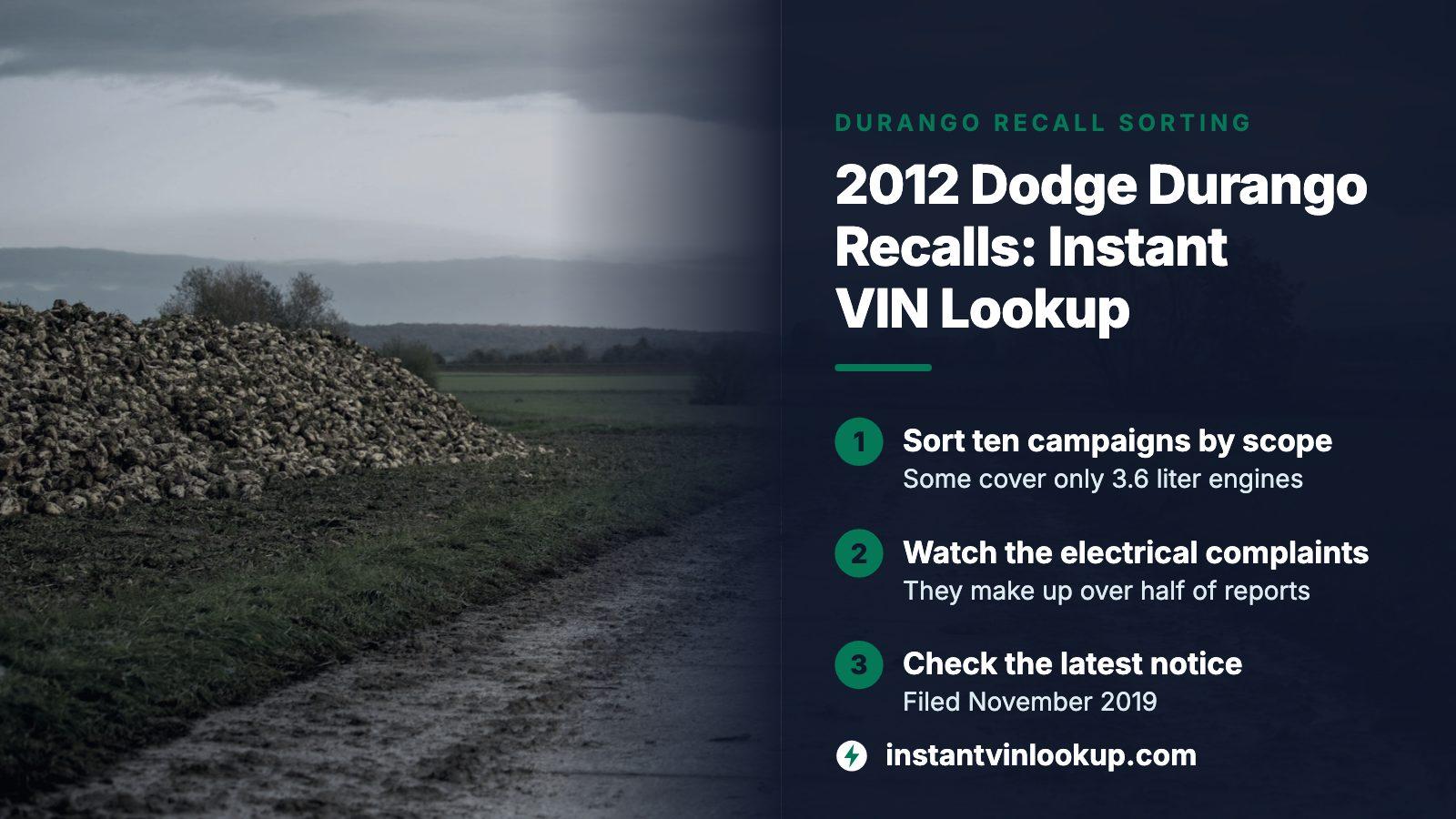
THE SHORT ANSWER
The 2012 Dodge Durango has 10 NHTSA recall campaigns: two on the brake booster, one on ABS software, one on bearing failure in early 3.6 liter engines, two on alternators, two on sun visor wiring and two on the fuel pump relay. Build dates, engine and earlier repairs decide which reach one vehicle, so the VIN settles it. The maker pays for the repair while the 15-year federal limit has not run out.
- Campaigns on file
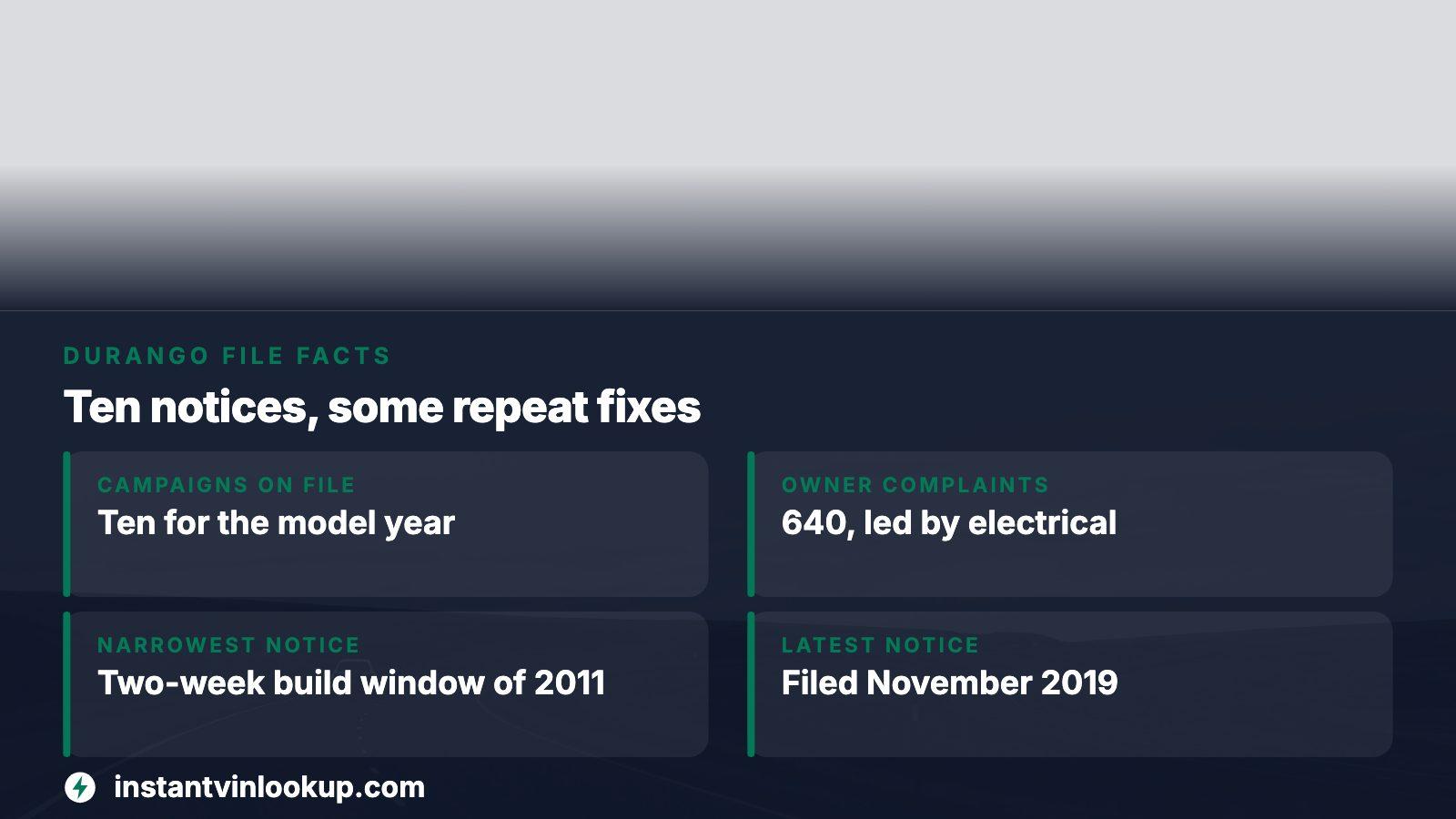
- 10 for the 2012 model year
- Owner complaints
- 640, led by electrical at 54%
- Narrowest campaign
- 11V487000, 3.6 liter engines built in a two-week window of 2011
- Latest notice
- 19V813000, filed November 2019
What an instant lookup does for one 2012 Durango
A listing says 2012 Dodge Durango. A VIN says which one: the build date, engine and repair history that decide whether any of ten campaigns reaches the vehicle. Type the 17 characters and the lookup answers in seconds, checking that single SUV against each notice.
The preview is free and shows which kinds of records exist for the VIN. The report adds odometer readings, damage entries and title brands, none of which a recall list holds. On a Durango with several owners, those can matter as much as any notice.
The ten campaigns and what a VIN has to match
Listed in the order they were filed. Any number can be pasted into NHTSA's recall search.
| Campaign | Fault | What the VIN must match |
|---|---|---|
| 11V487000 | Engine bearing failure, seizure risk | 3.6 liter, built August 31 to September 13, 2011 |
| 14V104000 | Hard brake pedal, ABS software update | Built October 11, 2011 to October 1, 2012 |
| 14V154000 | Booster corrodes, water can freeze inside | Built January 5, 2010 to September 8, 2013 |
| 14V391000 | Sun visor lamp wiring shorts after service | Built January 5, 2010 to December 11, 2013 |
| 14V634000 | Alternator can quit suddenly | 3.6 liter, 160 amp alternator, built April 22, 2010 to January 2, 2014 |
| 15V115000 | Fuel pump relay fails, engine stalls | 3.6 or 5.7 liter, built January 18, 2011 to August 19, 2013 |
| 15V879000 | Visor wiring again, repaired cars included | Built December 3, 2009 to September 1, 2012 |
| 17V435000 | Alternator failure, stall or short | 3.6 or 5.7 liter with electro-hydraulic steering, 160, 180 or 220 amp alternator |
| 17V572000 | Booster shield installed incorrectly | A Durango that already received the shield |
| 19V813000 | Relay trouble again, harness replaced too | Cars covered by the earlier relay campaigns, then by engine |
Three recalls that exist because an earlier fix fell short
A plain count hides a pattern. Visor wiring was recalled in 2014, then again in late 2015 for cars repaired under the first notice and for cars that skipped it. Brake boosters got a water shield in 2014, and a 2017 notice asked dealers to verify those shields. Fuel pump relays went from a swap in 2015 to a 2019 campaign that replaces the relay and its harness.
From an NHTSA owner complaint
An owner who filed in September 2015 said the visor wiring recall had been done the previous November. Two weeks before the incident, the Durango had been in for a starting problem, a tire sensor replacement and software updates. Smoke then rose from the driver's visor on the road. The owner and a toddler got out before flames started, and with a repair estimate near $20K the insurer totaled the SUV.
A completed repair opens the conversation instead of ending it. Ask what work followed, since the notice names later service as a trigger.
Reading the VIN off the SUV
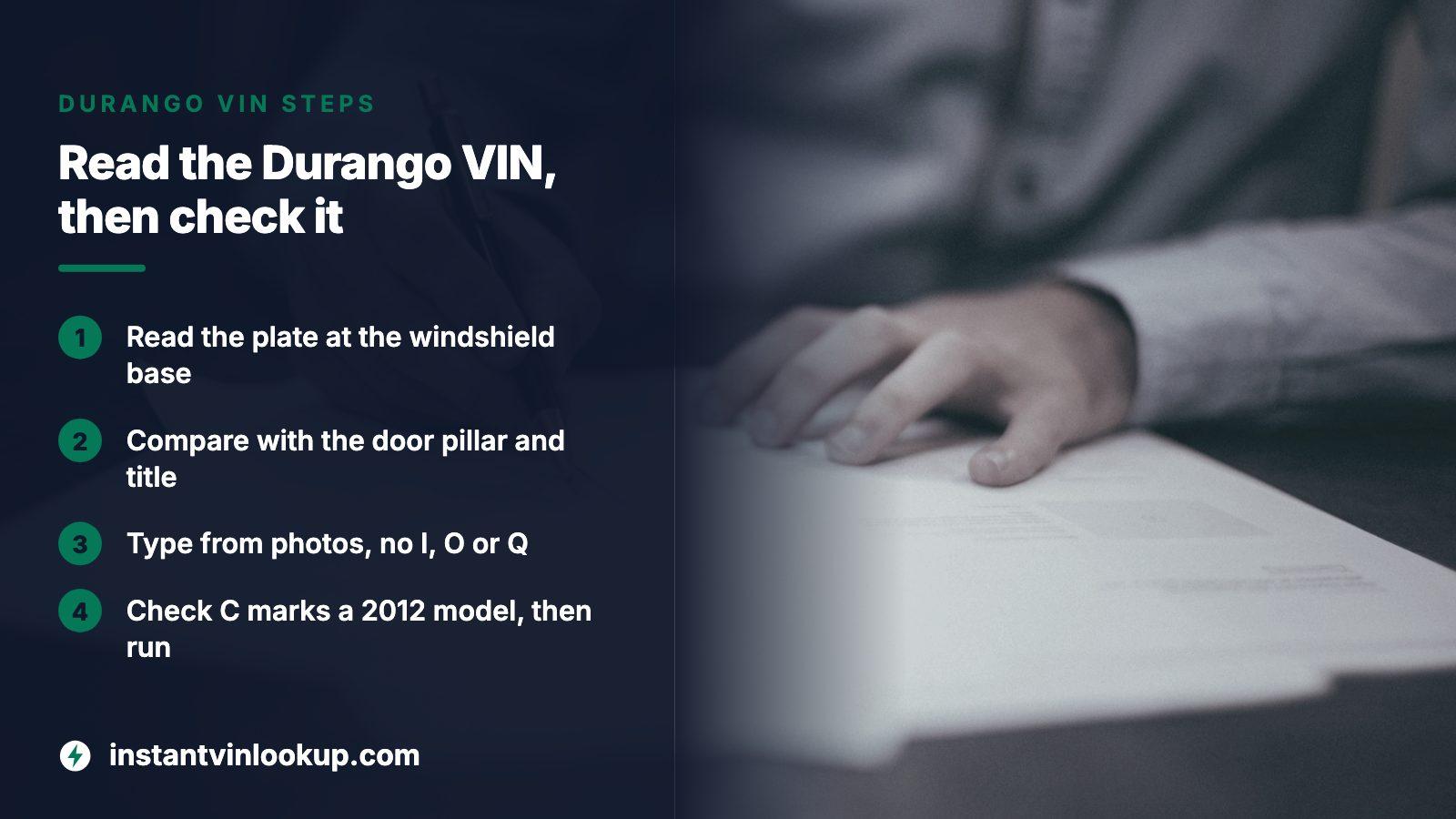
- Walk up to the Durango and read the metal tag at the driver's end of the dashboard top, visible from outside. Photograph it, because 17 characters are easy to misread.
- Then match it to the door-pillar label and to what the title paperwork shows. All three should read identically.
- Type from the photos. Neither I, O nor Q is ever used in a VIN, so anything that looks like one is a digit.
- Check the tenth character: C marks a 2012 model, which confirms the year before you trust a campaign list.
- Run the lookup, then read the preview before deciding on the report.
Open, completed, superseded or not listed
- Open: the campaign reaches this VIN and no repair is on record. Reach out to a Dodge service desk, supply both the VIN and the campaign number, and find out when parts are due in.
- Completed: a repair is recorded. For visor wiring and booster shields, ask for the work order, because each drew a second notice about the first repair.
- Superseded: 15V115000 is marked as replaced by 19V813000, so an older relay repair does not close the 2019 notice.
- Not listed: the VIN sits outside the dates, engine or earlier-repair conditions. That closes the campaign, not the symptom.
From an NHTSA owner complaint
In March 2017 an owner reported a brake booster that failed from corrosion, leaving the brakes working poorly. A booster recall existed for 2011 through 2014 models, yet the dealer said this VIN was not in it, even though the owner called it "the same problem as the recall."
A VIN outside the dates is a legitimate answer, but it does not repair a leaking booster. Test the brakes before agreeing on a price.
What owners file about, whatever the list says
NHTSA holds 640 owner complaints for this model year, and 347 of them, 54%, concern the electrical system. Engine follows with 141, fuel and propulsion with 89 and service brakes with 75. Of all filings, 32 flag a fire and 17 a crash. These are owners' descriptions, not findings.
Six of the ten campaigns are electrical, which fits the biggest complaint group. A complaint about a part is still not a campaign, though. A Durango built outside the dates can carry the same fault, as the booster owner found, so follow a clean lookup with a mechanic's check of the charging system and brakes.
How long the maker has to pay
A recall repair costs the owner nothing by statute, but the statute has an end date. Section 30120 of Title 49 lifts the maker's duty once 15 calendar years separate the first retail sale from the notice. The ten Durango campaigns were filed with NHTSA between 2011 and 2019, well inside that span.
A notice issued in the next year or two could find a 2012 Durango at or past the limit. Some dealers do the work anyway, so ask first.
What the lookup costs
Entering the VIN and reading the preview costs nothing. NHTSA's own recall search is also free and takes a VIN, so paying is about the rest: the title, damage, odometer and ownership entries behind the SUV. A Durango report is charged once per VIN, and a bigger pack, sized 3, 5 or 10 reports, covers anyone weighing several of them. There is no recurring fee, and prices appear on the pricing page.
What to do once the result is in
- List every campaign marked open, with its number.
- Phone a Dodge service department with the VIN and ask how long the part takes before you book.
- Request repair orders for anything marked completed, starting with the visor wiring and the booster shield.
- Read the title, damage and odometer entries, which a recall list never covers.
- Pay a mechanic to test the charging system, the brakes and the fuel pump relay before money changes hands.
From an NHTSA owner complaint
An owner filing in June 2025 took a Durango to a dealer in Albany, Georgia for the booster shield recall and a second one. Only one got done, since the shield part was a year out, and the owner worried about driving that long with the brake recall open.
Ask about parts supply before you buy, and price in a repair that may have to wait.
Where this information comes from
- NHTSA: Recalls — The federal search where each campaign number above can be matched to a VIN.
- U.S. Code: 49 U.S.C. 30120, remedies for defects — The statute that puts the repair cost on the maker and sets the 15-year cutoff.
- NMVTIS: National Motor Vehicle Title Information System — The national title record, which holds brands the recall file does not.
- NHTSA owner complaint 10775346 — owner experience, paraphrased
- NHTSA owner complaint 10957740 — owner experience, paraphrased
- NHTSA owner complaint 11669862 — owner experience, paraphrased
Sources and photos: Facts checked against the sources above in November 2026. Photos by Andrew Dawes, Scott Graham and John Kakuk on Unsplash; diagrams by InstantVINLookup.
Keep reading
- VIN Lookup: Check a VIN Number on a Car Before You BuyHow the lookup and its preview work for any vehicle, not only this SUV.
- Where Is the VIN Number? Find It in a Minute, Then Verify ItOther places a VIN is stamped if the dash strip is hard to read.
- NHTSA Investigation Check: Look Up a Model, Then Run the VINNHTSA also tracks investigations touching this model year, and this explains how to read one.
- 2013 Ford Explorer Recalls: 12 Campaigns and an Instant VIN LookupA common rival when shopping for a three-row SUV of this age, with its own campaign list.
Frequently asked questions
Which recalls apply to a 2012 Dodge Durango?
For this model year NHTSA shows 10 campaigns: three on brakes, one on the engine and six on electrical parts. A given Durango is usually named in only some, because build dates, engine size and earlier repairs decide, and the VIN carries all three.
Are the two fuel pump relay recalls the same thing?
No. Campaign 15V115000 moved the relay outside the power module. Campaign 19V813000 followed in 2019 for cars from the earlier relay actions and replaces the relay with its harness. A completed 2015 repair does not clear the later notice.
Can I check Durango recalls without the VIN?
Not reliably. Most campaigns turn on build dates, engine size or an earlier repair, so two 2012 Durangos from one lot can return different results. Year, make and model alone give the full list of ten.
Will a dealer still fix a 2012 Durango recall at no charge?
For campaigns inside the federal limit, yes, the maker pays. Section 30120 ends that duty once 15 calendar years pass after the first retail sale. Parts supply is a separate problem: one owner reported a wait of about a year for a booster shield.
What do I see before paying for the full report?
The preview is free and shows which kinds of records exist for the VIN, so you can judge whether a report is worth buying. A report for that VIN is billed once, or buy a 3, 5 or 10 report pack, and nothing renews.
Now check the car itself
The guide explains what to look for. The report shows what this VIN has on record.