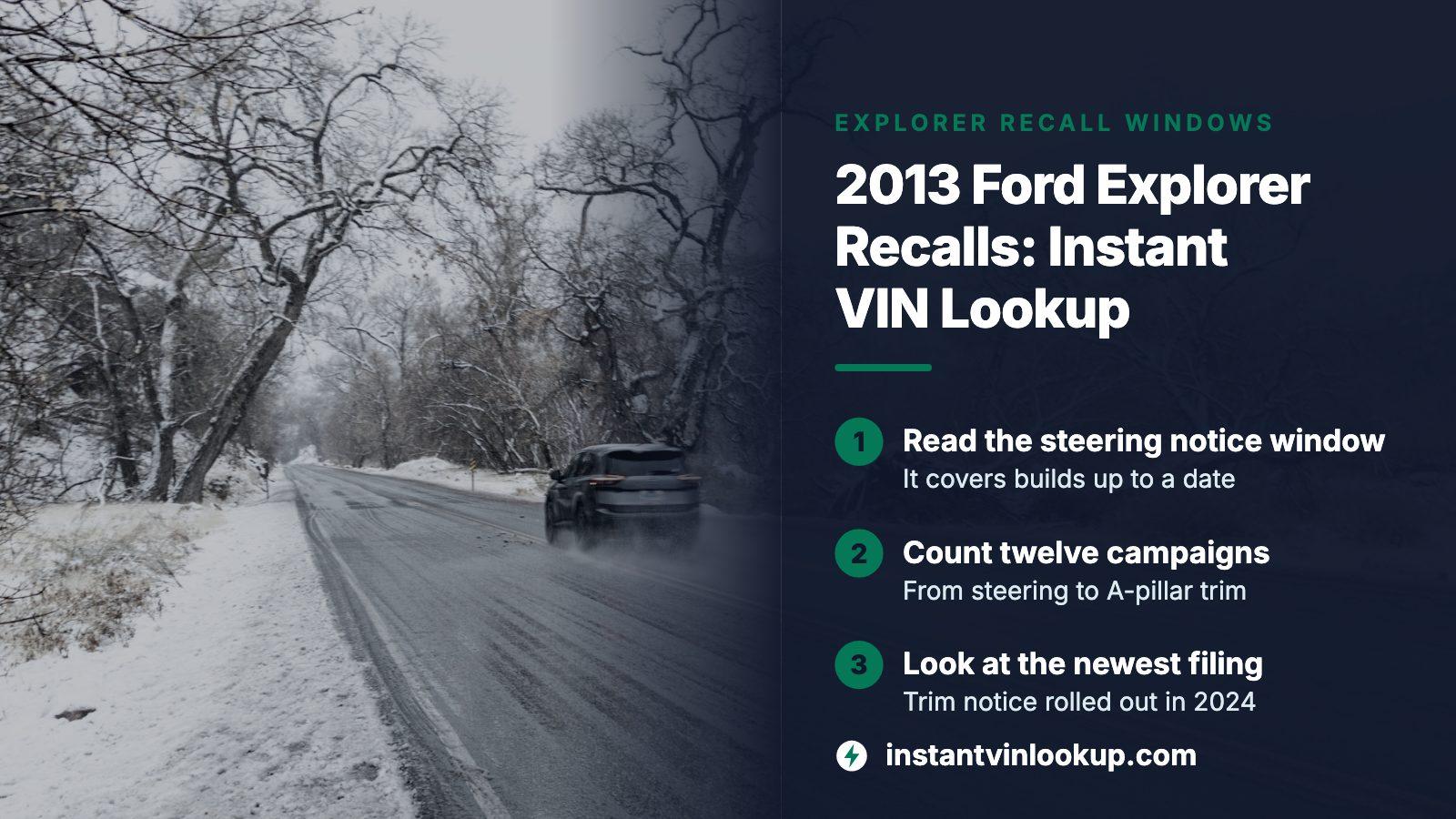
THE SHORT ANSWER
Twelve campaigns are filed against the 2013 Explorer. Four are rear suspension notices and three involve the fuel tank or fuel delivery module, so the list leans toward parts that hurt when they fail. What is open differs from SUV to SUV: the steering notice ends with cars assembled in February 2012, and some others apply only to listed states. A VIN lookup shows which of the twelve are still outstanding on the Explorer in front of you.
- Campaigns listed
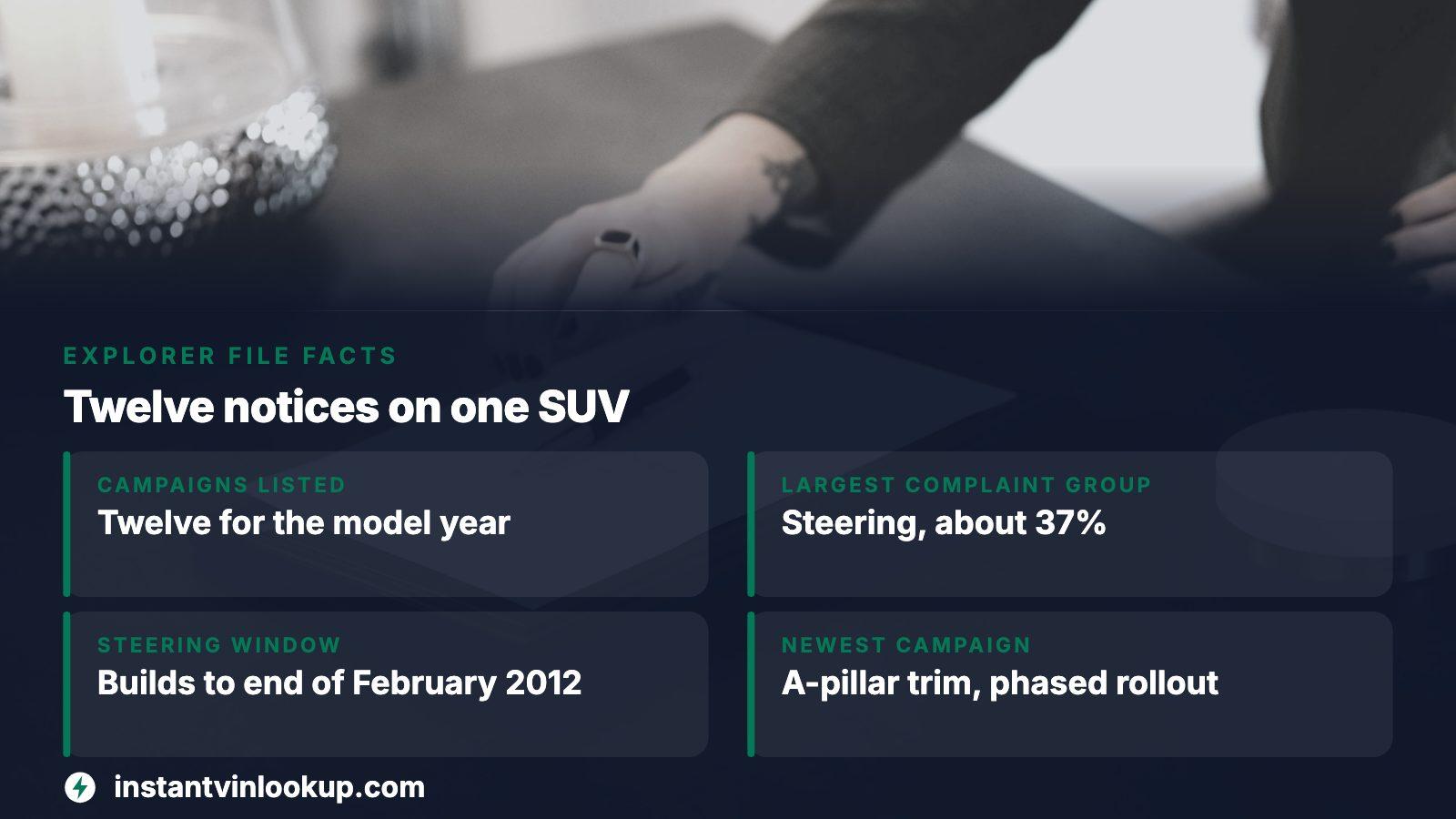
- 12 for the 2013 model year
- Largest complaint group
- Steering, 834 reports or about 37%
- Steering notice window
- 14V286000 covers builds up to the end of February 2012
- Newest campaign
- 24V031000, A-pillar trim, rolled out in phases
The twelve notices in plain words
Ford's campaigns on this model year fall into a few families. Paste any number into NHTSA's recall search to read the full notice.
| Campaign | Part | What can go wrong |
|---|---|---|
| 13V109000 | Fuel tank | Marginal seam may leak and weaken the tank |
| 13V227000 | Fuel delivery module | Cracked module may leak fuel |
| 13V270000 | Child locks | Can slip to off with no warning |
| 14V286000 | Electric power steering | Assist can shut down |
| 15V171000 | Interior door handles | Return spring may unseat |
| 15V812000 | Fuel delivery module | Cracked module may leak fuel |
| 17E048000 | Rear hub bearing, a service part | Wrong application on 4X2 cars |
| 19V435000 | Rear toe links | Link may fracture |
| 20V675000 | Rear toe link | Outboard section may fracture after an earlier repair |
| 21V537000 | Rear toe link | Road salt corrosion seizes the ball joint |
| 21V746000 | Rear toe link | Replacement ball joint may seize, listed states |
| 24V031000 | A-pillar trim | Clips may not hold, trim can detach |
The hub bearing entry is an equipment recall about a service part listed for the wrong axle, so ask whether anyone ever swapped a rear hub on a 4X2 Explorer.
How a build date can take a notice off one Explorer
The steering notice, 14V286000, applies to Explorers assembled between May 17, 2010 and February 28, 2012. One built later in the 2013 run falls outside it, although steering is where owners lodge the most complaints. The fuel module notice 15V812000 is worded for several other Ford and Lincoln models too, so the VIN gets read against that language as well.
From an NHTSA owner complaint
A filing from May 2026 describes power steering assist cutting out mid-drive, the wheel stiff at low speed, and lane keeping warnings lighting up together. The owner paid for a new battery to rule out a voltage fault, and a dealer then pointed at the steering module or gear. By the owner's account the SUV was assembled in June 2012, the steering notice was said to exclude it, and the repair was priced at $4,500.
That is one unverified account, but it shows what a build date does at a service desk. Run the VIN before you buy, so a steering fault does not arrive as a bill that no campaign covers.
Getting the VIN into the box without a typo
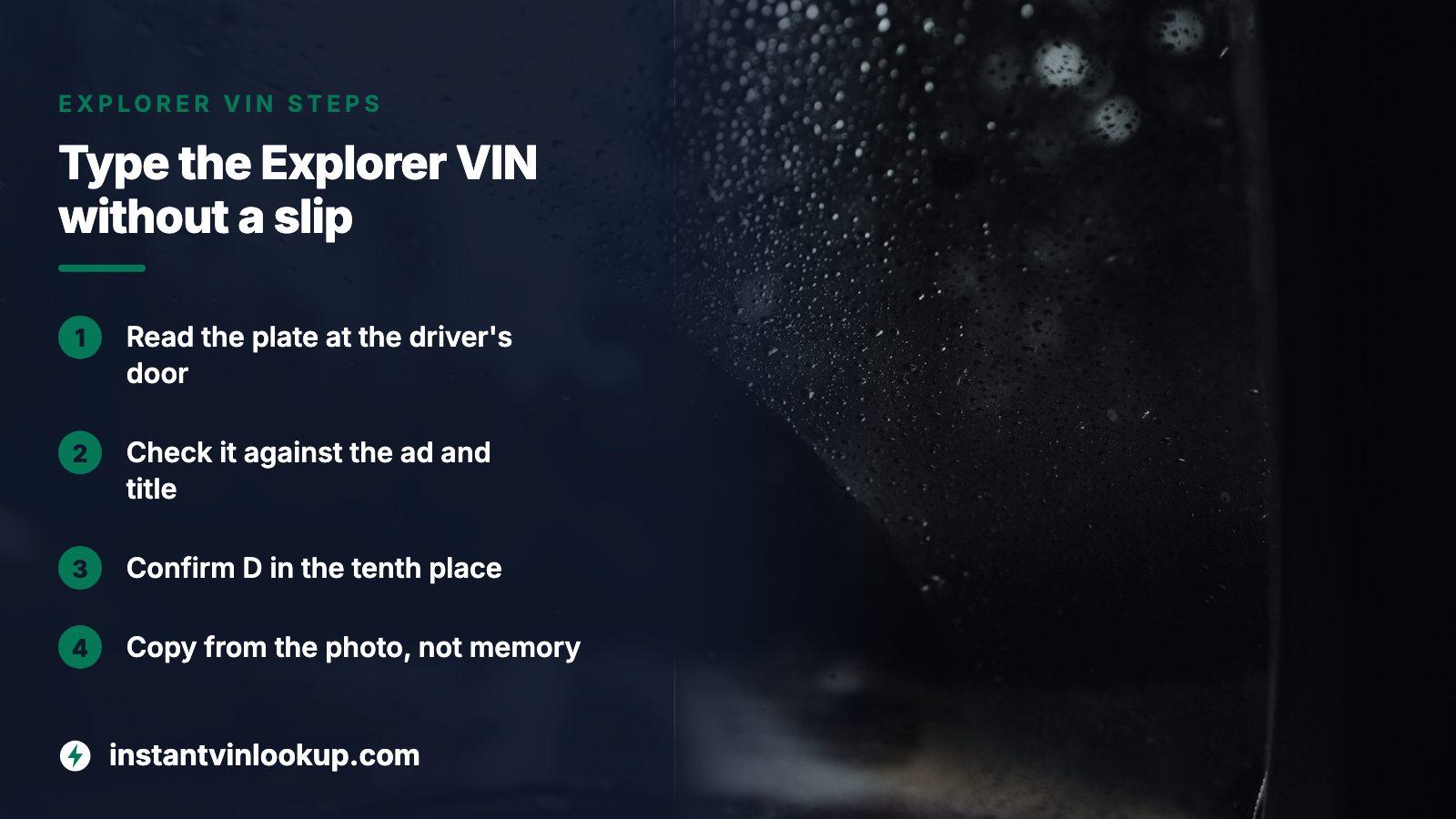
- Begin at the driver's door and read the number from the plate seen through the glass at the dash corner. A label on the door edge repeats it. Photograph one.
- Check it against the ad and the title paperwork. Any disagreement is your first finding, so write it down.
- Character ten encodes the model year, and D means 2013. Anything else tells you the listing's year is wrong.
- Copy from the photo, not from memory. No VIN uses I, O or Q, since they pass for 1 and 0, so a doubtful character is a numeral.
The lookup needs only those seventeen characters. It reads that exact SUV against each campaign's wording and answers in seconds.
Open, done, not listed, or open with no part yet
- Open: a notice reaches this VIN and no repair is on record. Phone a Ford dealer with the VIN and ask for a date, since parts and appointments vary.
- Done: ask for the work order. A car repaired under an early toe link notice can still fall under a later one, so learn which paperwork belongs to which campaign.
- Not listed: the VIN falls outside a build window or a state list, so that notice is closed for this car. The part can still wear out.
- Open with no part yet: the notice applies but the remedy has not shipped, which is where the newest campaign sits.
From an NHTSA owner complaint
The notice for 24V031000 had already reached one owner, yet the repair part had not been released when the passenger-side A-pillar trim came loose on the road. A local dealer confirmed the failure. The filing puts the incident in January 2024 and was lodged in October 2026, with the owner saying Ford had taken far too long.
An open entry can sit for months with nothing to book. Ask the dealer whether the part is shipping for your VIN before you count the repair as coming.
Four notices on one rear part
The rear toe link appears in 19V435000, 20V675000, 21V537000 and 21V746000. The first warns that stress on the rear suspension can fracture a link, which changes handling suddenly. The second reaches cars already repaired once, where the outboard section of the link may still break. The last two blame a seized ball joint, one through road salt corrosion and one through a replacement joint.
- Ask which toe link campaign the seller's repair belonged to, and whether the knuckle was replaced.
- Ask where the SUV has spent its winters, since salt is the stated trigger in one notice.
- Have a mechanic raise the car and look at both rear links and ball joints.
What the complaint file adds
Recalls are defects Ford has admitted to. Complaints are owners' reports that nobody has checked. For this model year steering draws the most, 834 reports or about 37%, ahead of structure at 436, engine at 224 and the electrical system at 163.
- Owners filed 44 crash reports, 11 fire reports and 61 injury reports, all in their own telling.
- NHTSA also lists 6 investigations touching the model year, an early signal that may end in nothing.
- Only one campaign addresses steering, and it has a build window, so a clean lookup says little about that system.
- Treat these as a reason to test the steering on a drive and ask for repair records.
How long Ford has to pay for the repair
Federal law, 49 U.S.C. 30120, makes Ford pay for recall repairs, with a time limit. The duty falls away for any car whose first retail sale came over 15 calendar years ahead of a campaign's announcement. Every one of the 12 Explorer notices was announced inside that span, so none has aged out. The margin narrows each year, and a campaign announced later may carry no right to a no-cost repair. Some dealers do the work regardless, so get an answer before you buy.
The cost of a lookup and what to do with the answer
The preview costs nothing and lists the kinds of records held for the VIN. Open recalls sit in the full report beside title brands, damage, odometer readings and use type. A report is billed once per VIN, with no subscription, and packs of three, five or ten suit a longer shortlist. Amounts are on the pricing page. Use type is worth reading here, because the fuel module notice names a Police Utility version of the Explorer.
- Write down every campaign marked open, with its number.
- Call a Ford service desk and ask whether the part is in stock before booking.
- Request work orders for anything marked done.
- Read the title, damage, odometer and use type entries that a recall list leaves out.
- Pay a mechanic to inspect the rear links, the steering and the fuel lines, then settle the price.
Where this information comes from
- NHTSA: Recalls — The federal search where each campaign number above can be matched to a VIN.
- U.S. Code: 49 U.S.C. 30120, remedies for defects — The statute that puts the repair cost on the maker and sets the 15-year cutoff.
- NHTSA: Ratings — The federal crash-test program behind the star results quoted in the answers.
- NMVTIS: National Motor Vehicle Title Information System — The national title record, which holds brands the recall file does not.
- NHTSA owner complaint 11738002 — owner experience, paraphrased
- NHTSA owner complaint 11769807 — owner experience, paraphrased
Sources and photos: Facts checked against the sources above in November 2026. Photos by Zoshua Colah, Justin Cron and Annika Wischnewsky on Unsplash; diagrams by InstantVINLookup.
Keep reading
- VIN Lookup: Check a VIN Number on a Car Before You BuyHow the lookup and its preview work for any vehicle, not only this SUV.
- Where Is the VIN Number? Find It in a Minute, Then Verify ItA closer guide to finding the plate and sticker when the VIN is hard to read.
- NHTSA Investigation Check: Look Up a Model, Then Run the VINNHTSA logs investigations on this model year too, and this shows how to read one.
- 2012 Dodge Durango Recalls: Instant VIN Lookup for Each CampaignA three-row SUV from the same era, with its own campaign list to compare.
Frequently asked questions
How many recalls are on file for the 2013 Ford Explorer?
The federal list shows 12 campaigns for the 2013 model year, numbered from 13V109000 to 24V031000. A single Explorer sits under only some of them, because build dates, states and earlier repairs narrow each notice. The VIN shows which ones are open on the SUV you are considering.
Can I look up Explorer recalls without the VIN?
Year, make and model return the full list of 12, and most searches stop there. That list cannot say which notices reach one car. NHTSA runs its own VIN search, and an instant lookup here adds title, damage and odometer entries once the free preview has convinced you.
Does the steering recall cover every 2013 Explorer?
No. Campaign 14V286000 reaches only Explorers assembled in a window that closes at the end of February 2012. The remedy is new software for the steering control module, plus a replacement steering rack when a car has a record of the position signal dropping out.
Is the 2013 Ford Explorer a safe SUV?
In NHTSA crash testing it earned five stars overall, five in frontal and side impacts, and four for rollover resistance. A rating describes the tested configuration. It cannot speak for a used example that has been wrecked or poorly repaired.
What do I see before paying for the full report?
The free preview lists the kinds of records held for the VIN, enough to judge whether a report is worth buying. The report itself is a single payment for that VIN with nothing to renew. The pricing page carries the amounts for one report and for packs.
Now check the car itself
The guide explains what to look for. The report shows what this VIN has on record.