THE SHORT ANSWER
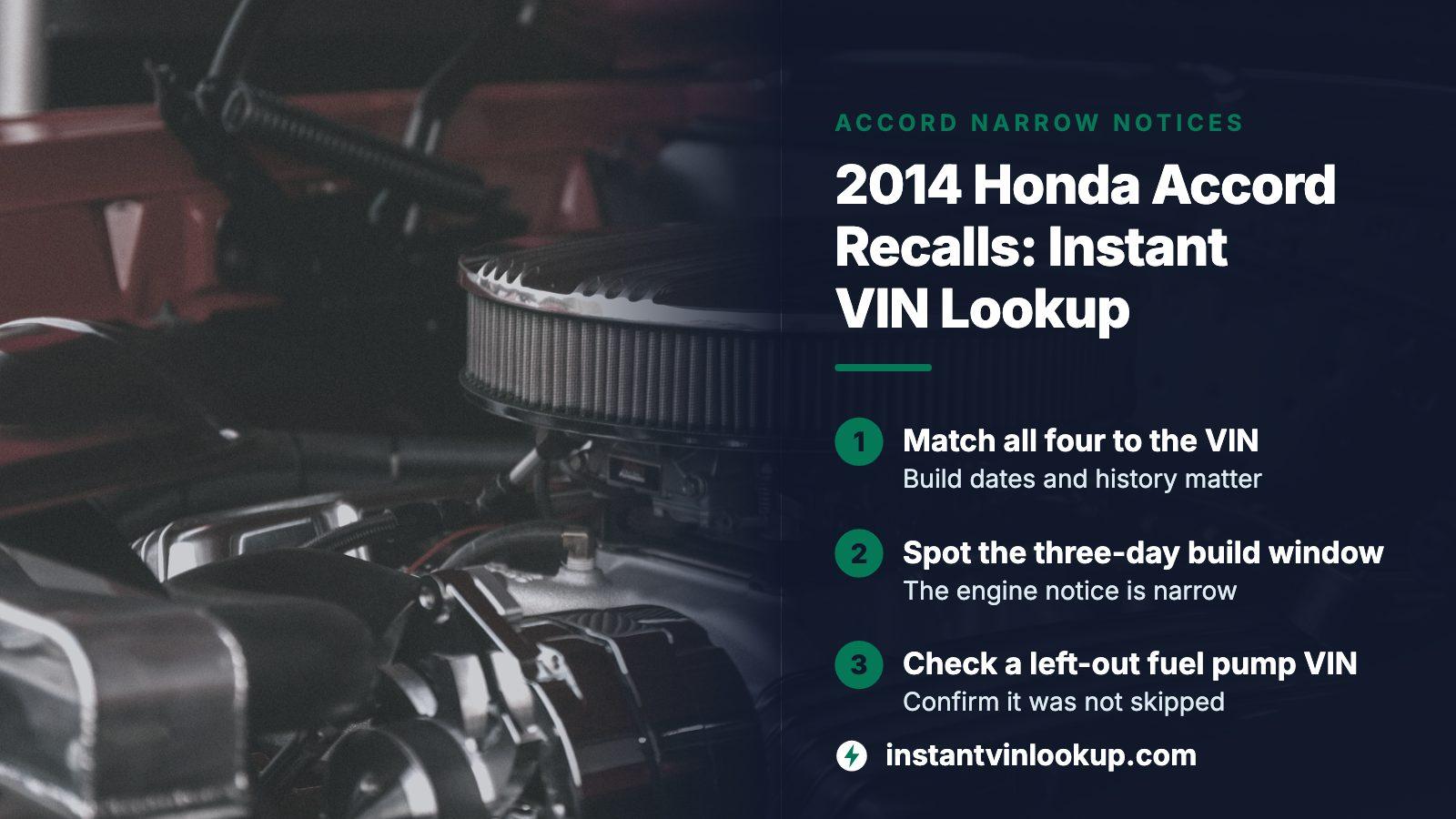
The 2014 Honda Accord has 4 campaigns on NHTSA's model-year list. The battery sensor notice spans several model years, the engine notice covers a three-day build window, the driveshaft notice depends on engine, transmission and registration history, and the fuel pump notice spans many Honda and Acura models. Type the VIN to see which ones are open on that exact car. Honda pays for the repair at no charge.
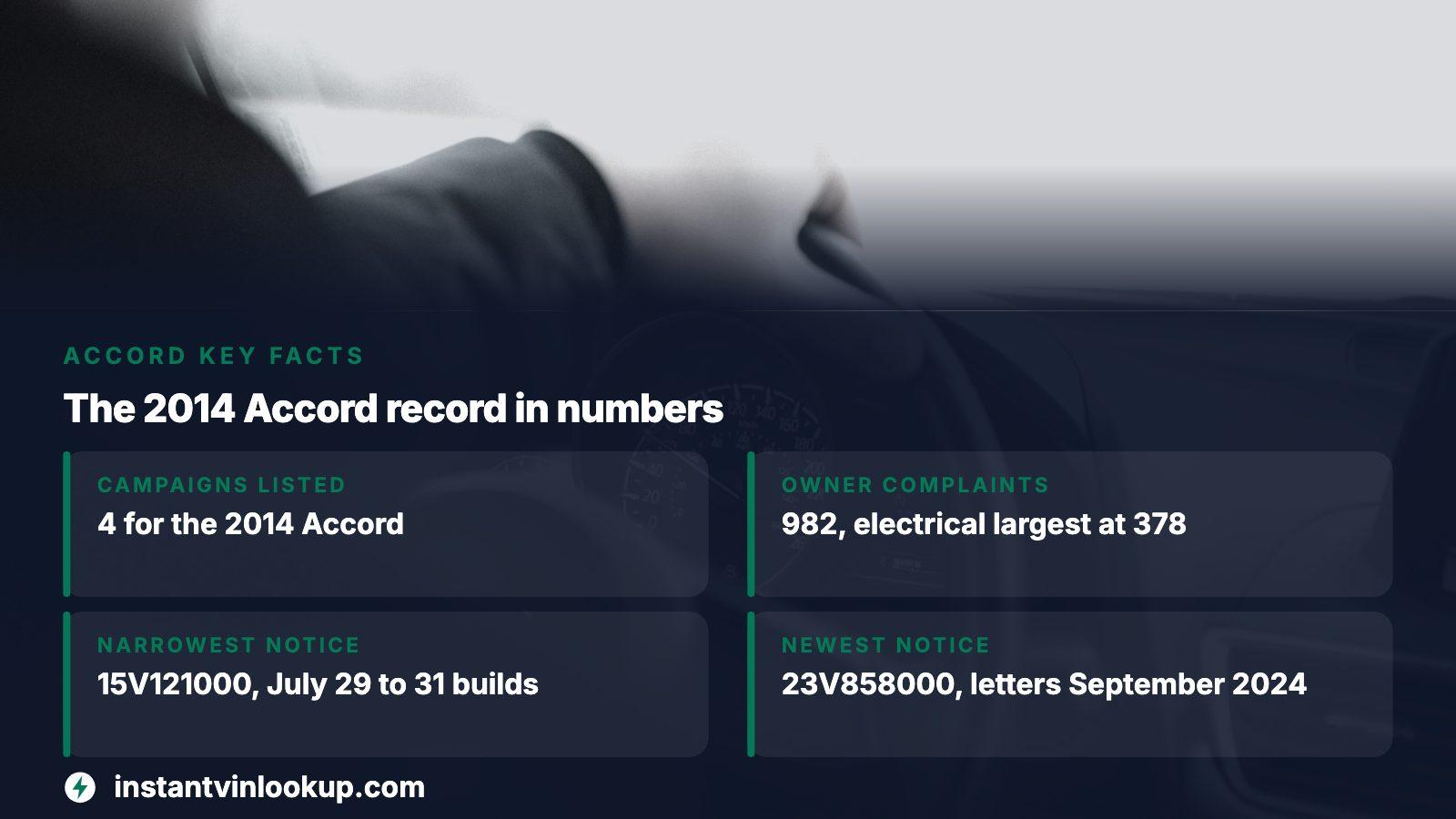
- Campaigns listed
- 4 for the 2014 Accord
- Owner complaints
- 982, electrical system the largest group at 378
- Narrowest notice
- 15V121000, cars built July 29 to July 31, 2014
- Newest notice
- 23V858000, owner letters mailed September 2024
Why a four-item list still needs a VIN
Search a year, make and model and NHTSA hands back every campaign filed against it. That is a menu, not a verdict. Honda drew each campaign's boundary around build dates, engines, gearboxes or the states where a car was registered, so two 2014 Accords on the same lot can return different answers.
InstantVINLookup is built for exactly that gap. Enter the 17 characters and the result comes back in seconds, tied to one car. A free preview shows what the VIN holds before any purchase, and open recalls sit in the full report beside title, damage and odometer entries, so one VIN answers the recall question and the questions next to it.
The four campaigns and what a VIN must satisfy
Each number below can be pasted into NHTSA's recall search. The right-hand column is the condition a particular car has to meet.
| Campaign | Fault | What the VIN has to match |
|---|---|---|
| 15V121000 | Connecting rod bolts torqued wrongly, engine can lose power or leak oil | 2014 Accord 4-cylinder built July 29 to July 31, 2014 |
| 17V418000 | Battery sensor case admits water, short circuit, fire risk | Accords from 2013 through 2016 |
| 20V769000 | Driveshaft coating degrades, road salt can corrode and break it | 2013 to 2015, 4-cylinder, CVT, sold or registered in 23 listed jurisdictions |
| 23V858000 | In-tank fuel pump may fail, engine can stall while driving | Certain cars inside a notice covering many Honda and Acura models |
Three of the four are conditional.
The engine notice that only a VIN can confirm
Campaign 15V121000 is the odd one. Honda found that some four-cylinder engines left the plant with connecting rod bolts that were not torqued correctly. For the 2014 model year, the affected cars were built on just three days at the end of July 2014. The fix is a new engine short block, and it costs the owner nothing.
From an NHTSA owner complaint
An owner in 2020 reported an Accord that burned a quart of oil every 1,000 miles and leaked. The owner had read about 15V121000, but the VIN was not part of it. A dealer suggested diagnosis, and the owner learned a short block replacement could run about $5,000. The failure mileage was listed as 55,000.
A clean answer closes the recall question without proving the engine sound. If a seller's Accord burns oil between changes, ask for service records.
Getting the VIN right before you type it
NHTSA's page names the driver-side windshield corner first. Registration paperwork carries the number too, and an insurance card may. Pick two places and compare them.
- Take a daylight photo of the windshield plate and enlarge it later. One wrong character returns another car, or nothing at all.
- Hold it up to the registration or the seller's title. If they disagree, walk away until the seller explains.
- Read the tenth character: an E stands for a 2014 model year, which checks the ad's claim in a second.
- Run the lookup from your photo and read the free preview first.

Open, fixed or absent: reading each answer
- Open: a campaign reaches this VIN and no repair is on record. Call a Honda service desk, quote the VIN and ask when parts and a bay are free.
- Fixed: ask for the work order. The battery sensor notice allows an interim adhesive seal ahead of the sensor swap, so find out which step was done.
- Absent: the VIN falls outside that campaign's build dates, engine or registration rule. The campaign is closed for this car, though the part can still wear out.
- Pending: a very recent notice may not have every VIN loaded yet, so check again before signing.
NHTSA's search does not display a recall that has already been repaired. That is the reason to ask for paperwork, because a quiet result and a completed repair look the same on that screen.
The battery sensor notice and a repair bill paid in advance
Campaign 17V418000 began in November 2017. Water can get into the sensor case sitting on the battery, and a short circuit raises fire risk. NHTSA counts 9 owner complaints on this model year that flag a fire, and they are owner descriptions rather than findings, though they explain why an open notice here deserves a quick appointment.
From an NHTSA owner complaint
One owner's Accord stalled at a gas station in October 2017, a month before the notice letter. The dealer found severe corrosion had snapped the positive battery cable. Cable, battery and towing came to $800.52 in all. The owner asked Honda to reimburse it, citing the notice, and Honda denied the claim.
Keep every invoice. A seller who says the sensor was handled should be able to name the dealer and the date, and a buyer can ask for the repair before paying or price in the wait.
Fuel pump trouble and the VIN that was left out
Campaign 23V858000 is the newest, with owner letters mailed in September 2024. It folds in two earlier notices and spans cars from 2013 through 2023. A failing pump can stall the engine while driving.
From an NHTSA owner complaint
In September 2025 an owner saw the check engine light come on and the Accord struggle to accelerate. The dealer blamed the fuel pump, yet the owner was told the VIN was not in 23V858000, even though the symptoms matched the notice. The failure mileage was 35,000, and the car had not been repaired.
Take from this that a pump can fail on a car the notice does not name. A lookup shows what is covered, and your mechanic tests the rest.
What recall data leaves out about the 2014 Accord
NHTSA holds 982 owner complaints for this model year. The electrical system leads with 378, then the engine with 179, steering with 143 and service brakes with 122. A complaint can name several parts and none is verified. Most of those areas have no campaign, so a clean lookup is silent on them.
- Ask whether the battery has been replaced often, since several owner reports describe cars that needed a jump or a charge to start.
- Ask for records on any steering or braking warning light.
- Look at the title and damage history, which a recall file never covers.
Hybrid and plug-in Accords sit under their own model names in NHTSA's data, so a hybrid listing should be looked up on its own VIN.
What the lookup costs and what to do with it
Entering a VIN and reading the preview carries no fee. Should you want the whole report, you pay a single time for that vehicle and no subscription follows. Shoppers comparing several sedans can pick a pack of three, five or ten. Prices live on the pricing page.
- Write down each campaign that shows open, with its number.
- Phone a Honda dealer with the VIN and confirm parts are on the shelf before booking.
- Ask for repair orders on anything marked done, the engine and battery sensor first.
- Read the report's title, damage and odometer entries, then pay a mechanic to inspect the engine, the underside and the electrical system before agreeing on a price.
Where this information comes from
- NHTSA recalls API: 2014 Honda Accord — Campaign numbers, build windows, faults and remedies for the four notices.
- NHTSA complaints API: 2014 Honda Accord — Source of the complaint total, component counts and the owner accounts.
- NHTSA: Check for Recalls — What NHTSA's VIN search does and does not show, including repaired recalls.
- U.S. Code: 49 U.S.C. 30120, remedies for defects — Statute text for the free-remedy rule and its 15-year cutoff.
- NHTSA owner complaint 11373739 — owner experience, paraphrased
- NHTSA owner complaint 11058282 — owner experience, paraphrased
- NHTSA owner complaint 11690478 — owner experience, paraphrased
Sources and photos: Facts checked against the sources above in November 2026. Photos by Victor Hughes, Anastasiia Nelen and Miles Loewen on Unsplash; diagrams by InstantVINLookup.
Keep reading
- VIN Lookup: Check a VIN Number on a Car Before You BuyHow the instant lookup and its free preview work for any vehicle, not only this sedan.
- 2013 Honda Accord Recalls: Instant VIN Lookup for This Exact CarThe prior model year shares two notices with this one and carries others of its own.
- Where Is the VIN Number? Find It in a Minute, Then Verify ItMore places to find the 17 characters when the windshield plate is hard to read.
- NHTSA Investigation Check: Look Up a Model, Then Run the VINNHTSA also logs investigations that touch a model year, and this explains how to read one.
Frequently asked questions
How many recalls does a 2014 Honda Accord have?
NHTSA's model-year list shows 4 campaigns, covering the battery sensor, connecting rod bolts, driveshafts and the fuel pump. Build dates, engine, gearbox and registration history split the cars, so most Accords fall under only some of them. The VIN decides which.
Can I check Accord recalls without the VIN?
Year, make and model return the full list of four, which is a fine starting point. That list cannot say which notices reach one car, because each has its own conditions. NHTSA offers a VIN search of its own, and an instant lookup here adds title and damage entries.
Does the connecting rod recall cover every 2014 Accord?
No. For the 2014 model year it names 4-cylinder cars built across three days, July 29 to July 31, 2014. An Accord built outside that window is not part of it. Check the VIN, and note that a V6 sedan was never named in the wording.
Will Honda still pay for a 2014 Accord recall repair?
Generally yes. Section 30120 lifts the free-repair obligation only when a notice is given more than 15 calendar years after the first buyer took delivery. A 2014 car has not reached that point. Some dealers go beyond the statute, so ask before you buy.
What do I get before paying for the full report?
The preview names the kinds of records held for the VIN, enough to judge whether a report is worth buying. The report is bought once for that vehicle, with no renewal date, and the preview never charges you.
Now check the car itself
The guide explains what to look for. The report shows what this VIN has on record.