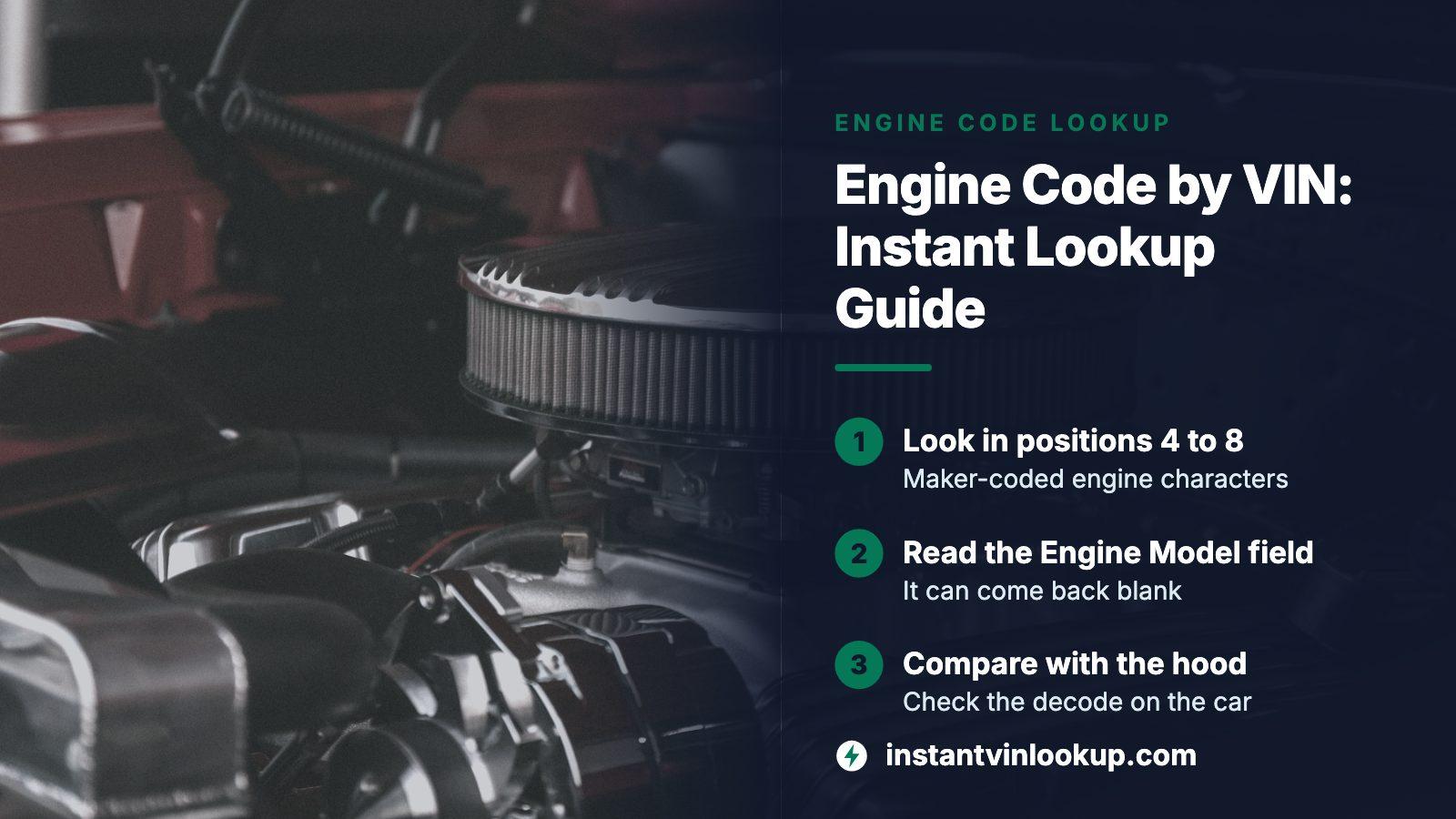
THE SHORT ANSWER
Yes, a VIN lookup can return your engine code, as long as the manufacturer filed it. The federal decoder reports an engine model, displacement, cylinders, fuel and sometimes horsepower. The field can come back empty even when size and cylinders appear, so treat a blank as a prompt to confirm the engine under the hood, in the manual or with a dealer parts desk, not as proof of anything.
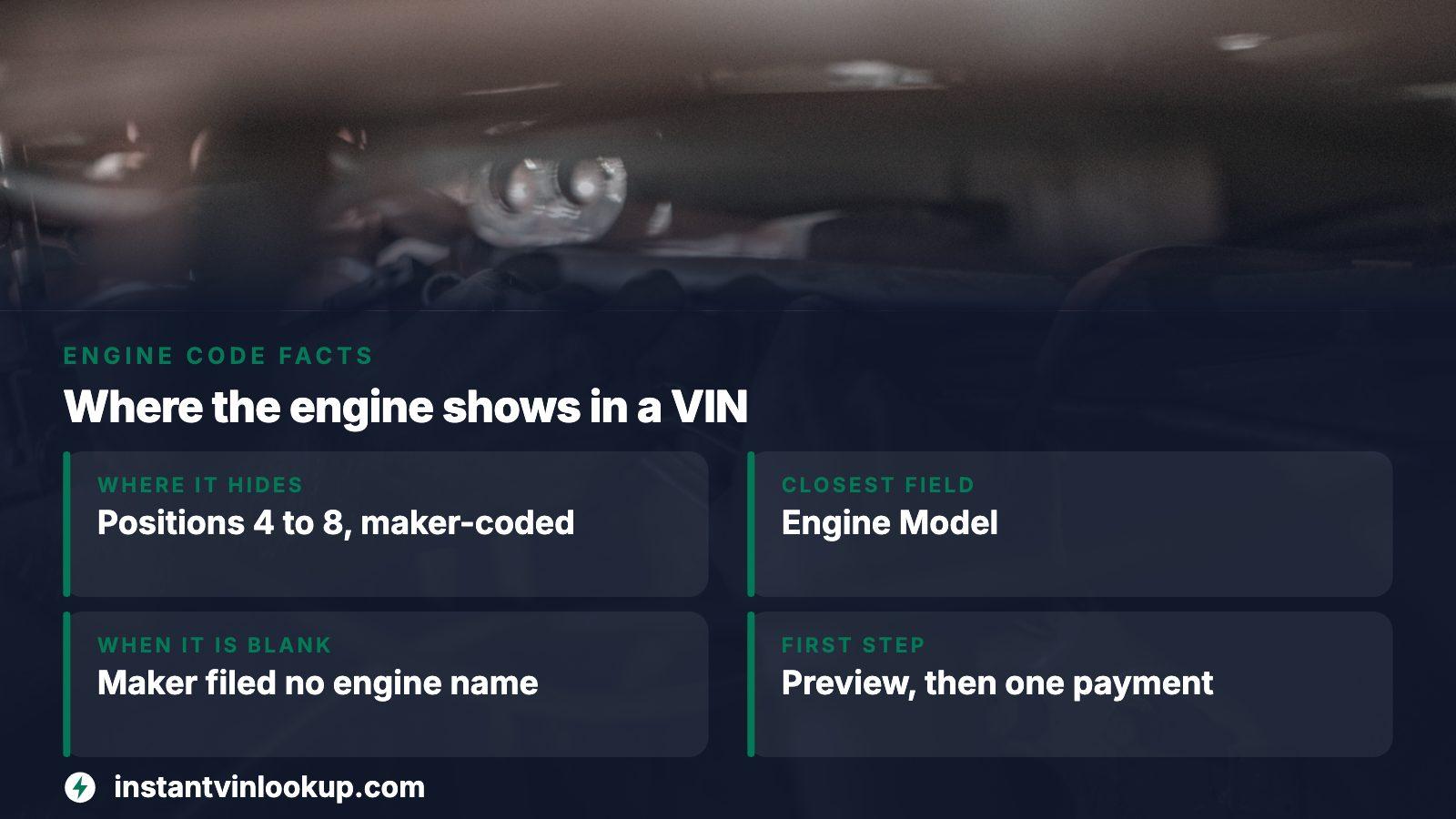
- Where the engine hides
- Inside positions 4 to 8, maker-coded
- Closest decoder field
- Engine Model
- When it can be blank
- Maker did not file an engine name
- Free first step
- VIN preview, then one payment
Engine facts inside a VIN
People say engine code for several different things: the family name stamped in a service manual, the short letter group a parts catalog uses, or the displacement and cylinder count on a listing. The federal rule behind the VIN speaks in a plainer term. It requires the engine type to be decipherable from the VIN for most vehicle classes, and trailers are the exception because they have no engine.
The rule stops short of picking a character. Five characters, positions 4 through 8, hold several vehicle traits at once, and the maker alone decides how they are spent. A chart claiming the eighth character is the engine describes one brand's habit. Elsewhere, that same slot can mean a body style or a restraint system.
Engine fields you will see in the result
Each decoder field comes from the manufacturer's filing with NHTSA. These are the engine fields worth reading, in the order you will probably need them.
| Decoder field | What it states | Typical use |
|---|---|---|
| Engine Model | The name the maker gives an engine family | The closest match to an engine code; quote it to a parts desk |
| Displacement (L) | Swept volume of all cylinders | Separates a model's smaller and larger engines |
| Engine Number of Cylinders | Count of cylinders | Checks the displacement makes sense |
| Fuel Type - Primary | Gasoline, diesel, electric and so on | Rules out the wrong parts family at once |
| Turbo | Yes, or empty | Flags a forced-induction variant |
| Electrification Level | Mild, strong, plug-in or battery electric | Shows whether a motor shares the job |
Why the engine model sometimes comes back empty
The decoder only reports what the manufacturer put into its filing. I ran a handful of sample VIN patterns through NHTSA's flat decode call to see how uneven that is. A Honda Accord pattern returned an engine model of L15BE with 1.5 liters and four cylinders. A Jeep Grand Cherokee pattern gave 3.6 liters and six cylinders but left the engine model field empty.
A battery-electric Tesla pattern showed electric as the fuel and had no displacement at all, which is correct for a car with no combustion engine. So a blank engine model is a gap in the filing, not an error on your side. Size, cylinders and fuel still narrow the question; the remaining step is to read the engine bay label or the manual.
Read the error line
Decode results carry an error code and message. A sample VIN I used with a wrong check digit still returned data, but the message said position 9 did not calculate. If you see that message, retype the VIN from the title or door jamb before trusting any field.
Steps from VIN to engine
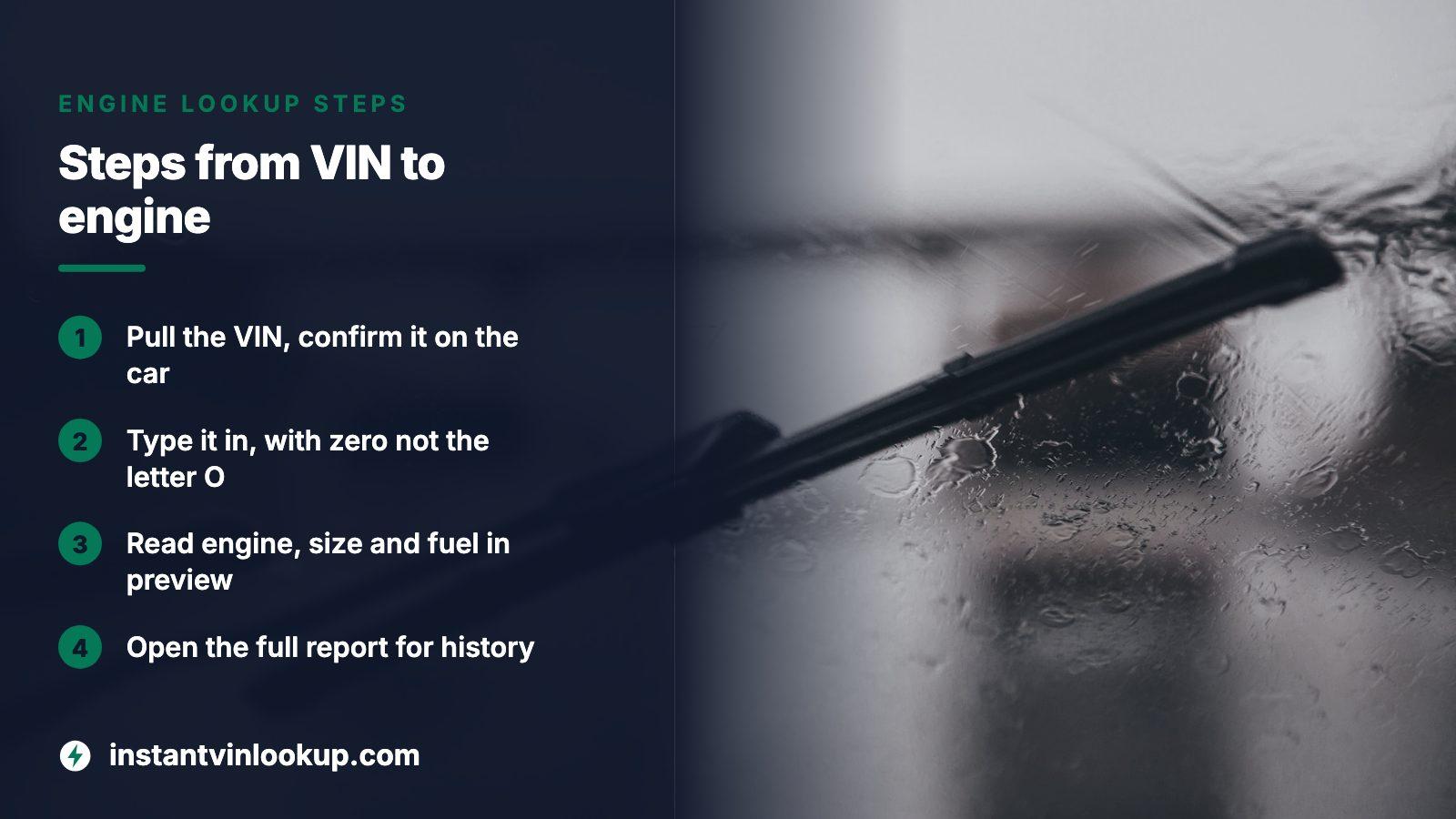
- Pull the VIN from paperwork such as the title, registration or insurance card. Confirm it on the vehicle itself, since a typo in a listing is common. Look at the dash corner nearest the driver and at the door pillar.
- Type it into the lookup box. Those three letters are never valid in a VIN. If you see an O, it is the digit zero.
- Read the preview for engine, size and fuel, and hold it up against the ad and the engine bay.
- Buying the car? Open the full report for the history behind it. One payment, no subscription.
The preview costs nothing and runs in seconds. Buying the full report is a different step from the preview, and nothing recurs afterward. See the pricing page for how it is sold.
Why the engine matters for recalls
Recall notices name certain vehicles, and the VIN decides whether yours is one. Take NHTSA campaign 17V226000, filed in March 2017. Hyundai's Sonata and its Santa Fe Sport sibling were both in scope, but only some build dates of the 2013 and 2014 years. The fault was a machining error in the factory that could wear bearings early, and dealers inspected the engine and swapped the short block where needed, free.
A later campaign, 18V934000, dealt with fuel pipes that may have been damaged or mis-torqued while engines were being replaced under earlier campaigns. Two cars with the same model name and year can sit on opposite sides of that line, so the VIN decides, not the model name.
From an NHTSA owner complaint
Two owners of a used 2013 Santa Fe Sport said they read up on the engine recall before buying and believed their SUV sat outside the affected VIN range. Within a year the engine seized with the wife at the wheel, climbing a hill in heavy traffic. In their view, the problem spread past what the recall covered.
Take from it that a clean answer on one campaign is not a promise about the engine. Run the VIN, read the open recalls, then add a mechanic's inspection.
Checking the decode against the hood
The decode reflects the engine installed at the factory. Pop the hood and compare. If the listing says a larger engine than the decode shows, or the label on the valve cover names a different family, stop and get an explanation from the seller first.
- Seller claims a turbo or a bigger option that the decode does not list: ask for the build documents or a dealer printout.
- Displacement and cylinders disagree with each other: re-enter the VIN, because one character is likely wrong.
- Engine model is blank: use the size, cylinders and fuel, then confirm the family with the manual or a parts desk.
- Engine matches, but the odometer or damage history looks off: that is where the paid report earns its place.
Treat a mismatch as something to ask about, not a final answer. Engines do get replaced for good reasons after a failure, and an honest seller will have a receipt.
After the decode: the history
The decode answers what was built. It cannot say what happened afterward. The full report covers that second half: title brands, collision and damage records, mileage readings, plus any recall still open for that VIN. A matching engine does not rescue a car with a branded title or tampered mileage. Avoid it, or price it very differently.
Run the free preview first. If the engine and specs fit what you were told, the report is the next step before you hand over a deposit.
What to do with the code once you have it
For parts, give the counter the full VIN along with the engine model, since fitment can change inside a single model year. For oil, belts and filters, use the engine name to find the right page in the owner's manual. For a purchase, put the VIN and the engine details in writing with the seller so the listing and the car are the same car on paper.
Keep a copy of the preview with the date you ran it. If the seller later changes the story about the engine, you have the decode from the day you looked.
Where this information comes from
- 49 CFR 565.15: VIN content requirements — supports engine type being decipherable in positions 4 to 8 with the maker choosing the characters
- NHTSA vPIC API — supports the decoder being built from maker filings and the flat decode call
- NHTSA vPIC variable list — supports the definitions of Engine Model and the other engine fields
- NHTSA recalls by vehicle: Hyundai Sonata 2013 — supports campaigns 17V226000 and 18V934000
- NHTSA owner complaint 11183482 — owner experience, paraphrased
Sources and photos: Facts checked against the sources above in November 2026. Photos by Victor Hughes, Thibault Valjevac and Nina Mercado on Unsplash; diagrams by InstantVINLookup.
Keep reading
- Parts by VIN: Run the Instant Lookup Before You OrderTurn the engine result into the right parts for the car.
- Oil Type by VIN: What an Instant Lookup Returns, and What It Can'tFind the oil that fits the engine you just identified.
- Transmission by VIN: What an Instant Lookup Shows for Your CarAnother build detail a decoder may or may not return.
- Where Is the VIN Number? Find It in a Minute, Then Verify ItLocate the VIN before you run the lookup.
Frequently asked questions
Is the engine code the same as the engine size?
No. Size is the displacement in liters, while the code or engine model names a family of engines that share a design. Two engines can share a displacement and still need different parts. A lookup that returns both gives you a better match than size alone when you order anything.
Which VIN character is the engine?
It depends on the manufacturer. Federal rules put the engine information somewhere in positions 4 through 8 and let each maker choose the characters. Brand-specific shortcuts fail on other makes, which makes a decoder built on maker filings the dependable route.
Can I find the engine code without the VIN?
Sometimes. The owner's manual, the engine bay label or a service record may name it. The VIN is still the safer starting point, because it ties the answer to your exact car instead of a model name that covers several engines.
Does the lookup work on diesels and electric cars?
It returns the fuel type for both. A diesel shows its fuel, size and cylinders where filed. An electric car shows electric as fuel and no displacement, which is expected because there is no combustion engine to measure.
Is the preview enough before buying a used car?
It confirms the factory engine and basic specs. Before paying a seller, read the history too, since title, damage and odometer records live in the report. The free part is the preview; the report costs one payment.
Now check the car itself
The guide explains what to look for. The report shows what this VIN has on record.