THE SHORT ANSWER
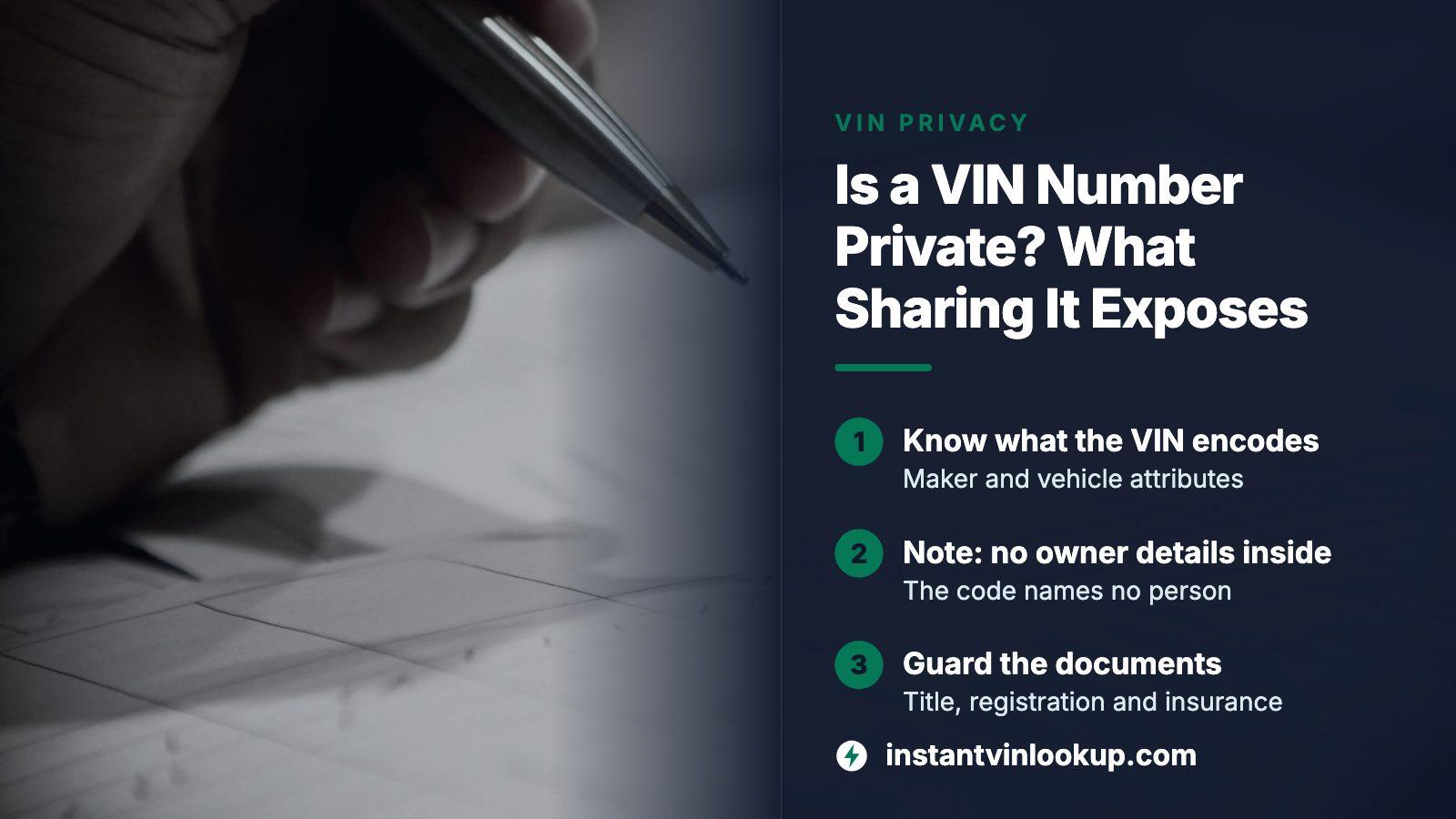
A VIN is safe to share and is not treated as personally identifying data. It encodes the maker and vehicle attributes, with no name, address or account number inside it. What deserves protection is the title, registration and insurance card that carry the VIN next to your details, plus any form asking for payment or a login.
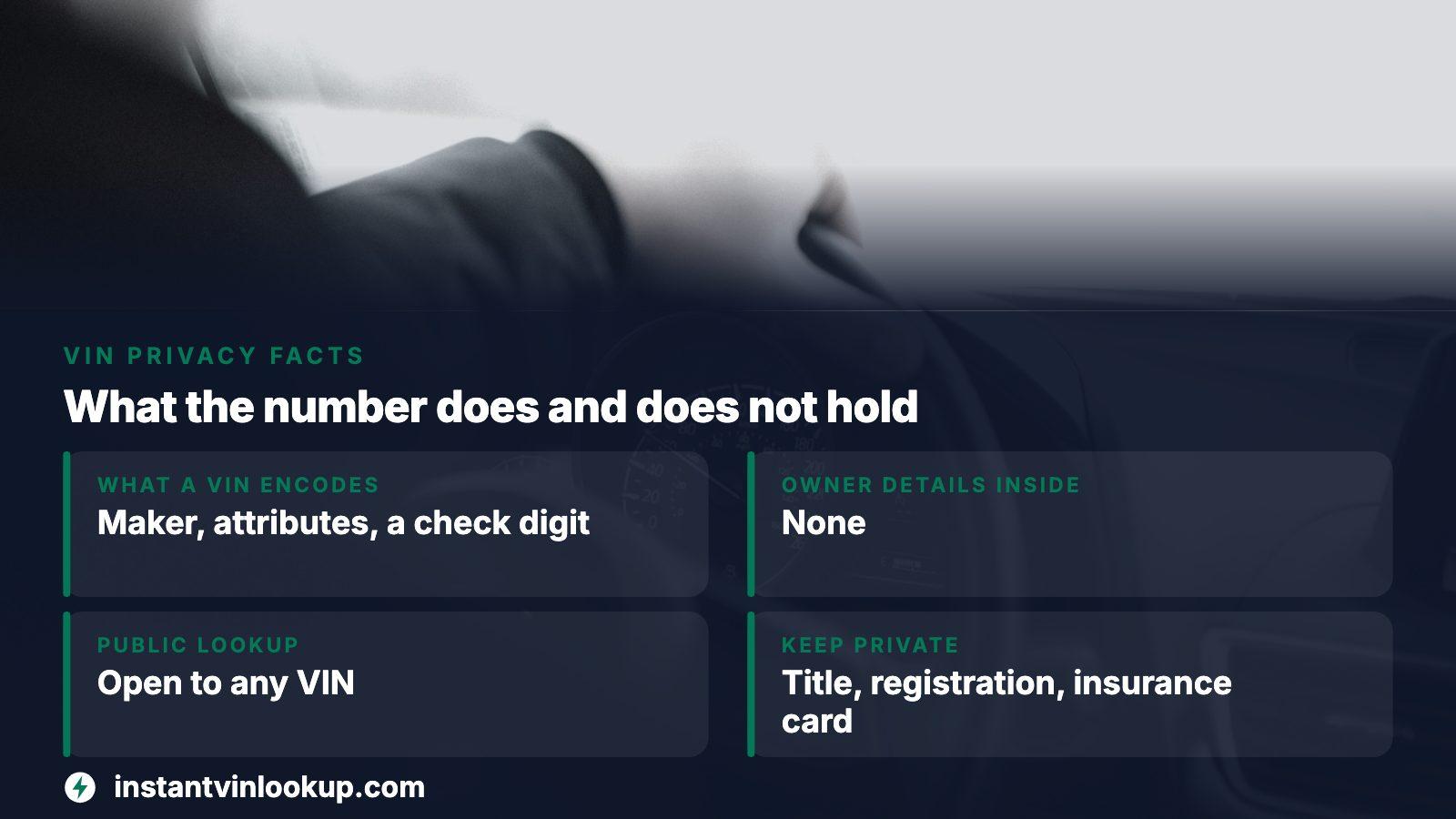
- What the VIN encodes
- Maker, vehicle attributes, a check digit
- Owner details inside
- None
- Public lookup
- NHTSA and NICB accept any VIN
- Keep private
- Title, registration card, insurance card
What the 17 characters actually say
Federal VIN rules set the contents. The first three characters point to the manufacturer and the type of vehicle. Characters four through eight describe how the vehicle was built, including its engine and body style, and each maker decides how to spend those five slots.
The ninth slot holds a check character, either a digit or X, calculated from the rest so that a mistyped copy fails the arithmetic. Nothing in the content rules asks for a name, an address or any owner detail to be stamped into the number. A VIN follows the vehicle through every sale, so it cannot hold facts about whoever owns it today.
Why the law does not treat it as personal information
Congress passed the Driver's Privacy Protection Act to limit what a state licensing office may hand out. Its idea of personal information is a list of identifiers tied to a human being, such as a face photo, an SSN, a license number, a name, a street address, a phone number and health details. A vehicle number is absent from that list.
The protected item is the motor vehicle record, meaning the file a state keeps behind a driver permit, a title, a registration or an identification card. Releasing the name and address on such a record is limited to listed purposes, among them recalls, theft work, insurers fighting fraud, and notices to owners of towed cars. The VIN printed in the same file is not what the statute guards.
Sensitive versus restricted
Photos, Social Security numbers and medical data fall under a tighter tier that usually needs the person's written consent. None of those ever appears in a VIN lookup.
It is meant to be read by strangers
NHTSA tells owners to look at the lower left of the windshield for the number, which means a person on the sidewalk can read it without touching the car. The agency adds that the same number is printed on the registration and, on some policies, the insurance card. Anyone parked next to you has a legal view of it.
NHTSA's recall search accepts any VIN, answers with that vehicle's open recalls, and lets a person run up to 100 in one go. NICB's VINCheck does the same for theft and salvage reports. Neither asks who owns the vehicle, and neither shows an owner's name in return.
Where the real risk sits
The number alone gives a stranger very little. The danger is what travels with it. A photo of a registration card shows the VIN beside a name and address. An insurance card adds a policy. A title in a screenshot adds signatures and sometimes a lienholder.
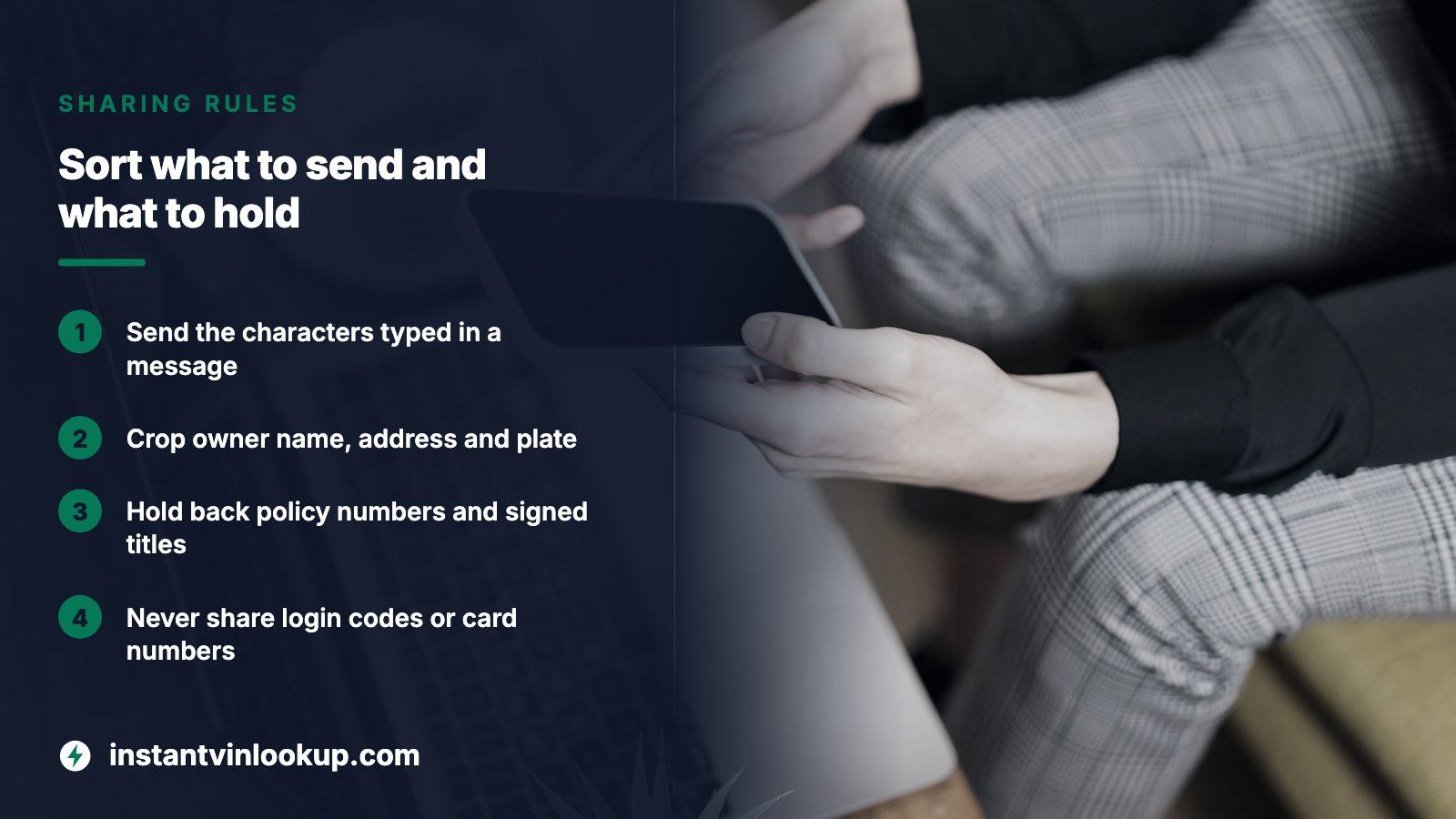
- Fine to send: the 17 characters typed into a message or ad
- Crop or cover: owner name, address and plate on a registration photo
- Hold back: policy numbers, signed titles, driver license images
- Never share: a login code or a card number to prove you own the car
When a buyer asks for the VIN to run a history check, give it. A seller who refuses to share the number is the warning sign, not the buyer who asks.
What a copied VIN can and cannot be used for
A VIN cannot open a car door, start the engine or move title into someone else's name. Transferring ownership needs the signed paperwork and the state's own process. The number does help a person who wants to describe a different vehicle as yours, which is why a clean-looking listing should always be matched against the car itself.
The practical defense is comparison. Dash plate, door label and title should all show an identical number, and a free lookup should return the same make and model the seller advertised. A mismatch tells you more about the seller's honesty than any privacy setting could.
Choosing a lookup that deserves the number
The VIN is harmless to type, so the thing to judge is the form around it. A decent tool needs only the VIN for a preview. Be wary of any page that wants a Social Security number, a bank login or a driver license upload before showing a result.
| Asked for | Reasonable? |
|---|---|
| The 17-character VIN | Yes, that is the whole point |
| Email address to send a report | Usually, if stated up front |
| Card details at checkout | Only on a secure payment page |
| Social Security number or license image | No, walk away |
On InstantVINLookup the preview needs just the VIN and carries no charge. Should you want the title, accident and odometer records behind it, the full report is bought once, on its own.
Before you hand over money
Since sharing the number is safe, use it. Photograph the dash plate yourself rather than trusting the seller's picture, compare it with the title, then try the no-cost public tools first. NHTSA covers open recalls, while NICB covers theft and salvage claims from insurers.
NICB says the insurers feeding VINCheck account for 92.49% of premiums earned across the country, and it warns that a clean result is not a guarantee, because only participating insurers report. That gap is where a paid history report earns its place, since it draws on title records as well.
Where this information comes from
- NHTSA: Check for recalls — where the VIN is displayed, and what a VIN recall search returns
- NICB: VINCheck lookup — free theft and salvage search and its stated limits
- VehicleHistory.gov: NMVTIS — federal title database purpose and secure-site warning
- 18 U.S.C. 2721: Driver's Privacy Protection Act — what state DMVs may and may not release
- 18 U.S.C. 2725: definitions — what counts as personal information
- 49 CFR 565.15: VIN content requirements — what each section of the VIN encodes
Sources and photos: Facts checked against the sources above in November 2026. Photos by Masjid MABA, Jakub Żerdzicki and Miles Loewen on Unsplash; diagrams by InstantVINLookup.
Keep reading
- Where Is the VIN Number? Find It in a Minute, Then Verify ItFind every copy of the number on the car before you share it.
- NICB VIN Check: What the Instant Theft and Salvage Lookup ShowsWhat the free insurer-based theft and salvage search covers.
- What Does a VIN Check Tell You About a Used Car?See what a history check returns once you have the number.
- Is the VIN Number on a Registration? Where It Appears and What to CheckWhich paperwork carries the VIN beside your personal details.
Frequently asked questions
Is a VIN number considered PII?
No. Federal law lists personal information as items such as a name, address, phone number, Social Security number and photograph. The VIN identifies a vehicle, and it stays the same through every owner. It becomes sensitive only when it appears in a document next to those personal details.
Is it safe to give my VIN to a buyer?
Yes. A serious buyer needs it to check recalls and history, and the number cannot be used to take title or start the car. Hide your name, address and plate in any registration photo you send, and keep signed titles until the sale is closing.
Can someone find my name from my VIN?
Not through the public tools. NHTSA's recall search and NICB's VINCheck return vehicle records and do not show an owner. State motor vehicle records with names are restricted by federal law to listed uses such as safety, theft and insurance work.
Can a scammer steal my car with just the VIN?
Not directly. Moving ownership needs signed paperwork and the state's transfer process. The more realistic misuse is a seller copying a real VIN onto a different car in an ad, which is why you match the number on the vehicle to the title.
Should I post my VIN online?
Posting it in a for-sale listing is common and low risk. Avoid posting photos that include the registration card, insurance card or title, and think twice before putting it on social media beside your address or plate, since that pairs the vehicle with you.
Now check the car itself
The guide explains what to look for. The report shows what this VIN has on record.