
THE SHORT ANSWER
A registration card lists the VIN, usually in a row of vehicle details next to the make, model year and plate number. Some states also print a partial VIN on the sticker. Treat the card as a claim made on paper: read the VIN on the car itself, check that the two agree character by character, and only then run the lookup. A card says the vehicle is registered, not that its history is clean.
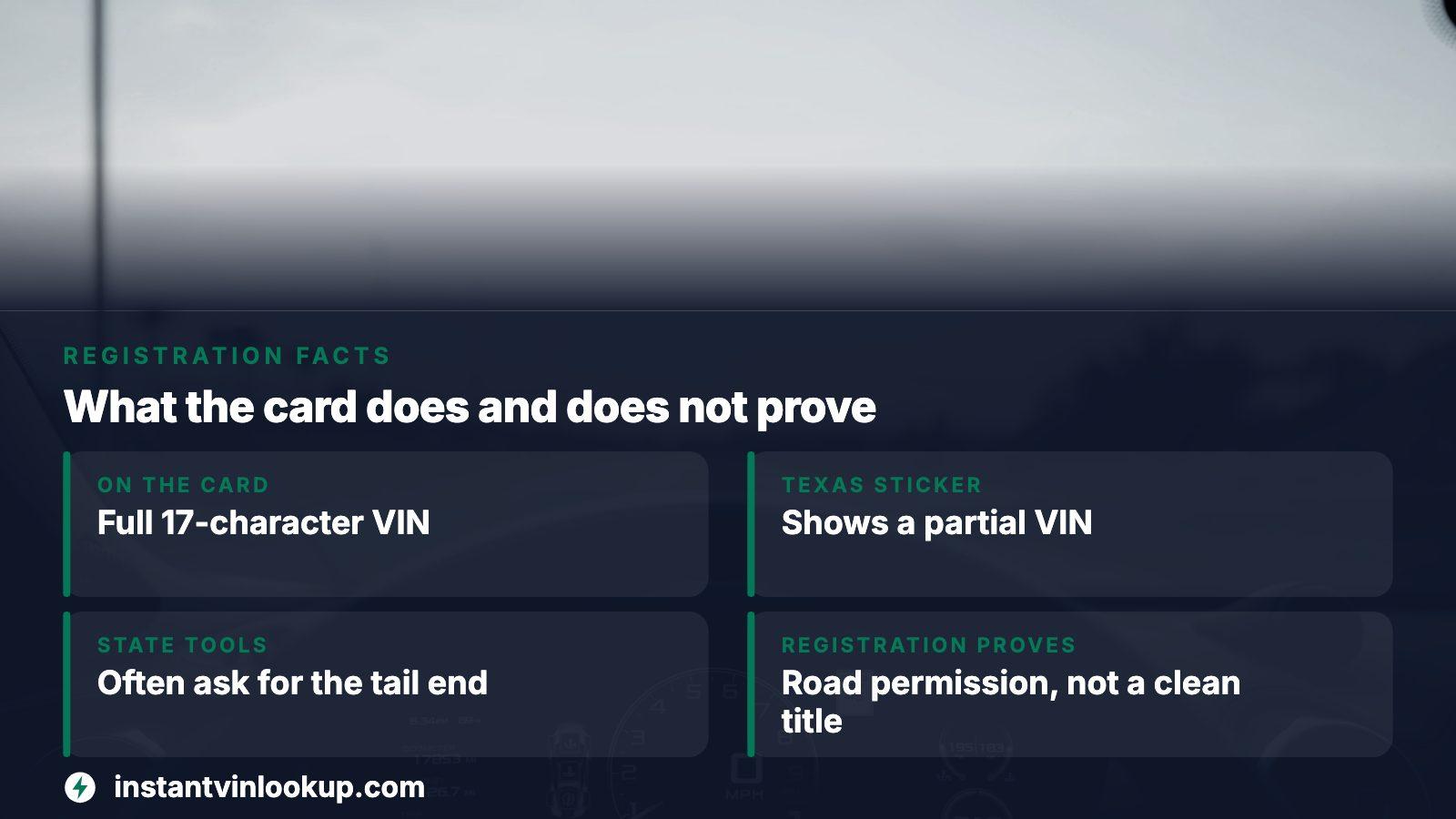
- On the card
- Full 17-character VIN, per NHTSA
- Texas sticker
- Shows a partial VIN
- State tools
- Often ask for only the tail end of the VIN
- Registration proves
- Road permission, not a clean title
What the registration card gives you
NHTSA's recall search page tells owners that the full number can be read from the windshield corner and also from the registration card, and that the insurance card may show it too. So the answer to the search is a plain yes. The card is one of the easiest places to get the VIN when the car is parked somewhere else.
Layouts differ by state, but the vehicle block is usually a short table or a line of fields: the VIN, the make, the model year and the plate. Look for the longest string of letters and digits. A real VIN is 17 characters long and holds no gaps, so a number that is shorter, or that has dashes, is probably something else, such as a title control number or an engine serial.
Read it slowly and copy it by eye, or photograph the card in good light. Smudged copies and faxed photocopies are where a 5 turns into an S and a zero into an O.
Why state offices keep asking for the VIN
Because the VIN names one specific vehicle, DMV tools use it as a lookup key, and some ask only for its tail end. The examples below come from state pages we opened.
| State | How the VIN is used |
|---|---|
| California | Registration status needs the plate plus the final five VIN digits, the owner's surname or the lessor's name |
| California | A replacement card at a kiosk needs the plate and the final five digits |
| Texas | The sticker shows a partial VIN; tracking an online sticker order needs the last four digits |
| Texas | Renewal without a notice can use the VIN, the plate or last year's receipt, with photo ID |
The pattern is useful to a buyer. Ask the seller to confirm the last digits shown on the sticker and the card, and compare them with the plate on the car. If a seller will not let you see the card at all, treat that as information.
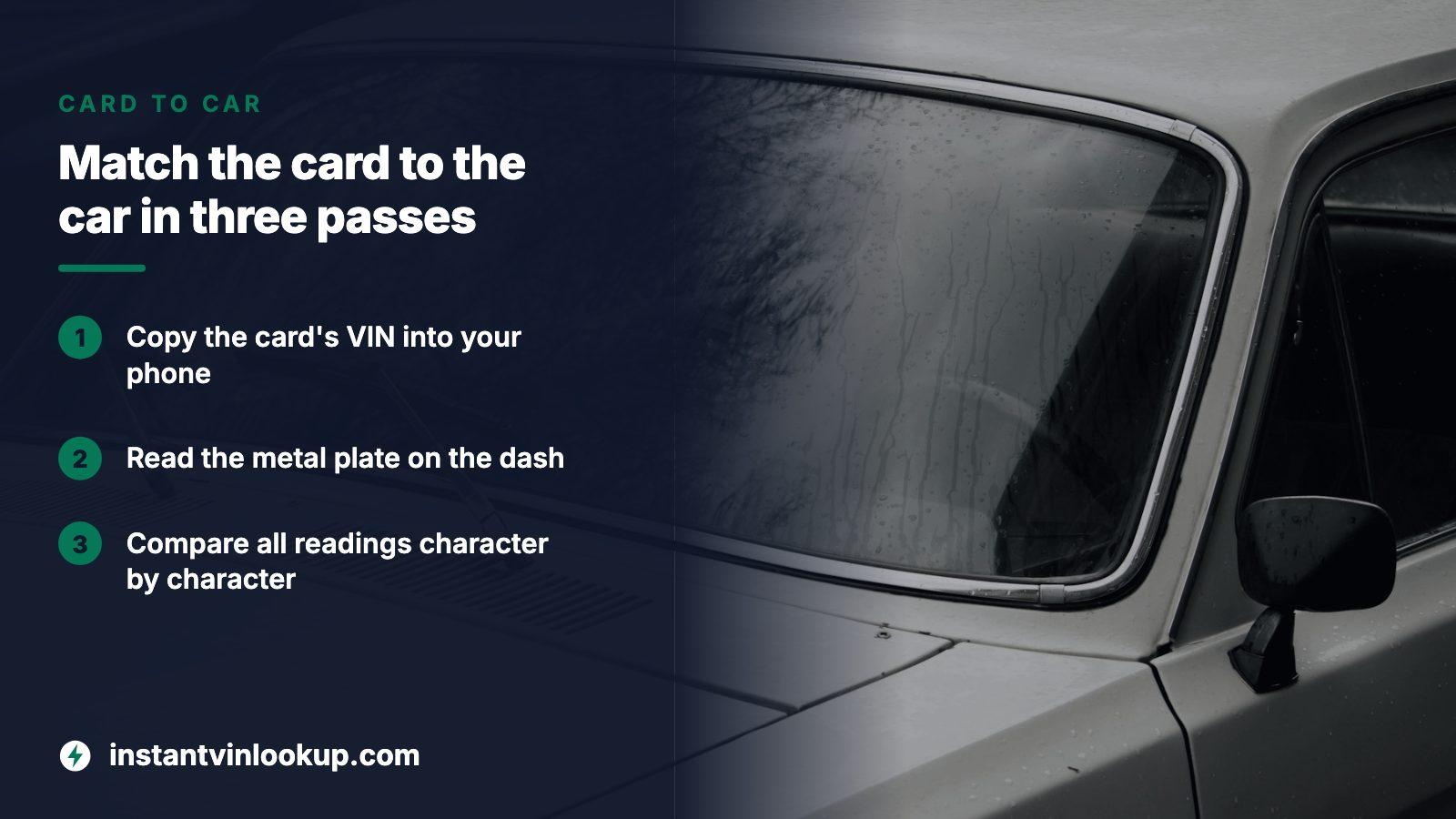
Match the card to the car in three passes
- Copy the VIN from the card into your phone, or photograph it, before you go near the car.
- Walk to the car and bend down to the small metal plate on the dash corner, visible from outside. Then open the door and read the manufacturer's label there.
- Compare all three readings from the first character to the last, finger on the screen if needed. One swapped digit counts as a mismatch.
A single transposed character on the card is usually a clerk's typing error, and the owner can have it corrected at the DMV. A card that agrees with the car but disagrees with the title is a different matter, and so is a card whose VIN does not decode to the make and model you are looking at. Our guide to where the VIN sits on the car walks through the physical locations.
When the paper and the metal disagree
California's DMV registration manual lists the situations where an officer must physically check a vehicle before registering it. One of them is the VIN on the certificates not matching the VIN in the state record. Others include a car last registered in another state and a salvage or junk vehicle being revived. The same manual leans on the federal safety label as a backup public reading of the number, and where that label is gone or illegible, a DMV employee must locate another accessible copy.
What a mismatch can mean
Most mismatches are innocent: a typo, a replaced windshield, a title issued for a rebuilt car. A few are not, such as a plate swapped from a wrecked vehicle onto a stolen one. You cannot tell which you have from the parking lot, so do not hand over money until the seller explains it and a record confirms it.
Ask for the explanation in writing, and ask which office issued the most recent paperwork.
What a registration cannot tell you
Registration is a permission to drive on public roads. It says nothing about whether the car was once declared a total loss, whether its odometer was rolled back, or whether it was reported stolen. A branded car can be registered like any other once the paperwork is cleared.
- Title brands such as salvage, flood or rebuilt are recorded on the title, not on the card.
- Odometer history is a separate record, kept in title and inspection data.
- Theft and insurance loss records sit with other databases.
- Unrepaired recalls depend on the maker's campaign and show up in NHTSA's own search.
That is why the federal NMVTIS guidance for buyers pairs three steps: an independent inspection, a title report and other vehicle information sources. It also points to the free NICB database that can be searched by VIN.
If the seller has no card, or it looks wrong
Cards get lost, and it is not alarming on its own. Both California and Texas let an owner order a replacement card or sticker for a fee, using the plate and the tail of the VIN. A seller who has a real car can usually fix this within days.
Some vehicles cannot use the quick online route. California lists junked cars, salvage-certificate cars, expired or suspended registrations and vehicles with a theft-related hold among those that need a paper application at an office or by mail. If that is the seller's story, ask what is blocking it, because the answer may point to a title problem.
In the meantime, use another paper that carries the VIN, such as the insurance card or the title, and compare it with the car as above.
Once the three readings agree, run the VIN
At that point the number is worth typing. Enter it at InstantVINLookup and the free preview shows the vehicle that VIN decodes to, so you can see at once whether it is the model, year and trim in the ad. NHTSA's public decoder works the same way, and its data comes from the manufacturer.
If the car passes that first test, the full report is a one-time purchase that goes into the records the card never held: title brands, damage and salvage history, odometer readings, liens, theft and open recalls. Pricing is on the pricing page, and you pay for one report at a time, with no subscription.
Run it before the deposit, not after, since the report is cheap next to a car you have to walk away from later.
Where this information comes from
- NHTSA: Check for recalls and find your VIN — Says the VIN is on the registration card and what a VIN recall search does and does not cover.
- NHTSA: VIN decoder — The 17-character rule and the public decoder, with data supplied by manufacturers.
- California DMV: Vehicle registration status — Shows how a state uses the end of the VIN with the plate.
- California DMV: Vehicle verifications — When a physical VIN check is required, including a certificate that disagrees with the record.
- Texas DMV: Register your vehicle — The partial VIN on the sticker and the renewal and tracking options.
- NMVTIS: Used car buying tips — The federal buying checklist: inspection, title report and free NICB search.
Sources and photos: Facts checked against the sources above in November 2026. Photos by Carrie Allen www.carrieallen.com, Tigran Shishmanyan and Dennis Eusebio on Unsplash; diagrams by InstantVINLookup.
Keep reading
- Where Is the VIN Number? Find It in a Minute, Then Verify ItEvery spot on the vehicle to compare against the card.
- Vehicle Identification Number: What an Instant Lookup Reads From ItWhat the 17 characters mean once they match.
- VIN Lookup: Check a VIN Number on a Car Before You BuyHow to run the lookup and read the preview.
- NICB VIN Check: What the Instant Theft and Salvage Lookup ShowsThe free theft and total-loss screen for a verified number.
Frequently asked questions
Is the VIN number on a vehicle registration?
Yes. NHTSA names the registration card as one of the places to read the 17-character number, along with the windshield corner and sometimes the insurance card. The card only repeats what the state recorded, so confirm it against the plate on the car.
Where is the VIN number on the registration card?
It sits in the vehicle details, near the make, year and plate. Layouts vary by state, so scan for a string of 17 letters and digits with no spaces. If you only see a short ending, that may be a sticker or a receipt showing a partial number.
Can I run a VIN check from a photo of the registration?
You can type the VIN from a photo, but only if it is readable. A blurry or cropped image causes wrong characters. Ask for a sharp picture of the card and the dash plate, then check that they agree before you search.
Does a current registration mean the car has a clean history?
No. Registration shows the car may be driven on public roads. A salvage, flood or rebuilt brand lives on the title, and mileage, theft and loss records live elsewhere. A history report is the check that covers those.
What if the VIN on the registration differs from the car?
Do not buy until it is explained. A typo can be fixed at the DMV, but a real mismatch might point to swapped plates or title trouble. Ask the seller for the title and the last paperwork, then run the VIN that is on the car.
Now check the car itself
The guide explains what to look for. The report shows what this VIN has on record.