
THE SHORT ANSWER
Count to the eleventh character of the 17-character VIN: that is the plant code. The federal rule fixes where it sits but not what each letter means, so every maker assigns its own. A decoder reads the maker's filing and returns the plant name. Same truck, different letter, different factory: the proof is in the examples below. Then compare what comes back with the certification label near the driver's door.
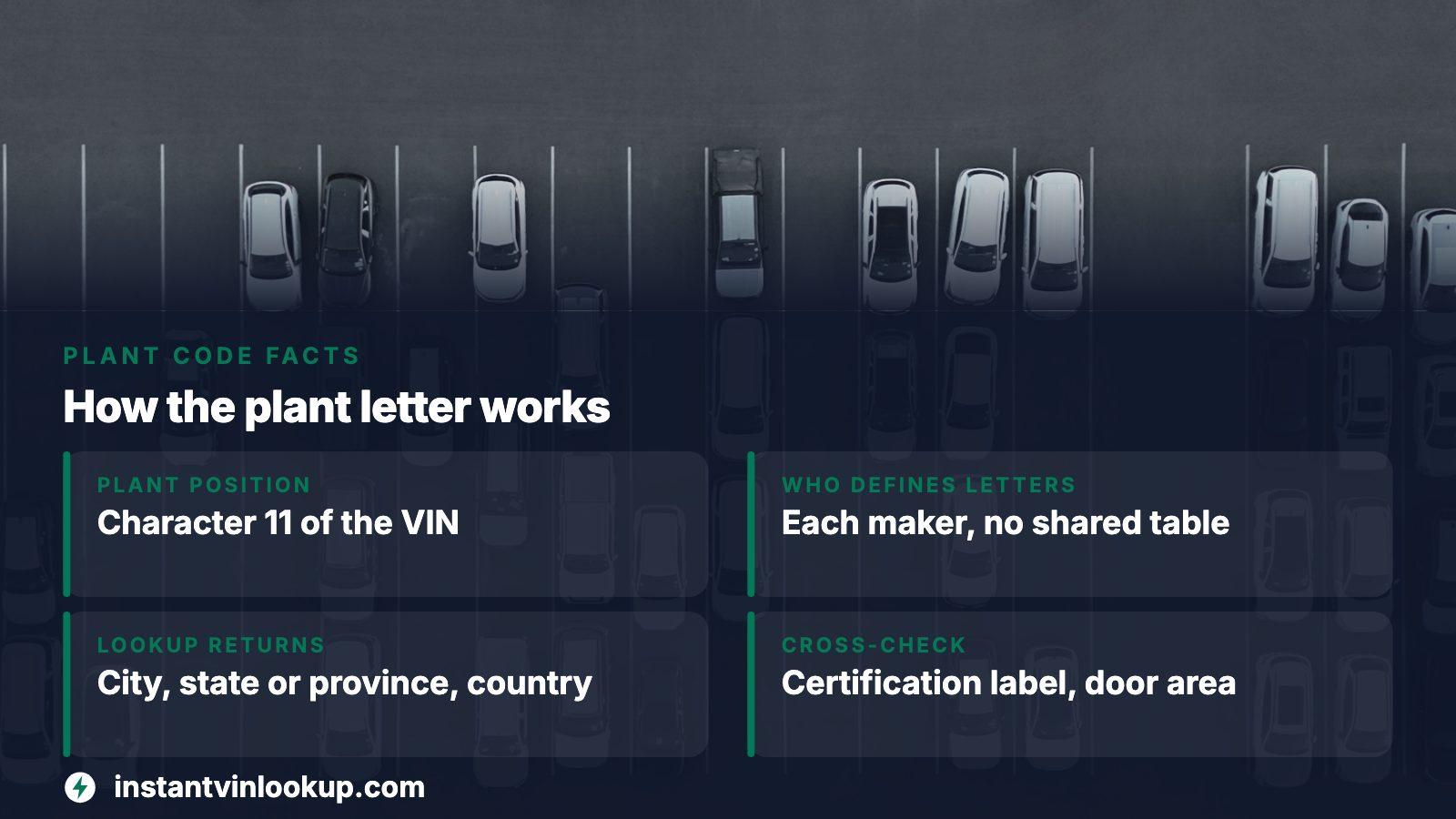
- Plant code position
- Character 11 of the VIN
- Who defines the letters
- Each maker, not a shared table
- What the lookup returns
- Plant city, state or province, country
- Cross-check
- Certification label, door area
Finding the plant character in seconds
Write the VIN out and count from the left. Reading left to right: the opening three name the builder, position nine is a math check, ten gives the year, and eleven gives the plant. The last six are that unit's place in the production order.
That layout comes from the federal VIN standard, which says the second character of the final section represents the plant of manufacture. The final section starts at position ten, so its second character lands on eleven. A typo anywhere earlier shifts your count, so read the digits off the metal itself and count a second time.
| Positions | Carries |
|---|---|
| 1 to 3 | Maker and vehicle type |
| 9 | Check digit |
| 10 | Model year |
| 11 | Plant code |
| 12 to 17 | Production serial |
Why there is no single plant letter chart
Search results love a one-page table of plant letters. The regulation behind the VIN never publishes one. It names the position and stops there, leaving each manufacturer to file its own coding with NHTSA. A K on a Ford means one thing, a K on a Toyota can mean another, and a K on a brand from a different country can mean a third.
So a loose chart is a guess dressed as a reference. The dependable route is to let a decoder match your whole number against what the maker filed, which is the reason this site starts from the lookup and not from a letter list.
One letter changed, a different factory answered
To see the code at work, I ran two partial VINs through NHTSA's decoder on 2026-11-07. They matched in every character except the eleventh, with an asterisk where the check digit goes. Both came back as a 2017 Ford F-150.
| Pattern | Plant letter | Plant returned |
|---|---|---|
| 1FTEW1EP*HF | F | Dearborn, Michigan |
| 1FTEW1EP*HK | K | Kansas City, Missouri |
Nothing else about the truck's description moved. That is the whole job of position eleven: it tells you where this particular unit was built, even when sister units share a model, trim and year.
What a decoded plant looks like across brands
Other patterns through the same endpoint gave the results below, from 2017 model years and one 2019. Detail varies: some include a company name, one leaves the city blank.
- Toyota Camry: Georgetown, Kentucky, under the maker's Kentucky manufacturing subsidiary.
- Toyota Prius: Toyota City, Aichi, Japan, listed under Toyota Motor Corporation - Tsutsumi Plant.
- Toyota Tacoma: Baja California, Mexico, with no city in the result.
- Jeep Grand Cherokee: Detroit, Michigan, Jefferson North Assembly.
- Chevrolet Silverado: Fort Wayne, Indiana.
- Tesla Model 3 (2019): Fremont, California.
Every one of those partial patterns also carried an incomplete-VIN error code, caused by the asterisk. The plant still came back. With a full 17-character number you should not see that code at all.
Checking the lookup against the car
NHTSA states that its decoded data is reported by the manufacturer, and that more detail may sit on a label on the vehicle. Two labels help. The certification label near the driver's door has to name the actual assembler in full, introduced by a short phrase such as Mfd By, and it also shows the month and year of build.
The second is the parts-content label required on new passenger vehicles built since October 1, 1994. It lists the final assembly point as city, state and country, plus where the engine and transmission originated. Dealers kept it on the window until sale, so a used car often no longer has one.
When the plant and the label disagree
If the lookup says Kentucky and the door label names an assembler in another country, stop. Re-read the VIN character by character, then ask the seller to explain. A mismatch can mean a mistyped number, a swapped door, or a vehicle that is not what the listing says.

Imports, blanks and cars with no answer
NHTSA built its decoder for cars destined for American showrooms, and it does not go back before model year 1981. A gray-market import or a very old classic may return little. A blank plant field means NHTSA has no data on file, which is not proof that anything is wrong, so use the door label and the seller's paperwork as the next step.
Also keep in mind what the field describes. It names the site where the maker affixed the VIN, which is a strong proxy for assembly, not a map of every part's origin.
After the plant: run the check on the whole car
The factory tells you how the car started life, and nothing about what came after. Put the VIN into InstantVINLookup and the free preview shows what turned up for that number before you commit to anything.
The full report is a single payment, with no subscription. It covers the records that start piling up once a car leaves the plant: title brands, accident and damage entries, odometer readings, and salvage or theft history. Current rates are on the pricing page.
Where this information comes from
- 49 CFR part 565: VIN requirements — where the plant character sits and what the other positions carry
- NHTSA vPIC VIN decoder — where plant information shows and how partial VINs are handled
- 49 CFR part 567: certification label — the assembler's name on the door label
- 49 CFR part 583: parts content labeling — final assembly point on new-vehicle labels
Sources and photos: Facts checked against the sources above in November 2026. Photos by Patrick von der Wehd, Cole Keister and Iain on Unsplash; diagrams by InstantVINLookup.
Keep reading
- Where Was My Car Made? Read the Plant From Your VINThe country question behind the plant letter, with more decoded examples.
- VIN Lookup: Check a VIN Number on a Car Before You BuyThe general lookup, for everything the number holds beyond the factory.
- Vehicle Identification Number: What an Instant Lookup Reads From ItA full tour of the 17 characters, not only position 11.
- Imported Car VIN Check: What an Instant Lookup Shows and MissesWhat to verify when the plant sits outside North America.
Frequently asked questions
Which VIN character is the plant code?
The eleventh. Counting from the left, it follows the model year character in position ten and precedes the six-character production serial. If your VIN is shorter or longer than 17 characters, the count will not line up, so recheck the number before drawing any conclusion.
Is there one list that decodes every plant letter?
No. The federal rule fixes the position but not the letters, and each maker files its own coding. The same character can point to different factories on different brands, which is why a decoder that reads the maker's filing beats a generic chart.
Can two identical trucks have different plant codes?
Yes. Two 2017 Ford F-150 patterns that differed only in character eleven returned Dearborn and Kansas City. Same model and year, different assembly sites, so the code tells you about the unit in front of you.
What if the plant field comes back empty?
An empty field means NHTSA has no plant data for that pattern, not that the VIN is bad. Check the certification label by the driver's door, ask for the original paperwork, and confirm every character of the VIN before relying on any result.
Does the plant code show whether a car was in an accident?
No. It records where the car was built. Crash damage, title brands and odometer problems sit in separate records, which is what a full VIN report is for, after the free preview.
Now check the car itself
The guide explains what to look for. The report shows what this VIN has on record.