THE SHORT ANSWER
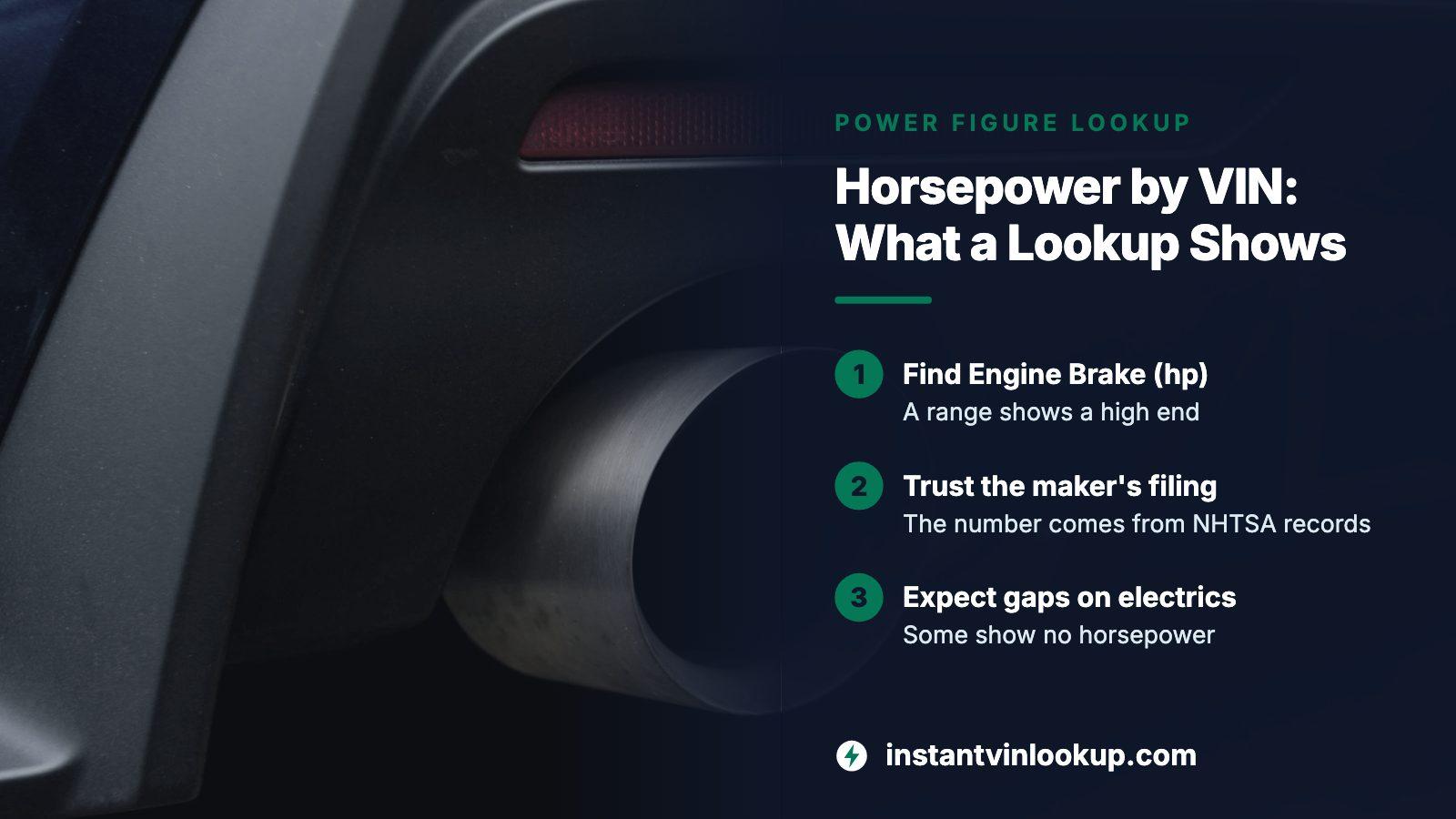
Sometimes. The federal VIN database has a horsepower field, and when the maker filled it in, a lookup prints the number, for example 325 for one 2017 Ford F-150 pattern I decoded. When the maker left it empty, the result is blank, even if displacement and cylinders are present. A blank means nothing was filed, so confirm output with the owner's manual or the dealer.
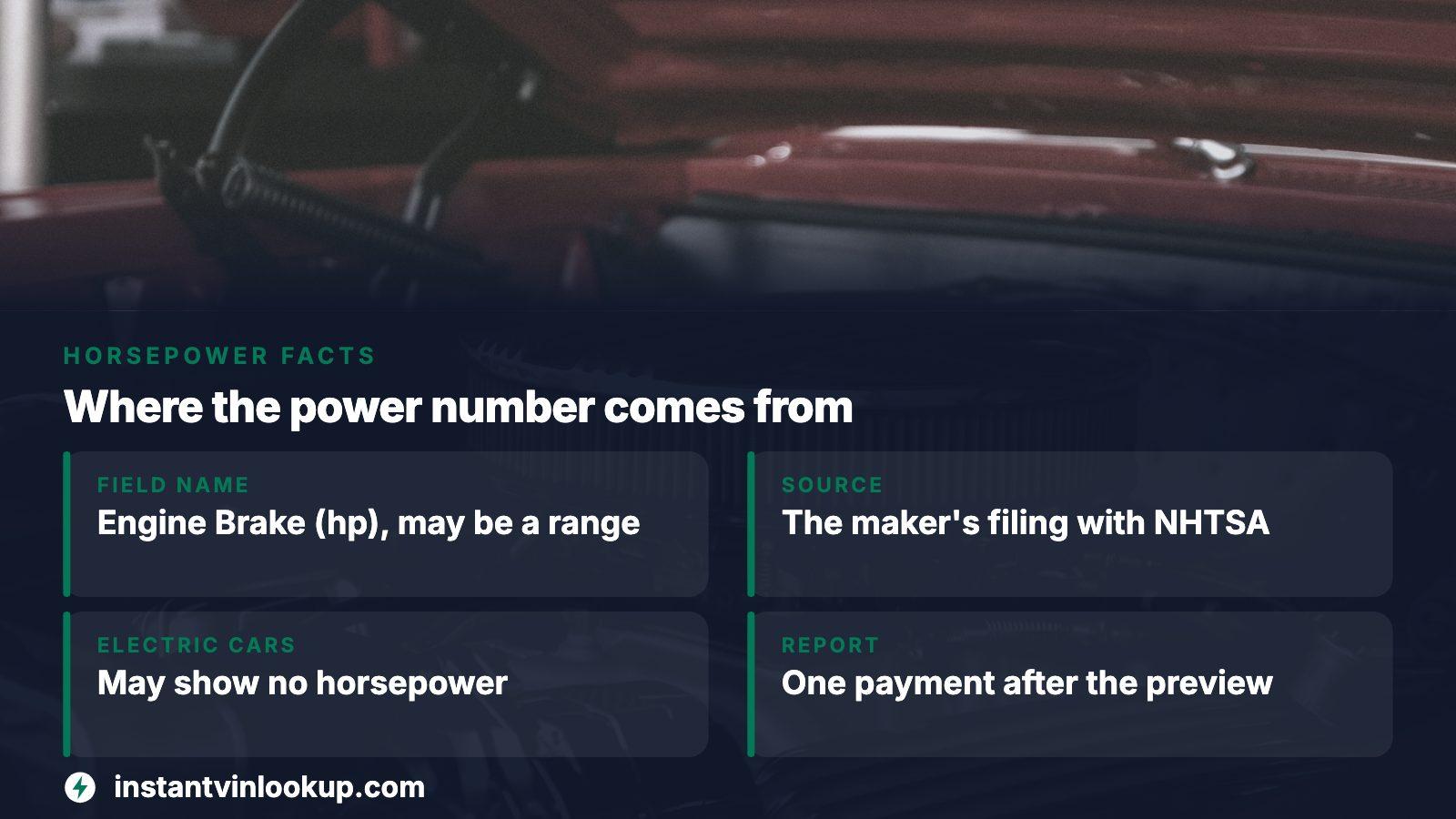
- Field name
- Engine Brake (hp), with a high end for ranges
- Source of the number
- The maker's own filing with NHTSA
- Electric cars
- May show no horsepower at all
- Preview
- Free; the full report is one payment
Where the power figure comes from
Nothing in the seventeen characters spells out output. Under the federal VIN rule, the middle block of positions 4 through 8 has to let a reader decipher the vehicle's traits, and the engine type is one of them. The maker chooses the characters. Output is not named.
The number you see in a decoder is a separate entry. Manufacturers send NHTSA the details behind their VIN scheme, and one optional detail is engine brake horsepower, defined as the output at the engine's shaft. The lookup reads that entry and prints it, nothing more. If a maker skipped it for your model year, the instant lookup has nothing to print, however fast it runs.
Eight decodes and what each returned
To see how uneven the filings are, I ran partial VIN patterns for popular models through NHTSA's flat decode on the day I wrote this. The pattern keeps the factory-coded characters and swaps the serial for filler, which is enough to show what the maker filed.
| Vehicle | Engine returned | Horsepower field |
|---|---|---|
| 2020 Ford Mustang | 5.0 L, 8 cylinders | 435 |
| 2017 Ford F-150 | 2.7 L, 6 cylinders | 325 |
| 2020 Jeep Grand Cherokee | 3.6 L, 6 cylinders | 295 |
| 2016 BMW 328i | 2.0 L, 4 cylinders | 241 |
| 2020 Honda Accord | 1.5 L turbo, 4 cylinders | 192 |
| 2019 Volkswagen Jetta | 1.4 L turbo, 4 cylinders | 147 |
| 2017 Chevrolet Silverado | 5.3 L, 8 cylinders | Empty |
| 2023 Chevrolet Malibu | 1.5 L turbo, 4 cylinders | Empty |
Six of the eight carried a figure. The two Chevrolets gave size, cylinders and in the Malibu's case an engine model, then left output blank. The decoder was not at fault in either case: the Malibu decode was clean.
Blank fields, ranges and kilowatts
The database stores power in three places: a low value, a high value for engines sold in more than one tune, and a separate kilowatt field. In every decode I ran, the high value and the kilowatt entry were empty, so a single horsepower number was all that ever appeared.
- A single number is the maker's rating for that engine as filed, not a measurement of the car in front of you.
- A low and a high value mean the engine was offered in more than one tune; check which one your trim carried.
- A blank is silence from the maker. Do not read it as low power or as an error.
- Cylinders and displacement without power still narrow the engine down, so keep them.
Electric and hybrid cars behave differently
A battery-electric car has no engine to rate. The 2019 Tesla Model 3 pattern I decoded reported its electrification level as battery electric and left cylinders, displacement, horsepower and kilowatts all empty. Someone searching for output on an electric car will see a dash where a number belongs.
For hybrids, the engine field may describe only the combustion engine, not what the electric motor adds. If a listing quotes a combined figure, treat it as the seller's or maker's claim until you see it in the manual or on a dealer sheet.
Getting from a VIN to an output figure
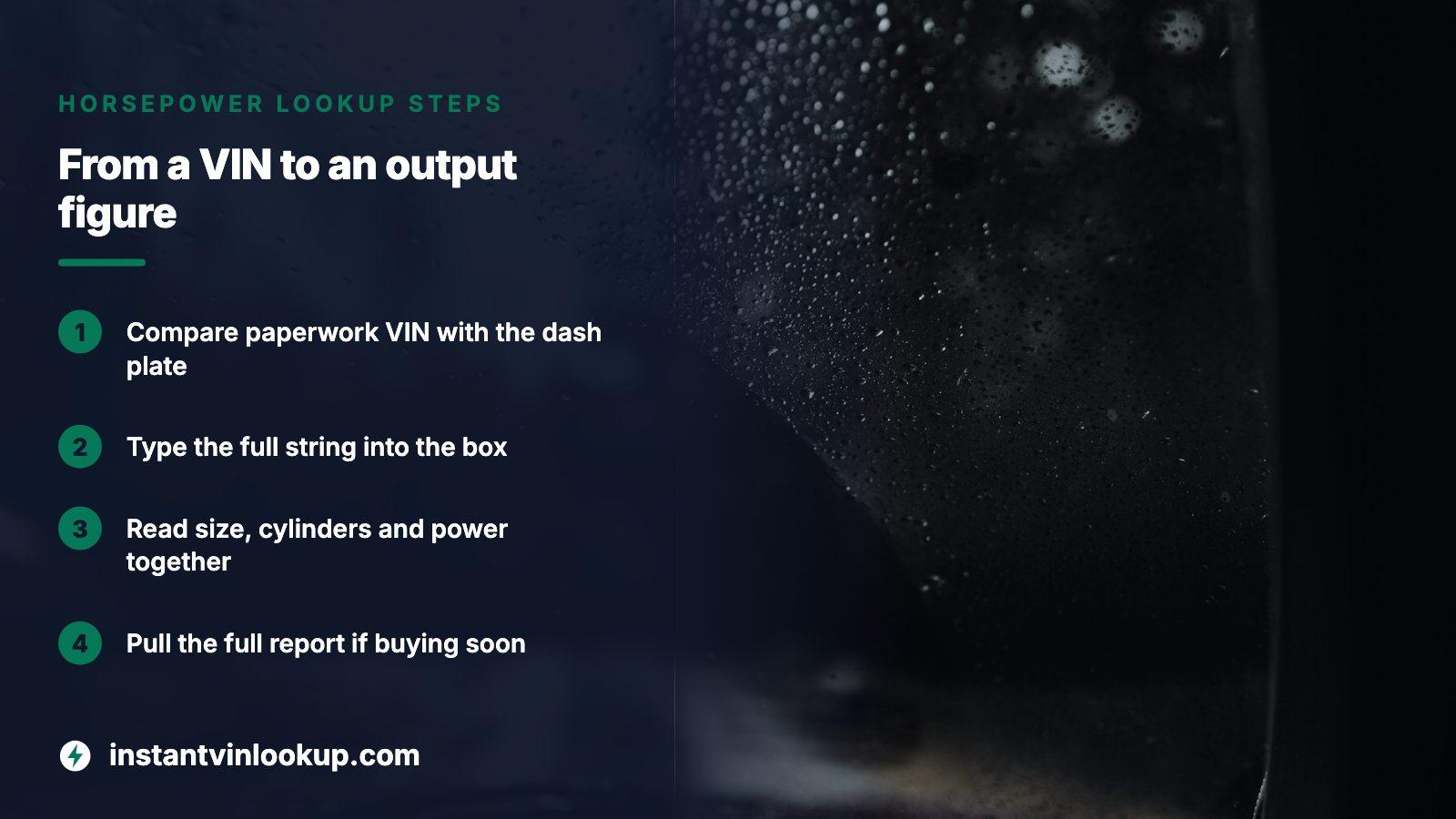
- Gather the VIN from the paperwork you have, such as the insurance card or the title, and compare it with the plate on the dashboard. One wrong character decodes a different car.
- Type the full string into the lookup box. Those characters exclude three letters, so a lookalike O in your notes should be a zero.
- Read engine size, cylinder count and the power line as a set. Do they agree with what the seller wrote?
- Buying soon? Pull the full report to see what happened to this particular car. The spec preview is no charge, while the report is a one-off purchase.
Checking the number against the car
A power figure matters only when it fits what the seller told you. Two cars sharing a model name and year may have left the factory with different engines, and the decode shows which one yours got. Hold it next to the listing.
- Seller advertises a larger motor, yet displacement in the decode is smaller: request the original sale paperwork.
- A power number shows up that nobody mentioned: the seller may not know which tune was fitted.
- Nothing appears for output: rely on displacement and cylinders to identify the motor, then read the rating in the owner's manual.
Rated output is not delivered output
The number is a rating from the factory. Neither the decode nor any lookup can tell you whether the engine in a used car still makes it. A test drive and a mechanic's inspection answer that.
When a car stops delivering its rated power
Owners filing complaints with NHTSA describe the gap between a rating on paper and a vehicle that will not accelerate. Two accounts are worth reading for what a lookup cannot see.
From an NHTSA owner complaint
A buyer of a 2017 Ford F-150 picked it up in July. Within a few weeks the truck dropped into limp mode on the highway and set a speed sensor code. The dealer ran the recall software update only, the owner says, and left the worn hardware in place, so the problem returned in August. The owner reports that Ford would not approve replacing the part.
From an NHTSA owner complaint
A Jeep Grand Cherokee owner from the 2020 model year reported two sudden losses of power: one while stopped in traffic, the other cruising on the interstate. The accelerator offered no resistance and nothing reached the engine, yet the dash stayed lit. A fresh recall sounded like the same fault to the owner, who believed this model year was left out. The dealership found no problem.
Take two lessons from these. A horsepower line says what the engine was built to make, not how the car runs today, and open recalls are tied to the VIN, so read them before you hand over money.
What the full report adds, and what it costs
The preview is the quick spec read. The full report goes after what a spec line cannot: title brands, accident and damage records, odometer readings, open recalls and salvage or auction history for the same VIN. For a performance car, those sections matter more than the rated figure, because a past wreck or a rolled-back odometer hurts a vehicle's value.
Pricing lives on the pricing page. One report or a pack is a single purchase, and nothing renews. Looking up the specs costs nothing.
Where this information comes from
- NHTSA vPIC API — supports the decoder being filled from maker submissions and the flat decode call with a partial VIN
- NHTSA vPIC variable list — supports the engine brake horsepower range fields and the separate kilowatt field
- 49 CFR 565.15: VIN content requirements — supports positions 4 to 8 carrying engine type, chosen by the maker, with no power figure required
- NHTSA owner complaint 11757699 — owner experience, paraphrased
- NHTSA owner complaint 11638726 — owner experience, paraphrased
Sources and photos: Facts checked against the sources above in November 2026. Photos by Dain Lindo, Justin Cron and Victor Hughes on Unsplash; diagrams by InstantVINLookup.
Keep reading
- Engine Code by VIN: Get the Engine Family in SecondsSee which engine family and displacement a decode names for your car.
- MPG by VIN: Find a Car's Fuel Economy From Its 17 CharactersPair output with the fuel economy figure for the same vehicle.
- Curb Weight by VIN: What an Instant Lookup Returns and What It MissesPower means more once you know what it has to move.
- Where Is the VIN Number? Find It in a Minute, Then Verify ItLocate the VIN before you run the lookup.
Frequently asked questions
Can you find horsepower from a VIN?
Often, but not always. The decoder reads a maker-supplied horsepower entry and shows it when one exists. Some makers leave it empty, so you get displacement and cylinders and no output. Check the owner's manual or ask a dealer parts desk with the VIN if the field is blank.
Why does my VIN decode show no horsepower?
The manufacturer did not provide it for that engine and model year. Fields exist for every vehicle, and makers fill them to different degrees. One Chevrolet pattern I ran returned size, cylinders and fuel but no output at all, with a clean decode and no error.
Does a VIN lookup show horsepower for an electric car?
Usually not. The battery-electric Tesla pattern I decoded listed its electrification level and left both horsepower and kilowatts empty. With no combustion engine there is no brake horsepower to file, so look in the owner's manual or the maker's spec sheet for motor output.
Is the horsepower on a decode what the car makes today?
No. It is the figure the manufacturer rated for that engine when new. Wear, repairs, an engine swap or a software change can alter real output. A road test, a scan for stored fault codes and a mechanic's check tell you what the car does now.
Do I need to pay to see the horsepower?
No. The preview that shows engine details costs nothing. The full report is a separate one-time purchase for history records such as title brands, accidents and recalls, and it matters when you are about to buy, not when you only want a spec.
Now check the car itself
The guide explains what to look for. The report shows what this VIN has on record.